Airborne microplastics reach farmland and water as well as cities. A year-long Swiss study estimates that around 219 tonnes settle annually across areas below 2,000 metres, with comparable deposition levels at rural, suburban and mountain monitoring sites.
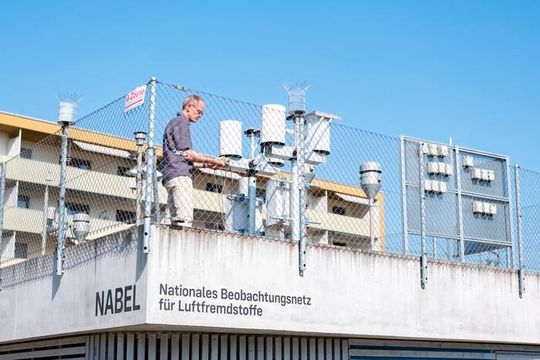
Empa researcher Christoph Hüglin collects samples of particles that are washed out of the air by rain and snow or settle due to gravity.
(Source: Empa)
Loose fibers from functional clothing, discarded PET bottles, or abandoned packaging: When such plastic materials enter the environment, they often persist there for a long time. UV radiation, precipitation, and ozone cause them to become brittle — and over time, mechanical forces break them down into increasingly smaller particles. Swirled up by the wind, they are carried further through the atmosphere. Until now, it was unclear how much microplastic ends up back in Swiss soil and water bodies through this process.
Researchers at Empa, together with colleagues from Eawag and Agroscope, have now systematically documented this for the first time. According to the study, which was supported by the Federal Office for the Environment (FOEN), approximately 219 tons of microplastics settle in Switzerland each year in areas below 2,000 meters in elevation. “Sensitive” areas are particularly relevant here: The researchers estimate that about 78 tons settle on agricultural land and about 10 tons settle directly into water bodies each year.
Microplastics Can also be Found in Rural Areas
Measurements were taken over the course of an entire year at five locations: Zurich, Dübendorf, Magadino, Payerne, and on Mount Chaumont in the Jura Mountains. Each month, the researchers collected samples of wet and dry deposition — that is, particles captured and washed out of the air by rain and snow, and those that settle due to gravity. The researchers analyzed microplastic particles with diameters ranging from 20 to 215 micrometers. At the urban site in Zurich, they found an average deposition of 881 particles per square meter per day. At the other sites, the values — ranging from 249 to 331 particles — were significantly lower and relatively similar.
It comes as little surprise that Zurich has more than twice the level of contamination. Dense population, traffic, and plastic products in outdoor spaces all contribute to this. What was more unexpected for the team led by Empa researcher Christoph Hüglin, however, was how similar the values were outside big cities. “The closer the location is to densely populated areas, the higher the levels we would have expected. But we don’t see such a difference.” The levels from Dübendorf, Magadino, Payerne, and Chaumont are comparable. This suggests that microplastics in the atmosphere are not just an urban phenomenon but also reach less densely populated regions.
Concrete Figures for a Hard-to-Quantify Environmental Problem
Previous studies had already shown that plastic particles are transported through the atmosphere. According to Hüglin, however, many results are difficult to compare because they use different methods and size ranges. “We wanted to collect data for Switzerland and apply an analytical method that delivers the most reliable results possible.” To do this, the team used the joint particle laboratory of Eawag, Empa, and Agroscope. There, the collected samples were prepared, applied to a filter, and then analyzed using imaging infrared microspectroscopy. Instead of examining only individual suspicious particles, the researchers developed a method to automatically scan randomly selected filter areas point by point. This made it possible to determine which particles were actually made of plastic and what type of plastic they were.
The researchers most frequently found polyethylene terephthalate (PET: 31 %), polyethylene (PE: 26 %), and polypropylene (PP: 21 %). These plastic particles have various sources: Polyethylene and polypropylene are among the most widely used plastics and are found, for example, in packaging, films, containers, and everyday products. The high proportion of PET is particularly striking. This plastic is commonly found in beverage bottles, but is also present in polyester fibers for textiles. According to the researchers, textile fibers could therefore also contribute significantly to microplastic pollution in the atmosphere. However, the study cannot determine the specific products from which the individual particles originate. Emissions from traffic must also be clearly distinguished: While tire wear is generally classified as microplastics, it was analyzed in a separate, ongoing study for analytical reasons.
Date: 08.12.2025
Naturally, we always handle your personal data responsibly. Any personal data we receive from you is processed in accordance with applicable data protection legislation. For detailed information please see our privacy policy.
Consent to the use of data for promotional purposes
I hereby consent to Vogel Communications Group GmbH & Co. KG, Max-Planck-Str. 7-9, 97082 Würzburg including any affiliated companies according to §§ 15 et seq. AktG (hereafter: Vogel Communications Group) using my e-mail address to send editorial newsletters. A list of all affiliated companies can be found here
Newsletter content may include all products and services of any companies mentioned above, including for example specialist journals and books, events and fairs as well as event-related products and services, print and digital media offers and services such as additional (editorial) newsletters, raffles, lead campaigns, market research both online and offline, specialist webportals and e-learning offers. In case my personal telephone number has also been collected, it may be used for offers of aforementioned products, for services of the companies mentioned above, and market research purposes.
Additionally, my consent also includes the processing of my email address and telephone number for data matching for marketing purposes with select advertising partners such as LinkedIn, Google, and Meta. For this, Vogel Communications Group may transmit said data in hashed form to the advertising partners who then use said data to determine whether I am also a member of the mentioned advertising partner portals. Vogel Communications Group uses this feature for the purposes of re-targeting (up-selling, cross-selling, and customer loyalty), generating so-called look-alike audiences for acquisition of new customers, and as basis for exclusion for on-going advertising campaigns. Further information can be found in section “data matching for marketing purposes”.
In case I access protected data on Internet portals of Vogel Communications Group including any affiliated companies according to §§ 15 et seq. AktG, I need to provide further data in order to register for the access to such content. In return for this free access to editorial content, my data may be used in accordance with this consent for the purposes stated here. This does not apply to data matching for marketing purposes.
Right of revocation
I understand that I can revoke my consent at will. My revocation does not change the lawfulness of data processing that was conducted based on my consent leading up to my revocation. One option to declare my revocation is to use the contact form found at https://contact.vogel.de. In case I no longer wish to receive certain newsletters, I have subscribed to, I can also click on the unsubscribe link included at the end of a newsletter. Further information regarding my right of revocation and the implementation of it as well as the consequences of my revocation can be found in the data protection declaration, section editorial newsletter.
Back to the Earth’s Surface, Wet or Dry
Microplastics return from the atmosphere to the Earth’s surface in two ways: The particles are either washed out by rain or snow, or they settle during dry weather. “Precipitation is a very efficient process for cleansing the atmosphere,” explains Hüglin. In Switzerland, however, dry deposition accounts for the larger share — about 60 % of the mass. Both pathways contribute to particles reaching the ground, plants, or bodies of water directly. For Swiss water bodies, the researchers estimate direct atmospheric input at around 10 tons per year. By comparison, a parallel Eawag study on microplastics from Swiss wastewater treatment plants estimates the input via treated wastewater at only about five tons annually.
However, when measured against the total mass of all airborne particles — including desert dust, soot and combustion residues, and biological particles — microplastics account for only a very small proportion: between 0.02 and 0.12 %. Over large areas, however, the constant deposition leads to considerable quantities that do not degrade at all or degrade only very slowly. Much remains unknown about the environmental and health impacts of microplastics. What is clear, however, is that plastics are widespread and that the finest plastic particles do not simply dissolve in the air, on land, or in water. “Plastic is a very good material for many applications,” says Hüglin. “But in accordance with the precautionary principle, we should avoid littering, use plastics only where necessary, and close material cycles as much as possible.”
Original Article: Wet and dry atmospheric deposition of microplastics at urban, suburban, rural and mountainous sites in Switzerland
Atmospheric Chemistry and Physics; DOI:10.5194/acp-26-11803-2026




:quality(80)/p7i.vogel.de/wcms/51/68/51687ac4cc19f2757c138498b877de57/0133167039v2.jpeg "CMFs are foams that consist of hollow spheres – made of materials such as stainless steel, nickel, or other metals and alloys – embedded in a metallic matrix. The resulting material is both lightweight and remarkably strong at absorbing compressive forces. (Source: Jie Sun/ NC State University)")
:quality(80)/p7i.vogel.de/wcms/cd/c0/cdc09efd1e5b3b8f83224e7729d66c10/0133105276v2.jpeg "From the data presented in this report, the authors show how TF3-MALS-RI is uniquely able to separate large polyacrylate molecules and provide precise molecular weight and Rg values. (Source: Postnova Analytics)")
:quality(80)/p7i.vogel.de/wcms/c6/f2/c6f2e2b4753a0d0cec682c03df4ed37c/0133088650v2.jpeg "PMBC vials for immunology and oncology research. (Source: Amsbio)")
:quality(80)/p7i.vogel.de/wcms/e0/72/e0728dc8dcadfc4d79a734e08cf6ced3/0133088641v2.jpeg "LM20 Microfluidizer and Cambridge CNT dispersion produced by the LM20 microfluidizer. (Source: Analytik)")
:quality(80)/p7i.vogel.de/wcms/86/01/86014d3d2a28cefc852f65c8d68317e4/0133104231v2.jpeg "Single-handed tube reading using a Handheld 2. (Source: Azenta Life Sciences)")
:quality(80)/p7i.vogel.de/wcms/0b/0f/0b0f8ed042dfc91f32582e10d54c2c7e/0133087444v2.jpeg "Offering advanced automation to increase your throughput, the Intellixcap provides secure sealing – eliminating the need for manual intervention, while preserving vital sample integrity. (Source: Azenta Life Sciences)")
:quality(80)/p7i.vogel.de/wcms/13/d3/13d35105f74a1c2e22b9c7a270e8e9b3/0132611155v2.jpeg "Circulating cell free DNA. (Source: Amsbio)")
:quality(80)/p7i.vogel.de/wcms/bc/ed/bced6850297a04dbea471a66cb6bb6fe/0132611405v2.jpeg "The latest addition to the range is a peristaltic tubing stop adapter that eliminates the need for fixed stoppers and allows custom cut lengths of peristaltic tubing to be installed on any pump head size. (Source: Biotech Fluidics )")
:quality(80)/p7i.vogel.de/wcms/8d/5c/8d5c6c7f897f91d6784825eee20b5584/0133321225v1.jpeg "Empa researcher Christoph Hüglin collects samples of particles that are washed out of the air by rain and snow or settle due to gravity. (Source: Empa)")
:quality(80)/p7i.vogel.de/wcms/a1/af/a1afbc7c8a067bbe94749ec680b4bafd/0133163762v2.jpeg "The study found in murkier water, fish took longer to move towards the food than those in clear water, but individuals in larger groups responded more quickly overall. (Source: Christos Ioannou)")
:quality(80)/p7i.vogel.de/wcms/32/80/3280aa3d44708962943c96fe2d466744/0133088560v2.jpeg "A bumble bee in flight at the University of Bristol Botanic Garden. (Source: Phil Savoie)")
:quality(80)/p7i.vogel.de/wcms/7b/e5/7be5c735140cbe28f3af0ec3d88274b9/0133045403v2.jpeg "After being buried in the ground for two months and broken down by soil organisms, a new pair of cotton underwear (left) shows clear signs of decomposition (right). (Source: Nicolas Zonvi)")
:quality(80)/p7i.vogel.de/wcms/bf/d0/bfd087349a85956a7aefad57ac1204c7/0133241961v2.jpeg "The Thermo Scientific Suretect Beverage Spoilage Multiplex PCR Assay provides a fast, broad-range molecular solution for detecting key spoilage microorganisms that threaten beverage quality. (Source: © OlegDoroshin - stock.adobe.com)")
:quality(80)/p7i.vogel.de/wcms/d4/61/d461ce0bd5743897993c6475f69e7ad6/0133067478v2.jpeg "In Harris County, 50 % of households with children reported food insecurity, compared with 33 % of households without children. (Source: Rice University)")
:quality(80)/p7i.vogel.de/wcms/79/76/7976d17b980bedfe35acaa532d690046/0132713841v2.jpeg "Observed rice yield losses from 1°C warming are more than twice as high as model estimates due to underestimated heat stress. (Source: AdobeStock/ducvien)")
:quality(80)/p7i.vogel.de/wcms/28/b6/28b6114fc9915c5dadee94d5c89bd129/0132593216v2.jpeg "Eating foods that contain common preservative food additives may increase the risks of high blood pressure and cardiovascular disease. (Source: Unsplash)")
:quality(80)/p7i.vogel.de/wcms/b0/b5/b0b59a78dc380bafc2326ac209f72187/0133321063v1.jpeg "Light pollution has been linked to cardiovascular disease. (Source: free licensed)")
:quality(80)/p7i.vogel.de/wcms/76/25/762549a8bc3df4ccf1470edbc46d78d3/0133321089v1.jpeg "The CPL-2a skeleton in the trench
(Source: Fakhri)")
:quality(80)/p7i.vogel.de/wcms/bb/e6/bbe6e158b1d43f32cb7a95cd771dccd7/0133321323v1.jpeg "An illustration of a Surinam toad with its toes if they were proportioned according to the amount of space they take up in the frog’s tiny brain. (Source: Rebeca Fuquen)")
:quality(80)/p7i.vogel.de/wcms/7e/4b/7e4ba18a8518e5e8430ad07afbfd6ae4/0133321385v2.jpeg "New findings raise concerns about potential misdiagnosis, inappropriate treatment, and errors in psychiatric research. (Source: free licensed)")
:quality(80)/images.vogel.de/vogelonline/bdb/1710600/1710675/original.jpg "Discover how to set yourself up for success when performing balance-based density determination of solids such as jewelry and precious metals. (Mettler Toledo)")
:quality(80)/images.vogel.de/vogelonline/bdb/1682500/1682579/original.jpg "The new XPR Analytical balance redesigned to meet the needs of laboratory technicians of working fast and lean. (Mettler Toledo)")
:quality(80)/images.vogel.de/vogelonline/bdb/1677000/1677080/original.jpg "Enhance your weighing accuracy, comfort and productivity with the redesigned XPR Analytical balance. (Mettler Toledo)")