Smart Solutions Introducing the World’s First Touchscreen Built into a Garment
Source: Press release
NUS
4 min Reading Time
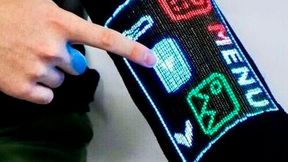
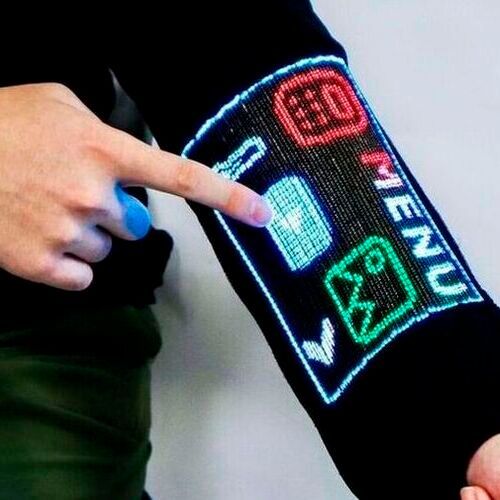
Researchers have developed the world’s first touchscreen integrated into a garment. The sleeve is capable of displaying images and videos, sensing touch and connecting wirelessly to digital devices.
The fibres support the functions early generations of smartphones could perform. The 96 by 54-pixel display can run a calculator, show a photo gallery, play a video, work as a compass, respond to voice commands, receive images over Bluetooth, as well as read and display body temperature.
(Source: NUS)
Queenstown/Singapore – Researchers at the National University of Singapore’s College of Design and Engineering (CDE) have developed a fibre that functions as pixels and senses touch at the same time, integrating 54 of them into a sleeve to create the world’s first touchscreen built into a garment.
The sleeve displays images and video, responds to finger presses and connects wirelessly to other devices, yet stays as washable, breathable and flexible as ordinary clothing. The team’s invention enables the creation of garments that act as a direct interface to a wearer’s health data and their digital devices, with no rigid screen involved.
The screens that we are familiar with, such as those on phones and laptops, typically present graphical user interfaces (GUIs) on flat, rigid panels that display information and enable interaction. Textiles, woven from one-dimensional fibres, have never matched this capability. A full-colour, touch-sensitive display that can be threaded like yarn was, until now, out of reach.
“What made this possible was our ability to construct the GUI system from electronic building blocks in fibre form — similar to traditional yarn, but with the sophisticated electronic functionality built directly into the fibres,” said Asst Prof Khudiyev.
The team, led by Assistant Professor Tural Khudiyev from the Department of Materials Science and Engineering at CDE, published their findings in Nature on 21 October 2026.
Interconnecting thousands of chips along a thread
To build a fibre-enabled garment display, the NUS team developed a programmable method that creates connection points along tiny, insulated wires exactly where each microchip needs them. A laser exposes these locations, while controlled surface wetting guides molten solder to bond only at the programmed points. This enabled the team to integrate more than 5,000 chips through over 20,000 electrical connections.
The strip of interconnected digital LEDs was then integrated into a multilayer fibre using a thermal drawing approach, which allows precise formation of the touch-sensitive and pixel layers within a thread just a millimetre thick and 10 metres long. A layer beneath the LEDs senses touch — pressing the fibre completes a circuit, and the signal reveals exactly where your finger landed so the nearest pixel lights up.
“A fibre has a one-dimensional, axially symmetric geometry, which makes it difficult to build complex circuitry using approaches developed for conventional two-dimensional electronics,” added Asst Prof Khudiyev. “We overcame this limitation through a new interconnection architecture, which enables thousands of microelectronic devices to be integrated and interconnected along a fibre.”
Beyond the touchscreen: Wear your apps on your sleeve
In the team’s prototype, 54 pixel fibres, each carrying 96 LEDs, were threaded into the forearm of a sleeve to form a 96 by 54-pixel display measuring 168 mm by 105 mm, refreshing 30 frames per second with 8-bit color depth. Each fibre has its own control channel, so a fault in one line leaves its neighbors working normally, and the system can register several touches at once. Alongside the pixel fibres, the team integrated peripheral fibres made the same way, carrying a microphone, a speaker and sensors that track movement, find magnetic north, measure temperature and gauge how bright the surroundings are.
Together, the fibres support the functions early generations of smartphones could perform: run a calculator, show a photo gallery, play a video at 30 frames per second (25 frames per second with synchronized audio), work as a compass, respond to voice commands, and receive images over Bluetooth. They can even rotate the screen and adjust brightness automatically. When positioned under the arm, the temperature-sensing fibre lets the sleeve read and display body temperature.
Date: 08.12.2025
Naturally, we always handle your personal data responsibly. Any personal data we receive from you is processed in accordance with applicable data protection legislation. For detailed information please see our privacy policy.
Consent to the use of data for promotional purposes
I hereby consent to Vogel Communications Group GmbH & Co. KG, Max-Planck-Str. 7-9, 97082 Würzburg including any affiliated companies according to §§ 15 et seq. AktG (hereafter: Vogel Communications Group) using my e-mail address to send editorial newsletters. A list of all affiliated companies can be found here
Newsletter content may include all products and services of any companies mentioned above, including for example specialist journals and books, events and fairs as well as event-related products and services, print and digital media offers and services such as additional (editorial) newsletters, raffles, lead campaigns, market research both online and offline, specialist webportals and e-learning offers. In case my personal telephone number has also been collected, it may be used for offers of aforementioned products, for services of the companies mentioned above, and market research purposes.
Additionally, my consent also includes the processing of my email address and telephone number for data matching for marketing purposes with select advertising partners such as LinkedIn, Google, and Meta. For this, Vogel Communications Group may transmit said data in hashed form to the advertising partners who then use said data to determine whether I am also a member of the mentioned advertising partner portals. Vogel Communications Group uses this feature for the purposes of re-targeting (up-selling, cross-selling, and customer loyalty), generating so-called look-alike audiences for acquisition of new customers, and as basis for exclusion for on-going advertising campaigns. Further information can be found in section “data matching for marketing purposes”.
In case I access protected data on Internet portals of Vogel Communications Group including any affiliated companies according to §§ 15 et seq. AktG, I need to provide further data in order to register for the access to such content. In return for this free access to editorial content, my data may be used in accordance with this consent for the purposes stated here. This does not apply to data matching for marketing purposes.
Right of revocation
I understand that I can revoke my consent at will. My revocation does not change the lawfulness of data processing that was conducted based on my consent leading up to my revocation. One option to declare my revocation is to use the contact form found at https://contact.vogel.de. In case I no longer wish to receive certain newsletters, I have subscribed to, I can also click on the unsubscribe link included at the end of a newsletter. Further information regarding my right of revocation and the implementation of it as well as the consequences of my revocation can be found in the data protection declaration, section editorial newsletter.
Importantly, the garment still behaves like fabric. Light output and touch response were nearly unchanged after 50 detergent washes in a typical washing machine, and after 1,000 bends around a 5 mm radius. In addition, the built display is as breathable as cotton, polyester and denim, and stays within established safety limits for skin contact.
Clothing as an interface
Smaller microchips and thinner fibres, both compatible with the team’s method, offer a route to sharper and larger displays. Furthermore, as the display and sensing elements sit along the length of the fibre, the thinner fibres can be knitted, weaved and embroidered using standard industrial machines. The same technology could one day perform other functions such as tracking health signs and delivering touch-based feedback.
“Healthcare is one particularly promising application,” said Asst Prof Khudiyev. “A garment could continuously collect physiological information through fibre-based sensors and allow the wearer to access and interact with that information directly through their clothing. Combined with artificial intelligence (AI), this could enable personalized health monitoring, feedback and assistance. Just as smartphones enabled applications that were difficult to imagine when they first appeared, garment GUIs could ultimately enable entirely new applications that do not yet exist.”
What’s next
The research team’s next step is to push the textile touchscreen further—towards higher resolution, integrated sensing and on-device AI, bringing display, touch, sensing and intelligence together within the same textile platform. This convergence could take the technology far beyond a wearable screen, towards clothing that understands both the wearer and their surroundings, providing information or interaction when and where needed.
The researchers are now developing a new interface between people and digital intelligence—one that extends beyond a device users carry to become a natural part of what they wear.