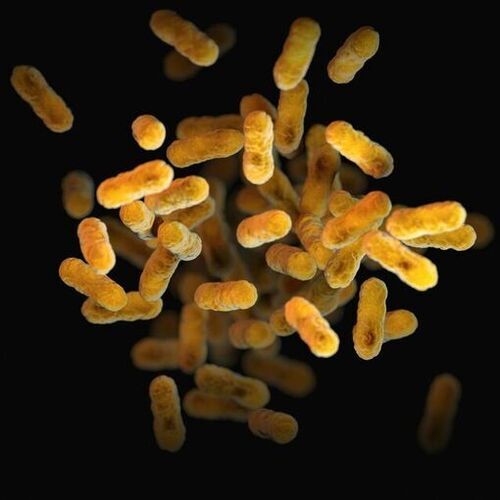
A study on mice has shown that the effectiveness of a probiotic in alleviating intestinal inflammation depends on the animals’ existing gut microbiota. These findings could help develop customized probiotic treatments more closely to individual gut microbiomes.
A research team set out to investigate the role of the existing gut microbiota in the efficacy of probiotics.
(Source: Unsplash)
Bern/Switzerland – Trillions of bacteria inhabit the gut. Among other functions, they break down components of our food and produce substances that are important for the intestinal lining. Probiotics contain living microorganisms intended to support this ecosystem. They are used, for example, in the treatment of irritable bowel syndrome and are being studied in relation to chronic inflammatory bowel diseases such as Crohn’s disease and ulcerative colitis. In these conditions, the composition and function of the gut microbiota can change, and probiotics may help relieve symptoms such as bloating, abdominal pain and irregular bowel movements. Probiotics are available as dietary supplements, and some probiotic microorganisms are also found in fermented foods such as yogurt and kefir. Their effects, however, can vary considerably: while some people benefit, others experience little or no improvement. The reasons for these differences are still only partly understood.
A research team led by Prof. Dr. Bahtiyar Yilmaz from the University Clinic for Visceral Surgery and Medicine at Inselspital, Bern University Hospital, and the Department for BioMedical Research (DBMR) at the University of Bern, set out to investigate the role of the existing gut microbiota in the efficacy of probiotics. The researchers tested a mixture of four bacterial strains in mice with experimentally induced intestinal inflammation. Their findings show that the existing community of gut bacteria influences how effective the probiotic is. The study has recently been published in Cell Reports.
Bern as a research hub for personalized microbiome medicine
“Bern is home to outstanding research at the intersection of gastrointestinal medicine, microbiome research and precision medicine,” says study leader Yilmaz. “This combination enables us to investigate not only the composition of the microbiome, but also its functions and its impact on intestinal diseases.” For the study, the researchers tested a probiotic mixture containing four bacterial strains in mice with different gut microbiota. The mixture was administered either preventively or after inflammation had already developed. “We wanted to determine not only whether the mixture was effective, but also under which conditions,” explains Yilmaz. “In particular, we were interested in whether the existing bacterial community served as a baseline for treatment.”
The researchers also analyzed the composition of the gut microbiota, and the metabolic products present in the gut. In a further experiment, they transferred gut microbiota from treated mice to germ-free animals to determine whether the transferred microbiome contributed to the animals’ differing responses to the probiotic.
The probiotic needs the right environment
The most pronounced protective effect was observed when the probiotic was administered before the onset of inflammation. In the groups that responded to treatment, the mice lost less weight, showed fewer signs of illness, and experienced less tissue damage. Their gut microbiota was more diverse and remained more stable throughout the inflammatory process. When treatment began only after inflammation had developed, the effect was less pronounced. It also diminished during repeated episodes of inflammation, despite continued administration. “This suggests that both the initial state of the gut and the timing of probiotic treatment may be critical,” explains co-first author Göktuğ Özkurt, a doctoral student at the DBMR at the University of Bern.
What also differed between the groups was the metabolic activity of the gut microbiome. Where the probiotic was effective, many inflammation-related changes in metabolites shifted back towards a healthy profile. The researchers also found higher levels of butyrate and propionate – short-chain fatty acids that, among other functions, help support the intestinal lining. “Our results show that an effective probiotic helps the existing gut microbiota maintain its functions and partially recover from inflammation,” says Jiaqi Li, co-first author of the study and a former doctoral student at the DBMR at the University of Bern.
Date: 08.12.2025
Naturally, we always handle your personal data responsibly. Any personal data we receive from you is processed in accordance with applicable data protection legislation. For detailed information please see our privacy policy.
Consent to the use of data for promotional purposes
I hereby consent to Vogel Communications Group GmbH & Co. KG, Max-Planck-Str. 7-9, 97082 Würzburg including any affiliated companies according to §§ 15 et seq. AktG (hereafter: Vogel Communications Group) using my e-mail address to send editorial newsletters. A list of all affiliated companies can be found here
Newsletter content may include all products and services of any companies mentioned above, including for example specialist journals and books, events and fairs as well as event-related products and services, print and digital media offers and services such as additional (editorial) newsletters, raffles, lead campaigns, market research both online and offline, specialist webportals and e-learning offers. In case my personal telephone number has also been collected, it may be used for offers of aforementioned products, for services of the companies mentioned above, and market research purposes.
Additionally, my consent also includes the processing of my email address and telephone number for data matching for marketing purposes with select advertising partners such as LinkedIn, Google, and Meta. For this, Vogel Communications Group may transmit said data in hashed form to the advertising partners who then use said data to determine whether I am also a member of the mentioned advertising partner portals. Vogel Communications Group uses this feature for the purposes of re-targeting (up-selling, cross-selling, and customer loyalty), generating so-called look-alike audiences for acquisition of new customers, and as basis for exclusion for on-going advertising campaigns. Further information can be found in section “data matching for marketing purposes”.
In case I access protected data on Internet portals of Vogel Communications Group including any affiliated companies according to §§ 15 et seq. AktG, I need to provide further data in order to register for the access to such content. In return for this free access to editorial content, my data may be used in accordance with this consent for the purposes stated here. This does not apply to data matching for marketing purposes.
Right of revocation
I understand that I can revoke my consent at will. My revocation does not change the lawfulness of data processing that was conducted based on my consent leading up to my revocation. One option to declare my revocation is to use the contact form found at https://contact.vogel.de. In case I no longer wish to receive certain newsletters, I have subscribed to, I can also click on the unsubscribe link included at the end of a newsletter. Further information regarding my right of revocation and the implementation of it as well as the consequences of my revocation can be found in the data protection declaration, section editorial newsletter.
A foundation for more targeted probiotics
The findings are currently limited to a mouse model of chemically induced intestinal inflammation. “They do not show that the mixture tested is effective in people with chronic inflammatory bowel disease nor do they yet provide a way of identifying which probiotics are best suited to which patients,” Yilmaz notes. It remains to be determined whether an unresponsive gut microbiota can be specifically modified to make it respond to a probiotic. “The key question going forward is not only which probiotic is administered, but also which gut microbiota it encounters,” says Yilmaz. The researchers will now validate their findings in further mouse studies and prospective clinical trials. High-resolution genetic analyses and measurements of bacterial gene activity should help identify the strains and functions that are critical to the response. They will also investigate whether unresponsive gut communities can be specifically modified.
The study was supported by the European Crohn’s and Colitis Organization, the Bern Center for Precision Medicine and the Swiss National Science Foundation.