Researchers at ETH Zurich and Empa have developed a recyclable wood-based composite that turns sawdust into a fire-resistant material using the mineral struvite. The lightweight panels could offer a more sustainable alternative to cement-bonded boards while supporting circular construction and longer material use.
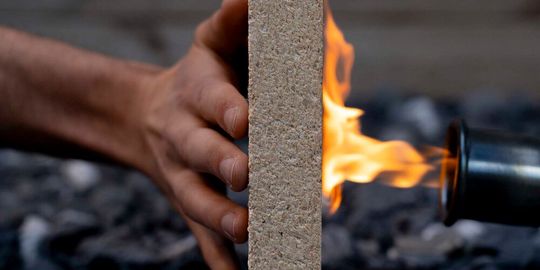
The researchers’ new material, based on mineralised sawdust, is an excellent fire retardant.
(Source: Dan Vivas Glaser / from Kürsteiner R et al. Chem Circularity 2026)
Every time a tree trunk is sawn, it creates sawdust. Millions of tonnes of sawdust are produced every year worldwide, with most of it is burned to generate energy. This releases the carbon dioxide stored in the wood back into the atmosphere — which is not ideal from an environmental perspective. Now, a team of researchers at the Chair of Wood Materials Science at ETH Zurich and Empa has developed a process that can convert sawdust into a recyclable and environmentally friendly composite using the mineral struvite, a crystalline, colourless ammonium magnesium phosphate. This, in turn, keeps the sawdust in the material cycle for longer.
Struvite has long been known for its fascinating fire protection properties. Previously, however, it had proven difficult to combine the mineral with sawdust particles due to its crystallisation behaviour. Now, ETH researchers are using an enzyme extracted from watermelon seeds to control the crystallisation of struvite from an aqueous suspension of the mineral precursor Newberyite. This process creates large crystals that fill the cavities between the sawdust particles and bind them together firmly. The material, which is pressed for two days, is then removed from the mould and dried at room temperature.
Wood Elements that Protect Themselves
“The material is stronger under compression perpendicular to the grain than the original spruce timber,” explains Ronny Kürsteiner, who developed the process as part of his doctoral thesis. The new material’s mechanical properties and excellent fire resistance make it particularly suitable for internal fittings. That’s because struvite is not only non-combustible, it also helps to actively increase fire resistance. When heated, the mineral breaks down, releasing water vapour and ammonia. This process absorbs heat from the surrounding environment, producing a cooling effect. The non-combustible gases that are released also displace the air, hindering the fire from spreading further and causing the material to char more quickly.
The ETH team partnered with researchers at the Polytechnic University of Turin, who tested the material in a so-called cone calorimeter — a standardised test that simulates how a material behaves when exposed to an external heat source. While untreated spruce ignites after around 15 seconds, the struvite sawdust composite takes more than three times as long. Once ignited, a protective layer of inorganic material and carbon forms quickly, protecting the material from further fire spread. “The struvite sawdust panels essentially protect themselves,” says Kürsteiner.
Initial estimates have shown that the material could achieve the same fire protection class as conventional cement-bonded particleboards, although larger-scale flame retardancy tests are still required to confirm this. Cement-bonded particleboards are currently widely used in interior fittings for flame protection applications. They contain 60 to 70 per cent cement by weight, making them heavy and giving them a poor carbon footprint due to the high level of energy involved in cement production. The struvite sawdust board, on the other hand, contains just 40 per cent binder, making it significantly lighter.
Easy to Recycle
Another advantage of this innovative composite compared to other composite building materials is that, unlike cement-bonded particleboards, for example, it doesn’t end up as waste after demolition. Once removed, the struvite sawdust board can be broken down into its individual components by breaking it up mechanically in a grinder and heating it to just over 100°C. This releases the ammonia and allows the sawdust to be sifted out. After dissolution of the reclaimed material, the precursor newberyite is then precipitated again as a solid.
Date: 08.12.2025
Naturally, we always handle your personal data responsibly. Any personal data we receive from you is processed in accordance with applicable data protection legislation. For detailed information please see our privacy policy.
Consent to the use of data for promotional purposes
I hereby consent to Vogel Communications Group GmbH & Co. KG, Max-Planck-Str. 7-9, 97082 Würzburg including any affiliated companies according to §§ 15 et seq. AktG (hereafter: Vogel Communications Group) using my e-mail address to send editorial newsletters. A list of all affiliated companies can be found here
Newsletter content may include all products and services of any companies mentioned above, including for example specialist journals and books, events and fairs as well as event-related products and services, print and digital media offers and services such as additional (editorial) newsletters, raffles, lead campaigns, market research both online and offline, specialist webportals and e-learning offers. In case my personal telephone number has also been collected, it may be used for offers of aforementioned products, for services of the companies mentioned above, and market research purposes.
Additionally, my consent also includes the processing of my email address and telephone number for data matching for marketing purposes with select advertising partners such as LinkedIn, Google, and Meta. For this, Vogel Communications Group may transmit said data in hashed form to the advertising partners who then use said data to determine whether I am also a member of the mentioned advertising partner portals. Vogel Communications Group uses this feature for the purposes of re-targeting (up-selling, cross-selling, and customer loyalty), generating so-called look-alike audiences for acquisition of new customers, and as basis for exclusion for on-going advertising campaigns. Further information can be found in section “data matching for marketing purposes”.
In case I access protected data on Internet portals of Vogel Communications Group including any affiliated companies according to §§ 15 et seq. AktG, I need to provide further data in order to register for the access to such content. In return for this free access to editorial content, my data may be used in accordance with this consent for the purposes stated here. This does not apply to data matching for marketing purposes.
Right of revocation
I understand that I can revoke my consent at will. My revocation does not change the lawfulness of data processing that was conducted based on my consent leading up to my revocation. One option to declare my revocation is to use the contact form found at https://contact.vogel.de. In case I no longer wish to receive certain newsletters, I have subscribed to, I can also click on the unsubscribe link included at the end of a newsletter. Further information regarding my right of revocation and the implementation of it as well as the consequences of my revocation can be found in the data protection declaration, section editorial newsletter.
Newberyite can then be mixed with sawdust once more to form the struvite composites. This new material could therefore be an important contributor to the circular economy in the future. It can also be used as a natural fertiliser, which has interesting implications for agriculture because it releases the bound phosphorus that plants need for growth in a slow and controlled manner.
Next, the researchers intend to continue optimising and scaling up the production process. Whether the material will catch on in the construction industry depends primarily on the cost of the binder, says Kürsteiner. Struvite is relatively expensive compared to polymer binders or cement. This could change, however, if they can tap into another cycle: struvite accumulates in large quantities in sewage treatment plants, where it clogs the sewage pipes. “We could use these deposits as a raw material for our building material,” says Kürsteiner.
Reference: Kürsteiner R, Vivas Glaser D, Ritter M, Parrilli A, Garemark J, Maddalena L, Schnider T, Dreimol CH, Carosio F, Burgert I, Panzarasa G: Enzyme-mediated consolidation of lignocellulosic materials with a flame-retardant and fully recyclable mineral binder. Chem Circularity 2026, 100004. DOI: 10.1016/j.checir.2025.100004




:quality(80)/p7i.vogel.de/wcms/62/32/62327aaae1415beeed47db6201e79661/0133375912v2.jpeg "A cotton trailer outfitted with benches and a sunshade offers farmworkers a reprieve from the sun as they take a break from picking cantaloupe melons in Firebaugh, Calif.
(Source: Joe Proudman/ Regents of the University of California)")
:quality(80)/p7i.vogel.de/wcms/e6/c8/e6c8bd554776ee1ad2f1f0723fb243a7/0133369387v1.jpeg "Roman road (Source: Queen Mary University of London)")
:quality(80)/p7i.vogel.de/wcms/51/68/51687ac4cc19f2757c138498b877de57/0133167039v2.jpeg "CMFs are foams that consist of hollow spheres – made of materials such as stainless steel, nickel, or other metals and alloys – embedded in a metallic matrix. The resulting material is both lightweight and remarkably strong at absorbing compressive forces. (Source: Jie Sun/ NC State University)")
:quality(80)/p7i.vogel.de/wcms/cd/c0/cdc09efd1e5b3b8f83224e7729d66c10/0133105276v2.jpeg "From the data presented in this report, the authors show how TF3-MALS-RI is uniquely able to separate large polyacrylate molecules and provide precise molecular weight and Rg values. (Source: Postnova Analytics)")
:quality(80)/p7i.vogel.de/wcms/86/01/86014d3d2a28cefc852f65c8d68317e4/0133104231v2.jpeg "Single-handed tube reading using a Handheld 2. (Source: Azenta Life Sciences)")
:quality(80)/p7i.vogel.de/wcms/0b/0f/0b0f8ed042dfc91f32582e10d54c2c7e/0133087444v2.jpeg "Offering advanced automation to increase your throughput, the Intellixcap provides secure sealing – eliminating the need for manual intervention, while preserving vital sample integrity. (Source: Azenta Life Sciences)")
:quality(80)/p7i.vogel.de/wcms/13/d3/13d35105f74a1c2e22b9c7a270e8e9b3/0132611155v2.jpeg "Circulating cell free DNA. (Source: Amsbio)")
:quality(80)/p7i.vogel.de/wcms/bc/ed/bced6850297a04dbea471a66cb6bb6fe/0132611405v2.jpeg "The latest addition to the range is a peristaltic tubing stop adapter that eliminates the need for fixed stoppers and allows custom cut lengths of peristaltic tubing to be installed on any pump head size. (Source: Biotech Fluidics )")
:quality(80)/p7i.vogel.de/wcms/8d/5c/8d5c6c7f897f91d6784825eee20b5584/0133321225v1.jpeg "Empa researcher Christoph Hüglin collects samples of particles that are washed out of the air by rain and snow or settle due to gravity. (Source: Empa)")
:quality(80)/p7i.vogel.de/wcms/a1/af/a1afbc7c8a067bbe94749ec680b4bafd/0133163762v2.jpeg "The study found in murkier water, fish took longer to move towards the food than those in clear water, but individuals in larger groups responded more quickly overall. (Source: Christos Ioannou)")
:quality(80)/p7i.vogel.de/wcms/32/80/3280aa3d44708962943c96fe2d466744/0133088560v2.jpeg "A bumble bee in flight at the University of Bristol Botanic Garden. (Source: Phil Savoie)")
:quality(80)/p7i.vogel.de/wcms/7b/e5/7be5c735140cbe28f3af0ec3d88274b9/0133045403v2.jpeg "After being buried in the ground for two months and broken down by soil organisms, a new pair of cotton underwear (left) shows clear signs of decomposition (right). (Source: Nicolas Zonvi)")
:quality(80)/p7i.vogel.de/wcms/ee/ad/eead38ab1e3c36f262bd889dfc8c5039/0133409909v2.jpeg "Eating a diet rich in wholegrain food is likely to prevent heart disease by reducing body weight, blood pressure and the levels of cholesterol and glucose in the blood. (Source: Unsplash)")
:quality(80)/p7i.vogel.de/wcms/ef/68/ef68375729607984e5bb0c143afdae70/0133375119v2.jpeg "Printed Rice-Lentil 3D structures
(Source: SUTD)")
:quality(80)/p7i.vogel.de/wcms/bf/d0/bfd087349a85956a7aefad57ac1204c7/0133241961v2.jpeg "The Thermo Scientific Suretect Beverage Spoilage Multiplex PCR Assay provides a fast, broad-range molecular solution for detecting key spoilage microorganisms that threaten beverage quality. (Source: © OlegDoroshin - stock.adobe.com)")
:quality(80)/p7i.vogel.de/wcms/d4/61/d461ce0bd5743897993c6475f69e7ad6/0133067478v2.jpeg "In Harris County, 50 % of households with children reported food insecurity, compared with 33 % of households without children. (Source: Rice University)")
:quality(80)/p7i.vogel.de/wcms/f5/d3/f5d3af7b7479d0573bec5c1fb9f1fd7b/0133409927v2.jpeg "The Match study looked at over 500 cancer survivors with varying types and stages of cancer and found that patients experienced less pain, fatigue, and sleep problems after participating in the interventions. (Source: Unsplash)")
:quality(80)/p7i.vogel.de/wcms/22/49/224964dd6850b62cccdbc4bde2d34693/0133372964v1.jpeg "Brain activity recorded during a video game helped researchers predict whether participants would take or avoid a risk half a second before they acted. (Source: free licensed)")
:quality(80)/p7i.vogel.de/wcms/48/a7/48a761934161543f70fef2403b44d714/0133372328v2.jpeg "The link between pollution and coughing persisted in the data, even when pollution levels were below the WHO’s recommended safe daily exposure limit. (Source: free licensed)")
:quality(80)/images.vogel.de/vogelonline/bdb/1710600/1710675/original.jpg "Discover how to set yourself up for success when performing balance-based density determination of solids such as jewelry and precious metals. (Mettler Toledo)")
:quality(80)/images.vogel.de/vogelonline/bdb/1682500/1682579/original.jpg "The new XPR Analytical balance redesigned to meet the needs of laboratory technicians of working fast and lean. (Mettler Toledo)")
:quality(80)/images.vogel.de/vogelonline/bdb/1677000/1677080/original.jpg "Enhance your weighing accuracy, comfort and productivity with the redesigned XPR Analytical balance. (Mettler Toledo)")
:fill(fff,0)/images.vogel.de/vogelonline/companyimg/107800/107832/65.jpg "logoDueperthal.jpg ()")
:fill(fff,0)/p7i.vogel.de/companies/69/b7/69b7f63f311d9/logo-bimos-tif--2-.jpeg "logo-bimos-tif--2- (https://www.bimos.com/de-de/)")
:quality(80)/p7i.vogel.de/wcms/03/95/0395e673e26fd81beeea1055d0269707/0125270300v2.jpeg "3D-printed “pineapple” with cyanobacteria growing inside after a development period of 60 days. The green colour comes from the chlorophyll of the photosynthetic bacteria. (Source: Yifan Cui / ETH Zurich)")
:quality(80)/p7i.vogel.de/wcms/c9/a3/c9a33d5a20f5de3775aebaf763f5d336/0132811091v1.jpeg "A commercial plant operated by Heirloom Carbon Technologies, featuring air contactors where CO₂ is captured from the atmosphere. (Source: Heirloom Carbon Technologies)")
:quality(80)/p7i.vogel.de/wcms/9f/d8/9fd8ffb67c1132b4f48dc60e4e194226/0131784166v2.jpeg "Still life featuring protein beads loaded with potassium hydroxide. The porous act as a sponge for CO2. (Source: Mezzenga Lab / ETH Zurich)")