Microplastics can generate reactive oxygen species when they interact with water, researchers at Columbia University and the University of California, Berkeley, have found. The study identifies a chemical mechanism that could help explain how plastic particles contribute to biological damage.
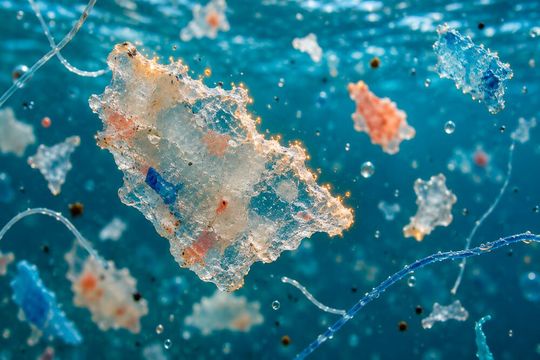
Microplastics can generate reactive oxygen species at their surfaces when interacting with water, according to a new study, suggesting a potential mechanism for biological harm.
(Source: Dall-E / KI-generiert)
Plastics are supposed to be chemically inert. It’s the reason they’re used so frequently to package food, bottle water, and create children’s toys: They’re safe. But something important happens when a large piece of plastic fragments into micro- and nanoparticles. Its surface area increases dramatically relative to its volume. Vastly more of the material is now exposed to its surroundings.
A new study by researchers from Columbia University and the University of California, Berkeley, found that this newly created surface is not necessarily safe, and identified the chemical reasons why.
Fragmentation Creates Chemically Active Surfaces
“As plastic fragments into smaller and smaller particles, its surface area increases enormously. Then microplastics change the water that surrounds them, generating high-energy, reactive radicals (reactive oxygen species, ROS) that very likely contribute to biological damage that we see in animals and potentially in humans as a result of microplastic exposure,” said Wei Min, a Columbia professor of Chemistry and Biomedical Engineering.
The work challenges the common view of microplastics as largely passive fragments of inert material, and contributes to a growing understanding of why the large-scale presence of microplastics is a cause for concern. The research was published today in the journal Nature.
This is particularly noteworthy for human health because human blood is largely made up of water. The new research suggests that microplastics that enter the bloodstream or cells could remain chemically active in this water-rich biological environment.
Earlier Research Highlighted the Scale of Nanoplastic Exposure
Min’s group at Columbia University also led a 2024 study that developed a laser based microscope technology and found that on average, a liter of bottled water contained some 240,000 detectable plastic fragments (mostly nanometer-sized plastic, nanoplastics) — 10 to 100 times more fragments than had previously been estimated. That study led to a growing recognition that micro and nanoplastics exist throughout the food system.
The group’s 2024 research on nanoplastics garnered widespread media attention, and combating microplastic has become a public health priority. This year, the U.S federal government launched a $144 million program to combat toxic microplastics in the human body. The U.S. Environmental Protection Agency also recently added microplastics to a federal list of contaminants that may pose a concern for drinking water, the first time microplastics have appeared on the list.
Subsequent research in prominent journals including New England Journal of Medicine, Nature Medicine, and Nature Health have found links between micro and nanoplastic exposure and heart attack, stroke, dementia, and brain tumor. But, given its supposed inertness, the mechanism by which microplastics could contribute to these illnesses had been unclear.
This new study specifies a previously overlooked mechanism that might help bridge this gap.
Water Plays an Active Role in Radical Formation
“Our research found that when microplastics interact with water, as they do when they’re in bottled water, or when they’re absorbed into our bloodstream, they spontaneously generate what we call reactive oxygen species (ROS),” said Naixin Qian, a postdoctoral researcher in Wei Min’s lab who helped lead the research. “ROS are textbook examples of the kinds of molecules that can damage animal and human tissue.”
“Water is a key active player here, rather than just a spectator. It’s integral to making these microplastics reactive. Water molecules become chemically active when they come into contact with plastic, which is hydrophobic. Contact between the water and plastic creates an environment that facilitates electron transfer, and the formation of reactive radicals. When plastics fragment into smaller particles, their increasing surface-to-volume ratio creates more of these chemically active areas,” Min said.
Simulations Explain Reactions at the Plastic–Water Interface
The Columbia team conducted the chemical and biological experiments, while collaborators in the lab of Professor Teresa Head-Gordon at the University of California, Berkeley, created theoretical calculations and dynamical simulations to identify how the microplastic interacted with water.
Date: 08.12.2025
Naturally, we always handle your personal data responsibly. Any personal data we receive from you is processed in accordance with applicable data protection legislation. For detailed information please see our privacy policy.
Consent to the use of data for promotional purposes
I hereby consent to Vogel Communications Group GmbH & Co. KG, Max-Planck-Str. 7-9, 97082 Würzburg including any affiliated companies according to §§ 15 et seq. AktG (hereafter: Vogel Communications Group) using my e-mail address to send editorial newsletters. A list of all affiliated companies can be found here
Newsletter content may include all products and services of any companies mentioned above, including for example specialist journals and books, events and fairs as well as event-related products and services, print and digital media offers and services such as additional (editorial) newsletters, raffles, lead campaigns, market research both online and offline, specialist webportals and e-learning offers. In case my personal telephone number has also been collected, it may be used for offers of aforementioned products, for services of the companies mentioned above, and market research purposes.
Additionally, my consent also includes the processing of my email address and telephone number for data matching for marketing purposes with select advertising partners such as LinkedIn, Google, and Meta. For this, Vogel Communications Group may transmit said data in hashed form to the advertising partners who then use said data to determine whether I am also a member of the mentioned advertising partner portals. Vogel Communications Group uses this feature for the purposes of re-targeting (up-selling, cross-selling, and customer loyalty), generating so-called look-alike audiences for acquisition of new customers, and as basis for exclusion for on-going advertising campaigns. Further information can be found in section “data matching for marketing purposes”.
In case I access protected data on Internet portals of Vogel Communications Group including any affiliated companies according to §§ 15 et seq. AktG, I need to provide further data in order to register for the access to such content. In return for this free access to editorial content, my data may be used in accordance with this consent for the purposes stated here. This does not apply to data matching for marketing purposes.
Right of revocation
I understand that I can revoke my consent at will. My revocation does not change the lawfulness of data processing that was conducted based on my consent leading up to my revocation. One option to declare my revocation is to use the contact form found at https://contact.vogel.de. In case I no longer wish to receive certain newsletters, I have subscribed to, I can also click on the unsubscribe link included at the end of a newsletter. Further information regarding my right of revocation and the implementation of it as well as the consequences of my revocation can be found in the data protection declaration, section editorial newsletter.
Head-Gordon’s lab led the theory that showed that hydroxide ions that are promoted to the immediate water layers near the hydrophobic microplastic interface can more easily lose their electron to create hydroxyl radicals.
Findings Could Inform Changes to Plastic Chemistry
“Our fundamental work that the most hydrophobic microplastics interacting with water can drive chemical reactivity could ultimately lead to new engineering solutions by redesigning the chemistry of these commodity plastics to reduce the toxic outcomes on health and the environment,” said Head-Gordon.
“This work has significant implications for environmental and human health,” said co-author Beizhan Yan of Lamont-Doherty Earth Observatory. “In certain environments, such as discharges from plastic manufacturers and laundromats, microplastics can form and enter aquatic environments. This work also indicates that radicals can form on hydrophobic plastic surfaces in water, which could affect ecosystems and human health following exposure. In addition, various uses and processes in our daily lives can generate microplastics, including microwave heating, sunlight exposure of bottled water during storage. This foundational work provides a potential pathway for understanding their health impacts.”




:quality(80)/p7i.vogel.de/wcms/61/89/618990ef2cb2d4456da6f260c03343e3/0133981905v2.jpeg "Workers who were worried about the future of their occupation were more likely to morally disengage at work. (Source: free licensed)")
:quality(80)/p7i.vogel.de/wcms/a7/df/a7df32474d451da816851d9a8f52a22d/0133906333v2.jpeg "The Nobel Prize in Physiology or Medicine 2026 is awarded for optogenetics — a method that makes it possible to show how nerve cells shape memories, feelings and behaviours in the living brain. (Source: © The Nobel Committee for Physiology or Medicine. Ill. Mattias Karlén)")
:quality(80)/p7i.vogel.de/wcms/3f/2b/3f2b75ae816c4c7d2834642c675d1b72/0133864426v1.jpeg "Researchers recently found that spending just 10 minutes relying on an AI tool significantly impairs the user's ability to focus and persist with difficult tasks. A preliminary draft made waves earlier this year, and the team presented the updated, peer-reviewed paper this week at the Conference on Language Modeling. (Source: free licensed)")
:quality(80)/p7i.vogel.de/wcms/24/31/24319808d44e55ba97ce10223c21791b/0133864445v1.jpeg "This new battery binder could reduce the toxic ingredients, energy use and waste when building and recycling lithium-ion batteries. (Source: David Baillot | UC San Diego Jacobs School of Engineering (CC BY-ND 4.0))")
:quality(80)/p7i.vogel.de/wcms/3e/3c/3e3cc29b52fedebf1c97dea23b92a760/0133673542v2.jpeg "Fig.1: The path to accurate pH measurements starts with precise calibration. Use fresh buffers and verify mV response for optimal electrode performance. (Source: METTLER TOLEDO)")
:quality(80)/p7i.vogel.de/wcms/2d/92/2d9231a37601aa58b40d4688f609f004/0133687591v2.jpeg "Horiba’s new CE IVDR certified Yumizen H500 CRP benchtop hematology analyzer delivers a simultaneous complete blood count with 5-part extended differential and rapid CRP whole blood measurement. (Source: Horiba )")
:quality(80)/p7i.vogel.de/wcms/e5/e9/e5e97a3c76cbf47308ce21c4a567a812/0133686320v2.jpeg "The picture shows the Kern PDS precision scale in combination with Kern Balanceconnection software. (Source: Kern & Sohn)")
:quality(80)/p7i.vogel.de/wcms/a8/6e/a86e9b1f1561a67038b6d8a9fe629117/0133465534v2.jpeg "Clean, calibrate, and store pH electrodes properly to ensure accurate, reliable measurements every time. (Source: METTLER TOLEDO)")
:quality(80)/p7i.vogel.de/wcms/2e/f5/2ef5c7b1206d1a2957f965f97d1f8ddd/0133980521v1.jpeg "Alaska glacier (Source: Oregon State University)")
:quality(80)/p7i.vogel.de/wcms/60/9c/609c1bc8643d2eed0b26431c12186f98/0133981015v1.jpeg "Microplastics can generate reactive oxygen species at their surfaces when interacting with water, according to a new study, suggesting a potential mechanism for biological harm. (Source: Dall-E / KI-generiert)")
:quality(80)/p7i.vogel.de/wcms/7b/db/7bdb5608f8d1d8ddb29abd8817d35872/0133981301v2.jpeg "A Vienna team investigated whether discarded plastics could provide the starting material for these molecular sponges. (Source: free licensed)")
:quality(80)/p7i.vogel.de/wcms/b1/b7/b1b7778bcba4902f4b7226a2707562d2/0133966790v2.jpeg "Insects are an important source of food for birds, fish, reptiles, amphibians and mammals. (Source: Sami Kivelä, LUKE)")
:quality(80)/p7i.vogel.de/wcms/e1/f4/e1f48a0c4b6d5c00059370affdc13113/0133694409v2.jpeg "Broccoli growing beneath semi-transparent, colored solar panels at the experimental site at Kärrbo Prästgård farm in Sweden. (Source: Silvia Ma Lu)")
:quality(80)/p7i.vogel.de/wcms/95/3e/953e490f1819f6638bc08fe3d4d43e87/0133566684v1.jpeg "The soy protein isolate the researchers fed to the mice. (Source: KyotoU / Tomoko T. Asai)")
:quality(80)/p7i.vogel.de/wcms/ba/38/ba38179dbcd20fbc3887b2709193d0a8/0133566669v2.jpeg "Consumers in a Cornell study showed no consistent bias against the colour of hybrid red wines, with several ranking among the most visually appealing. (Source: free licensed)")
:quality(80)/p7i.vogel.de/wcms/ac/d1/acd1a8888f6e78206f11f2b4eb33926f/0133566582v1.jpeg "A claim on the front of a box of food products is a hint, not a verdict. The nutrition label on the back – added sugars, sodium, saturated fat, all of it together – still tells the fuller story. (Source: free licensed)")
:quality(80)/p7i.vogel.de/wcms/7f/90/7f90cbfba445fb1790cdf272b7b0dfce/0133980752v1.jpeg "Because prenatal depression is both common and treatable, improving access to evidence-based mental health interventions during pregnancy could benefit the mothers’ mental wellbeing as well as the next generation. (Source: free licensed)")
:quality(80)/p7i.vogel.de/wcms/48/9f/489f0d616f59fbb57401babe0b161ac5/0133966222v2.jpeg "Glassteng prototype next to one of the tiny, thin, lightweight sensors. (Source: Northwestern University)")
:quality(80)/p7i.vogel.de/wcms/e4/5b/e45b74e986e325695415f633d2094673/0133908923v2.jpeg "The report brings together all the existing research on how to prevent deaths and hospitalizations during heatwaves in people with different forms of cardiovascular disease. (Source: Unsplash)")
:quality(80)/p7i.vogel.de/wcms/79/e7/79e7c5ee90d19fe72bdae3627024c168/0133864685v2.jpeg "Findings suggest cannabis-related sleep disruptions may go unnoticed by users themselves (Source: free licensed)")
:quality(80)/images.vogel.de/vogelonline/bdb/1710600/1710675/original.jpg "Discover how to set yourself up for success when performing balance-based density determination of solids such as jewelry and precious metals. (Mettler Toledo)")
:quality(80)/images.vogel.de/vogelonline/bdb/1682500/1682579/original.jpg "The new XPR Analytical balance redesigned to meet the needs of laboratory technicians of working fast and lean. (Mettler Toledo)")
:quality(80)/images.vogel.de/vogelonline/bdb/1677000/1677080/original.jpg "Enhance your weighing accuracy, comfort and productivity with the redesigned XPR Analytical balance. (Mettler Toledo)")
:fill(fff,0)/images.vogel.de/vogelonline/companyimg/131900/131910/65.jpg "Xylem_tag_rgb.jpg ()")
:fill(fff,0)/p7i.vogel.de/companies/69/b7/69b7f63f311d9/logo-bimos-tif--2-.jpeg "logo-bimos-tif--2- (https://www.bimos.com/de-de/)")
:quality(80)/p7i.vogel.de/wcms/2e/55/2e55c9d23d33f4408d901b55e9e15094/0130918768v1.jpeg "Researchers at the University of Plymouth are investigating whether micro- and nanoplastics that accumulate in the liver could contribute to inflammation, fibrosis and other processes associated with rising rates of liver disease. (Source: free licensed)")
:quality(80)/p7i.vogel.de/wcms/a4/38/a438009114e10222678ad128139cbdd0/0132591375v2.jpeg "The researchers say the study adds to growing evidence that environmental pollution may affect cardiovascular health. (Source: Unsplash)")