A new study has revealed that frailty among transplant candidates can be significantly improved with the right personalized, physician-led fitness program.
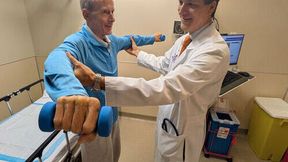
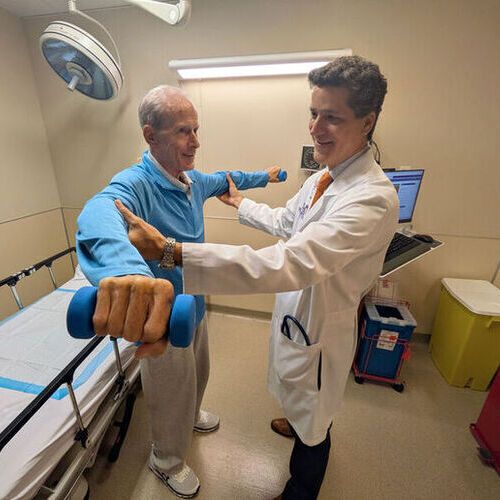
Study senior author Dr. Andres Duarte (right) and transplant candidate Steven McGowan at Northwestern Medicine Organ Transplant Center in Chicago.
(Source: Northwestern University / Ben Schamisso)
Illinois/USA – When transplant candidates become frail, doctors often worry that they are too weak to survive transplantation. But according to a new study from Northwestern Medicine and the University of Pittsburgh, frailty can be significantly improved with the right personalized, physician-led fitness program.
In the study, more than 350 liver transplant candidates participated in a highly individualized workout and nutrition program. Nearly two-thirds of patients who attended at least three program visits lowered their frailty score by an average of nearly 0.4 points — a number which turned out to be a game changer.
Patients whose score improved by 0.4 points or more had a roughly 50 % lower risk of dying while waiting for a transplant.
“It doesn’t matter how severe their disease is,” said study senior author Dr. Andres Duarte-Rojo, a professor in the divisions of Gastroenterology and Hepatology, and Organ Transplantation at Northwestern University Feinberg School of Medicine. “If they exercise and do what we ask them to do, they see a major improvement in their fitness and reduce their mortality risk before transplantation.”
The study was published on Oct. 21 in the journal Clinical Gastroenterology and Hepatology.
Transplant fitness
According to Duarte-Rojo, only about 10 transplant centers worldwide (including at Northwestern and Pittsburgh) offer patients this personalized fitness program, called prehabilitation. In the study, patients underwent tests to assess strength and nutritional needs as soon as they were referred to the transplantation center. During that initial visit, they received an at-home exercise plan that was adjusted during follow-up appointments every four to 12 weeks.
For each patient, Duarte-Rojo worked closely with a physical therapist and a dietitian to set up the fitness and nutritional plans and track progress.
“There are precautions, of course,” said Duarte-Rojo who also is a Northwestern Medicine transplant hepatologist. “You don’t send these patients to the gym to lift 100 pounds. You have to start low and progress slowly. But we find that the frailest ones often improve the most.”
Duarte-Rojo said he has spent 20 years studying fitness programs for patients with advanced liver disease — 20 years, he says, of attempting to prove to the medical establishment that many sick and frail patients need it the most.
“Some authorities in the field have long told me, ‘You’re crazy, they’re going to bleed, they’re going to have more encephalopathy, they’re going to get sicker, they’re going to get injured,’” Duarte said. “And we proved through many field studies that is exactly the other way around.”
Findings
Duarte-Rojo and colleagues studied nearly 1,300 adults evaluated for liver transplantation between 2018 and 2022 at the University of Pittsburgh’s transplantation center. Among them, 355 returned for at least two follow-up visits and were therefore considered participants of the prehabilitation program.
In those patients, Duarte-Rojo’s team tracked changes in their Liver Frailty Index, a score based on three tests: grip strength, chair stands and the ability to remain in three balancing positions.
Among the prehabilitation patients, 64 % improved their score. And after accounting for factors known to influence mortality — such as age, disease severity and baseline frailty — patients who improved their score by at least 0.4 points had a roughly 50 % lower risk of dying while awaiting a transplant.
Date: 08.12.2025
Naturally, we always handle your personal data responsibly. Any personal data we receive from you is processed in accordance with applicable data protection legislation. For detailed information please see our privacy policy.
Consent to the use of data for promotional purposes
I hereby consent to Vogel Communications Group GmbH & Co. KG, Max-Planck-Str. 7-9, 97082 Würzburg including any affiliated companies according to §§ 15 et seq. AktG (hereafter: Vogel Communications Group) using my e-mail address to send editorial newsletters. A list of all affiliated companies can be found here
Newsletter content may include all products and services of any companies mentioned above, including for example specialist journals and books, events and fairs as well as event-related products and services, print and digital media offers and services such as additional (editorial) newsletters, raffles, lead campaigns, market research both online and offline, specialist webportals and e-learning offers. In case my personal telephone number has also been collected, it may be used for offers of aforementioned products, for services of the companies mentioned above, and market research purposes.
Additionally, my consent also includes the processing of my email address and telephone number for data matching for marketing purposes with select advertising partners such as LinkedIn, Google, and Meta. For this, Vogel Communications Group may transmit said data in hashed form to the advertising partners who then use said data to determine whether I am also a member of the mentioned advertising partner portals. Vogel Communications Group uses this feature for the purposes of re-targeting (up-selling, cross-selling, and customer loyalty), generating so-called look-alike audiences for acquisition of new customers, and as basis for exclusion for on-going advertising campaigns. Further information can be found in section “data matching for marketing purposes”.
In case I access protected data on Internet portals of Vogel Communications Group including any affiliated companies according to §§ 15 et seq. AktG, I need to provide further data in order to register for the access to such content. In return for this free access to editorial content, my data may be used in accordance with this consent for the purposes stated here. This does not apply to data matching for marketing purposes.
Right of revocation
I understand that I can revoke my consent at will. My revocation does not change the lawfulness of data processing that was conducted based on my consent leading up to my revocation. One option to declare my revocation is to use the contact form found at https://contact.vogel.de. In case I no longer wish to receive certain newsletters, I have subscribed to, I can also click on the unsubscribe link included at the end of a newsletter. Further information regarding my right of revocation and the implementation of it as well as the consequences of my revocation can be found in the data protection declaration, section editorial newsletter.
Duarte-Rojo said the 0.4 benchmark is critical because transplant centers around the world could use it as a clinical goal and as a way to identify patients who are more likely to survive.
Why this matters
At any given time in the U.S., roughly 100,000 candidates are waiting for a transplant. Depending on the organ, the average wait times range from a few months to a few years.
Beyond that population, Duarte-Rojo said the prehabilitation program could be replicated for cancers and certain surgeries. “As we are getting older and as we are getting sicker, we need to be more prepared to take care of our bodies,” he said.
Patient perspective
Steven McGowan is a 62-year-old retiree from the Chicago area who is awaiting both a kidney and liver transplant. He has been participating in Duarte-Rojo’s prehabilitation program at Northwestern since January. The grandfather of five said he was classified as “very frail” during his initial visit. After months of rigorously following his fitness and dietary plan, Duarte-Rojo’s team now considers him “robust.”
“I was very frail when I went in,” McGowan said. “I started getting stronger pretty quickly. I’m honestly surprised how much I’m doing. I’m walking three to four miles a day now.”
The study is called “Personalized Prehabilitation: A Pathway to Improved Frailty Metrics and Survival in Liver Transplant Candidates.”