Drinking water with meals may not curb appetite as widely assumed, while extra spice could help people eat less. Cornell researchers found that bite-and-sip patterns and slower eating may have a greater influence on food intake than previously thought.
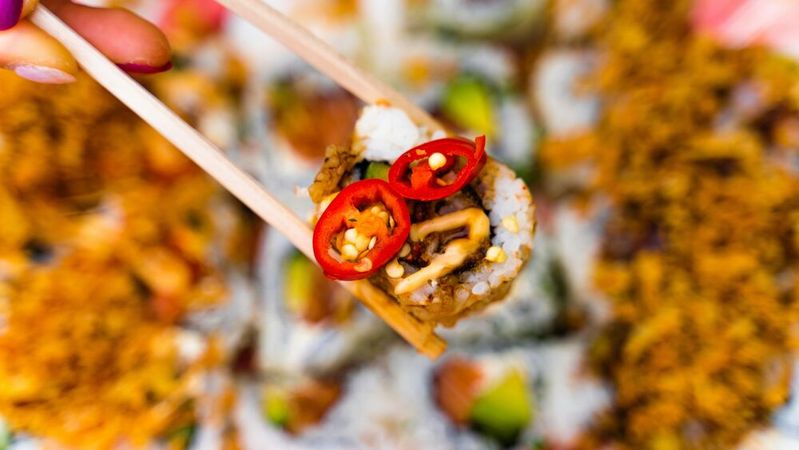
Adding spice may help people eat less by slowing them down.
The common rationale for drinking water at meals is that it physically stretches the stomach, triggering fullness so you don’t eat too much. But a new Cornell study found no support for that idea in practice.
Instead, for every additional 100 grams of water participants drank, they ate about 39 more grams of food — roughly 49 more calories. People who frequently switched back and forth between bites of food and sips of water ate even more: each additional switch was tied to about 4.4 more grams of food consumed.
Gallery
Researchers suspect this “switching” effect works by delaying something called sensory-specific satiety — the way a food’s appeal naturally fades the longer you eat it. Alternating with water may reintroduce contrast that keeps the meal appealing longer, delaying the point at which people stop eating.
“There’s been this widespread advice that if we drink water, it fills us up,” said Paige Cunningham, assistant professor in the Division of Nutritional Sciences in the College of Human Ecology. “But water is emptied quickly from the stomach so it likely doesn’t fill us up for long. Instead. ...”
Cunningham is the corresponding author on the new analysis, published in July in the journal Appetite and conducted with longtime collaborator John Hayes of Penn State’s Department of Food Science. In a second related study, the researchers measured the effect of spicy salsa on eating volume — and again found a surprising result.
“Both studies show how mealtime behaviors and food properties can significantly influence how much we eat, without us even realizing. We found that just drinking more water was associated with greater consumption, while adding a bit more spice to a snack slowed eating and decreased how much participants ate,” said Cunningham.
The drinking water study pooled data from two earlier lab experiments, 86 adults in all, who ate as much as they wanted of a lunch (either beef chili or chicken tikka masala) served with water, while researchers recorded every bite and sip on video.
One result cut against the researchers’ own expectations: Participants who drank water faster during a meal ended up eating less, not more. The paper offers this as a genuine open question rather than a settled explanation, noting it may reflect how long water sits in the mouth, or may simply track with how long a meal lasts overall.
“This was a secondary analysis looking at associations,” Cunningham said. “We are following up on this right now so we can make those causal inferences.”
In a separate experiment, whose results published April in Food Quality and Preference, 49 adults were served tortilla chips alongside a mild or spicy salsa, once a week for two weeks; only the salsa’s cayenne content changed between conditions. The spicier version cut total snack intake by 28% — not just of the salsa itself, but of the chips too, even though the chips themselves didn’t change.
Participants ate the spicy snack about 30% more slowly than the mild one, which the researchers suspect drove the decrease: Heat slowed people down, and slower eating meant less eaten overall. Water intake during the snack was unaffected by spice level, which the researchers note rules it out as an explanation for the reduced intake.
“We were interested in whether making the salsa spicy would result in people eating the same amount of chips,” Cunningham said. “And they didn’t.”
The takeaway is that adding spice to one part of the snack can significantly influence how much people eat overall.
Paige Cunningham, Assistant professor in the Division of Nutritional Sciences in the College of Human Ecology
Read together, the two papers make a case that runs against two different strands of popular nutrition advice at once: that water at meals is a simple ally in eating less, and that spicy food is something to approach with caution if you're watching what you eat. This research showed the opposite might be true: water tracked with eating more, and spice tracked with eating less.
Date: 08.12.2025
Naturally, we always handle your personal data responsibly. Any personal data we receive from you is processed in accordance with applicable data protection legislation. For detailed information please see our privacy policy.
Consent to the use of data for promotional purposes
I hereby consent to Vogel Communications Group GmbH & Co. KG, Max-Planck-Str. 7-9, 97082 Würzburg including any affiliated companies according to §§ 15 et seq. AktG (hereafter: Vogel Communications Group) using my e-mail address to send editorial newsletters. A list of all affiliated companies can be found here
Newsletter content may include all products and services of any companies mentioned above, including for example specialist journals and books, events and fairs as well as event-related products and services, print and digital media offers and services such as additional (editorial) newsletters, raffles, lead campaigns, market research both online and offline, specialist webportals and e-learning offers. In case my personal telephone number has also been collected, it may be used for offers of aforementioned products, for services of the companies mentioned above, and market research purposes.
Additionally, my consent also includes the processing of my email address and telephone number for data matching for marketing purposes with select advertising partners such as LinkedIn, Google, and Meta. For this, Vogel Communications Group may transmit said data in hashed form to the advertising partners who then use said data to determine whether I am also a member of the mentioned advertising partner portals. Vogel Communications Group uses this feature for the purposes of re-targeting (up-selling, cross-selling, and customer loyalty), generating so-called look-alike audiences for acquisition of new customers, and as basis for exclusion for on-going advertising campaigns. Further information can be found in section “data matching for marketing purposes”.
In case I access protected data on Internet portals of Vogel Communications Group including any affiliated companies according to §§ 15 et seq. AktG, I need to provide further data in order to register for the access to such content. In return for this free access to editorial content, my data may be used in accordance with this consent for the purposes stated here. This does not apply to data matching for marketing purposes.
Right of revocation
I understand that I can revoke my consent at will. My revocation does not change the lawfulness of data processing that was conducted based on my consent leading up to my revocation. One option to declare my revocation is to use the contact form found at https://contact.vogel.de. In case I no longer wish to receive certain newsletters, I have subscribed to, I can also click on the unsubscribe link included at the end of a newsletter. Further information regarding my right of revocation and the implementation of it as well as the consequences of my revocation can be found in the data protection declaration, section editorial newsletter.
“These strategies might help consumers achieve their goals to reduce energy intake,” Cunningham said.
Both papers are explicit about their limits: the meals and snacks tested were a narrow set — chili, tikka masala and one chip-and-salsa combination — all eaten in a controlled lab setting, and the researchers caution against assuming the same patterns would hold for very different foods or in everyday, uncontrolled eating.
“We are looking to future experiments that explore what other factors or properties of foods can we leverage to influence behaviors,” Cunningham said.
Original Article: Water intake, switching between bites and sips, and drinking behavior are associated with food intake across meals varying in spiciness: A secondary analysis of two randomized crossover studies; Appetite; DOI:10.1016/j.appet.2026.108698




:quality(80)/p7i.vogel.de/wcms/cd/c0/cdc09efd1e5b3b8f83224e7729d66c10/0133105276v2.jpeg "From the data presented in this report, the authors show how TF3-MALS-RI is uniquely able to separate large polyacrylate molecules and provide precise molecular weight and Rg values. (Source: Postnova Analytics)")
:quality(80)/p7i.vogel.de/wcms/c6/f2/c6f2e2b4753a0d0cec682c03df4ed37c/0133088650v2.jpeg "PMBC vials for immunology and oncology research. (Source: Amsbio)")
:quality(80)/p7i.vogel.de/wcms/e0/72/e0728dc8dcadfc4d79a734e08cf6ced3/0133088641v2.jpeg "LM20 Microfluidizer and Cambridge CNT dispersion produced by the LM20 microfluidizer. (Source: Analytik)")
:quality(80)/p7i.vogel.de/wcms/55/f2/55f26cfb29878f58625b4697bacff0b9/0132894544v2.jpeg "The programme is designed to build an integrated R&D platform for sustainable specialty polymers. (Source: NUS)")
:quality(80)/p7i.vogel.de/wcms/86/01/86014d3d2a28cefc852f65c8d68317e4/0133104231v2.jpeg "Single-handed tube reading using a Handheld 2. (Source: Azenta Life Sciences)")
:quality(80)/p7i.vogel.de/wcms/0b/0f/0b0f8ed042dfc91f32582e10d54c2c7e/0133087444v2.jpeg "Offering advanced automation to increase your throughput, the Intellixcap provides secure sealing – eliminating the need for manual intervention, while preserving vital sample integrity. (Source: Azenta Life Sciences)")
:quality(80)/p7i.vogel.de/wcms/13/d3/13d35105f74a1c2e22b9c7a270e8e9b3/0132611155v2.jpeg "Circulating cell free DNA. (Source: Amsbio)")
:quality(80)/p7i.vogel.de/wcms/bc/ed/bced6850297a04dbea471a66cb6bb6fe/0132611405v2.jpeg "The latest addition to the range is a peristaltic tubing stop adapter that eliminates the need for fixed stoppers and allows custom cut lengths of peristaltic tubing to be installed on any pump head size. (Source: Biotech Fluidics )")
:quality(80)/p7i.vogel.de/wcms/32/80/3280aa3d44708962943c96fe2d466744/0133088560v2.jpeg "A bumble bee in flight at the University of Bristol Botanic Garden. (Source: Phil Savoie)")
:quality(80)/p7i.vogel.de/wcms/7b/e5/7be5c735140cbe28f3af0ec3d88274b9/0133045403v2.jpeg "After being buried in the ground for two months and broken down by soil organisms, a new pair of cotton underwear (left) shows clear signs of decomposition (right). (Source: Nicolas Zonvi)")
:quality(80)/p7i.vogel.de/wcms/c7/5e/c75e9b334a94b8b5c2a758f20ba080a8/0133039712v1.jpeg "Researchers have developed a microaerobic activated sludge process that enables ammonium to be recovered from fermentation industry wastewater instead of releasing nitrogen into the atmosphere. (Source: free licensed)")
:quality(80)/p7i.vogel.de/wcms/9a/a0/9aa0a7f2d93c4f3a9c6297fb39a5c756/0133018161v2.jpeg "Volcanic activity and hydroclimatic anomalies. Eruptions produce a repeating wave pattern in high-altitude winds (left panels) that line up with widespread drying across Asia (right panels). This pattern appears regardless of background climate conditions. (Source: ©2026 Nie et al. CC-BY-ND)")
:quality(80)/p7i.vogel.de/wcms/d4/61/d461ce0bd5743897993c6475f69e7ad6/0133067478v2.jpeg "In Harris County, 50 % of households with children reported food insecurity, compared with 33 % of households without children. (Source: Rice University)")
:quality(80)/p7i.vogel.de/wcms/79/76/7976d17b980bedfe35acaa532d690046/0132713841v2.jpeg "Observed rice yield losses from 1°C warming are more than twice as high as model estimates due to underestimated heat stress. (Source: AdobeStock/ducvien)")
:quality(80)/p7i.vogel.de/wcms/28/b6/28b6114fc9915c5dadee94d5c89bd129/0132593216v2.jpeg "Eating foods that contain common preservative food additives may increase the risks of high blood pressure and cardiovascular disease. (Source: Unsplash)")
:quality(80)/p7i.vogel.de/wcms/01/bc/01bcb16a3381a1d46533861eedbbae71/0132371290v1.jpeg "Adding spice may help people eat less by slowing them down. (Source: free licensed)")
:quality(80)/p7i.vogel.de/wcms/12/89/12898926c84533b848ef20475b822129/0133103465v2.jpeg "As national MMR vaccination rates among kindergarteners continue to decline, according to a CDC report, the U.S. has recorded its first adult measles-related deaths of 2026 in Pennsylvania. (Source: Pixabay)")
:quality(80)/p7i.vogel.de/wcms/e4/07/e407a7ca05d57041aac21e3d716c48f5/0133100475v2.jpeg "Exercise-based cardiac rehabilitation is strongly recommended for patients after a MI in the ESC Guidelines on acute coronary syndromes and in the new ESC Guidelines on cardiac rehabilitation. (Source: Unsplash)")
:quality(80)/p7i.vogel.de/wcms/54/c2/54c20d95b1b4b4cc7d56674ef58b7c25/0133097847v2.jpeg "Staree was a double-blind trial conducted among people aged 70 years and over with no history of clinical cardiovascular disease, diabetes or dementia recruited from Australian general practice. (Source: Unsplash)")
:quality(80)/p7i.vogel.de/wcms/1c/64/1c64bf757ace04243990f44dce11f5ed/0133067501v2.jpeg "Despite the proven benefits of blood pressure-lowering medication in reducing cardiovascular events, around half of patients do not take them as prescribed. (Source: Pixabay)")
:quality(80)/images.vogel.de/vogelonline/bdb/1710600/1710675/original.jpg "Discover how to set yourself up for success when performing balance-based density determination of solids such as jewelry and precious metals. (Mettler Toledo)")
:quality(80)/images.vogel.de/vogelonline/bdb/1682500/1682579/original.jpg "The new XPR Analytical balance redesigned to meet the needs of laboratory technicians of working fast and lean. (Mettler Toledo)")
:quality(80)/images.vogel.de/vogelonline/bdb/1677000/1677080/original.jpg "Enhance your weighing accuracy, comfort and productivity with the redesigned XPR Analytical balance. (Mettler Toledo)")
:fill(fff,0)/images.vogel.de/vogelonline/companyimg/107800/107832/65.jpg "logoDueperthal.jpg ()")
:fill(fff,0)/images.vogel.de/vogelonline/companyimg/131900/131910/65.jpg "Xylem_tag_rgb.jpg ()")
:fill(fff,0)/p7i.vogel.de/companies/69/b7/69b7f63f311d9/logo-bimos-tif--2-.jpeg "logo-bimos-tif--2- (https://www.bimos.com/de-de/)")
:quality(80)/p7i.vogel.de/wcms/a3/85/a385ff4a530fdf3672b69ee9cde44df6/0132371274v1.jpeg "Participants who drank water faster during a meal ended up eating less, not more. (Source: Laila Milevski/ Cornell University)")
:quality(80)/p7i.vogel.de/wcms/5d/9e/5d9e3d5f6fa9b501199a6e52b6595f8e/0132371272v1.jpeg "Spicier salsa reduced total chip-and-salsa consumption by 28%, while participants ate about 30% more slowly. The researchers therefore suggest that eating speed, rather than increased water consumption, explained the lower intake.(Source: Laila Milevski/ Cornell University)")
:quality(80)/p7i.vogel.de/wcms/c4/89/c489a312e149d4508fc5e7084859cb1b/0132371284v1.jpeg "Adding spice may help people eat less by slowing them down.(Source: free licensed / Unsplash)")
:quality(80)/p7i.vogel.de/wcms/2a/07/2a0737995810d504b318f8a0f9ac2c3d/0130386209v1.jpeg "Simple, repeatable eating habits may help people stick to diets, see better results, study says (Source: free licensed)")
:quality(80)/p7i.vogel.de/wcms/e1/b3/e1b3e26d03101ba93b76b304da150c9a/0129025388v2.jpeg "The research reanalyzed data from a seminal clinical trial, led by US National Institutes of Health veteran Dr Kevin Hall, which first exposed how eating exclusively UPFs results in excessive calorie consumption and weight gain. (Source: Pixabay)")