An AI-powered model could help communities detect E. coli contamination risks in waterways before lab results arrive. By using rainfall, streamflow, turbidity and other environmental data, the system may support earlier beach warnings, reduce public health risks and limit unnecessary closures.
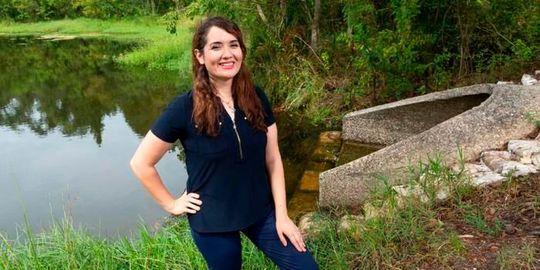
Famu-FSU College of Engineering Assistant Professor Nasrin Alamdari.
(Source: Scott Holstein/ Famu-FSU College of Engineering)
Every summer, beach closures disrupt families, harm local businesses and raise public health alarms. Most of the time, the warning comes after it is already too late. A new artificial intelligence framework developed at the Famu-FSU College of Engineering aims to change that by alerting water managers to E. coli contamination risk before anyone falls sick.
Researchers led by Assistant Professor Nasrin Alamdari developed an AI-powered predictive modeling framework that uses environmental and hydrometeorological data to provide early warnings of Escherichia coli (E. coli) contamination in recreational waterways, giving communities a window to act before health risks emerge.
Their model, which was published in Water Research, identified unsafe conditions with approximately 85% accuracy, demonstrating its potential to offer earlier warnings before levels reach unsafe thresholds.
“Beach closures often occur because we detect contamination after water conditions have already become unsafe,” said Alamdari, a researcher in the Department of Civil and Environmental Engineering and the Resilient Infrastructure and Disaster Response (Rider) Center. “Our goal is to move from a reactive approach to a predictive one, leveraging continuous environmental data, including rainfall, river flow, turbidity, temperature and upstream conditions, to estimate E. coli levels in near real time and up to a day in advance.”
How it Works
Traditional water quality monitoring relies on manual sampling followed by laboratory analysis, a process that takes 18 to 24 hours to yield results. By the time a beach or river is closed, swimmers may have already been exposed to dangerous levels of contamination.
The framework developed by researchers uses current and historical environmental data to estimate contamination risk without waiting for lab results. Inputs include upstream hydrologic conditions, streamflow rates, rainfall totals, turbidity readings and water temperature. By combining these variables, the model can flag elevated E. coli risk with 24 hours advance warning.
A 2023 sewage spill that occurred after a malfunction at the Big Creek Water Reclamation Facility illustrates exactly the kind of scenario the model is built to address.
“The 2023 Big Creek sewage spill is an example of how a sudden treatment failure can rapidly contaminate downstream recreational waters,” said Ali Salou Moumouni, a graduate researcher on the project. “Our predictive models use current and past environmental and hydrometeorological data to estimate contamination risk before lab results arrive. By factoring in upstream hydrologic conditions, our model provides earlier warnings and more targeted monitoring, improving preparedness during sudden contamination events.”
Why it Matters: Human Health Impacts and Economic Costs
E. coli contamination in recreational waterways can infect people swimming there, causing gastrointestinal distress, nausea or fatigue. Vulnerable populations, such as the very young or old, are at greater risk.
The consequences of delayed contamination alerts extend beyond public health. When closures happen unexpectedly, hotels, outfitters and water recreation businesses lose revenue with little warning. Municipalities absorb higher costs from emergency public notifications and increased health incident response.
“Delays expose the public to greater health risks and increase medical expenses from waterborne illness,” Alamdari said. “Local economies that depend on recreation and tourism suffer revenue losses when visitors cancel trips or avoid affected areas, while municipalities incur higher operational costs for water testing and emergency response. Repeated advisories can also erode public trust, leading to longer-term declines in visitation and further economic loss.”
Date: 08.12.2025
Naturally, we always handle your personal data responsibly. Any personal data we receive from you is processed in accordance with applicable data protection legislation. For detailed information please see our privacy policy.
Consent to the use of data for promotional purposes
I hereby consent to Vogel Communications Group GmbH & Co. KG, Max-Planck-Str. 7-9, 97082 Würzburg including any affiliated companies according to §§ 15 et seq. AktG (hereafter: Vogel Communications Group) using my e-mail address to send editorial newsletters. A list of all affiliated companies can be found here
Newsletter content may include all products and services of any companies mentioned above, including for example specialist journals and books, events and fairs as well as event-related products and services, print and digital media offers and services such as additional (editorial) newsletters, raffles, lead campaigns, market research both online and offline, specialist webportals and e-learning offers. In case my personal telephone number has also been collected, it may be used for offers of aforementioned products, for services of the companies mentioned above, and market research purposes.
Additionally, my consent also includes the processing of my email address and telephone number for data matching for marketing purposes with select advertising partners such as LinkedIn, Google, and Meta. For this, Vogel Communications Group may transmit said data in hashed form to the advertising partners who then use said data to determine whether I am also a member of the mentioned advertising partner portals. Vogel Communications Group uses this feature for the purposes of re-targeting (up-selling, cross-selling, and customer loyalty), generating so-called look-alike audiences for acquisition of new customers, and as basis for exclusion for on-going advertising campaigns. Further information can be found in section “data matching for marketing purposes”.
In case I access protected data on Internet portals of Vogel Communications Group including any affiliated companies according to §§ 15 et seq. AktG, I need to provide further data in order to register for the access to such content. In return for this free access to editorial content, my data may be used in accordance with this consent for the purposes stated here. This does not apply to data matching for marketing purposes.
Right of revocation
I understand that I can revoke my consent at will. My revocation does not change the lawfulness of data processing that was conducted based on my consent leading up to my revocation. One option to declare my revocation is to use the contact form found at https://contact.vogel.de. In case I no longer wish to receive certain newsletters, I have subscribed to, I can also click on the unsubscribe link included at the end of a newsletter. Further information regarding my right of revocation and the implementation of it as well as the consequences of my revocation can be found in the data protection declaration, section editorial newsletter.
Proactive alerts, by contrast, give businesses and government agencies advance notice, reduce unnecessary closures and help communities protect both public health and economic stability. By shifting from reactive to predictive monitoring, communities can better protect public health while reducing unnecessary closures and improving economic resilience.
Risk Factors
The study also documents how land use changes intensify contamination. Between 2007 and 2023, urbanization in the study area increased impervious cover from 24% to 28%, altering runoff pathways, leading to more polluted runoff and higher and more variable E. coli levels in streams.
As precipitation patterns grow less predictable, even moderate rainfall events carry elevated contamination risk in urbanized watersheds. The model accounts for rainfall history, streamflow and watershed wetness indicators to improve prediction during those in-between conditions that traditional models often miss.
“Our findings show that every development decision influences water quality and public health, highlighting the need for green infrastructure,” said Imtiaz Syed Usama, a graduate researcher on the team.
Storms compound the problem. E. coli levels can spike within hours of heavy rainfall, but traditional lab testing is too slow to catch those surges before people enter the water.
“Our model flips the script: by combining rainfall, streamflow, turbidity and other hydrometeorological data, it helps predict E. coli risk in near real time and up to a day ahead, including during extreme weather,” said Nasr Azadani Mitra, a graduate researcher at RIDER. “Communities without routine lab testing can still issue early warnings and protect public health.”
Original Article: Near real-time and next-day prediction for Escherichia coli (E. coli) concentrations in highly urbanized watersheds; Water Research; DOI:10.1016/j.watres.2025.125030




:quality(80)/p7i.vogel.de/wcms/62/32/62327aaae1415beeed47db6201e79661/0133375912v2.jpeg "A cotton trailer outfitted with benches and a sunshade offers farmworkers a reprieve from the sun as they take a break from picking cantaloupe melons in Firebaugh, Calif.
(Source: Joe Proudman/ Regents of the University of California)")
:quality(80)/p7i.vogel.de/wcms/e6/c8/e6c8bd554776ee1ad2f1f0723fb243a7/0133369387v1.jpeg "Roman road (Source: Queen Mary University of London)")
:quality(80)/p7i.vogel.de/wcms/51/68/51687ac4cc19f2757c138498b877de57/0133167039v2.jpeg "CMFs are foams that consist of hollow spheres – made of materials such as stainless steel, nickel, or other metals and alloys – embedded in a metallic matrix. The resulting material is both lightweight and remarkably strong at absorbing compressive forces. (Source: Jie Sun/ NC State University)")
:quality(80)/p7i.vogel.de/wcms/cd/c0/cdc09efd1e5b3b8f83224e7729d66c10/0133105276v2.jpeg "From the data presented in this report, the authors show how TF3-MALS-RI is uniquely able to separate large polyacrylate molecules and provide precise molecular weight and Rg values. (Source: Postnova Analytics)")
:quality(80)/p7i.vogel.de/wcms/86/01/86014d3d2a28cefc852f65c8d68317e4/0133104231v2.jpeg "Single-handed tube reading using a Handheld 2. (Source: Azenta Life Sciences)")
:quality(80)/p7i.vogel.de/wcms/0b/0f/0b0f8ed042dfc91f32582e10d54c2c7e/0133087444v2.jpeg "Offering advanced automation to increase your throughput, the Intellixcap provides secure sealing – eliminating the need for manual intervention, while preserving vital sample integrity. (Source: Azenta Life Sciences)")
:quality(80)/p7i.vogel.de/wcms/13/d3/13d35105f74a1c2e22b9c7a270e8e9b3/0132611155v2.jpeg "Circulating cell free DNA. (Source: Amsbio)")
:quality(80)/p7i.vogel.de/wcms/bc/ed/bced6850297a04dbea471a66cb6bb6fe/0132611405v2.jpeg "The latest addition to the range is a peristaltic tubing stop adapter that eliminates the need for fixed stoppers and allows custom cut lengths of peristaltic tubing to be installed on any pump head size. (Source: Biotech Fluidics )")
:quality(80)/p7i.vogel.de/wcms/8d/5c/8d5c6c7f897f91d6784825eee20b5584/0133321225v1.jpeg "Empa researcher Christoph Hüglin collects samples of particles that are washed out of the air by rain and snow or settle due to gravity. (Source: Empa)")
:quality(80)/p7i.vogel.de/wcms/a1/af/a1afbc7c8a067bbe94749ec680b4bafd/0133163762v2.jpeg "The study found in murkier water, fish took longer to move towards the food than those in clear water, but individuals in larger groups responded more quickly overall. (Source: Christos Ioannou)")
:quality(80)/p7i.vogel.de/wcms/32/80/3280aa3d44708962943c96fe2d466744/0133088560v2.jpeg "A bumble bee in flight at the University of Bristol Botanic Garden. (Source: Phil Savoie)")
:quality(80)/p7i.vogel.de/wcms/7b/e5/7be5c735140cbe28f3af0ec3d88274b9/0133045403v2.jpeg "After being buried in the ground for two months and broken down by soil organisms, a new pair of cotton underwear (left) shows clear signs of decomposition (right). (Source: Nicolas Zonvi)")
:quality(80)/p7i.vogel.de/wcms/ef/68/ef68375729607984e5bb0c143afdae70/0133375119v2.jpeg "Printed Rice-Lentil 3D structures
(Source: SUTD)")
:quality(80)/p7i.vogel.de/wcms/bf/d0/bfd087349a85956a7aefad57ac1204c7/0133241961v2.jpeg "The Thermo Scientific Suretect Beverage Spoilage Multiplex PCR Assay provides a fast, broad-range molecular solution for detecting key spoilage microorganisms that threaten beverage quality. (Source: © OlegDoroshin - stock.adobe.com)")
:quality(80)/p7i.vogel.de/wcms/d4/61/d461ce0bd5743897993c6475f69e7ad6/0133067478v2.jpeg "In Harris County, 50 % of households with children reported food insecurity, compared with 33 % of households without children. (Source: Rice University)")
:quality(80)/p7i.vogel.de/wcms/79/76/7976d17b980bedfe35acaa532d690046/0132713841v2.jpeg "Observed rice yield losses from 1°C warming are more than twice as high as model estimates due to underestimated heat stress. (Source: AdobeStock/ducvien)")
:quality(80)/p7i.vogel.de/wcms/22/49/224964dd6850b62cccdbc4bde2d34693/0133372964v1.jpeg "Brain activity recorded during a video game helped researchers predict whether participants would take or avoid a risk half a second before they acted. (Source: free licensed)")
:quality(80)/p7i.vogel.de/wcms/48/a7/48a761934161543f70fef2403b44d714/0133372328v2.jpeg "The link between pollution and coughing persisted in the data, even when pollution levels were below the WHO’s recommended safe daily exposure limit. (Source: free licensed)")
:quality(80)/p7i.vogel.de/wcms/83/b4/83b4563a65c6036b61990931507428b4/0133363611v2.jpeg "Magnesium sulphate uptake and the north / south divide for the Precept program. (Source: University of Bristol )")
:quality(80)/p7i.vogel.de/wcms/bb/06/bb06c1c3c5d250f3f93016366c56525d/0133363201v2.jpeg "The team identified more than 1,200 associated genetic variants and found that these influences are remarkably consistent across countries, ages and methods of measuring personality. (Source: Pixabay - PublicDomainPictures)")
:quality(80)/images.vogel.de/vogelonline/bdb/1710600/1710675/original.jpg "Discover how to set yourself up for success when performing balance-based density determination of solids such as jewelry and precious metals. (Mettler Toledo)")
:quality(80)/images.vogel.de/vogelonline/bdb/1682500/1682579/original.jpg "The new XPR Analytical balance redesigned to meet the needs of laboratory technicians of working fast and lean. (Mettler Toledo)")
:quality(80)/images.vogel.de/vogelonline/bdb/1677000/1677080/original.jpg "Enhance your weighing accuracy, comfort and productivity with the redesigned XPR Analytical balance. (Mettler Toledo)")
:fill(fff,0)/images.vogel.de/vogelonline/companyimg/107800/107832/65.jpg "logoDueperthal.jpg ()")
:fill(fff,0)/images.vogel.de/vogelonline/companyimg/131900/131910/65.jpg "Xylem_tag_rgb.jpg ()")
:fill(fff,0)/p7i.vogel.de/companies/69/b7/69b7f63f311d9/logo-bimos-tif--2-.jpeg "logo-bimos-tif--2- (https://www.bimos.com/de-de/)")
:quality(80)/p7i.vogel.de/wcms/51/0a/510ad5a3dcd0860e01bc8a3cc2542de9/0125919434v1.jpeg "Scientists looked at variants of the antibiotic albicidin to identify structural differences (colored boxes) that may be associated with reduced suscepitibility to resistance. (Source: Laboratory of Genetically Encoded Small Molecules at The Rockefeller University)")
:quality(80)/p7i.vogel.de/wcms/00/76/007699ebab7da92ec93002497189948a/0131515176v2.jpeg "Wars not only destroy lives but also have long-term impacts on the environment. (Source: © Rayhan - stock.adobe.com)")
:quality(80)/p7i.vogel.de/wcms/19/9a/199a9c04befed796fc4c7f917028f8ab/0127145423v1.jpeg "Harnessing biochar for nitrate removal from contaminated soil and water environments: Economic implications, practical feasibility, and future perspectives.
(Source: Rakesh Kumar, Atiqur Rahman, Jasmeet Lamba, Sushil Adhikari & Henry Allen Torbert)")