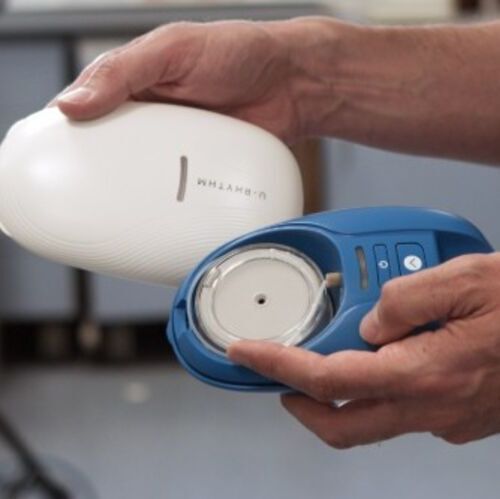
Researchers have developed a new portable, wearable device that has the capacity to detect hidden hormone spikes which can lead to high blood pressure as well as other health conditions.
The wearable U-Rhythm device, developed by the University of Bristol.
(Source: David Hills (Glude.tv))
Bristol/UK – The study, published in the journal Science Translational Medicine, concerns a condition called primary aldosteronism – a hormone disorder which affects up to one in five people with high blood pressure and puts them at higher risk of developing heart disease, stroke, diabetes, and other major health problems.
Researchers from the University of Bristol and the University of Manchester in the UK, the University of Bergen in Norway, and partners in Stockholm and Athens found that patients with the disorder experienced bursts of hormone production during the day as well as in the night while asleep, when routine blood testing is rarely carried out.
Thanks to an ingenious portable device, developed at the University of Bristol, the hormone levels of patients were able to be monitored round-the-clock in their homes rather than a hospital or research unit. This means hidden irregularities could be uncovered, which may normally go undetected by current testing methods, leading to earlier detection of health conditions.
Study co-lead author Dr Thomas Upton, Clinical Research Fellow in Automated Sampling Clinical Fellow at the University of Bristol, and Senior Clinical Fellow at Bristol Hospitals NHS Foundation Trust said: “Primary aldosteronism is an important cause of high blood pressure and the most common cause of secondary hypertension we see in our blood pressure clinic. It could be affecting millions of people in the UK. However, due to the way hormones change during the day and the current complexity of the diagnostic process, diagnosis is often delayed or never made at all.
“In our study, patients were monitored at home during normal activity, and this allowed us to see how hormones changed over time in realistic settings. This approach could potentially revolutionize how we diagnose hypertension and ultimately reduce cardiovascular disease – particularly heart disease and strokes – that could have been prevented.”
The proof-of-concept investigation continuously monitored hormone levels every 20 minutes in 60 patients from Bristol, Bergen, Stockholm, and Athens, over a 24-hour period. The patients all wore a lightweight device – which is the size of a mobile phone and attaches at the waist – allowing hormones to be measured from the skin, while they carried out normal daily activities, including sleeping at night.
Called U-Rhythm, the technology was adopted and advanced by the spinout company Dynamic Therapeutics in 2023.
Study senior author Dr Eder Zavala, UKRI Future Leader Fellow at the University of Manchester, said: “By continuously monitoring hormones over 24 hours, we were able to reveal a previously hidden pattern of nocturnal hormone bursts. This gives us a much clearer understanding of the disease and could ultimately help doctors detect it earlier and treat patients more effectively.
“A more detailed mathematical and computational analysis of daily hormonal profiles could eventually also help uncover earlier and more subtle forms of the disease, opening new opportunities to improve outcomes for patients living with high blood pressure.”
Computational analysis of data from the device allowed researchers to track changes in aldosterone, the hormone responsible for regulating salt and water balance in humans, along with two closely related hormones known as 18-hydroxycortisol and 18-oxocortisol.
Existing tests may be missing patients because the study results showed aldosterone levels do not stay high all the time. Furthermore, the researchers found that even among some of the most severe cases of the disease, there were periods when hormone levels dipped below the minimum thresholds used to diagnose the condition.
Date: 08.12.2025
Naturally, we always handle your personal data responsibly. Any personal data we receive from you is processed in accordance with applicable data protection legislation. For detailed information please see our privacy policy.
Consent to the use of data for promotional purposes
I hereby consent to Vogel Communications Group GmbH & Co. KG, Max-Planck-Str. 7-9, 97082 Würzburg including any affiliated companies according to §§ 15 et seq. AktG (hereafter: Vogel Communications Group) using my e-mail address to send editorial newsletters. A list of all affiliated companies can be found here
Newsletter content may include all products and services of any companies mentioned above, including for example specialist journals and books, events and fairs as well as event-related products and services, print and digital media offers and services such as additional (editorial) newsletters, raffles, lead campaigns, market research both online and offline, specialist webportals and e-learning offers. In case my personal telephone number has also been collected, it may be used for offers of aforementioned products, for services of the companies mentioned above, and market research purposes.
Additionally, my consent also includes the processing of my email address and telephone number for data matching for marketing purposes with select advertising partners such as LinkedIn, Google, and Meta. For this, Vogel Communications Group may transmit said data in hashed form to the advertising partners who then use said data to determine whether I am also a member of the mentioned advertising partner portals. Vogel Communications Group uses this feature for the purposes of re-targeting (up-selling, cross-selling, and customer loyalty), generating so-called look-alike audiences for acquisition of new customers, and as basis for exclusion for on-going advertising campaigns. Further information can be found in section “data matching for marketing purposes”.
In case I access protected data on Internet portals of Vogel Communications Group including any affiliated companies according to §§ 15 et seq. AktG, I need to provide further data in order to register for the access to such content. In return for this free access to editorial content, my data may be used in accordance with this consent for the purposes stated here. This does not apply to data matching for marketing purposes.
Right of revocation
I understand that I can revoke my consent at will. My revocation does not change the lawfulness of data processing that was conducted based on my consent leading up to my revocation. One option to declare my revocation is to use the contact form found at https://contact.vogel.de. In case I no longer wish to receive certain newsletters, I have subscribed to, I can also click on the unsubscribe link included at the end of a newsletter. Further information regarding my right of revocation and the implementation of it as well as the consequences of my revocation can be found in the data protection declaration, section editorial newsletter.
Rather than finding persistently raised hormone levels, the researchers discovered repeated night-time bursts of hormone secretion while the day-night rhythm remained intact.
These hormone spikes, produced by the adrenal glands, were particularly prominent in patients whose disease was caused by a problem in only one adrenal gland rather than both. The abnormal hormone patterns disappeared after surgical removal of the affected adrenal gland, providing further evidence that the bursts were directly linked to the disease.
Study co-author Prof Stafford Lightman, Professor of Medicine at the University of Bristol and inventor of the U-Rhythm technology, added: “The findings suggest that clinicians may need to rethink how they look for the disorder which the Endocrine Society clinical practice guidelines now recommend should be considered for all people with hypertension, also known as high blood pressure.
“Future diagnosis could move away from single time point blood tests and towards tracking the body's hormone rhythms over time, particularly the overnight patterns that appear to hold crucial clues to disease. Further research is needed to define the best clinical pathways, using dynamic hormone measurement, to ensure early diagnosis of this common and potentially curable cause of high blood pressure.”
The research was funded by EU Horizon 2020, the Trond Mohn Foundation, the UKRI Biotechnology and Biological Sciences Research Council (BBSRC), Medical Research Council, University Hospitals Bristol and Weston NHS Foundation, the Swedish Medical Research Council and Knut and Alice Wallenberg Foundation.
The findings support the University of Bristol's research 'Grand Challenge' focus on Understanding and Preventing Cardiovascular Disease and builds on NIHR-funded initiatives aimed at earlier identification of people with hypertension and other cardiovascular risk factors.
Paper: ‘Tissue corticosteroid rhythms are dysregulated predominantly during sleep in primary aldosteronism’ by M.A. Grytaas et al. in Science Translational Medicine.




:quality(80)/p7i.vogel.de/wcms/55/f2/55f26cfb29878f58625b4697bacff0b9/0132894544v2.jpeg "The programme is designed to build an integrated R&D platform for sustainable specialty polymers. (Source: NUS)")
:quality(80)/p7i.vogel.de/wcms/2d/9e/2d9ea6bd89a718c2eb6a99172c3b92ad/0132813039v2.jpeg "A new nontargeted chemical analysis of 113 personal care and cleaning products in the US found that nearly all contained unlabeled chemicals. (Source: free licensed)")
:quality(80)/p7i.vogel.de/wcms/1e/cb/1ecbe8d7e82ac7dcfefef112d32415a3/0132811057v1.jpeg "A study of 426 university students highlights the combined importance of laboratory safety practices and healthy dietary habits. (Source: free licensed)")
:quality(80)/p7i.vogel.de/wcms/17/c0/17c0660deff66cc5f9b09a0e3b3286b5/0132714162v1.jpeg "Due to its unique properties, green hydrogen may be a promising tool to achieve a low-carbon economy. (Source: free licensed)")
:quality(80)/p7i.vogel.de/wcms/13/d3/13d35105f74a1c2e22b9c7a270e8e9b3/0132611155v2.jpeg "Circulating cell free DNA. (Source: Amsbio)")
:quality(80)/p7i.vogel.de/wcms/bc/ed/bced6850297a04dbea471a66cb6bb6fe/0132611405v2.jpeg "The latest addition to the range is a peristaltic tubing stop adapter that eliminates the need for fixed stoppers and allows custom cut lengths of peristaltic tubing to be installed on any pump head size. (Source: Biotech Fluidics )")
:quality(80)/p7i.vogel.de/wcms/c2/34/c234a6626d4f6360382ca7f1f440bebb/0132611196v2.jpeg "Testa Analytical's Trinity – a powerful new triple detector for Gel Permeation Chromatography / Size Exclusion Chromatography. (Source: Testa Analytical)")
:quality(80)/p7i.vogel.de/wcms/5b/3f/5b3fc0d5fb08c1f9727125bd926b1481/0132555049v1.jpeg "On 1 and 2 December 2026, the T3 – Transform The Tomorrow conference will explore strategies that help companies future-proof their operations. (Bild: © Vogel Corporate Solutions / AdobeStock 1280236166, Oksana)")
:quality(80)/p7i.vogel.de/wcms/7b/e5/7be5c735140cbe28f3af0ec3d88274b9/0133045403v2.jpeg "After being buried in the ground for two months and broken down by soil organisms, a new pair of cotton underwear (left) shows clear signs of decomposition (right). (Source: Nicolas Zonvi)")
:quality(80)/p7i.vogel.de/wcms/c7/5e/c75e9b334a94b8b5c2a758f20ba080a8/0133039712v1.jpeg "Researchers have developed a microaerobic activated sludge process that enables ammonium to be recovered from fermentation industry wastewater instead of releasing nitrogen into the atmosphere. (Source: free licensed)")
:quality(80)/p7i.vogel.de/wcms/9a/a0/9aa0a7f2d93c4f3a9c6297fb39a5c756/0133018161v2.jpeg "Volcanic activity and hydroclimatic anomalies. Eruptions produce a repeating wave pattern in high-altitude winds (left panels) that line up with widespread drying across Asia (right panels). This pattern appears regardless of background climate conditions. (Source: ©2026 Nie et al. CC-BY-ND)")
:quality(80)/p7i.vogel.de/wcms/d5/a3/d5a33f32cd6adf709c8afefc998d3f04/0132845576v1.jpeg "The study shows that the foreign media are less likely to report on certain effects of climate change, such as droughts and flooding (shown here: the 2021 Ahrtal floods). (Source: Volker Lannert/ Uni Bonn)")
:quality(80)/p7i.vogel.de/wcms/d4/61/d461ce0bd5743897993c6475f69e7ad6/0133067478v2.jpeg "In Harris County, 50 % of households with children reported food insecurity, compared with 33 % of households without children. (Source: Rice University)")
:quality(80)/p7i.vogel.de/wcms/79/76/7976d17b980bedfe35acaa532d690046/0132713841v2.jpeg "Observed rice yield losses from 1°C warming are more than twice as high as model estimates due to underestimated heat stress. (Source: AdobeStock/ducvien)")
:quality(80)/p7i.vogel.de/wcms/28/b6/28b6114fc9915c5dadee94d5c89bd129/0132593216v2.jpeg "Eating foods that contain common preservative food additives may increase the risks of high blood pressure and cardiovascular disease. (Source: Unsplash)")
:quality(80)/p7i.vogel.de/wcms/01/bc/01bcb16a3381a1d46533861eedbbae71/0132371290v1.jpeg "Adding spice may help people eat less by slowing them down. (Source: free licensed)")
:quality(80)/p7i.vogel.de/wcms/1c/64/1c64bf757ace04243990f44dce11f5ed/0133067501v2.jpeg "Despite the proven benefits of blood pressure-lowering medication in reducing cardiovascular events, around half of patients do not take them as prescribed. (Source: Pixabay)")
:quality(80)/p7i.vogel.de/wcms/13/7a/137a844cf32c194b2c3d8227b6970b1d/0133067490v2.jpeg "The wearable U-Rhythm device, developed by the University of Bristol. (Source: David Hills (Glude.tv))")
:quality(80)/p7i.vogel.de/wcms/f1/32/f132088425218bad1ff90ee035189cf8/0133067467v2.jpeg "Researchers have discovered a molecular mechanism that regulates whether the cells of an aggressive colorectal cancer are conventional or inverted when they spread in the body. (Source: Turun yliopiston viestintä/University of Turku Communications)")
:quality(80)/p7i.vogel.de/wcms/35/a6/35a63dfc2bbb54e81ef1ecc93e81695d/0133045368v2.jpeg "An updated Cochrane review finds that regulated nicotine e-cigarettes help more people quit smoking than nicotine replacement therapies such as patches and gum, although vaping is not risk-free. (Source: free licensed)")
:quality(80)/images.vogel.de/vogelonline/bdb/1710600/1710675/original.jpg "Discover how to set yourself up for success when performing balance-based density determination of solids such as jewelry and precious metals. (Mettler Toledo)")
:quality(80)/images.vogel.de/vogelonline/bdb/1682500/1682579/original.jpg "The new XPR Analytical balance redesigned to meet the needs of laboratory technicians of working fast and lean. (Mettler Toledo)")
:quality(80)/images.vogel.de/vogelonline/bdb/1677000/1677080/original.jpg "Enhance your weighing accuracy, comfort and productivity with the redesigned XPR Analytical balance. (Mettler Toledo)")