Hunting in murky water takes a sensitive touch. UCLA researchers have found that Surinam toads detect prey through water movements using specialised fingertips, with a surprisingly large brain region devoted to processing these signals.
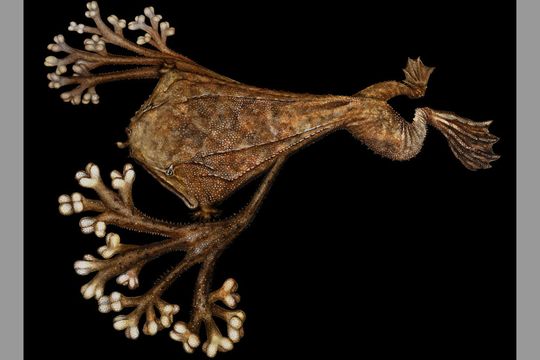
An illustration of a Surinam toad with its toes if they were proportioned according to the amount of space they take up in the frog’s tiny brain.
(Source: Rebeca Fuquen)
Surinam toads (Pipa pipa) are strange, flat frogs with minuscule eyes that live in the murky waters of the Amazon basin and carry their eggs on their back. The way they catch their prey is even weirder. They lie in wait with outstretched forelimbs until a small fish approaches, then snap open their jaws to create enough suction to draw the fish into their tongueless mouths and swallow it whole, all in a few hundredths of a second. But how do these frogs hunt in low visibility with poor vision?
A new study by UCLA biologists points to an answer that has been hiding in plain sight for two centuries: the frog’s peculiar fingertips. In fact, they are commonly called star-fingered toads. The research, published in the Journal of Comparative Physiology A, has revealed a sensory system that processes signals gathered by neurons in unusual lobes on the frog’s front fingers to identify the proximity and size of potential prey.
Because vision is not useful in their turbid environment, the frogs position their arms in front of and just to the sides of their mouth, fingers spread wide, to detect prey through the movement of water as a fish swims. Each finger ends not in a claw or pad but in a small cluster of softer lobes, an anatomical oddity noted by 19th-century naturalists but never satisfactorily explained. The new work shows that these lobes are dedicated touch organs, the amphibian equivalent to the fovea — a high-resolution patch of sensors at the center of the eye.
“I was reading an anatomy report that described how the tips of the fingers of Surinam toads split into four, and each of those four little lobes split again into four,” said Duncan Leitch, a corresponding author and UCLA assistant professor of integrative biology and physiology. “It immediately seemed to me like these lobes might be somewhat analogous to antennae that the frogs extend so they can feel the space around them.”
16 Lobes per Finger
Leitch and his co-authors looked at the anatomy of the finger surface area using a scanning electron microscope and identified a total of 128 mini-lobes, called lobules, per frog. The skin on each lobe was covered with nearly four times the density of dome-shaped bumps called papillae than on skin elsewhere on their fingers. Papillae, also found on the human tongue, are known to increase touch sensitivity.
They then touched the frog’s hands with calibrated filaments to see how easily neurons from each skin area become excited by precisely known forces, and found that they became increasingly sensitive to touch, peaking at the ends of the fingers where thresholds fell into the same range as human fingertips. Next, the researchers studied the electrophysiology of nerves in the arms and found dense clusters of touch-receptive nerves on the fingertip lobules. Even though the lobules occupied only 8 percent of the total forelimb skin surface, they contained 60 percent of the touch-sensitive nerves serving the arm.
For the next phase of the study, the researchers observed high-speed video of the frogs hunting and consuming prey. The videos showed that when fish and other moving animals approached the frog’s outstretched fingers within about half a centimeter, the frog could accurately and efficiently suck up prey before even touching it — even in the dark. This indicates that the frogs were using their fingers to detect the water’s movement as the fish swam.
An Exaggerated Map in the Brain
The results establish the fingertip lobes of the Surinam toad as specialized mechanoreceptive organs analogous to the tentacle-like appendages on the star-nosed mole’s face. These types of specialized sensing organs are known as tactile fovea. This degree of magnification of important sensory surfaces has only been observed physiologically in several animals, including the bill of the platypus and the fingertips of primates — in a higher relay of the brain in the cortex, which is found only in mammals.
Date: 08.12.2025
Naturally, we always handle your personal data responsibly. Any personal data we receive from you is processed in accordance with applicable data protection legislation. For detailed information please see our privacy policy.
Consent to the use of data for promotional purposes
I hereby consent to Vogel Communications Group GmbH & Co. KG, Max-Planck-Str. 7-9, 97082 Würzburg including any affiliated companies according to §§ 15 et seq. AktG (hereafter: Vogel Communications Group) using my e-mail address to send editorial newsletters. A list of all affiliated companies can be found here
Newsletter content may include all products and services of any companies mentioned above, including for example specialist journals and books, events and fairs as well as event-related products and services, print and digital media offers and services such as additional (editorial) newsletters, raffles, lead campaigns, market research both online and offline, specialist webportals and e-learning offers. In case my personal telephone number has also been collected, it may be used for offers of aforementioned products, for services of the companies mentioned above, and market research purposes.
Additionally, my consent also includes the processing of my email address and telephone number for data matching for marketing purposes with select advertising partners such as LinkedIn, Google, and Meta. For this, Vogel Communications Group may transmit said data in hashed form to the advertising partners who then use said data to determine whether I am also a member of the mentioned advertising partner portals. Vogel Communications Group uses this feature for the purposes of re-targeting (up-selling, cross-selling, and customer loyalty), generating so-called look-alike audiences for acquisition of new customers, and as basis for exclusion for on-going advertising campaigns. Further information can be found in section “data matching for marketing purposes”.
In case I access protected data on Internet portals of Vogel Communications Group including any affiliated companies according to §§ 15 et seq. AktG, I need to provide further data in order to register for the access to such content. In return for this free access to editorial content, my data may be used in accordance with this consent for the purposes stated here. This does not apply to data matching for marketing purposes.
Right of revocation
I understand that I can revoke my consent at will. My revocation does not change the lawfulness of data processing that was conducted based on my consent leading up to my revocation. One option to declare my revocation is to use the contact form found at https://contact.vogel.de. In case I no longer wish to receive certain newsletters, I have subscribed to, I can also click on the unsubscribe link included at the end of a newsletter. Further information regarding my right of revocation and the implementation of it as well as the consequences of my revocation can be found in the data protection declaration, section editorial newsletter.
Frogs, however, don’t have a cortex. The researchers instead found it in a part of the brain called the optic tectum, a midbrain area found in most vertebrates, where a region corresponding to just fingertip touch was greatly exaggerated.
The researchers determined how much space, if proportioned according to the entire body surface, this area should occupy. Even though the fingertips make up very little of the body’s total surface area, the optic tectum region devoted to processing information from the fingertips was far out of proportion to their size.
Finding the same organizational logic in a frog — in a lineage that split from mammals more than 350 million years ago — suggests this magnification is a very old solution to a general problem: When an animal needs fine detail from a tiny patch of the body, evolution builds a fovea, whatever the body plan.
“It seems that mammals share some of these sensory processing properties with frogs, from whom they diverged evolutionarily a very long time ago,” Leitch said. “This is probably a much more ancient and widespread kind of system than previously believed. People may have thought that these are mammal-specific traits, but certainly frogs, and I expect birds and other animals also would have specialized sensing systems if you really look for them.”
Journal: A somatosensory fovea in the fingertips of the Surinam toad; Journal of Comparative Physiology; DOI:10.1007/s00359-026-01838-w




:quality(80)/p7i.vogel.de/wcms/51/68/51687ac4cc19f2757c138498b877de57/0133167039v2.jpeg "CMFs are foams that consist of hollow spheres – made of materials such as stainless steel, nickel, or other metals and alloys – embedded in a metallic matrix. The resulting material is both lightweight and remarkably strong at absorbing compressive forces. (Source: Jie Sun/ NC State University)")
:quality(80)/p7i.vogel.de/wcms/cd/c0/cdc09efd1e5b3b8f83224e7729d66c10/0133105276v2.jpeg "From the data presented in this report, the authors show how TF3-MALS-RI is uniquely able to separate large polyacrylate molecules and provide precise molecular weight and Rg values. (Source: Postnova Analytics)")
:quality(80)/p7i.vogel.de/wcms/c6/f2/c6f2e2b4753a0d0cec682c03df4ed37c/0133088650v2.jpeg "PMBC vials for immunology and oncology research. (Source: Amsbio)")
:quality(80)/p7i.vogel.de/wcms/e0/72/e0728dc8dcadfc4d79a734e08cf6ced3/0133088641v2.jpeg "LM20 Microfluidizer and Cambridge CNT dispersion produced by the LM20 microfluidizer. (Source: Analytik)")
:quality(80)/p7i.vogel.de/wcms/86/01/86014d3d2a28cefc852f65c8d68317e4/0133104231v2.jpeg "Single-handed tube reading using a Handheld 2. (Source: Azenta Life Sciences)")
:quality(80)/p7i.vogel.de/wcms/0b/0f/0b0f8ed042dfc91f32582e10d54c2c7e/0133087444v2.jpeg "Offering advanced automation to increase your throughput, the Intellixcap provides secure sealing – eliminating the need for manual intervention, while preserving vital sample integrity. (Source: Azenta Life Sciences)")
:quality(80)/p7i.vogel.de/wcms/13/d3/13d35105f74a1c2e22b9c7a270e8e9b3/0132611155v2.jpeg "Circulating cell free DNA. (Source: Amsbio)")
:quality(80)/p7i.vogel.de/wcms/bc/ed/bced6850297a04dbea471a66cb6bb6fe/0132611405v2.jpeg "The latest addition to the range is a peristaltic tubing stop adapter that eliminates the need for fixed stoppers and allows custom cut lengths of peristaltic tubing to be installed on any pump head size. (Source: Biotech Fluidics )")
:quality(80)/p7i.vogel.de/wcms/8d/5c/8d5c6c7f897f91d6784825eee20b5584/0133321225v1.jpeg "Empa researcher Christoph Hüglin collects samples of particles that are washed out of the air by rain and snow or settle due to gravity. (Source: Empa)")
:quality(80)/p7i.vogel.de/wcms/a1/af/a1afbc7c8a067bbe94749ec680b4bafd/0133163762v2.jpeg "The study found in murkier water, fish took longer to move towards the food than those in clear water, but individuals in larger groups responded more quickly overall. (Source: Christos Ioannou)")
:quality(80)/p7i.vogel.de/wcms/32/80/3280aa3d44708962943c96fe2d466744/0133088560v2.jpeg "A bumble bee in flight at the University of Bristol Botanic Garden. (Source: Phil Savoie)")
:quality(80)/p7i.vogel.de/wcms/7b/e5/7be5c735140cbe28f3af0ec3d88274b9/0133045403v2.jpeg "After being buried in the ground for two months and broken down by soil organisms, a new pair of cotton underwear (left) shows clear signs of decomposition (right). (Source: Nicolas Zonvi)")
:quality(80)/p7i.vogel.de/wcms/bf/d0/bfd087349a85956a7aefad57ac1204c7/0133241961v2.jpeg "The Thermo Scientific Suretect Beverage Spoilage Multiplex PCR Assay provides a fast, broad-range molecular solution for detecting key spoilage microorganisms that threaten beverage quality. (Source: © OlegDoroshin - stock.adobe.com)")
:quality(80)/p7i.vogel.de/wcms/d4/61/d461ce0bd5743897993c6475f69e7ad6/0133067478v2.jpeg "In Harris County, 50 % of households with children reported food insecurity, compared with 33 % of households without children. (Source: Rice University)")
:quality(80)/p7i.vogel.de/wcms/79/76/7976d17b980bedfe35acaa532d690046/0132713841v2.jpeg "Observed rice yield losses from 1°C warming are more than twice as high as model estimates due to underestimated heat stress. (Source: AdobeStock/ducvien)")
:quality(80)/p7i.vogel.de/wcms/28/b6/28b6114fc9915c5dadee94d5c89bd129/0132593216v2.jpeg "Eating foods that contain common preservative food additives may increase the risks of high blood pressure and cardiovascular disease. (Source: Unsplash)")
:quality(80)/p7i.vogel.de/wcms/b0/b5/b0b59a78dc380bafc2326ac209f72187/0133321063v1.jpeg "Light pollution has been linked to cardiovascular disease. (Source: free licensed)")
:quality(80)/p7i.vogel.de/wcms/76/25/762549a8bc3df4ccf1470edbc46d78d3/0133321089v1.jpeg "The CPL-2a skeleton in the trench
(Source: Fakhri)")
:quality(80)/p7i.vogel.de/wcms/bb/e6/bbe6e158b1d43f32cb7a95cd771dccd7/0133321323v1.jpeg "An illustration of a Surinam toad with its toes if they were proportioned according to the amount of space they take up in the frog’s tiny brain. (Source: Rebeca Fuquen)")
:quality(80)/p7i.vogel.de/wcms/7e/4b/7e4ba18a8518e5e8430ad07afbfd6ae4/0133321385v2.jpeg "New findings raise concerns about potential misdiagnosis, inappropriate treatment, and errors in psychiatric research. (Source: free licensed)")
:quality(80)/images.vogel.de/vogelonline/bdb/1710600/1710675/original.jpg "Discover how to set yourself up for success when performing balance-based density determination of solids such as jewelry and precious metals. (Mettler Toledo)")
:quality(80)/images.vogel.de/vogelonline/bdb/1682500/1682579/original.jpg "The new XPR Analytical balance redesigned to meet the needs of laboratory technicians of working fast and lean. (Mettler Toledo)")
:quality(80)/images.vogel.de/vogelonline/bdb/1677000/1677080/original.jpg "Enhance your weighing accuracy, comfort and productivity with the redesigned XPR Analytical balance. (Mettler Toledo)")
:fill(fff,0)/images.vogel.de/vogelonline/companyimg/107800/107832/65.jpg "logoDueperthal.jpg ()")
:fill(fff,0)/images.vogel.de/vogelonline/companyimg/131900/131910/65.jpg "Xylem_tag_rgb.jpg ()")
:fill(fff,0)/p7i.vogel.de/companies/69/b7/69b7f63f311d9/logo-bimos-tif--2-.jpeg "logo-bimos-tif--2- (https://www.bimos.com/de-de/)")
:quality(80)/p7i.vogel.de/wcms/11/29/112984f0c5d11cd5daf58fbfbc1d3aac/0133166885v1.jpeg "Researchers develop a parametric design tool that converts the desired dimensions of a body part into a printable 2D pattern for a self-folding paper wearable device. This approach integrated with copper tape electrodes allows biosignal measurements. (Source: Dr. Hiroki Shigemune/ Shibaura Institute of Technology)")
:quality(80)/p7i.vogel.de/wcms/e0/47/e0471aba187b684e713df3c4d63461f8/0131909497v1.jpeg "Banded mongooses (Mungos mungo) can cooperate with common warthogs (Phacochoerus africanus) by cleaning them, removing ticks and other parasites, while the warthogs provide access to food and safety from predators through their vigilance and presence. Example footage from Queen Elizabeth National Park, Uganda.
(Source: Leela Channer)")