A new study made use of the earthquake model and found out that stresses in the crust are higher today than at any time in the last millennium. It also warns that a critical fault junction near Los Angeles could determine the scale of the next major quake.
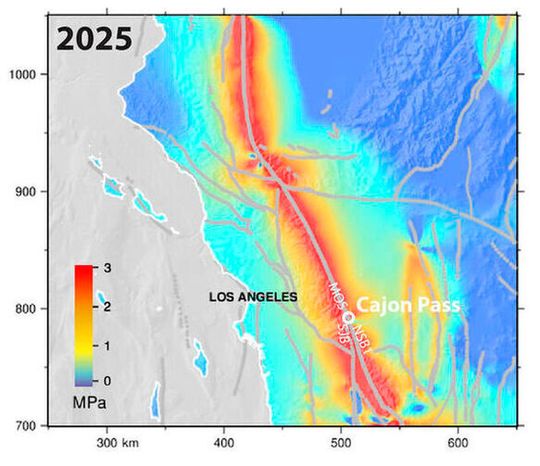
Present-day (2025) modeled Coulomb stress accumulation of the southern San Andreas fault system in regional context. Overlaid fault traces can be seen in gray. The white circle marks the location of the Cajon Pass and the three adjacent fault segments. The colors show the Coulomb stress, which indicates whether an earthquake is more or less likely to occur there.
Bern/Switzerland – Earthquakes usually occur along fracture zones in the Earth's crust, where large tectonic plates slide past one another and become locked. Stress builds up over long periods of time and is suddenly released in the form of an earthquake. In Southern California, the San Andreas and San Jacinto faults are among the most significant of these zones, accommodating the majority of the plate motion in the region. Where the two fault systems approach each other northeast of Los Angeles lies the Cajon Pass – a tectonically complex junction where a rupture on one fault could potentially cross onto the other. Since the last major earthquake to affect the wider Los Angeles region, the Fort Tejon earthquake of 1857 with a magnitude of 7.9, tectonic stress along the fault segments has built up continuously, which is a prolonged quiet period that has long concerned researchers given the potential for a large future rupture.
In a new study led by Dr. Liliane Burkhard of the Division of Space Research and Planetary Sciences (WP) at the Physics Institute of the University of Bern, an international research team has modeled 1,000 years of earthquake history along the southern San Andreas and San Jacinto fault systems to estimate the present-day stress loading at Cajon Pass. Researchers from the University of Hawaiʻi at Mānoa, the U.S. Geological Survey Earthquake Science Center in Pasadena and the Scripps Institution of Oceanography at UC San Diego were involved. The results show that tectonic stresses in the region have reached and, in some cases, exceeded the highest levels of the last millennium. In the study, the researchers also introduce the concept of Cajon Pass as an "earthquake gate": a junction that controls whether large earthquakes remain confined to a single fault or propagate across both systems simultaneously. The study has just been published in Journal of Geophysical Research: Solid Earth.
Modeling 1,000 years of earthquake history
To investigate how the stress along the San Andreas and San Jacinto faults and at the critical Cajon Pass junction has evolved over time, the research team constructed a physics-based, four-dimensional earthquake cycle model that simulates the processes in three spatial dimensions and over time. The researchers then fed the model with a 1,000-year earthquake record reconstructed from geological evidence such as radiocarbon dating, tree-ring anomalies, and historical documentation of ground ruptures.
"The model tracks how each earthquake changes stress on neighboring fault segments, how stress accumulates during the quiet intervals between events, and how the deeper layers of the crust slowly relax following large ruptures," explains Burkhard. "This simulation allows us to understand how stresses in the fault system build up over centuries,” continues Burkhard. “By running the earthquake history of Southern California as a simulation, we can estimate the extent to which the fault system is already under stress today." The researchers show that stresses in the region are currently at their highest level in the last 1,000 years.
"Earthquake gate" as a decisive key factor
A key finding of the study is that the Cajon Pass can act as a so-called "earthquake gate", a junction that controls whether large ruptures remain confined to a single fault or cross both fault systems. Historical examples of both behaviors exist: The Fort Tejon earthquake of 1857 terminated at Cajon Pass and did not involve the San Jacinto Fault, while the Wrightwood earthquake of 1812 ruptured through the junction and across both systems in a single through-going event. "The earthquake gate concept captures something important about how fault junctions work," explains Burkhard. "Cajon Pass doesn’t simply block or channel earthquakes: It responds to stress conditions, and those conditions change over centuries."
The study also shows that the decisive factor is not only how much stress has built up on a single fault but how aligned the stresses on the two fault systems are. When the stress on both faults rises in concert over time, toward similarly high levels, conditions favor a large joint rupture crossing both systems. When stress levels evolve out of step with each other, ruptures are more likely to terminate at the junction rather than propagate further. Currently, modeled stress has reached 3.6 MPa on the San Jacinto-Bernardino section, exceeding the highest value seen anywhere in the 1,000-year simulation. On the neighboring Mojave South section of the San Andreas fault, it is 2.8 MPa. Both segments are therefore highly and relatively similarly stressed, placing the system in a configuration that historically has preceded joint ruptures. "So not only is it concerning that the stresses are reaching historic highs," says Burkhard, "but also that the relative stress conditions between the two fault systems are approaching the range we associate with major ruptures crossing both faults simultaneously – and that is a scenario with much larger consequences for the region."
Date: 08.12.2025
Naturally, we always handle your personal data responsibly. Any personal data we receive from you is processed in accordance with applicable data protection legislation. For detailed information please see our privacy policy.
Consent to the use of data for promotional purposes
I hereby consent to Vogel Communications Group GmbH & Co. KG, Max-Planck-Str. 7-9, 97082 Würzburg including any affiliated companies according to §§ 15 et seq. AktG (hereafter: Vogel Communications Group) using my e-mail address to send editorial newsletters. A list of all affiliated companies can be found here
Newsletter content may include all products and services of any companies mentioned above, including for example specialist journals and books, events and fairs as well as event-related products and services, print and digital media offers and services such as additional (editorial) newsletters, raffles, lead campaigns, market research both online and offline, specialist webportals and e-learning offers. In case my personal telephone number has also been collected, it may be used for offers of aforementioned products, for services of the companies mentioned above, and market research purposes.
Additionally, my consent also includes the processing of my email address and telephone number for data matching for marketing purposes with select advertising partners such as LinkedIn, Google, and Meta. For this, Vogel Communications Group may transmit said data in hashed form to the advertising partners who then use said data to determine whether I am also a member of the mentioned advertising partner portals. Vogel Communications Group uses this feature for the purposes of re-targeting (up-selling, cross-selling, and customer loyalty), generating so-called look-alike audiences for acquisition of new customers, and as basis for exclusion for on-going advertising campaigns. Further information can be found in section “data matching for marketing purposes”.
In case I access protected data on Internet portals of Vogel Communications Group including any affiliated companies according to §§ 15 et seq. AktG, I need to provide further data in order to register for the access to such content. In return for this free access to editorial content, my data may be used in accordance with this consent for the purposes stated here. This does not apply to data matching for marketing purposes.
Right of revocation
I understand that I can revoke my consent at will. My revocation does not change the lawfulness of data processing that was conducted based on my consent leading up to my revocation. One option to declare my revocation is to use the contact form found at https://contact.vogel.de. In case I no longer wish to receive certain newsletters, I have subscribed to, I can also click on the unsubscribe link included at the end of a newsletter. Further information regarding my right of revocation and the implementation of it as well as the consequences of my revocation can be found in the data protection declaration, section editorial newsletter.
Increased risk in densely populated regions
A joint rupture of the San Andreas fault and the San Jacinto fault that crosses the Cajon Pass would be a much more severe event than one that is limited to a single fault. The affected region includes some of the most densely populated, infrastructure-critical corridors in the U.S., including the greater Los Angeles area, San Bernardino, Riverside and the Coachella Valley. Major highways, railroads and energy infrastructure run through the Cajon Pass itself.
"The question of when and how the next major earthquake will occur in this region is one of the most pressing problems in applied geoscience. Our results provide a clearer, physics-based picture of the current stress state of the fault system, and the framework we developed is not just applicable to California, but also for other complex fault junctions worldwide," says Burkhard.
However, Burkhard emphasizes: "The study is not a prediction of when an earthquake will occur. What we can say is that the system is critically stressed and that physics-based models like ours give a clearer picture of the range of scenarios we should be prepared for. This information is important for hazard assessment, infrastructure planning and emergency preparedness."




:quality(80)/p7i.vogel.de/wcms/62/32/62327aaae1415beeed47db6201e79661/0133375912v2.jpeg "A cotton trailer outfitted with benches and a sunshade offers farmworkers a reprieve from the sun as they take a break from picking cantaloupe melons in Firebaugh, Calif.
(Source: Joe Proudman/ Regents of the University of California)")
:quality(80)/p7i.vogel.de/wcms/e6/c8/e6c8bd554776ee1ad2f1f0723fb243a7/0133369387v1.jpeg "Roman road (Source: Queen Mary University of London)")
:quality(80)/p7i.vogel.de/wcms/51/68/51687ac4cc19f2757c138498b877de57/0133167039v2.jpeg "CMFs are foams that consist of hollow spheres – made of materials such as stainless steel, nickel, or other metals and alloys – embedded in a metallic matrix. The resulting material is both lightweight and remarkably strong at absorbing compressive forces. (Source: Jie Sun/ NC State University)")
:quality(80)/p7i.vogel.de/wcms/cd/c0/cdc09efd1e5b3b8f83224e7729d66c10/0133105276v2.jpeg "From the data presented in this report, the authors show how TF3-MALS-RI is uniquely able to separate large polyacrylate molecules and provide precise molecular weight and Rg values. (Source: Postnova Analytics)")
:quality(80)/p7i.vogel.de/wcms/86/01/86014d3d2a28cefc852f65c8d68317e4/0133104231v2.jpeg "Single-handed tube reading using a Handheld 2. (Source: Azenta Life Sciences)")
:quality(80)/p7i.vogel.de/wcms/0b/0f/0b0f8ed042dfc91f32582e10d54c2c7e/0133087444v2.jpeg "Offering advanced automation to increase your throughput, the Intellixcap provides secure sealing – eliminating the need for manual intervention, while preserving vital sample integrity. (Source: Azenta Life Sciences)")
:quality(80)/p7i.vogel.de/wcms/13/d3/13d35105f74a1c2e22b9c7a270e8e9b3/0132611155v2.jpeg "Circulating cell free DNA. (Source: Amsbio)")
:quality(80)/p7i.vogel.de/wcms/bc/ed/bced6850297a04dbea471a66cb6bb6fe/0132611405v2.jpeg "The latest addition to the range is a peristaltic tubing stop adapter that eliminates the need for fixed stoppers and allows custom cut lengths of peristaltic tubing to be installed on any pump head size. (Source: Biotech Fluidics )")
:quality(80)/p7i.vogel.de/wcms/8d/5c/8d5c6c7f897f91d6784825eee20b5584/0133321225v1.jpeg "Empa researcher Christoph Hüglin collects samples of particles that are washed out of the air by rain and snow or settle due to gravity. (Source: Empa)")
:quality(80)/p7i.vogel.de/wcms/a1/af/a1afbc7c8a067bbe94749ec680b4bafd/0133163762v2.jpeg "The study found in murkier water, fish took longer to move towards the food than those in clear water, but individuals in larger groups responded more quickly overall. (Source: Christos Ioannou)")
:quality(80)/p7i.vogel.de/wcms/32/80/3280aa3d44708962943c96fe2d466744/0133088560v2.jpeg "A bumble bee in flight at the University of Bristol Botanic Garden. (Source: Phil Savoie)")
:quality(80)/p7i.vogel.de/wcms/7b/e5/7be5c735140cbe28f3af0ec3d88274b9/0133045403v2.jpeg "After being buried in the ground for two months and broken down by soil organisms, a new pair of cotton underwear (left) shows clear signs of decomposition (right). (Source: Nicolas Zonvi)")
:quality(80)/p7i.vogel.de/wcms/ef/68/ef68375729607984e5bb0c143afdae70/0133375119v2.jpeg "Printed Rice-Lentil 3D structures
(Source: SUTD)")
:quality(80)/p7i.vogel.de/wcms/bf/d0/bfd087349a85956a7aefad57ac1204c7/0133241961v2.jpeg "The Thermo Scientific Suretect Beverage Spoilage Multiplex PCR Assay provides a fast, broad-range molecular solution for detecting key spoilage microorganisms that threaten beverage quality. (Source: © OlegDoroshin - stock.adobe.com)")
:quality(80)/p7i.vogel.de/wcms/d4/61/d461ce0bd5743897993c6475f69e7ad6/0133067478v2.jpeg "In Harris County, 50 % of households with children reported food insecurity, compared with 33 % of households without children. (Source: Rice University)")
:quality(80)/p7i.vogel.de/wcms/79/76/7976d17b980bedfe35acaa532d690046/0132713841v2.jpeg "Observed rice yield losses from 1°C warming are more than twice as high as model estimates due to underestimated heat stress. (Source: AdobeStock/ducvien)")
:quality(80)/p7i.vogel.de/wcms/22/49/224964dd6850b62cccdbc4bde2d34693/0133372964v1.jpeg "Brain activity recorded during a video game helped researchers predict whether participants would take or avoid a risk half a second before they acted. (Source: free licensed)")
:quality(80)/p7i.vogel.de/wcms/48/a7/48a761934161543f70fef2403b44d714/0133372328v2.jpeg "The link between pollution and coughing persisted in the data, even when pollution levels were below the WHO’s recommended safe daily exposure limit. (Source: free licensed)")
:quality(80)/p7i.vogel.de/wcms/83/b4/83b4563a65c6036b61990931507428b4/0133363611v2.jpeg "Magnesium sulphate uptake and the north / south divide for the Precept program. (Source: University of Bristol )")
:quality(80)/p7i.vogel.de/wcms/bb/06/bb06c1c3c5d250f3f93016366c56525d/0133363201v2.jpeg "The team identified more than 1,200 associated genetic variants and found that these influences are remarkably consistent across countries, ages and methods of measuring personality. (Source: Pixabay - PublicDomainPictures)")
:quality(80)/images.vogel.de/vogelonline/bdb/1710600/1710675/original.jpg "Discover how to set yourself up for success when performing balance-based density determination of solids such as jewelry and precious metals. (Mettler Toledo)")
:quality(80)/images.vogel.de/vogelonline/bdb/1682500/1682579/original.jpg "The new XPR Analytical balance redesigned to meet the needs of laboratory technicians of working fast and lean. (Mettler Toledo)")
:quality(80)/images.vogel.de/vogelonline/bdb/1677000/1677080/original.jpg "Enhance your weighing accuracy, comfort and productivity with the redesigned XPR Analytical balance. (Mettler Toledo)")
:fill(fff,0)/images.vogel.de/vogelonline/companyimg/107800/107832/65.jpg "logoDueperthal.jpg ()")
:fill(fff,0)/p7i.vogel.de/companies/69/b7/69b7f63f311d9/logo-bimos-tif--2-.jpeg "logo-bimos-tif--2- (https://www.bimos.com/de-de/)")
:quality(80)/p7i.vogel.de/wcms/ed/ff/edff58efa9930f672f2e50a63e65562f/0132477775v1.jpeg "Contemporary languages and endangerment status. Made with a Natural Earth base map using data from Glottolog 5.3 and information adapted from Glottoscope. (Source: Claire Bowern)")
:quality(80)/p7i.vogel.de/wcms/9a/a0/9aa0a7f2d93c4f3a9c6297fb39a5c756/0133018161v2.jpeg "Volcanic activity and hydroclimatic anomalies. Eruptions produce a repeating wave pattern in high-altitude winds (left panels) that line up with widespread drying across Asia (right panels). This pattern appears regardless of background climate conditions. (Source: ©2026 Nie et al. CC-BY-ND)")