Using a specially designed 3D printed vacuum system, scientists have developed a way to ‘trap’ dark matter with the aim of detecting domain walls, this will be a significant step forwards in unravelling some of the mysteries of the universe.
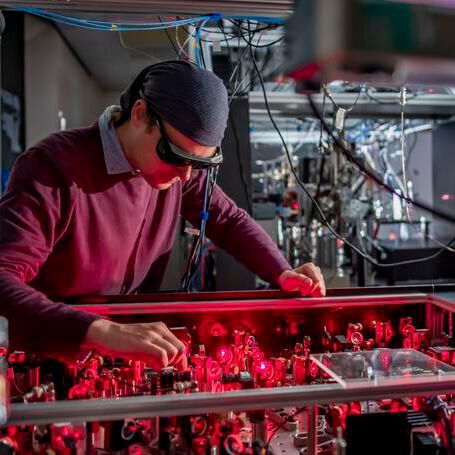
Laser photon system in the lab at the University of Nottingham
(Source: University of Nottingham)
Scientists from the University of Nottingham’s’ School of Physics have created a 3D printed vacuum system that they will use in a new experiment to reduce the density of gas, then and add in ultra-cold lithium atoms to try to detect dark walls. The research has been published in Physical Review D.
Professor Clare Burrage from the School of Physics is one of the lead authors on the study and explains: “Ordinary matter that the world is made from is only a tiny fraction of the contents of the universe, around 5 %, the rest is either dark matter or dark energy — we can see their effects on how the universe behaves but we don’t know what they are. One way people try to measure dark matter is to introduce a particle called a scalar field.
“Dark matter is the missing mass in galaxies, dark energy can explain the acceleration of the expansion of the universe. The scalar fields that we are looking for could be either dark matter, or dark energy. By introducing the ultra-cold atoms and examining the effects it produces we may be able to explain why the expansion of the universe is accelerating and whether this has any effects on earth.”
The researchers based the construction of the 3D vessels on the theory that light scalar fields, with double well potentials and direct matter couplings, undergo density driven phase transitions, leading to the formation of domain walls.
Professor Burrage continues: “As density is lowered defects form — this is similar to when water freezes into ice, water molecules are random and when they freeze you get a crystal structure with molecules lined up at random, with some lined up one way and some another and this creates fault lines. Something similar happens in scalar fields as the density gets lower. You can’t see these fault lines by eye but if particles pass across them it might change their trajectory These defects are dark walls and can prove the theory of scalar fields — either that these fields exist or don’t.”
To detect these defects or dark walls the team have created a specially designed vacuum that they will use in a new experiment that will mimic moving from a dense environment to less dense environment. Using the new set-up they will cool lithium atoms with laser photons to -273 which is close to absolute zero, at this temperature they take on quantum properties which makes analysis more precise and predictable.
Lucia Hackermueller, Associate Professor in the School of Physics has led the design of the laboratory experiment, she explains: “The 3D printed vessels we are using as the vacuum chamber have been constructed using theoretical calculations of Dark Walls, this has created what we believed to be the ideal shape, structure and texture to trap the dark matter. To successfully demonstrate that dark walls have been trapped, we will let a cold atom cloud pass through those walls. The cloud is then deflected. To cool those atoms we fire laser photons at the atoms, which reduces the energy in the atom — this is like slowing down an elephant using snowballs!”
The system took the team three years to build and they expect to have results within a year.
Dr Hackermueller adds: “Whether we prove dark walls exist or not it will be an important step forwards in our understanding of dark energy and dark matter, and an excellent example of how a well controlled lab experiment can be designed to directly measure effects that are relevant for the Universe and otherwise cannot be observed.”
Date: 08.12.2025
Naturally, we always handle your personal data responsibly. Any personal data we receive from you is processed in accordance with applicable data protection legislation. For detailed information please see our privacy policy.
Consent to the use of data for promotional purposes
I hereby consent to Vogel Communications Group GmbH & Co. KG, Max-Planck-Str. 7-9, 97082 Würzburg including any affiliated companies according to §§ 15 et seq. AktG (hereafter: Vogel Communications Group) using my e-mail address to send editorial newsletters. A list of all affiliated companies can be found here
Newsletter content may include all products and services of any companies mentioned above, including for example specialist journals and books, events and fairs as well as event-related products and services, print and digital media offers and services such as additional (editorial) newsletters, raffles, lead campaigns, market research both online and offline, specialist webportals and e-learning offers. In case my personal telephone number has also been collected, it may be used for offers of aforementioned products, for services of the companies mentioned above, and market research purposes.
Additionally, my consent also includes the processing of my email address and telephone number for data matching for marketing purposes with select advertising partners such as LinkedIn, Google, and Meta. For this, Vogel Communications Group may transmit said data in hashed form to the advertising partners who then use said data to determine whether I am also a member of the mentioned advertising partner portals. Vogel Communications Group uses this feature for the purposes of re-targeting (up-selling, cross-selling, and customer loyalty), generating so-called look-alike audiences for acquisition of new customers, and as basis for exclusion for on-going advertising campaigns. Further information can be found in section “data matching for marketing purposes”.
In case I access protected data on Internet portals of Vogel Communications Group including any affiliated companies according to §§ 15 et seq. AktG, I need to provide further data in order to register for the access to such content. In return for this free access to editorial content, my data may be used in accordance with this consent for the purposes stated here. This does not apply to data matching for marketing purposes.
Right of revocation
I understand that I can revoke my consent at will. My revocation does not change the lawfulness of data processing that was conducted based on my consent leading up to my revocation. One option to declare my revocation is to use the contact form found at https://contact.vogel.de. In case I no longer wish to receive certain newsletters, I have subscribed to, I can also click on the unsubscribe link included at the end of a newsletter. Further information regarding my right of revocation and the implementation of it as well as the consequences of my revocation can be found in the data protection declaration, section editorial newsletter.
Original Article: Detecting dark domain walls through their impact on particle trajectories in tailored ultrahigh vacuum environments; Physical Review D; DOI:10.1103/PhysRevD.109.123023




:quality(80)/p7i.vogel.de/wcms/62/32/62327aaae1415beeed47db6201e79661/0133375912v2.jpeg "A cotton trailer outfitted with benches and a sunshade offers farmworkers a reprieve from the sun as they take a break from picking cantaloupe melons in Firebaugh, Calif.
(Source: Joe Proudman/ Regents of the University of California)")
:quality(80)/p7i.vogel.de/wcms/e6/c8/e6c8bd554776ee1ad2f1f0723fb243a7/0133369387v1.jpeg "Roman road (Source: Queen Mary University of London)")
:quality(80)/p7i.vogel.de/wcms/51/68/51687ac4cc19f2757c138498b877de57/0133167039v2.jpeg "CMFs are foams that consist of hollow spheres – made of materials such as stainless steel, nickel, or other metals and alloys – embedded in a metallic matrix. The resulting material is both lightweight and remarkably strong at absorbing compressive forces. (Source: Jie Sun/ NC State University)")
:quality(80)/p7i.vogel.de/wcms/cd/c0/cdc09efd1e5b3b8f83224e7729d66c10/0133105276v2.jpeg "From the data presented in this report, the authors show how TF3-MALS-RI is uniquely able to separate large polyacrylate molecules and provide precise molecular weight and Rg values. (Source: Postnova Analytics)")
:quality(80)/p7i.vogel.de/wcms/a8/6e/a86e9b1f1561a67038b6d8a9fe629117/0133465534v2.jpeg "Clean, calibrate, and store pH electrodes properly to ensure accurate, reliable measurements every time. (Source: METTLER TOLEDO)")
:quality(80)/p7i.vogel.de/wcms/86/01/86014d3d2a28cefc852f65c8d68317e4/0133104231v2.jpeg "Single-handed tube reading using a Handheld 2. (Source: Azenta Life Sciences)")
:quality(80)/p7i.vogel.de/wcms/0b/0f/0b0f8ed042dfc91f32582e10d54c2c7e/0133087444v2.jpeg "Offering advanced automation to increase your throughput, the Intellixcap provides secure sealing – eliminating the need for manual intervention, while preserving vital sample integrity. (Source: Azenta Life Sciences)")
:quality(80)/p7i.vogel.de/wcms/13/d3/13d35105f74a1c2e22b9c7a270e8e9b3/0132611155v2.jpeg "Circulating cell free DNA. (Source: Amsbio)")
:quality(80)/p7i.vogel.de/wcms/6f/ea/6feaf3edd34eb4a9f1df201dc2e6448d/0133548706v2.jpeg "The researchers studied people’s perceptions, beliefs and knowledge about climate change in two coastal regions, one low-lying island and the other a mainland coast. (Source: P Afna)")
:quality(80)/p7i.vogel.de/wcms/8d/5c/8d5c6c7f897f91d6784825eee20b5584/0133321225v1.jpeg "Empa researcher Christoph Hüglin collects samples of particles that are washed out of the air by rain and snow or settle due to gravity. (Source: Empa)")
:quality(80)/p7i.vogel.de/wcms/a1/af/a1afbc7c8a067bbe94749ec680b4bafd/0133163762v2.jpeg "The study found in murkier water, fish took longer to move towards the food than those in clear water, but individuals in larger groups responded more quickly overall. (Source: Christos Ioannou)")
:quality(80)/p7i.vogel.de/wcms/32/80/3280aa3d44708962943c96fe2d466744/0133088560v2.jpeg "A bumble bee in flight at the University of Bristol Botanic Garden. (Source: Phil Savoie)")
:quality(80)/p7i.vogel.de/wcms/95/3e/953e490f1819f6638bc08fe3d4d43e87/0133566684v1.jpeg "The soy protein isolate the researchers fed to the mice. (Source: KyotoU / Tomoko T. Asai)")
:quality(80)/p7i.vogel.de/wcms/ba/38/ba38179dbcd20fbc3887b2709193d0a8/0133566669v2.jpeg "Consumers in a Cornell study showed no consistent bias against the colour of hybrid red wines, with several ranking among the most visually appealing. (Source: free licensed)")
:quality(80)/p7i.vogel.de/wcms/ac/d1/acd1a8888f6e78206f11f2b4eb33926f/0133566582v1.jpeg "A claim on the front of a box of food products is a hint, not a verdict. The nutrition label on the back – added sugars, sodium, saturated fat, all of it together – still tells the fuller story. (Source: free licensed)")
:quality(80)/p7i.vogel.de/wcms/84/10/8410a026021778497197d21ef6987940/0133532147v2.jpeg "Fig. 1: Behind every sweet, tangy, or refreshing fruit lies a unique pH balance that shapes its flavor, freshness, and quality. (Source: METTLER TOLEDO)")
:quality(80)/p7i.vogel.de/wcms/f3/32/f332f826e9c6b84c66c63c6a79fd9e68/0133566559v2.jpeg "An analysis of 1.4 million adults in England found that 59% of participants with high blood pressure had not been diagnosed and were not taking blood pressure-lowering medication. (Source: free licensed)")
:quality(80)/p7i.vogel.de/wcms/5b/68/5b68667dfbf7bae351f864f0590cc985/0133566532v2.jpeg "Blood pressure normally falls during sleep. A modelling study suggests that a delay in the kidneys’ salt-processing rhythm could disrupt this overnight dip, a mechanism that still needs experimental and clinical testing. (Source: free licensed)")
:quality(80)/p7i.vogel.de/wcms/a9/11/a911e9abe761c9bcf5221cd218e14e80/0133560426v2.jpeg "With direct ties to the trade show, the Medica Labmed Forum bridges the gap between current scientific developments and practical healthcare issues. (Source: Constanze Tillmann/Messe Düsseldorf)")
:quality(80)/p7i.vogel.de/wcms/b2/3c/b23c5aedafa5afc1788f81e6f3b9f4fd/0133548748v2.jpeg "A team led by Prof. Dr. Bahtiyar Yilmaz from the Department for Visceral Surgery and Medicine at Inselspital, Bern University Hospital, and the DBMR at the University of Bern has now investigated what happens in the gut after a fecal microbiota transplant. (Source: Unsplash)")
:quality(80)/images.vogel.de/vogelonline/bdb/1710600/1710675/original.jpg "Discover how to set yourself up for success when performing balance-based density determination of solids such as jewelry and precious metals. (Mettler Toledo)")
:quality(80)/images.vogel.de/vogelonline/bdb/1682500/1682579/original.jpg "The new XPR Analytical balance redesigned to meet the needs of laboratory technicians of working fast and lean. (Mettler Toledo)")
:quality(80)/images.vogel.de/vogelonline/bdb/1677000/1677080/original.jpg "Enhance your weighing accuracy, comfort and productivity with the redesigned XPR Analytical balance. (Mettler Toledo)")
:fill(fff,0)/p7i.vogel.de/companies/5f/3f/5f3f63ceedc78/knf-logo.jpg "KNF_Logo.jpg (www.knf.com)")
:fill(fff,0)/images.vogel.de/vogelonline/companyimg/107800/107832/65.jpg "logoDueperthal.jpg ()")
:quality(80)/p7i.vogel.de/wcms/99/cf/99cf937080dc1f2dea423e3ca0dcc6d8/0128496742v2.jpeg "Abram Fluckiger holds up a sample panel square that has five sandwiched layers of a new material nearly transparent insulation material called Mochi, which was designed buy CU Boulder researchers in physics professor Ivan Smalyukh’s lab.
(Source: Glenn J. Asakawa/CU Boulder)")
:quality(80)/p7i.vogel.de/wcms/e5/9c/e59c5dd9fe4308acae7d5c6de8038c88/0130484607v1.jpeg "A close-up of a laser-directed energy deposition (LDED) system fabricating the novel AI-designed ultra-high strength steel, which achieves a rare balance of strength and ductility, excellent corrosion resistance, and requires only 6 hours of single-step heat treatment at low cost. (Source: Yating Luo et. al.)")