Building permanent settlements on the Moon could become easier by using locally available materials. Researchers at the University of Arkansas have developed a 3D-printing process that turns simulated lunar dust into interlocking construction blocks without additional binders. Although the resulting bricks still have limited mechanical strength, the approach could reduce the need to transport building materials from Earth.
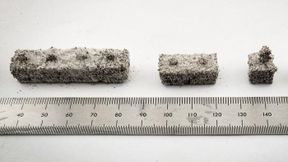
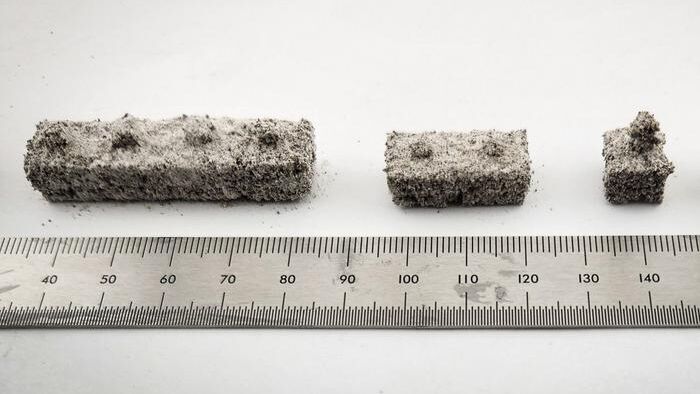
A 3D printer was used to create stackable bricks of pure lunar dust.
(Source: Cole McCallum)
Permanent structures on the Moon could start with something already there: lunar dust. New research from the University of Arkansas shows that pure regolith, the loose material that covers the Moon, could be 3D-printed into Lego-like bricks. Using it for construction could reduce what NASA needs to send from Earth as it works toward future lunar settlements.
The research was published in the journal NPJ Advanced Manufacturing. Cole McCallum, a U of A undergraduate at the time, was the first author. Wan Shou, an assistant professor of mechanical engineering, was the senior author.
The researchers used a form of 3D printing called laser powder bed fusion. A fine powder is spread across a flat bed, then a high-powered light source such as a laser fuses the powder through a process known as sintering. The bed is lowered, more powder is applied and the next layer is created.
Lunar regolith, unlike soil on Earth, contains no organic matter. It consists of loose, jagged particles created over billions of years as asteroids, micrometeorites and other space debris struck the Moon’s surface. For their experiments, the U of A researchers used Lunar Highlands Regolith Simulant (LHS-1), a commercially available material designed to mimic samples collected during the Apollo missions in the 1960s and early 1970s.
Printing Without Binders
Other researchers have used binders with lunar regolith to 3D-print objects. But those binding agents would have to be transported from Earth to the Moon. The U of A researchers were the first to demonstrate that lunar regolith simulant could be sintered directly without a binder into reconfigurable building blocks for construction using a relatively low power light source.
“There’s nothing else it’s binding to. The regolith powder is binding to itself,” McCallum said.
The researchers printed blocks a few centimeters wide, some shaped like crosses and others like the letter H. The two representative shapes could be fitted together like Legos to build larger structures. However, the objects made from pure regolith are more porous and structurally weaker than objects printed with binders.
“These structures we’re making can be self-supported,” McCallum said. “But I would be hesitant to say our process could be used for something that’s supporting other loads at this moment yet.”
According to Shou, more research is needed to understand this process in microgravity and vacuum environments. Also, the mechanical performance of the bricks should be optimized to be practically useful. He is optimistic that the reported approach could provide an efficient way to create components and structures for a permanent settlement on the Moon.
An Early Start in Research
McCallum, a Little Rock native, started working in Shou’s lab early in his undergraduate studies at U of A. “He had this really strong belief that undergrads should get involved more with research,” McCallum said.
McCallum graduated in May with degrees in both mechanical engineering and physics. He received an inaugural Lafayette Fellowship, which selected 30 fellows from more than 3,400 applicants to pursue master’s degrees in France. The program was created to celebrate the 250th anniversary of the United States.
McCallum is studying aerospace engineering in Toulouse at the Institut Supérieur de l’Aéronautique et de l’Espace, or Isae-Supaero, one of France’s leading aerospace engineering schools. Although McCallum has shifted his focus from the additive manufacturing work that he pursued in Shou’s lab, the project taught him fundamental lessons about research.
“It helps you refine and overcome all the problems you have as a researcher. There are a lot of mistakes that I made the first time through,” he said. “It was really nice to have a head start on everyone else and make those mistakes early.”
Date: 08.12.2025
Naturally, we always handle your personal data responsibly. Any personal data we receive from you is processed in accordance with applicable data protection legislation. For detailed information please see our privacy policy.
Consent to the use of data for promotional purposes
I hereby consent to Vogel Communications Group GmbH & Co. KG, Max-Planck-Str. 7-9, 97082 Würzburg including any affiliated companies according to §§ 15 et seq. AktG (hereafter: Vogel Communications Group) using my e-mail address to send editorial newsletters. A list of all affiliated companies can be found here
Newsletter content may include all products and services of any companies mentioned above, including for example specialist journals and books, events and fairs as well as event-related products and services, print and digital media offers and services such as additional (editorial) newsletters, raffles, lead campaigns, market research both online and offline, specialist webportals and e-learning offers. In case my personal telephone number has also been collected, it may be used for offers of aforementioned products, for services of the companies mentioned above, and market research purposes.
Additionally, my consent also includes the processing of my email address and telephone number for data matching for marketing purposes with select advertising partners such as LinkedIn, Google, and Meta. For this, Vogel Communications Group may transmit said data in hashed form to the advertising partners who then use said data to determine whether I am also a member of the mentioned advertising partner portals. Vogel Communications Group uses this feature for the purposes of re-targeting (up-selling, cross-selling, and customer loyalty), generating so-called look-alike audiences for acquisition of new customers, and as basis for exclusion for on-going advertising campaigns. Further information can be found in section “data matching for marketing purposes”.
In case I access protected data on Internet portals of Vogel Communications Group including any affiliated companies according to §§ 15 et seq. AktG, I need to provide further data in order to register for the access to such content. In return for this free access to editorial content, my data may be used in accordance with this consent for the purposes stated here. This does not apply to data matching for marketing purposes.
Right of revocation
I understand that I can revoke my consent at will. My revocation does not change the lawfulness of data processing that was conducted based on my consent leading up to my revocation. One option to declare my revocation is to use the contact form found at https://contact.vogel.de. In case I no longer wish to receive certain newsletters, I have subscribed to, I can also click on the unsubscribe link included at the end of a newsletter. Further information regarding my right of revocation and the implementation of it as well as the consequences of my revocation can be found in the data protection declaration, section editorial newsletter.
Original Article: Additive manufacturing of lunar regolith for reconfigurable building blocks toward lunar habitation; npj Advanced Manufacturing; DOI:10.1038/s44334-026-00111-x