Fossil teeth from southern China reveal that Homo erectus survived in tropical rainforests much longer than previously thought. Published in Nature, the findings suggest that our ancient relatives were more adaptable and mobile than assumed, challenging established theories about their preferred habitats and regional extinction.
Illustration of Homo erectus lurking in the shadows of the tropical forest in Guangxi, with the entrance to Baxian Cave in the background.
(Source: Garciart/ Joannes-Boyau)
Our distant relative, Homo erectus, survived for nearly two million years, far longer than our species Homo sapiens. The extinct species of archaic human spread from Africa across Asia as far as China and Java in Indonesia through grasslands and woodland savannas. Despite having evidence of these achievements, our understanding of their flexibility, preferred environmental conditions, ability to adapt and even the causes of their extinction is still very limited.
New evidence published across two papers in Nature, uncovered by a team of Australian, Chinese and European researchers, demonstrates beyond doubt that Homo erectus was still surviving in southern China between 324,000 and 184,000 years ago in dense, tropical forest environments. These habitats were thought to have been the domain of Homo sapiens and were considered too challenging for ancient humans.
Gallery
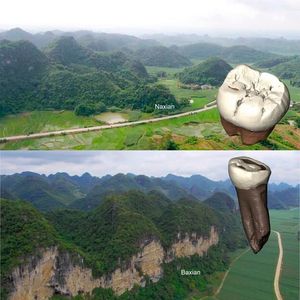
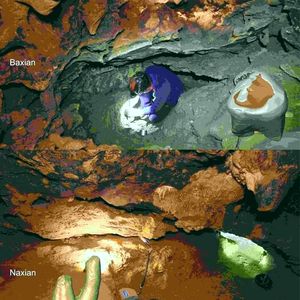
The study focuses on eight human teeth and thousands of other fossils recovered from two sister caves, Baxian and Naxian, in the karst landscapes of Guangxi province, southern China. These two caves lie only about 15 km apart in a region of steep limestone hills, caves and tropical vegetation.
The teeth were identified as Homo erectus using both their physical characteristics and ancient genetic signatures, and their age was established using five independent dating techniques applied to the teeth and the surrounding cave sediments and mineral formations. The results confidently place these humans in this southern China landscape at a time when we thought they were already regionally extinct. This makes the fossils the youngest securely dated evidence for Homo erectus in mainland China.
“This is a fascinating discovery because it confirms the presence of Homo erectus in a location we were not expecting and at a time we hadn’t considered,” said geochronologist and co-lead author Professor Kira Westaway of Macquarie University, Sydney Australia. “This has huge implications for the timeline of Homo erectus as we attempt to understand the causes of its extinction.”
The teeth were vital for more than just dating — the team analysed the human and animal teeth to reconstruct the environment and to establish how Homo erectus behaved. Teeth preserve chemical traces of the food and water consumed during life, making them a biological archive of past environments. At Baxian and Naxian, those traces reveal a reliance on dense tropical rainforest for the animals and the humans, rather than the open grasslands or woodland environment usually assigned to Homo erectus.
“Teeth can record the environments in which animals and humans lived,” said Dr Nicolas Bourgon of the Max Planck Institute of Geoanthropology, Jena, Germany. “In this case, the animal teeth and the Homo erectus teeth are telling the same story — these individuals were part of a rainforest ecosystem.”
Fossil Teeth Reveal Homo erectus Mobility Across Ancient Rainforests
The human teeth were also used to reconstruct how Homo erectus moved across the landscape. By analysing strontium, a chemical element in the enamel that is linked to the local geology, the researchers found that some individuals may have spent their childhoods moving through forested karst regions across surprisingly large areas rather than remaining in one small local area.
“Some of the chemical signatures in the fossil teeth point well beyond the immediate cave region, potentially towards northern Vietnam and mainland Southeast Asia,” said Professor Renaud Joannes-Boyau of Southern Cross University in Lismore, co-lead author of the study. “This suggests these humans were far more mobile than previously recognised, moving across surprisingly large distances through a complex rainforest landscape.”
The new findings are significant because the spread of rainforests in Southeast Asia has been linked to the disappearance of some non-sapiens human groups, but the evidence from southern China shows that the relationship between ancient humans and tropical forests was more complex.
“These findings change how we think about Homo erectus,” said palaeontologist Professor Yingqi Zhang, from the Institute of Vertebrate Palaeontology and Palaeoanthropology at the Chinese Academy of Sciences. “Finding Homo erectus evidence for the first time amongst a rainforest fauna challenges all our assumptions about their ability to adapt to environmental changes.”
Date: 08.12.2025
Naturally, we always handle your personal data responsibly. Any personal data we receive from you is processed in accordance with applicable data protection legislation. For detailed information please see our privacy policy.
Consent to the use of data for promotional purposes
I hereby consent to Vogel Communications Group GmbH & Co. KG, Max-Planck-Str. 7-9, 97082 Würzburg including any affiliated companies according to §§ 15 et seq. AktG (hereafter: Vogel Communications Group) using my e-mail address to send editorial newsletters. A list of all affiliated companies can be found here
Newsletter content may include all products and services of any companies mentioned above, including for example specialist journals and books, events and fairs as well as event-related products and services, print and digital media offers and services such as additional (editorial) newsletters, raffles, lead campaigns, market research both online and offline, specialist webportals and e-learning offers. In case my personal telephone number has also been collected, it may be used for offers of aforementioned products, for services of the companies mentioned above, and market research purposes.
Additionally, my consent also includes the processing of my email address and telephone number for data matching for marketing purposes with select advertising partners such as LinkedIn, Google, and Meta. For this, Vogel Communications Group may transmit said data in hashed form to the advertising partners who then use said data to determine whether I am also a member of the mentioned advertising partner portals. Vogel Communications Group uses this feature for the purposes of re-targeting (up-selling, cross-selling, and customer loyalty), generating so-called look-alike audiences for acquisition of new customers, and as basis for exclusion for on-going advertising campaigns. Further information can be found in section “data matching for marketing purposes”.
In case I access protected data on Internet portals of Vogel Communications Group including any affiliated companies according to §§ 15 et seq. AktG, I need to provide further data in order to register for the access to such content. In return for this free access to editorial content, my data may be used in accordance with this consent for the purposes stated here. This does not apply to data matching for marketing purposes.
Right of revocation
I understand that I can revoke my consent at will. My revocation does not change the lawfulness of data processing that was conducted based on my consent leading up to my revocation. One option to declare my revocation is to use the contact form found at https://contact.vogel.de. In case I no longer wish to receive certain newsletters, I have subscribed to, I can also click on the unsubscribe link included at the end of a newsletter. Further information regarding my right of revocation and the implementation of it as well as the consequences of my revocation can be found in the data protection declaration, section editorial newsletter.
Rainforests are demanding environments, and they can be difficult places to find food, move through the landscape and survive.
“While there has been growing recognition that our own species, Homo sapiens, adapted to rainforests around the world between 100,000 and 13,000 years ago, this is the first clear, direct evidence we have for another hominin living within these habitats,” said Professor Patrick Roberts of the Max Planck Institute of Geoanthropology, Germany.
Together, the fossils, dating evidence and tooth chemistry suggest that southern China was an important refuge for late Homo erectus. Rather than being restricted to their preferred open landscapes, these populations had the ability to survive in tropical forests and could move across a wider landscape outside the karst hills.
The discovery places southern China at the centre of new debates about the fate of Homo erectus in mainland Asia, and about how adaptable our ancient relatives really were.
Original Article: Rainforest adaptation in late Homo erectus from southern China; Nature; DOI:10.1038/s41586-026-11155-6