Cannabis seeds and molecular traces of psychoactive cannabis compounds were discovered in human hair in a princely tomb in Siberia. This proves that cannabis was used as an intoxicant as early as 2,800 years ago.
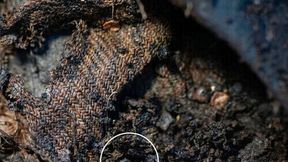
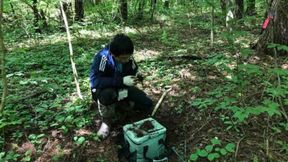
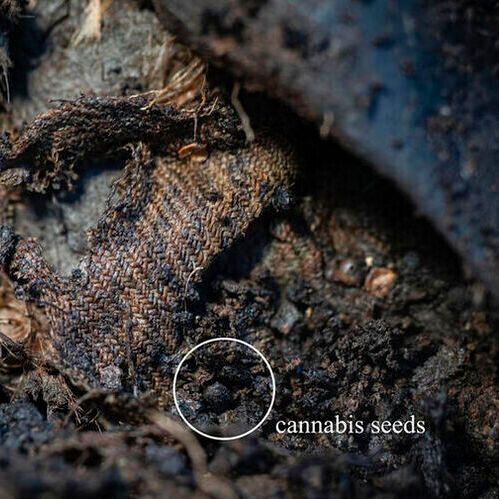
The cannabis seeds are not easy to spot in the excavation context.
(Source: T. Wallace)
Bern/Switzerland – An international research team led by the University of Bern has discovered cannabis seeds and molecular traces of psychoactive cannabis compounds in human hair in a princely tomb in Siberia. Radiocarbon dates place the seeds in the early eighth century B.C. According to the research team, this is the oldest directly dated evidence to date for the intoxicating use of cannabis.
Cannabis is one of the most commonly used psychoactive plants today. However, it is difficult to determine archaeologically how cannabis was used in prehistoric times. Plant parts such as flowers, leaves and resins are perishable and therefore rarely survive. It is known that cannabis served various purposes, such as the production of oil or fiber, and was not used solely as medicine or a drug.
An international research team led by Dr. Gino Caspari of the Institute of Archaeological Sciences of the University of Bern and the Max Planck Institute of Geoanthropology has now combined various analytical methods in its investigation of a princely tomb in the South Siberian Republic of Tyva. The tomb belongs to high-ranking members of Scythian society, a horse-riding culture of the Eurasian steppe. A total of about 1,000 cannabis seeds were recovered from it. Six seeds were directly dated using the radiocarbon method. Together with other dating results, this indicates that the seeds were placed in the grave in the early eighth century B.C. “The seeds show that cannabis played an important role in the rituals surrounding the burial,” says Caspari, an archaeologist and the study’s lead author. The research team also examined preserved human hair from the central burial chamber. The analyses point to cannabis use. “This study is particularly insightful because it combines the analysis of plant remains with molecular traces in the human body,” says Caspari. The study has now been published in the journal Science.
Molecular traces in human hair
The seeds recovered from the grave likely stem from wild plants. It is not possible to determine from this whether they were specifically cultivated for their psychoactive properties. Their presence in a grave does not, in and of itself, prove the psychoactive use of cannabis. This became apparent only through the analysis of the hair: In several of the hair samples examined, the researchers found clear signals consistent with cannabinol (CBN). CBN is produced, among other things, by the oxidation of tetrahydrocannabinol (THC), the most important intoxicating compound in cannabis. In addition, the team detected weak signals that, based on their mass, are consistent with THC. High-resolution mass spectrometry, among other methods, was used to analyze the hair samples.
According to the researchers, the hair analyses indicate cannabis use. However, they do not allow for a reliable determination of the amount consumed. Neither is it possible to determine with certainty how the active compounds entered the body—for example, through inhalation or ingestion. The analyses therefore do not confirm a specific method of consumption. Later archaeological sites in Central Asia have revealed chemical residues of cannabinoids in vessels and on heated stones, clearly indicating inhalation.
“The molecular traces in the hair and the cannabis seeds come from the same grave and suggest that cannabis was used for its intoxicating properties,” says Caspari, who conducts research at the Institute of Archaeological Sciences at the University of Bern and the Max Planck Institute for Geoanthropology in Jena (Germany).
Cannabis in a ritual burial context
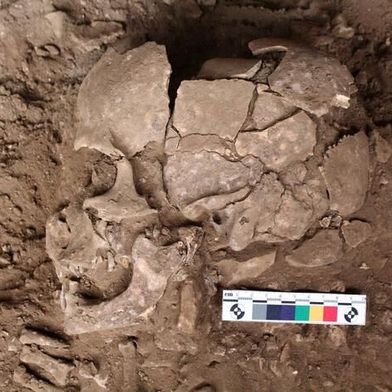
The research team situates the cannabis finds in a ritual burial context. “In this princely tomb, the burials were accompanied by extensive horse sacrifices and, most likely, human sacrifices as well,” says Gino Caspari. In a previous publication, the research team had discovered the remains of 18 horses that had once been arranged on the burial mound. In the meantime, several dozen additional horse sacrifices and scattered human bones have come to light.
Further investigation into the early use of cannabis
The findings provide what is currently the oldest directly dated archaeological evidence of the use of cannabis for its intoxicating properties. However, they do not allow any conclusions to be drawn about the THC content of the plants from that time. Neither has it been possible so far to determine whether the plants were specifically selected or cultivated for higher levels of active compounds.
Date: 08.12.2025
Naturally, we always handle your personal data responsibly. Any personal data we receive from you is processed in accordance with applicable data protection legislation. For detailed information please see our privacy policy.
Consent to the use of data for promotional purposes
I hereby consent to Vogel Communications Group GmbH & Co. KG, Max-Planck-Str. 7-9, 97082 Würzburg including any affiliated companies according to §§ 15 et seq. AktG (hereafter: Vogel Communications Group) using my e-mail address to send editorial newsletters. A list of all affiliated companies can be found here
Newsletter content may include all products and services of any companies mentioned above, including for example specialist journals and books, events and fairs as well as event-related products and services, print and digital media offers and services such as additional (editorial) newsletters, raffles, lead campaigns, market research both online and offline, specialist webportals and e-learning offers. In case my personal telephone number has also been collected, it may be used for offers of aforementioned products, for services of the companies mentioned above, and market research purposes.
Additionally, my consent also includes the processing of my email address and telephone number for data matching for marketing purposes with select advertising partners such as LinkedIn, Google, and Meta. For this, Vogel Communications Group may transmit said data in hashed form to the advertising partners who then use said data to determine whether I am also a member of the mentioned advertising partner portals. Vogel Communications Group uses this feature for the purposes of re-targeting (up-selling, cross-selling, and customer loyalty), generating so-called look-alike audiences for acquisition of new customers, and as basis for exclusion for on-going advertising campaigns. Further information can be found in section “data matching for marketing purposes”.
In case I access protected data on Internet portals of Vogel Communications Group including any affiliated companies according to §§ 15 et seq. AktG, I need to provide further data in order to register for the access to such content. In return for this free access to editorial content, my data may be used in accordance with this consent for the purposes stated here. This does not apply to data matching for marketing purposes.
Right of revocation
I understand that I can revoke my consent at will. My revocation does not change the lawfulness of data processing that was conducted based on my consent leading up to my revocation. One option to declare my revocation is to use the contact form found at https://contact.vogel.de. In case I no longer wish to receive certain newsletters, I have subscribed to, I can also click on the unsubscribe link included at the end of a newsletter. Further information regarding my right of revocation and the implementation of it as well as the consequences of my revocation can be found in the data protection declaration, section editorial newsletter.
The research team is currently continuing the investigation. “We have already begun sequencing some of the plant samples,” says Gino Caspari. “DNA preservation is excellent in this case. This will help us learn more about the history of the domestication and spread of this crop soon.”