Separating benzene from cyclohexane is a costly and energy-intensive step in chemical manufacturing. Researchers in the US and China have developed a reusable, molecularly woven material that absorbed nearly 98% of benzene from a test mixture. The new approach could offer a more energy-efficient alternative to conventional distillation in the production of nylon, paints and other industrial materials.
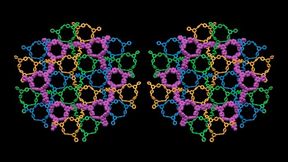
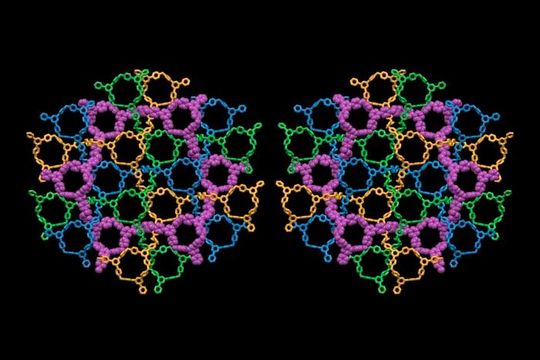
This molecular fabric is made of four molecular networks (shown in green, orange, purple and blue) that weave above and below each other to create a layer with an interlocking pattern. A single layer of the material can come in two forms: one in which the various molecular networks cross each other in a clockwise spiral (left) and a mirror-like version (right) in which the networks cross in a counterclockwise spiral.
(Source: University of Texas at Austin/ Zhejiang University)
Separating out a particular toxic chemical from industrial processes linked to the manufacture of nylon, paint, certain foams found in furniture and even detergents requires a lot of energy and hassle. Now a team of scientists from UT Austin and Zhejiang University have struck upon a solution that could prove far more energy efficient and practical. The team published their research this month in the journal Nature.
Companies often use a chemical called cyclohexane in making a range of materials, but cyclohexane is typically produced from a similarly shaped chemical called benzene, which is a carcinogen. When chemists create cyclohexane, they often form toxic benzene as an additional, unwanted product, and the process for separating the two is highly energy-intensive. The researchers’ solution involves a molecularly woven fabric that can filter out most of the benzene in a mixture.
“Unbelievable amounts of energy go into chemical separation. It’s one of the top energy sinks in the modern world,” said UT chemist Jonathan Sessler, one of the corresponding authors on the paper. “In a sense, we are addressing the challenge of improving efficiency using one of humanity’s oldest technologies: weaving. It’s remarkable that the same principle of interlacing works at the molecular level.”
Chemical plants traditionally separate cyclohexane from benzene by using a distillation method. Different chemicals have different boiling points, so in many cases chemists can heat a mixture up until the unwanted chemicals vaporize, leaving the necessary ones behind or vice versa. However, cyclohexane and benzene have nearly the same boiling points and tend to vaporize together. This complicates the distillation process and typically requires the addition of additives.
“This makes traditional distillation-based benzene-cyclohexane separations challenging and expensive,” said Sessler, the R.P. Doherty, Jr.-Welch Regents Chair in Chemistry.
The new fabric is made of four molecular networks that weave above and below each other to create a layer with an interlocking pattern. A single layer of the material can come in two forms: one in which the various molecular networks cross each other in a clockwise spiral and a mirror-like version in which the networks cross in a counterclockwise spiral. This property is known as chirality or “handedness.” To create the fabric, layers are stacked on top of each other, alternating between the regular orientation and the mirror image orientation.
This creates a springy fabric that can act as a thick filter, separating large amounts of benzene from cyclohexane. The multi-thread fabric is stronger than linearly-woven fabric, where single threads are woven to make a layer.
The new fabric is self-assembling, meaning that the molecular networks arrange and interconnect on their own.
“The whole thing converges by itself based on the underlying chemistry, which is especially cool because it allows the creation of these new materials in a facile way,” Sessler said.
The fabric is also reusable. After pouring a benzene-containing mixture onto the fabric, scientists can heat it up, vaporize the benzene and use the fabric again.
Sessler and the Zhejiang University team led by professors Feihe Huang and Guangfeng Li tested the fabric by pouring on a mixture that was 50% benzene and 50% cyclohexane. The fabric absorbed 97.9% of the benzene. For applications that require higher levels of separation, multiple passes might be used. They also demonstrated the fabric’s ability to separate several other compounds of commercial interest.
Sessler said that at Zhejiang University, scientists have demonstrated how to use the fabric on a larger, industrial scale. Although an economic analysis has not yet been performed, the researchers believe this could significantly reduce the amount of energy the chemical industry uses for molecular separation, with major implications for industries that manufacture paint, nylon, polyurethane and other cyclohexane-containing products.
Date: 08.12.2025
Naturally, we always handle your personal data responsibly. Any personal data we receive from you is processed in accordance with applicable data protection legislation. For detailed information please see our privacy policy.
Consent to the use of data for promotional purposes
I hereby consent to Vogel Communications Group GmbH & Co. KG, Max-Planck-Str. 7-9, 97082 Würzburg including any affiliated companies according to §§ 15 et seq. AktG (hereafter: Vogel Communications Group) using my e-mail address to send editorial newsletters. A list of all affiliated companies can be found here
Newsletter content may include all products and services of any companies mentioned above, including for example specialist journals and books, events and fairs as well as event-related products and services, print and digital media offers and services such as additional (editorial) newsletters, raffles, lead campaigns, market research both online and offline, specialist webportals and e-learning offers. In case my personal telephone number has also been collected, it may be used for offers of aforementioned products, for services of the companies mentioned above, and market research purposes.
Additionally, my consent also includes the processing of my email address and telephone number for data matching for marketing purposes with select advertising partners such as LinkedIn, Google, and Meta. For this, Vogel Communications Group may transmit said data in hashed form to the advertising partners who then use said data to determine whether I am also a member of the mentioned advertising partner portals. Vogel Communications Group uses this feature for the purposes of re-targeting (up-selling, cross-selling, and customer loyalty), generating so-called look-alike audiences for acquisition of new customers, and as basis for exclusion for on-going advertising campaigns. Further information can be found in section “data matching for marketing purposes”.
In case I access protected data on Internet portals of Vogel Communications Group including any affiliated companies according to §§ 15 et seq. AktG, I need to provide further data in order to register for the access to such content. In return for this free access to editorial content, my data may be used in accordance with this consent for the purposes stated here. This does not apply to data matching for marketing purposes.
Right of revocation
I understand that I can revoke my consent at will. My revocation does not change the lawfulness of data processing that was conducted based on my consent leading up to my revocation. One option to declare my revocation is to use the contact form found at https://contact.vogel.de. In case I no longer wish to receive certain newsletters, I have subscribed to, I can also click on the unsubscribe link included at the end of a newsletter. Further information regarding my right of revocation and the implementation of it as well as the consequences of my revocation can be found in the data protection declaration, section editorial newsletter.
The work at UT was supported by the Robert A. Welch Foundation and the work abroad was supported by the National Natural Science Foundation of China, the Zhejiang Provincial Natural Science Foundation of China, the ‘Pioneer’ and ‘Leading Goose’ R&D Program of Zhejiang, the Ministry of Education of China and the China Postdoctoral Science Foundation.
Among the study’s coauthors is the late Sir Fraser Stoddart, a co-recipient of the 2016 Nobel Prize in Chemistry, who passed away before the study was complete.
Original Article: A two-dimensional reticular triaxial molecularly woven fabric; Nature; DOI:10.1038/s41586-026-11218-8