Smart MaterialsOrigami Design Turns Paper Into Wearable Sensors
Source:
Shibaura Institute of Technology
3 min Reading Time
Researchers in Japan have developed a design framework that turns flat paper sheets into customised, self-folding wearable sensors. Inspired by climbing vines, the helical devices conform to fingers or arms without adhesives or straps and can measure biosignals.
Researchers develop a parametric design tool that converts the desired dimensions of a body part into a printable 2D pattern for a self-folding paper wearable device. This approach integrated with copper tape electrodes allows biosignal measurements.
(Source: Dr. Hiroki Shigemune/ Shibaura Institute of Technology)
Wearable sensors, such as wristbands, rings, and adhesive patches, are becoming increasingly common for healthcare monitoring, fitness tracking, and human–machine interaction. While most wearable devices are made from flexible polymers or textiles, paper-based sensors are emerging as a cheaper and more sustainable alternatives. Such sensors could be used for applications such as medical diagnosis or detecting contaminants and toxins, and could be safely discarded after use.
Now, a team of researchers led by Associate Professor Hiroki Shigemune, College of Engineering, Shibaura Institute of Technology, Japan, along with Mr. Yugo Takashima, Shibaura Institute of Technology, Japan, have developed a parametric design tool that transforms flat sheets of paper into self-folding, helical wearable sensors. The new approach integrating copper tape electrodes allow sensors to automatically conform to the desired dimensions of a body part without straps or adhesives and can help measure biosignals. The study was made available online on July 25, 2026, and was published in Volume 5, Issue 7 of the journal Advanced Sensor Research on July 01, 2026.
“We were inspired by the way climbing vines naturally wrap around supports in a helical form and adapt to their shape. By combining this concept with our paper self-folding technology, we developed a parametric design tool that converts the desired dimensions of a body part, such as finger, wrist, or arm, into a printable 2D pattern to generate a customized self-folding paper wearable device,” says Dr. Shigemune.
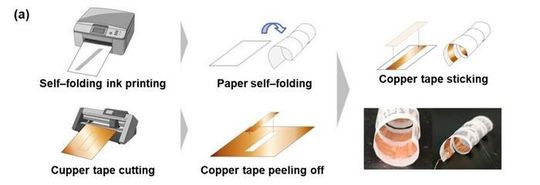
The fabrication process begins by printing self-folding patterns onto a flat sheet of paper using a standard inkjet printer. The printed patterns cause the paper to bend and fold automatically along predefined crease lines. By arranging these crease lines at an angle, the individual folds gradually form a 3D helical structure that conforms to the wearer’s body while remaining flexible enough to accommodate movement.
The researchers created two software tools to produce these wearables. One generates the printing pattern and previews the final 3D structure, while the other automatically creates a customized printing pattern based on the desired dimensions of the wearable. Users simply enter the desired dimensions—such as the diameter and length needed to fit a finger or forearm—and the software calculates the paper dimensions and generates the corresponding printing pattern.
Using this approach, the researchers successfully fabricated wearable devices for both fingers and forearms that closely matched their intended designs, with their dimensions differing within 5% from the target values. They then demonstrated the sensing capability using a finger-mounted device, which measured triboelectric signals and galvanic skin response with performance comparable to that of conventional strap-based wearable sensors.
These findings demonstrate that paper, digital design, and inkjet printing can be combined to rapidly produce customized wearable sensors on demand. By combining sustainable materials with a simple software-guided design process, the approach could enable low-cost, disposable wearable electronics. The researchers note that further testing is needed to evaluate the sensor’s practical use. However, the results demonstrate the potential of this approach for developing scalable and personalized wearable electronics.
“Our software-to-print approach holds great potential in point-of-care or decentralized short-term monitoring of physiological signals, such as galvanic skin response. Because the devices can be designed on demand to fit different body parts, the approach could enable rapid, low-cost, environmentally friendly fabrication of single-use sensors for clinical, homecare, and field settings, as well as for touch sensing and human–machine interfaces,” concludes Dr. Shigemune.
Reference: Title of original paper: Design Software for Helical Origami Wearable Devices Fitting Body Shapes Utilizing Parametric Design
Date: 08.12.2025
Naturally, we always handle your personal data responsibly. Any personal data we receive from you is processed in accordance with applicable data protection legislation. For detailed information please see our privacy policy.
Consent to the use of data for promotional purposes
I hereby consent to Vogel Communications Group GmbH & Co. KG, Max-Planck-Str. 7-9, 97082 Würzburg including any affiliated companies according to §§ 15 et seq. AktG (hereafter: Vogel Communications Group) using my e-mail address to send editorial newsletters. A list of all affiliated companies can be found here
Newsletter content may include all products and services of any companies mentioned above, including for example specialist journals and books, events and fairs as well as event-related products and services, print and digital media offers and services such as additional (editorial) newsletters, raffles, lead campaigns, market research both online and offline, specialist webportals and e-learning offers. In case my personal telephone number has also been collected, it may be used for offers of aforementioned products, for services of the companies mentioned above, and market research purposes.
Additionally, my consent also includes the processing of my email address and telephone number for data matching for marketing purposes with select advertising partners such as LinkedIn, Google, and Meta. For this, Vogel Communications Group may transmit said data in hashed form to the advertising partners who then use said data to determine whether I am also a member of the mentioned advertising partner portals. Vogel Communications Group uses this feature for the purposes of re-targeting (up-selling, cross-selling, and customer loyalty), generating so-called look-alike audiences for acquisition of new customers, and as basis for exclusion for on-going advertising campaigns. Further information can be found in section “data matching for marketing purposes”.
In case I access protected data on Internet portals of Vogel Communications Group including any affiliated companies according to §§ 15 et seq. AktG, I need to provide further data in order to register for the access to such content. In return for this free access to editorial content, my data may be used in accordance with this consent for the purposes stated here. This does not apply to data matching for marketing purposes.
Right of revocation
I understand that I can revoke my consent at will. My revocation does not change the lawfulness of data processing that was conducted based on my consent leading up to my revocation. One option to declare my revocation is to use the contact form found at https://contact.vogel.de. In case I no longer wish to receive certain newsletters, I have subscribed to, I can also click on the unsubscribe link included at the end of a newsletter. Further information regarding my right of revocation and the implementation of it as well as the consequences of my revocation can be found in the data protection declaration, section editorial newsletter.




:quality(80)/p7i.vogel.de/wcms/51/68/51687ac4cc19f2757c138498b877de57/0133167039v2.jpeg "CMFs are foams that consist of hollow spheres – made of materials such as stainless steel, nickel, or other metals and alloys – embedded in a metallic matrix. The resulting material is both lightweight and remarkably strong at absorbing compressive forces. (Source: Jie Sun/ NC State University)")
:quality(80)/p7i.vogel.de/wcms/cd/c0/cdc09efd1e5b3b8f83224e7729d66c10/0133105276v2.jpeg "From the data presented in this report, the authors show how TF3-MALS-RI is uniquely able to separate large polyacrylate molecules and provide precise molecular weight and Rg values. (Source: Postnova Analytics)")
:quality(80)/p7i.vogel.de/wcms/c6/f2/c6f2e2b4753a0d0cec682c03df4ed37c/0133088650v2.jpeg "PMBC vials for immunology and oncology research. (Source: Amsbio)")
:quality(80)/p7i.vogel.de/wcms/e0/72/e0728dc8dcadfc4d79a734e08cf6ced3/0133088641v2.jpeg "LM20 Microfluidizer and Cambridge CNT dispersion produced by the LM20 microfluidizer. (Source: Analytik)")
:quality(80)/p7i.vogel.de/wcms/86/01/86014d3d2a28cefc852f65c8d68317e4/0133104231v2.jpeg "Single-handed tube reading using a Handheld 2. (Source: Azenta Life Sciences)")
:quality(80)/p7i.vogel.de/wcms/0b/0f/0b0f8ed042dfc91f32582e10d54c2c7e/0133087444v2.jpeg "Offering advanced automation to increase your throughput, the Intellixcap provides secure sealing – eliminating the need for manual intervention, while preserving vital sample integrity. (Source: Azenta Life Sciences)")
:quality(80)/p7i.vogel.de/wcms/13/d3/13d35105f74a1c2e22b9c7a270e8e9b3/0132611155v2.jpeg "Circulating cell free DNA. (Source: Amsbio)")
:quality(80)/p7i.vogel.de/wcms/bc/ed/bced6850297a04dbea471a66cb6bb6fe/0132611405v2.jpeg "The latest addition to the range is a peristaltic tubing stop adapter that eliminates the need for fixed stoppers and allows custom cut lengths of peristaltic tubing to be installed on any pump head size. (Source: Biotech Fluidics )")
:quality(80)/p7i.vogel.de/wcms/a1/af/a1afbc7c8a067bbe94749ec680b4bafd/0133163762v2.jpeg "The study found in murkier water, fish took longer to move towards the food than those in clear water, but individuals in larger groups responded more quickly overall. (Source: Christos Ioannou)")
:quality(80)/p7i.vogel.de/wcms/32/80/3280aa3d44708962943c96fe2d466744/0133088560v2.jpeg "A bumble bee in flight at the University of Bristol Botanic Garden. (Source: Phil Savoie)")
:quality(80)/p7i.vogel.de/wcms/7b/e5/7be5c735140cbe28f3af0ec3d88274b9/0133045403v2.jpeg "After being buried in the ground for two months and broken down by soil organisms, a new pair of cotton underwear (left) shows clear signs of decomposition (right). (Source: Nicolas Zonvi)")
:quality(80)/p7i.vogel.de/wcms/c7/5e/c75e9b334a94b8b5c2a758f20ba080a8/0133039712v1.jpeg "Researchers have developed a microaerobic activated sludge process that enables ammonium to be recovered from fermentation industry wastewater instead of releasing nitrogen into the atmosphere. (Source: free licensed)")
:quality(80)/p7i.vogel.de/wcms/d4/61/d461ce0bd5743897993c6475f69e7ad6/0133067478v2.jpeg "In Harris County, 50 % of households with children reported food insecurity, compared with 33 % of households without children. (Source: Rice University)")
:quality(80)/p7i.vogel.de/wcms/79/76/7976d17b980bedfe35acaa532d690046/0132713841v2.jpeg "Observed rice yield losses from 1°C warming are more than twice as high as model estimates due to underestimated heat stress. (Source: AdobeStock/ducvien)")
:quality(80)/p7i.vogel.de/wcms/28/b6/28b6114fc9915c5dadee94d5c89bd129/0132593216v2.jpeg "Eating foods that contain common preservative food additives may increase the risks of high blood pressure and cardiovascular disease. (Source: Unsplash)")
:quality(80)/p7i.vogel.de/wcms/01/bc/01bcb16a3381a1d46533861eedbbae71/0132371290v1.jpeg "Adding spice may help people eat less by slowing them down. (Source: free licensed)")
:quality(80)/p7i.vogel.de/wcms/6a/d8/6ad838b20e80c36d04940b5a6bc8ccf1/0133167025v2.jpeg "Dr Kassandra Giragosian and a chimp (Source: Kassandra Giragosian)")
:quality(80)/p7i.vogel.de/wcms/6b/30/6b30243e240851f135c1f7cf4fd41c29/0133166867v1.jpeg "5-HT2A-PET (Source: Mikael Palner/ University of Southern Denmark)")
:quality(80)/p7i.vogel.de/wcms/11/29/112984f0c5d11cd5daf58fbfbc1d3aac/0133166885v1.jpeg "Researchers develop a parametric design tool that converts the desired dimensions of a body part into a printable 2D pattern for a self-folding paper wearable device. This approach integrated with copper tape electrodes allows biosignal measurements. (Source: Dr. Hiroki Shigemune/ Shibaura Institute of Technology)")
:quality(80)/p7i.vogel.de/wcms/23/9f/239f474c3e568804360678fbd48f8008/0133166989v2.jpeg "Sud Pinglay, principal investigator with AI Biodesign (Source: Allen Institute)")
:quality(80)/images.vogel.de/vogelonline/bdb/1710600/1710675/original.jpg "Discover how to set yourself up for success when performing balance-based density determination of solids such as jewelry and precious metals. (Mettler Toledo)")
:quality(80)/images.vogel.de/vogelonline/bdb/1682500/1682579/original.jpg "The new XPR Analytical balance redesigned to meet the needs of laboratory technicians of working fast and lean. (Mettler Toledo)")
:quality(80)/images.vogel.de/vogelonline/bdb/1677000/1677080/original.jpg "Enhance your weighing accuracy, comfort and productivity with the redesigned XPR Analytical balance. (Mettler Toledo)")