A new mouse study has revealed that loneliness rewires the brain and pushes for alcohol consumption. The scientists identified, for the first time, a brain mechanism through which isolation escalates alcohol use in male mice but suppresses it in females.
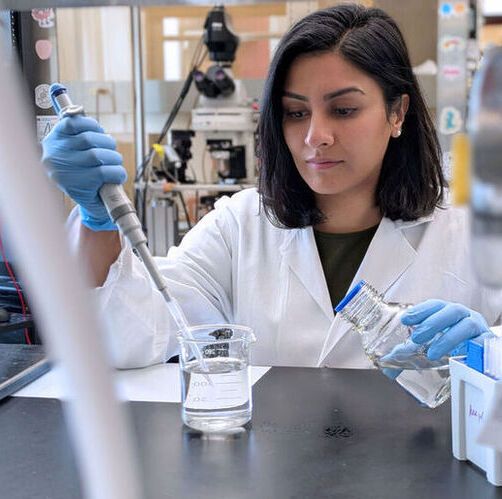
Study first author Dr. Reesha Patel doing research in her lab at Northwestern University Feinberg School of Medicine in Chicago.
(Source: Ben Schamisso / Northwestern University)
Chicago/USA – Loneliness can reprogram the brain in ways that push alcohol consumption, reports a new preclinical study led by Northwestern University and the Salk Institute for Biological Studies. The scientists identified, for the first time, a brain mechanism through which isolation escalates alcohol use in male mice but suppresses it in females.
Social isolation is rising worldwide and is now recognized as a major public health risk, with strong links to substance misuse. In 2023, then-U.S. Surgeon General Dr. Vivek Murthy warned that loneliness and social isolation had become an epidemic. Yet scientists don’t fully understand how feeling isolated rewires the brain in ways that increase vulnerability to alcohol abuse.
“This is the first study to identify a specific brain circuit that explains how social isolation can drive increased alcohol use in males, marking a major advance for the field,” said study first author Reesha Patel, assistant professor of general psychiatry and neuroscience at Northwestern University Feinberg School of Medicine.
“These findings provide a much clearer biological target for understanding and eventually treating alcohol misuse that arises from isolation, a problem that is becoming increasingly common.”
The study was published in Nature Neuroscience.
Sex differences
Adult male and female mice were first housed socially, then some were moved to single housing to model adult social isolation, while others remained socially housed as controls.
The mice were given daily one-hour opportunities to drink from a bottle of water or a bottle filled with a 15 % alcohol solution. Their consumption and choices were tracked over roughly two weeks, during which male mice progressively increased their alcohol intake, while females reduced it.
With miniature microscopes, the scientists recorded activity in specific brain cells while the animals freely moved around and chose whether to drink alcohol. The cells they monitored form a brain pathway, or circuit, connecting the basolateral amygdala, which processes emotional and stress signals, to the medial prefrontal cortex, which regulates decision-making.
“Our work shows that a defined pathway becomes overactive during isolation and directly increases drinking, and that males and females rely on different neural strategies when they’re lonely,” Patel said. “This may help explain long-standing sex differences in neuropsychiatric disorders.”
Patel said she cannot say definitively why isolation increased alcohol consumption in male mice but reduced it in females. But she noted that the sex differences observed in the study mirror patterns reported in some human research.
Turning the circuit on and off
The team then tested whether this brain pathway merely reflected drinking or caused it. Using optogenetics, brief pulses of light that turn brain circuits on or off, they artificially activated the circuit in non-isolated male mice. This caused their brains to respond to alcohol as if they had been socially isolated.
Conversely, when the same circuit was silenced in isolated male mice, alcohol consumption decreased.
Next steps
The scientists say they now want to understand what keeps this circuit overactive during social isolation and how downstream brain regions, including the medial prefrontal cortex, contribute to the effect. They also plan to explore why males and females respond so differently to isolation and whether hormones or deeper circuit-level differences play a role. Another important step is determining how these findings translate to humans.
The study is titled, “Social isolation recruits amygdala–medial prefrontal cortex projections to escalate alcohol drinking in male mice.” It was supported by the National Institutes of Health, including the National Institute on Alcohol Abuse and Alcoholism (AA029180), the National Institute on Drug Abuse (K99 DA055111), the National Institute of Mental Health (K00 MH132569, R01 MH115920 and R37 MH102441), the National Institute of General Medical Sciences (K12 GM068524) and the National Center for Complementary and Integrative Health (DP1 AT009925), as well as the Howard Hughes Medical Institute, the Kavli Foundation, the Dolby Family Fund and the Salk Institute for Biological Studies.
Date: 08.12.2025
Naturally, we always handle your personal data responsibly. Any personal data we receive from you is processed in accordance with applicable data protection legislation. For detailed information please see our privacy policy.
Consent to the use of data for promotional purposes
I hereby consent to Vogel Communications Group GmbH & Co. KG, Max-Planck-Str. 7-9, 97082 Würzburg including any affiliated companies according to §§ 15 et seq. AktG (hereafter: Vogel Communications Group) using my e-mail address to send editorial newsletters. A list of all affiliated companies can be found here
Newsletter content may include all products and services of any companies mentioned above, including for example specialist journals and books, events and fairs as well as event-related products and services, print and digital media offers and services such as additional (editorial) newsletters, raffles, lead campaigns, market research both online and offline, specialist webportals and e-learning offers. In case my personal telephone number has also been collected, it may be used for offers of aforementioned products, for services of the companies mentioned above, and market research purposes.
Additionally, my consent also includes the processing of my email address and telephone number for data matching for marketing purposes with select advertising partners such as LinkedIn, Google, and Meta. For this, Vogel Communications Group may transmit said data in hashed form to the advertising partners who then use said data to determine whether I am also a member of the mentioned advertising partner portals. Vogel Communications Group uses this feature for the purposes of re-targeting (up-selling, cross-selling, and customer loyalty), generating so-called look-alike audiences for acquisition of new customers, and as basis for exclusion for on-going advertising campaigns. Further information can be found in section “data matching for marketing purposes”.
In case I access protected data on Internet portals of Vogel Communications Group including any affiliated companies according to §§ 15 et seq. AktG, I need to provide further data in order to register for the access to such content. In return for this free access to editorial content, my data may be used in accordance with this consent for the purposes stated here. This does not apply to data matching for marketing purposes.
Right of revocation
I understand that I can revoke my consent at will. My revocation does not change the lawfulness of data processing that was conducted based on my consent leading up to my revocation. One option to declare my revocation is to use the contact form found at https://contact.vogel.de. In case I no longer wish to receive certain newsletters, I have subscribed to, I can also click on the unsubscribe link included at the end of a newsletter. Further information regarding my right of revocation and the implementation of it as well as the consequences of my revocation can be found in the data protection declaration, section editorial newsletter.




:quality(80)/p7i.vogel.de/wcms/55/f2/55f26cfb29878f58625b4697bacff0b9/0132894544v2.jpeg "The programme is designed to build an integrated R&D platform for sustainable specialty polymers. (Source: NUS)")
:quality(80)/p7i.vogel.de/wcms/2d/9e/2d9ea6bd89a718c2eb6a99172c3b92ad/0132813039v2.jpeg "A new nontargeted chemical analysis of 113 personal care and cleaning products in the US found that nearly all contained unlabeled chemicals. (Source: free licensed)")
:quality(80)/p7i.vogel.de/wcms/1e/cb/1ecbe8d7e82ac7dcfefef112d32415a3/0132811057v1.jpeg "A study of 426 university students highlights the combined importance of laboratory safety practices and healthy dietary habits. (Source: free licensed)")
:quality(80)/p7i.vogel.de/wcms/17/c0/17c0660deff66cc5f9b09a0e3b3286b5/0132714162v1.jpeg "Due to its unique properties, green hydrogen may be a promising tool to achieve a low-carbon economy. (Source: free licensed)")
:quality(80)/p7i.vogel.de/wcms/13/d3/13d35105f74a1c2e22b9c7a270e8e9b3/0132611155v2.jpeg "Circulating cell free DNA. (Source: Amsbio)")
:quality(80)/p7i.vogel.de/wcms/bc/ed/bced6850297a04dbea471a66cb6bb6fe/0132611405v2.jpeg "The latest addition to the range is a peristaltic tubing stop adapter that eliminates the need for fixed stoppers and allows custom cut lengths of peristaltic tubing to be installed on any pump head size. (Source: Biotech Fluidics )")
:quality(80)/p7i.vogel.de/wcms/c2/34/c234a6626d4f6360382ca7f1f440bebb/0132611196v2.jpeg "Testa Analytical's Trinity – a powerful new triple detector for Gel Permeation Chromatography / Size Exclusion Chromatography. (Source: Testa Analytical)")
:quality(80)/p7i.vogel.de/wcms/5b/3f/5b3fc0d5fb08c1f9727125bd926b1481/0132555049v1.jpeg "On 1 and 2 December 2026, the T3 – Transform The Tomorrow conference will explore strategies that help companies future-proof their operations. (Bild: © Vogel Corporate Solutions / AdobeStock 1280236166, Oksana)")
:quality(80)/p7i.vogel.de/wcms/d5/a3/d5a33f32cd6adf709c8afefc998d3f04/0132845576v1.jpeg "The study shows that the foreign media are less likely to report on certain effects of climate change, such as droughts and flooding (shown here: the 2021 Ahrtal floods). (Source: Volker Lannert/ Uni Bonn)")
:quality(80)/p7i.vogel.de/wcms/c9/a3/c9a33d5a20f5de3775aebaf763f5d336/0132811091v1.jpeg "A commercial plant operated by Heirloom Carbon Technologies, featuring air contactors where CO₂ is captured from the atmosphere. (Source: Heirloom Carbon Technologies)")
:quality(80)/p7i.vogel.de/wcms/06/1a/061a5d3a4e85383454d9450761a67de7/0132611653v2.jpeg "Shihong Lin, associate professor of civil and environmental engineering at Rice. (Source: Alex Becker/ Rice University)")
:quality(80)/p7i.vogel.de/wcms/c4/f5/c4f55f42fdf878aec3f850e5569b84ce/0132594173v2.jpeg "The latest research sheds some light on an issue that deserves more attention, that of climate-related suicide. (Source: Unsplash)")
:quality(80)/p7i.vogel.de/wcms/79/76/7976d17b980bedfe35acaa532d690046/0132713841v2.jpeg "Observed rice yield losses from 1°C warming are more than twice as high as model estimates due to underestimated heat stress. (Source: AdobeStock/ducvien)")
:quality(80)/p7i.vogel.de/wcms/28/b6/28b6114fc9915c5dadee94d5c89bd129/0132593216v2.jpeg "Eating foods that contain common preservative food additives may increase the risks of high blood pressure and cardiovascular disease. (Source: Unsplash)")
:quality(80)/p7i.vogel.de/wcms/01/bc/01bcb16a3381a1d46533861eedbbae71/0132371290v1.jpeg "Adding spice may help people eat less by slowing them down. (Source: free licensed)")
:quality(80)/p7i.vogel.de/wcms/b3/16/b316ac585e067d024da89a5156c950a9/0132370983v1.jpeg "Laboratory tests suggest that some low-calorie sweeteners can alter the growth of gut bacteria, with particularly strong effects observed when isosteviol was combined with the antidepressant duloxetine. (Source: free licensed)")
:quality(80)/p7i.vogel.de/wcms/8e/95/8e9539127c0938a064ac8c9ad29cc455/0133014930v3.jpeg "Study first author Dr. Reesha Patel doing research in her lab at Northwestern University Feinberg School of Medicine in Chicago. (Source: Ben Schamisso / Northwestern University)")
:quality(80)/p7i.vogel.de/wcms/0a/7b/0a7bb76d9504843e17e2f797d9bfddee/0132969222v1.jpeg "Researchers compared 115 Nasa photographs of 13 astronauts taken on Earth and in space to measure changes in lower eyelid position. (Source: Nasa)")
:quality(80)/p7i.vogel.de/wcms/de/98/de983aa98f7152603c5a3a9991f577c6/0132968886v1.jpeg "Pre-existing antibody patterns may reveal how strongly a person will respond to vaccination, helping identify individuals at risk of a blunted immune response. (Source: Jason Drees)")
:quality(80)/p7i.vogel.de/wcms/44/44/4444675f0944af59b65fceb4e6a28941/0132968868v1.jpeg "Rachelle Stark, a Ph.D. student and co-author of the new study, in the Anders Näär lab at Berkeley. (Source: Mathew Burciaga/ UC Berkeley)")
:quality(80)/images.vogel.de/vogelonline/bdb/1710600/1710675/original.jpg "Discover how to set yourself up for success when performing balance-based density determination of solids such as jewelry and precious metals. (Mettler Toledo)")
:quality(80)/images.vogel.de/vogelonline/bdb/1682500/1682579/original.jpg "The new XPR Analytical balance redesigned to meet the needs of laboratory technicians of working fast and lean. (Mettler Toledo)")
:quality(80)/images.vogel.de/vogelonline/bdb/1677000/1677080/original.jpg "Enhance your weighing accuracy, comfort and productivity with the redesigned XPR Analytical balance. (Mettler Toledo)")
:quality(80)/p7i.vogel.de/wcms/15/e0/15e08e2ebb02e3d0bd13bba1c0ff44e4/0131588088v2.jpeg "In the new study, the scientists examined young and old male and female mice, with or without loss of brain estrogen, which allowed them to pinpoint the effects specifically relevant to older females. (Source: 愚木混株 Yumu on Unsplash)")
:quality(80)/p7i.vogel.de/wcms/b5/05/b505af30c4c5d568073b613a9e9a1541/0129779931v2.jpeg "Researchers tested what factors improve or worsen the quality of sleep in mice. (Source: Pixabay)")