New research has found that like humans, mice also can take a single sniff to deliberately probe their environment — something scientists previously did not know.
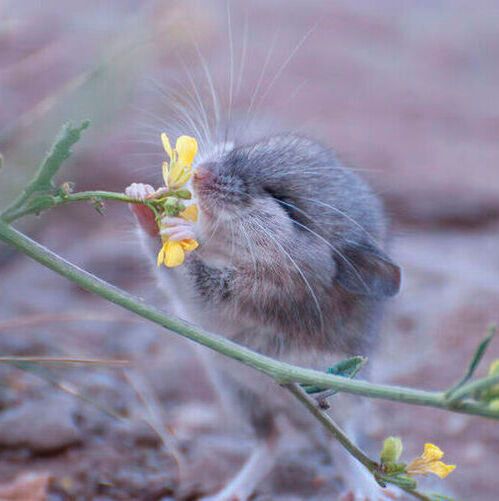
A mouse appears to sniff a flower.
(Source: Michael Lynch, inaturalist)
Chicago/USA – Picture a mouse taking rapid, staccato sniffs of a crumb it’s found while foraging for food. Now compare that with a human, leaning in for a single, deep inhale to gauge if a cantaloupe is ripe. New research from Northwestern University has found, like humans, mice also can take a single sniff to deliberately probe their environment — something scientists previously did not know.
Two new complementary Northwestern University studies, published together on July 3 in Science Advances, studied olfaction from opposite ends and found rodents and humans rely on the same underlying neurophysiology — the brain’s motor and rhythmic building blocks — to process smells. Although a mouse’s single sniff is much shorter than a human’s, the underlying tempo of smell processing is the same, according to the findings. The results suggest these sensory systems are fundamentally similar and have been preserved through evolution.
Taken together, the findings from the two labs suggest something important: Mammals all rely on a similar underlying system for smell, with each species putting its own twist on the same basic design. The work answers a fundamental question: How do mice and humans sample our environment so we understand it and predict the next thing we want to do?
“The true similarity is this single sniff, but it’s not just a sniff,” said corresponding author John M. Barrett, research assistant professor of neuroscience at Northwestern University Feinberg School of Medicine. “Mice even move their hands while sniffing, which shows it’s volitional — they’re doing it on purpose.”
What are the implications for humans?
Behavioral changes in sniffing are linked to conditions like autism and Alzheimer’s and Parkinson’s diseases, so understanding the olfaction system’s basic wiring could help with earlier detection or better treatments, the study authors said.
“Knowing we have this evolutionarily conserved set of mechanisms helps us understand how mammalian brains work, which could ultimately help us understand how they fail in pathology,” said first author Andrew Sheriff. “It helps us know how the brain works so we know how to fix it when it doesn’t work.”
A tale of two papers
One study found mice inspect their food using single sniffs that look remarkably human-like. The other found humans organize odor information at a rapid rate within a single sniff, in a form of olfactory brain processing that looks remarkably rodent-like. Together, these separate but complementary studies suggest there are shared, fundamental biological rules behind how these two mammals’ senses of smell work, and that these have been preserved through evolution.
First study: mice can sniff like humans
The first paper began with a simple observation: When mice handle food, they’ll occasionally bring it briefly to their noses before continuing to eat.
The study was conducted in the lab of Gordon M. G. Shepherd in the department of neuroscience at Northwestern University Feinberg School of Medicine, along with colleagues locally and at the University of Pennsylvania and University of Florida College of Medicine.
The team built a robotic multi-camera recording system to follow mice around as they forage and eat. Led by Mang Gao and Barrett from the Shepherd lab, the scientists tracked at high resolution the mice’s hand and head movements while simultaneously tracking their breathing.
The mice timed a single sniff to the exact moment the food reached their nose, precisely coordinating their hands, head and breathing. Unlike the steady sniffing they use when searching for food, this behavior is quick and deliberate, much like when a human lifts food to their nose for one careful smell before taking a bite.
Date: 08.12.2025
Naturally, we always handle your personal data responsibly. Any personal data we receive from you is processed in accordance with applicable data protection legislation. For detailed information please see our privacy policy.
Consent to the use of data for promotional purposes
I hereby consent to Vogel Communications Group GmbH & Co. KG, Max-Planck-Str. 7-9, 97082 Würzburg including any affiliated companies according to §§ 15 et seq. AktG (hereafter: Vogel Communications Group) using my e-mail address to send editorial newsletters. A list of all affiliated companies can be found here
Newsletter content may include all products and services of any companies mentioned above, including for example specialist journals and books, events and fairs as well as event-related products and services, print and digital media offers and services such as additional (editorial) newsletters, raffles, lead campaigns, market research both online and offline, specialist webportals and e-learning offers. In case my personal telephone number has also been collected, it may be used for offers of aforementioned products, for services of the companies mentioned above, and market research purposes.
Additionally, my consent also includes the processing of my email address and telephone number for data matching for marketing purposes with select advertising partners such as LinkedIn, Google, and Meta. For this, Vogel Communications Group may transmit said data in hashed form to the advertising partners who then use said data to determine whether I am also a member of the mentioned advertising partner portals. Vogel Communications Group uses this feature for the purposes of re-targeting (up-selling, cross-selling, and customer loyalty), generating so-called look-alike audiences for acquisition of new customers, and as basis for exclusion for on-going advertising campaigns. Further information can be found in section “data matching for marketing purposes”.
In case I access protected data on Internet portals of Vogel Communications Group including any affiliated companies according to §§ 15 et seq. AktG, I need to provide further data in order to register for the access to such content. In return for this free access to editorial content, my data may be used in accordance with this consent for the purposes stated here. This does not apply to data matching for marketing purposes.
Right of revocation
I understand that I can revoke my consent at will. My revocation does not change the lawfulness of data processing that was conducted based on my consent leading up to my revocation. One option to declare my revocation is to use the contact form found at https://contact.vogel.de. In case I no longer wish to receive certain newsletters, I have subscribed to, I can also click on the unsubscribe link included at the end of a newsletter. Further information regarding my right of revocation and the implementation of it as well as the consequences of my revocation can be found in the data protection declaration, section editorial newsletter.
The mice sniffed more vigorously when handling unappetizing food, the study found, but it was not only the presence of odor that drove the behavior. When the scientists interfered with the mice’s sense of smell, they continued performing food sniffs as normal. What ultimately stopped the behavior was silencing the motor cortex — the region of the brain associated with conscious, intentional movement.
“This means when mice sniff food, they’re not doing it as a reflexive response to an odor, but rather as a proactive act of deliberate sensory sampling,” said Gao, a postdoctoral scholar in the Shepherd lab. “It turns out the mice choose to perform these quick ‘smell checks,’ which is characteristic of a lot of human olfactory behavior, rather than being passively triggered to sniff.”
This is the first study to document this intentional, non-reflexive sniffing behavior among rodents in a real-world setting.
Second study: humans can process odors like mice
The second study, from the lab of Christina Zelano in the department of neurology at Feinberg, in collaboration with Dr. Bruce Tan in the department of otolaryngology at Feinberg, sought to answer how humans can achieve the same perceptual precision as rodents with a single, slow sniff.
“We wanted to understand how we can identify odors as fast as rodents do even though we sniff over 10 times slower,” said Sheriff, a postdoctoral scholar in Zelano’s lab. “By recording directly from the human olfactory bulb using a novel technique, we were able to find rhythms of odor processing that closely resemble those of rodents, suggesting conserved time windows for olfaction across species.”
The team used a minimally invasive, high-precision method developed in the Zelano lab to record sniffing in the brains of healthy human volunteers. When participants breathed in a single intentional inhalation, it elicited low frequency brain waves called theta oscillations (2–8 Hz) in the human olfactory bulb, at precisely the same frequencies at which rodents sniff. This slow brain rhythm helps organize faster bursts of activity that happen when the brain is actually processing a smell, the study found, meaning the human brain can generate the theta rhythm from a single sniff and use it the same way rodents use their sniff cycle.
“The implications of our findings are significant,” said co-author Qiaohan Yang, a graduate student in Northwestern University Interdepartmental Neuroscience. “In rodents, sniffing and theta are so tightly fused that the two are nearly indistinguishable. In humans, the slower sniff rate pulls them apart, revealing the theta oscillation as a distinct, independently generated rhythm that a single deliberate inhalation is sufficient to engage.”
Funding for the mouse study was provided by the National Institutes of Health (NIH) (grants R34DA059723 and R37NS061963). Funding for the human study was supported by the National Institute on Deafness and Other Communication Disorders, of the NIH (grants R01DC016364, R01DC018539 and R01DC021663 to CZ) and NIH training grant T32 NS047987.




:quality(80)/p7i.vogel.de/wcms/62/32/62327aaae1415beeed47db6201e79661/0133375912v2.jpeg "A cotton trailer outfitted with benches and a sunshade offers farmworkers a reprieve from the sun as they take a break from picking cantaloupe melons in Firebaugh, Calif.
(Source: Joe Proudman/ Regents of the University of California)")
:quality(80)/p7i.vogel.de/wcms/e6/c8/e6c8bd554776ee1ad2f1f0723fb243a7/0133369387v1.jpeg "Roman road (Source: Queen Mary University of London)")
:quality(80)/p7i.vogel.de/wcms/51/68/51687ac4cc19f2757c138498b877de57/0133167039v2.jpeg "CMFs are foams that consist of hollow spheres – made of materials such as stainless steel, nickel, or other metals and alloys – embedded in a metallic matrix. The resulting material is both lightweight and remarkably strong at absorbing compressive forces. (Source: Jie Sun/ NC State University)")
:quality(80)/p7i.vogel.de/wcms/cd/c0/cdc09efd1e5b3b8f83224e7729d66c10/0133105276v2.jpeg "From the data presented in this report, the authors show how TF3-MALS-RI is uniquely able to separate large polyacrylate molecules and provide precise molecular weight and Rg values. (Source: Postnova Analytics)")
:quality(80)/p7i.vogel.de/wcms/86/01/86014d3d2a28cefc852f65c8d68317e4/0133104231v2.jpeg "Single-handed tube reading using a Handheld 2. (Source: Azenta Life Sciences)")
:quality(80)/p7i.vogel.de/wcms/0b/0f/0b0f8ed042dfc91f32582e10d54c2c7e/0133087444v2.jpeg "Offering advanced automation to increase your throughput, the Intellixcap provides secure sealing – eliminating the need for manual intervention, while preserving vital sample integrity. (Source: Azenta Life Sciences)")
:quality(80)/p7i.vogel.de/wcms/13/d3/13d35105f74a1c2e22b9c7a270e8e9b3/0132611155v2.jpeg "Circulating cell free DNA. (Source: Amsbio)")
:quality(80)/p7i.vogel.de/wcms/bc/ed/bced6850297a04dbea471a66cb6bb6fe/0132611405v2.jpeg "The latest addition to the range is a peristaltic tubing stop adapter that eliminates the need for fixed stoppers and allows custom cut lengths of peristaltic tubing to be installed on any pump head size. (Source: Biotech Fluidics )")
:quality(80)/p7i.vogel.de/wcms/8d/5c/8d5c6c7f897f91d6784825eee20b5584/0133321225v1.jpeg "Empa researcher Christoph Hüglin collects samples of particles that are washed out of the air by rain and snow or settle due to gravity. (Source: Empa)")
:quality(80)/p7i.vogel.de/wcms/a1/af/a1afbc7c8a067bbe94749ec680b4bafd/0133163762v2.jpeg "The study found in murkier water, fish took longer to move towards the food than those in clear water, but individuals in larger groups responded more quickly overall. (Source: Christos Ioannou)")
:quality(80)/p7i.vogel.de/wcms/32/80/3280aa3d44708962943c96fe2d466744/0133088560v2.jpeg "A bumble bee in flight at the University of Bristol Botanic Garden. (Source: Phil Savoie)")
:quality(80)/p7i.vogel.de/wcms/7b/e5/7be5c735140cbe28f3af0ec3d88274b9/0133045403v2.jpeg "After being buried in the ground for two months and broken down by soil organisms, a new pair of cotton underwear (left) shows clear signs of decomposition (right). (Source: Nicolas Zonvi)")
:quality(80)/p7i.vogel.de/wcms/ef/68/ef68375729607984e5bb0c143afdae70/0133375119v2.jpeg "Printed Rice-Lentil 3D structures
(Source: SUTD)")
:quality(80)/p7i.vogel.de/wcms/bf/d0/bfd087349a85956a7aefad57ac1204c7/0133241961v2.jpeg "The Thermo Scientific Suretect Beverage Spoilage Multiplex PCR Assay provides a fast, broad-range molecular solution for detecting key spoilage microorganisms that threaten beverage quality. (Source: © OlegDoroshin - stock.adobe.com)")
:quality(80)/p7i.vogel.de/wcms/d4/61/d461ce0bd5743897993c6475f69e7ad6/0133067478v2.jpeg "In Harris County, 50 % of households with children reported food insecurity, compared with 33 % of households without children. (Source: Rice University)")
:quality(80)/p7i.vogel.de/wcms/79/76/7976d17b980bedfe35acaa532d690046/0132713841v2.jpeg "Observed rice yield losses from 1°C warming are more than twice as high as model estimates due to underestimated heat stress. (Source: AdobeStock/ducvien)")
:quality(80)/p7i.vogel.de/wcms/22/49/224964dd6850b62cccdbc4bde2d34693/0133372964v1.jpeg "Brain activity recorded during a video game helped researchers predict whether participants would take or avoid a risk half a second before they acted. (Source: free licensed)")
:quality(80)/p7i.vogel.de/wcms/48/a7/48a761934161543f70fef2403b44d714/0133372328v2.jpeg "The link between pollution and coughing persisted in the data, even when pollution levels were below the WHO’s recommended safe daily exposure limit. (Source: free licensed)")
:quality(80)/p7i.vogel.de/wcms/83/b4/83b4563a65c6036b61990931507428b4/0133363611v2.jpeg "Magnesium sulphate uptake and the north / south divide for the Precept program. (Source: University of Bristol )")
:quality(80)/p7i.vogel.de/wcms/bb/06/bb06c1c3c5d250f3f93016366c56525d/0133363201v2.jpeg "The team identified more than 1,200 associated genetic variants and found that these influences are remarkably consistent across countries, ages and methods of measuring personality. (Source: Pixabay - PublicDomainPictures)")
:quality(80)/images.vogel.de/vogelonline/bdb/1710600/1710675/original.jpg "Discover how to set yourself up for success when performing balance-based density determination of solids such as jewelry and precious metals. (Mettler Toledo)")
:quality(80)/images.vogel.de/vogelonline/bdb/1682500/1682579/original.jpg "The new XPR Analytical balance redesigned to meet the needs of laboratory technicians of working fast and lean. (Mettler Toledo)")
:quality(80)/images.vogel.de/vogelonline/bdb/1677000/1677080/original.jpg "Enhance your weighing accuracy, comfort and productivity with the redesigned XPR Analytical balance. (Mettler Toledo)")
:fill(fff,0)/images.vogel.de/vogelonline/companyimg/107800/107832/65.jpg "logoDueperthal.jpg ()")
:fill(fff,0)/images.vogel.de/vogelonline/companyimg/131900/131910/65.jpg "Xylem_tag_rgb.jpg ()")
:fill(fff,0)/p7i.vogel.de/companies/69/b7/69b7f63f311d9/logo-bimos-tif--2-.jpeg "logo-bimos-tif--2- (https://www.bimos.com/de-de/)")
:quality(80)/p7i.vogel.de/wcms/b8/06/b806507a64f260a89fd89dad56e8e4da/0131002822v2.jpeg "Working in mice, Datta and his team have now created the first detailed map of how the thousand-plus types of smell receptors in the nose are organized. (Source: free licensed)")
:quality(80)/p7i.vogel.de/wcms/ff/06/ff061c4c8244b72b3d89d44ce66c7bb9/0127043074v1.jpeg "New research shows that loss of smell after COVID-19 can persist for years — often unnoticed — with lasting impacts on health and quality of life. (Source: free licensed)")