Windows are among the biggest weak points in energy-efficient buildings. A new transparent insulation material developed at the University of Colorado Boulder could change that — combining near-perfect clarity with remarkable heat-blocking performance.
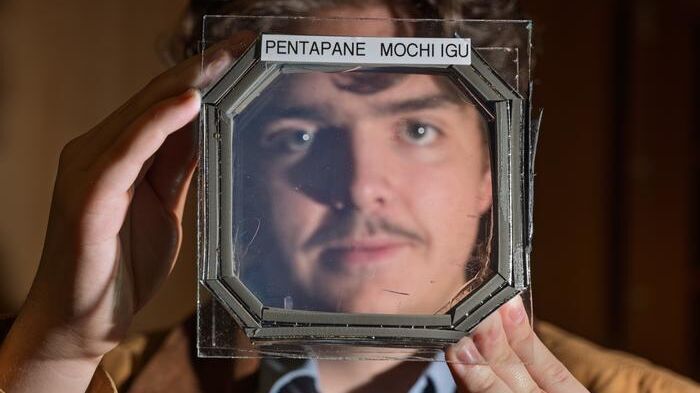
Abram Fluckiger holds up a sample panel square that has five sandwiched layers of a new material nearly transparent insulation material called Mochi, which was designed buy CU Boulder researchers in physics professor Ivan Smalyukh’s lab.
(Source: Glenn J. Asakawa/CU Boulder)
Physicists at the University of Colorado Boulder have designed a new material for insulating windows that could improve the energy efficiency of buildings worldwide — and it works a bit like a high-tech version of Bubble Wrap. The team’s material, called Mesoporous Optically Clear Heat Insulator, or Mochi, comes in large slabs or thin sheets that can be applied to the inside of any window. So far, the team only makes the material in the lab, and it’s not available for consumers. But the researchers say Mochi is long-lasting and is almost completely transparent. That means it won’t disrupt your view, unlike many insulating materials on the market today.
“To block heat exchange, you can put a lot of insulation in your walls, but windows need to be transparent,” said Ivan Smalyukh, senior author of the study and a professor of physics at CU Boulder. “Finding insulators that are transparent is really challenging.”
Gallery
Buildings, from single-family homes to office skyscrapers, consume about 40 % of all energy generated worldwide. They also leak, losing heat to the outdoors on cold days and absorbing heat when the temperature rises.
Smalyukh and his colleagues aim to slow down that exchange. The group’s Mochi material is a silicone gel with a twist: The gel traps air through a network of tiny pores that are many times thinner than the width of a human hair. Those tiny air bubbles are so good at blocking heat that you can use a Mochi sheet just 5 millimeters thick to hold a flame in the palm of your hand.
“No matter what the temperatures are outside, we want people to be able to have comfortable temperatures inside without having to waste energy,” said Smalyukh, a fellow at the Renewable And Sustainable Energy Institute (Rasei) at CU Boulder.
Bubble Magic
Smalyukh said the secret to Mochi comes down to precisely controlling those pockets of air. The team’s new invention is similar to aerogels, a class of insulating material that is in widespread use today. (Nasa uses aerogels inside its Mars rovers to keep electronics warm).
Like Mochi, aerogels trap countless pockets of air. But those bubbles tend to be distributed randomly throughout aerogels and often reflect light rather than let it pass through. As a result, these materials often look cloudy, which is why they’re sometimes called “frozen smoke.” In the new research, Smalyukh and his colleagues wanted to take a different approach to insulation.
To make Mochi, the group mixes a special type of molecule known as surfactants into a liquid solution. These molecules natural clump together to form thin threads in a process not unlike how oil and vinegar separate in salad dressing. Next, molecules of silicone in the same solution begin to stick to the outside of those threads.
Through a series of steps, the researchers then replace the clumps of detergent molecules with air. That leaves silicone surrounding a network of incredibly small pipes filled with air, which Smalyukh compares to a “plumber’s nightmare.”
In all, air makes up more than 90 % of the volume of the Mochi material.
Smalyukh said that heat passes through a gas in a process something like a game of pool: Heat energizes molecules and atoms in the gas, which then bang into other molecules and atoms, transferring the energy. The bubbles in Mochi material are so small, however, that the gases inside can’t bang into each other, effectively keeping heat from flowing through. “The molecules don’t have a chance to collide freely with each other and exchange energy,” Smalyukh said. “Instead, they bump into the walls of the pores.” At the same time, the Mochi material only reflects about .2 % of incoming light.
Date: 08.12.2025
Naturally, we always handle your personal data responsibly. Any personal data we receive from you is processed in accordance with applicable data protection legislation. For detailed information please see our privacy policy.
Consent to the use of data for promotional purposes
I hereby consent to Vogel Communications Group GmbH & Co. KG, Max-Planck-Str. 7-9, 97082 Würzburg including any affiliated companies according to §§ 15 et seq. AktG (hereafter: Vogel Communications Group) using my e-mail address to send editorial newsletters. A list of all affiliated companies can be found here
Newsletter content may include all products and services of any companies mentioned above, including for example specialist journals and books, events and fairs as well as event-related products and services, print and digital media offers and services such as additional (editorial) newsletters, raffles, lead campaigns, market research both online and offline, specialist webportals and e-learning offers. In case my personal telephone number has also been collected, it may be used for offers of aforementioned products, for services of the companies mentioned above, and market research purposes.
Additionally, my consent also includes the processing of my email address and telephone number for data matching for marketing purposes with select advertising partners such as LinkedIn, Google, and Meta. For this, Vogel Communications Group may transmit said data in hashed form to the advertising partners who then use said data to determine whether I am also a member of the mentioned advertising partner portals. Vogel Communications Group uses this feature for the purposes of re-targeting (up-selling, cross-selling, and customer loyalty), generating so-called look-alike audiences for acquisition of new customers, and as basis for exclusion for on-going advertising campaigns. Further information can be found in section “data matching for marketing purposes”.
In case I access protected data on Internet portals of Vogel Communications Group including any affiliated companies according to §§ 15 et seq. AktG, I need to provide further data in order to register for the access to such content. In return for this free access to editorial content, my data may be used in accordance with this consent for the purposes stated here. This does not apply to data matching for marketing purposes.
Right of revocation
I understand that I can revoke my consent at will. My revocation does not change the lawfulness of data processing that was conducted based on my consent leading up to my revocation. One option to declare my revocation is to use the contact form found at https://contact.vogel.de. In case I no longer wish to receive certain newsletters, I have subscribed to, I can also click on the unsubscribe link included at the end of a newsletter. Further information regarding my right of revocation and the implementation of it as well as the consequences of my revocation can be found in the data protection declaration, section editorial newsletter.
The researchers see a lot of uses for this clear-but-insulating material. Engineers could design a device that uses Mochi to trap the heat from sunlight, converting it into cheap and sustainable energy. “Even when it’s a somewhat cloudy day, you could still harness a lot of energy and then use it to heat your water and your building interior,” Smalyukh said.
You probably won’t see these products on the market soon. Currently, the team relies on a time-intensive process to produce Mochi in the lab. But Smalyukh believes the manufacturing process can be streamlined. The ingredients his team uses to make Mochi are also relatively inexpensive, which the physicist said bodes well for turning this material into a commercial product.
For now, the future for Mochi, like the view through a window coated in this insulating material, looks bright.
Original Article: Mesoporous optically clear heat insulators for sustainable building envelopes; Science; DOI:10.1126/science.adx5568




:quality(80)/p7i.vogel.de/wcms/62/32/62327aaae1415beeed47db6201e79661/0133375912v2.jpeg "A cotton trailer outfitted with benches and a sunshade offers farmworkers a reprieve from the sun as they take a break from picking cantaloupe melons in Firebaugh, Calif.
(Source: Joe Proudman/ Regents of the University of California)")
:quality(80)/p7i.vogel.de/wcms/e6/c8/e6c8bd554776ee1ad2f1f0723fb243a7/0133369387v1.jpeg "Roman road (Source: Queen Mary University of London)")
:quality(80)/p7i.vogel.de/wcms/51/68/51687ac4cc19f2757c138498b877de57/0133167039v2.jpeg "CMFs are foams that consist of hollow spheres – made of materials such as stainless steel, nickel, or other metals and alloys – embedded in a metallic matrix. The resulting material is both lightweight and remarkably strong at absorbing compressive forces. (Source: Jie Sun/ NC State University)")
:quality(80)/p7i.vogel.de/wcms/cd/c0/cdc09efd1e5b3b8f83224e7729d66c10/0133105276v2.jpeg "From the data presented in this report, the authors show how TF3-MALS-RI is uniquely able to separate large polyacrylate molecules and provide precise molecular weight and Rg values. (Source: Postnova Analytics)")
:quality(80)/p7i.vogel.de/wcms/86/01/86014d3d2a28cefc852f65c8d68317e4/0133104231v2.jpeg "Single-handed tube reading using a Handheld 2. (Source: Azenta Life Sciences)")
:quality(80)/p7i.vogel.de/wcms/0b/0f/0b0f8ed042dfc91f32582e10d54c2c7e/0133087444v2.jpeg "Offering advanced automation to increase your throughput, the Intellixcap provides secure sealing – eliminating the need for manual intervention, while preserving vital sample integrity. (Source: Azenta Life Sciences)")
:quality(80)/p7i.vogel.de/wcms/13/d3/13d35105f74a1c2e22b9c7a270e8e9b3/0132611155v2.jpeg "Circulating cell free DNA. (Source: Amsbio)")
:quality(80)/p7i.vogel.de/wcms/bc/ed/bced6850297a04dbea471a66cb6bb6fe/0132611405v2.jpeg "The latest addition to the range is a peristaltic tubing stop adapter that eliminates the need for fixed stoppers and allows custom cut lengths of peristaltic tubing to be installed on any pump head size. (Source: Biotech Fluidics )")
:quality(80)/p7i.vogel.de/wcms/8d/5c/8d5c6c7f897f91d6784825eee20b5584/0133321225v1.jpeg "Empa researcher Christoph Hüglin collects samples of particles that are washed out of the air by rain and snow or settle due to gravity. (Source: Empa)")
:quality(80)/p7i.vogel.de/wcms/a1/af/a1afbc7c8a067bbe94749ec680b4bafd/0133163762v2.jpeg "The study found in murkier water, fish took longer to move towards the food than those in clear water, but individuals in larger groups responded more quickly overall. (Source: Christos Ioannou)")
:quality(80)/p7i.vogel.de/wcms/32/80/3280aa3d44708962943c96fe2d466744/0133088560v2.jpeg "A bumble bee in flight at the University of Bristol Botanic Garden. (Source: Phil Savoie)")
:quality(80)/p7i.vogel.de/wcms/7b/e5/7be5c735140cbe28f3af0ec3d88274b9/0133045403v2.jpeg "After being buried in the ground for two months and broken down by soil organisms, a new pair of cotton underwear (left) shows clear signs of decomposition (right). (Source: Nicolas Zonvi)")
:quality(80)/p7i.vogel.de/wcms/ef/68/ef68375729607984e5bb0c143afdae70/0133375119v2.jpeg "Printed Rice-Lentil 3D structures
(Source: SUTD)")
:quality(80)/p7i.vogel.de/wcms/bf/d0/bfd087349a85956a7aefad57ac1204c7/0133241961v2.jpeg "The Thermo Scientific Suretect Beverage Spoilage Multiplex PCR Assay provides a fast, broad-range molecular solution for detecting key spoilage microorganisms that threaten beverage quality. (Source: © OlegDoroshin - stock.adobe.com)")
:quality(80)/p7i.vogel.de/wcms/d4/61/d461ce0bd5743897993c6475f69e7ad6/0133067478v2.jpeg "In Harris County, 50 % of households with children reported food insecurity, compared with 33 % of households without children. (Source: Rice University)")
:quality(80)/p7i.vogel.de/wcms/79/76/7976d17b980bedfe35acaa532d690046/0132713841v2.jpeg "Observed rice yield losses from 1°C warming are more than twice as high as model estimates due to underestimated heat stress. (Source: AdobeStock/ducvien)")
:quality(80)/p7i.vogel.de/wcms/22/49/224964dd6850b62cccdbc4bde2d34693/0133372964v1.jpeg "Brain activity recorded during a video game helped researchers predict whether participants would take or avoid a risk half a second before they acted. (Source: free licensed)")
:quality(80)/p7i.vogel.de/wcms/48/a7/48a761934161543f70fef2403b44d714/0133372328v2.jpeg "The link between pollution and coughing persisted in the data, even when pollution levels were below the WHO’s recommended safe daily exposure limit. (Source: free licensed)")
:quality(80)/p7i.vogel.de/wcms/83/b4/83b4563a65c6036b61990931507428b4/0133363611v2.jpeg "Magnesium sulphate uptake and the north / south divide for the Precept program. (Source: University of Bristol )")
:quality(80)/p7i.vogel.de/wcms/bb/06/bb06c1c3c5d250f3f93016366c56525d/0133363201v2.jpeg "The team identified more than 1,200 associated genetic variants and found that these influences are remarkably consistent across countries, ages and methods of measuring personality. (Source: Pixabay - PublicDomainPictures)")
:quality(80)/images.vogel.de/vogelonline/bdb/1710600/1710675/original.jpg "Discover how to set yourself up for success when performing balance-based density determination of solids such as jewelry and precious metals. (Mettler Toledo)")
:quality(80)/images.vogel.de/vogelonline/bdb/1682500/1682579/original.jpg "The new XPR Analytical balance redesigned to meet the needs of laboratory technicians of working fast and lean. (Mettler Toledo)")
:quality(80)/images.vogel.de/vogelonline/bdb/1677000/1677080/original.jpg "Enhance your weighing accuracy, comfort and productivity with the redesigned XPR Analytical balance. (Mettler Toledo)")
:fill(fff,0)/images.vogel.de/vogelonline/companyimg/107800/107832/65.jpg "logoDueperthal.jpg ()")
:fill(fff,0)/p7i.vogel.de/companies/69/b7/69b7f63f311d9/logo-bimos-tif--2-.jpeg "logo-bimos-tif--2- (https://www.bimos.com/de-de/)")
:quality(80)/p7i.vogel.de/wcms/a6/77/a6770756ba4a77c3db48f00143456b52/0128496716v1.jpeg "Abram Fluckiger holds up a sample panel square that has five sandwiched layers of a new material nearly transparent insulation material called Mochi, which was designed buy CU Boulder researchers in physics professor Ivan Smalyukh’s lab. (Source: Glenn J. Asakawa/CU Boulder)")
:quality(80)/p7i.vogel.de/wcms/71/6d/716d5de586022a0f9efd0094a7b242d8/0128496717v1.jpeg "Shakshi Bhardwaj holds up blocks in different sizes of a new material nearly transparent insulation material called Mochi, which was designed buy CU Boulder researchers in physics professor Ivan Smalyukh’s lab.(Source: Glenn J. Asakawa/CU Boulder)")
:quality(80)/p7i.vogel.de/wcms/db/38/db38cfffb5ce11ce0a79cee68c7ecc15/0128496718v1.jpeg "Eldho Abraham, left, and Taewoo Lee, right, hold up a new window insulation material called Mochi-affixed to a thin sheet of plastic, which was designed by CU Boulder researchers in physic professor Ivan Smalyukh’s lab. (Source: Glenn J. Asakawa/CU Boulder)")
:quality(80)/p7i.vogel.de/wcms/03/95/0395e673e26fd81beeea1055d0269707/0125270300v2.jpeg "3D-printed “pineapple” with cyanobacteria growing inside after a development period of 60 days. The green colour comes from the chlorophyll of the photosynthetic bacteria. (Source: Yifan Cui / ETH Zurich)")
:quality(80)/p7i.vogel.de/wcms/6e/a8/6ea8f1ae8dd3d2bf84a941bae68e9a16/0130484528v1.jpeg "Highly porous biochar from spent coffee ground for fully green thermal insulating composites with thermal conductivity of 0.04 W m−1 K−1 (Source: Sung Jin Kim/ Seong Yun Kim)")
:quality(80)/p7i.vogel.de/wcms/63/0c/630cf9ab0cafdcdd9b33802d53c5b943/0128938770v1.jpeg "A microscopic close-up of the bubbles in foam, whose movements mathematically mirror the process of deep learning, used to train modern AI systems. (Source: Crocker Lab)")