Scientists have developed a system that allows for precise, on-demand control of cell division outside living organisms. Using a molecular switch to toggle critical proteins, researchers can now fast-forward and rewind the complex choreography of cell division, offering unprecedented insights into cellular mechanics.
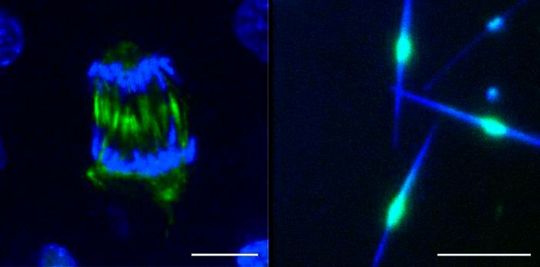
Researcher are now able to rebuild the switch that remodel the cytoskeleton. Images of an anaphase cytoskeleton in a dividing cell (left) and when rebuilt in vitro (right). PRC1 (green) crosslinks microtubules and organises compacted microtubule bundles.
(Source: Jayant Asthana, Wei Ming Lim/ Centre for Genomic Regulation)
A living cell is a bustling metropolis, with countless molecules and proteins navigating crowded spaces in every direction. Cell division is a grand event which completely transforms the landscape. The cell starts behaving like the host of an international competition, reconfiguring entire streets, relocating buildings and rerouting its transportation systems.
For decades, researchers have been captivated by the cell's ability to organise such a dramatic transformation. Central to the process is the microtubule cytoskeleton, a network of fibres which provides structural support and facilitates movement within the cell, ensuring that chromosomes are correctly segregated. Errors in cell division can lead to a wide array of diseases and disorders, including cancer or genetic disorders.
Yet, despite its critical importance, the exact mechanisms governing how cells reorganise their insides during cell division have remained a mystery. How does a cell know when and how to rearrange its internal scaffolding? What are the molecular signals governing these changes? Who are the key players conducting it all?
According to new research, some of the changes come down to a surprisingly simple and elegant system — the flip of a molecular switch. The findings are published today in Nature Communications by researchers at the Centre for Genomic Regulation in Barcelona and the Max Planck Institute of Molecular Physiology in Dortmund.
At the heart of the discovery is the protein PRC1. During cell division, PRC1 plays a key role in organising cell division. It crosslinks microtubules, helping to form a structure in the crucial region where microtubules overlap and chromosomes are separated.
But PRC1 doesn't act alone. Its activity is tightly controlled to ensure that microtubules assemble at the right time and place. The protein is controlled through a process called phosphorylation, where enzymes add small chemical tags to specific regions on its surface. These molecular tags can turn PRC1's activity up or down.
“We discovered that manipulating the phosphorylation state of PRC1 can induce large-scale transitions between different states of cytoskeleton organization that are needed for cell division. The changes take only a few minutes to complete”, explains Dr. Wei Ming Lim, first author of the study and postdoctoral researcher at the CRG.
The researchers made this discovery by developing a new laboratory system where they can precisely control and even reverse the transitions of the cytoskeletal structures associated with different stages of cell division outside of a living system. The new technology can help the researchers study the fundamental mechanisms governing cell division with greater control and detail than previously possible, and in real time.
“We can now create and observe movies of a re-organizing cytoskeleton under the microscope, while fast forwarding and rewinding as we please. This is an important milestone in the field,” says Icrea Research Professor Thomas Surrey, senior author of the study and researcher at the Centre for Genomic Regulation in Barcelona.
The new system can eventually shed light on potential therapeutic strategies for conditions where cell division goes wrong, like cancer. However, for Surrey, the implications of the study are how it inspires a sense of wonder at the sophistication of the natural world. “Cells are incredibly small, yet within them exists a highly organised and very complex system that operates with great precision. With discoveries like these, that complexity is beginning to unravel,” he concludes.
Date: 08.12.2025
Naturally, we always handle your personal data responsibly. Any personal data we receive from you is processed in accordance with applicable data protection legislation. For detailed information please see our privacy policy.
Consent to the use of data for promotional purposes
I hereby consent to Vogel Communications Group GmbH & Co. KG, Max-Planck-Str. 7-9, 97082 Würzburg including any affiliated companies according to §§ 15 et seq. AktG (hereafter: Vogel Communications Group) using my e-mail address to send editorial newsletters. A list of all affiliated companies can be found here
Newsletter content may include all products and services of any companies mentioned above, including for example specialist journals and books, events and fairs as well as event-related products and services, print and digital media offers and services such as additional (editorial) newsletters, raffles, lead campaigns, market research both online and offline, specialist webportals and e-learning offers. In case my personal telephone number has also been collected, it may be used for offers of aforementioned products, for services of the companies mentioned above, and market research purposes.
Additionally, my consent also includes the processing of my email address and telephone number for data matching for marketing purposes with select advertising partners such as LinkedIn, Google, and Meta. For this, Vogel Communications Group may transmit said data in hashed form to the advertising partners who then use said data to determine whether I am also a member of the mentioned advertising partner portals. Vogel Communications Group uses this feature for the purposes of re-targeting (up-selling, cross-selling, and customer loyalty), generating so-called look-alike audiences for acquisition of new customers, and as basis for exclusion for on-going advertising campaigns. Further information can be found in section “data matching for marketing purposes”.
In case I access protected data on Internet portals of Vogel Communications Group including any affiliated companies according to §§ 15 et seq. AktG, I need to provide further data in order to register for the access to such content. In return for this free access to editorial content, my data may be used in accordance with this consent for the purposes stated here. This does not apply to data matching for marketing purposes.
Right of revocation
I understand that I can revoke my consent at will. My revocation does not change the lawfulness of data processing that was conducted based on my consent leading up to my revocation. One option to declare my revocation is to use the contact form found at https://contact.vogel.de. In case I no longer wish to receive certain newsletters, I have subscribed to, I can also click on the unsubscribe link included at the end of a newsletter. Further information regarding my right of revocation and the implementation of it as well as the consequences of my revocation can be found in the data protection declaration, section editorial newsletter.
Original Article: Regulation of minimal spindle midzone organization by mitotic kinases; Nature Communications; DOI:10.1038/s41467-024-53500-1




:quality(80)/p7i.vogel.de/wcms/cd/c0/cdc09efd1e5b3b8f83224e7729d66c10/0133105276v2.jpeg "From the data presented in this report, the authors show how TF3-MALS-RI is uniquely able to separate large polyacrylate molecules and provide precise molecular weight and Rg values. (Source: Postnova Analytics)")
:quality(80)/p7i.vogel.de/wcms/c6/f2/c6f2e2b4753a0d0cec682c03df4ed37c/0133088650v2.jpeg "PMBC vials for immunology and oncology research. (Source: Amsbio)")
:quality(80)/p7i.vogel.de/wcms/e0/72/e0728dc8dcadfc4d79a734e08cf6ced3/0133088641v2.jpeg "LM20 Microfluidizer and Cambridge CNT dispersion produced by the LM20 microfluidizer. (Source: Analytik)")
:quality(80)/p7i.vogel.de/wcms/55/f2/55f26cfb29878f58625b4697bacff0b9/0132894544v2.jpeg "The programme is designed to build an integrated R&D platform for sustainable specialty polymers. (Source: NUS)")
:quality(80)/p7i.vogel.de/wcms/86/01/86014d3d2a28cefc852f65c8d68317e4/0133104231v2.jpeg "Single-handed tube reading using a Handheld 2. (Source: Azenta Life Sciences)")
:quality(80)/p7i.vogel.de/wcms/0b/0f/0b0f8ed042dfc91f32582e10d54c2c7e/0133087444v2.jpeg "Offering advanced automation to increase your throughput, the Intellixcap provides secure sealing – eliminating the need for manual intervention, while preserving vital sample integrity. (Source: Azenta Life Sciences)")
:quality(80)/p7i.vogel.de/wcms/13/d3/13d35105f74a1c2e22b9c7a270e8e9b3/0132611155v2.jpeg "Circulating cell free DNA. (Source: Amsbio)")
:quality(80)/p7i.vogel.de/wcms/bc/ed/bced6850297a04dbea471a66cb6bb6fe/0132611405v2.jpeg "The latest addition to the range is a peristaltic tubing stop adapter that eliminates the need for fixed stoppers and allows custom cut lengths of peristaltic tubing to be installed on any pump head size. (Source: Biotech Fluidics )")
:quality(80)/p7i.vogel.de/wcms/32/80/3280aa3d44708962943c96fe2d466744/0133088560v2.jpeg "A bumble bee in flight at the University of Bristol Botanic Garden. (Source: Phil Savoie)")
:quality(80)/p7i.vogel.de/wcms/7b/e5/7be5c735140cbe28f3af0ec3d88274b9/0133045403v2.jpeg "After being buried in the ground for two months and broken down by soil organisms, a new pair of cotton underwear (left) shows clear signs of decomposition (right). (Source: Nicolas Zonvi)")
:quality(80)/p7i.vogel.de/wcms/c7/5e/c75e9b334a94b8b5c2a758f20ba080a8/0133039712v1.jpeg "Researchers have developed a microaerobic activated sludge process that enables ammonium to be recovered from fermentation industry wastewater instead of releasing nitrogen into the atmosphere. (Source: free licensed)")
:quality(80)/p7i.vogel.de/wcms/9a/a0/9aa0a7f2d93c4f3a9c6297fb39a5c756/0133018161v2.jpeg "Volcanic activity and hydroclimatic anomalies. Eruptions produce a repeating wave pattern in high-altitude winds (left panels) that line up with widespread drying across Asia (right panels). This pattern appears regardless of background climate conditions. (Source: ©2026 Nie et al. CC-BY-ND)")
:quality(80)/p7i.vogel.de/wcms/d4/61/d461ce0bd5743897993c6475f69e7ad6/0133067478v2.jpeg "In Harris County, 50 % of households with children reported food insecurity, compared with 33 % of households without children. (Source: Rice University)")
:quality(80)/p7i.vogel.de/wcms/79/76/7976d17b980bedfe35acaa532d690046/0132713841v2.jpeg "Observed rice yield losses from 1°C warming are more than twice as high as model estimates due to underestimated heat stress. (Source: AdobeStock/ducvien)")
:quality(80)/p7i.vogel.de/wcms/28/b6/28b6114fc9915c5dadee94d5c89bd129/0132593216v2.jpeg "Eating foods that contain common preservative food additives may increase the risks of high blood pressure and cardiovascular disease. (Source: Unsplash)")
:quality(80)/p7i.vogel.de/wcms/01/bc/01bcb16a3381a1d46533861eedbbae71/0132371290v1.jpeg "Adding spice may help people eat less by slowing them down. (Source: free licensed)")
:quality(80)/p7i.vogel.de/wcms/12/89/12898926c84533b848ef20475b822129/0133103465v2.jpeg "As national MMR vaccination rates among kindergarteners continue to decline, according to a CDC report, the U.S. has recorded its first adult measles-related deaths of 2026 in Pennsylvania. (Source: Pixabay)")
:quality(80)/p7i.vogel.de/wcms/e4/07/e407a7ca05d57041aac21e3d716c48f5/0133100475v2.jpeg "Exercise-based cardiac rehabilitation is strongly recommended for patients after a MI in the ESC Guidelines on acute coronary syndromes and in the new ESC Guidelines on cardiac rehabilitation. (Source: Unsplash)")
:quality(80)/p7i.vogel.de/wcms/54/c2/54c20d95b1b4b4cc7d56674ef58b7c25/0133097847v2.jpeg "Staree was a double-blind trial conducted among people aged 70 years and over with no history of clinical cardiovascular disease, diabetes or dementia recruited from Australian general practice. (Source: Unsplash)")
:quality(80)/p7i.vogel.de/wcms/1c/64/1c64bf757ace04243990f44dce11f5ed/0133067501v2.jpeg "Despite the proven benefits of blood pressure-lowering medication in reducing cardiovascular events, around half of patients do not take them as prescribed. (Source: Pixabay)")
:quality(80)/images.vogel.de/vogelonline/bdb/1710600/1710675/original.jpg "Discover how to set yourself up for success when performing balance-based density determination of solids such as jewelry and precious metals. (Mettler Toledo)")
:quality(80)/images.vogel.de/vogelonline/bdb/1682500/1682579/original.jpg "The new XPR Analytical balance redesigned to meet the needs of laboratory technicians of working fast and lean. (Mettler Toledo)")
:quality(80)/images.vogel.de/vogelonline/bdb/1677000/1677080/original.jpg "Enhance your weighing accuracy, comfort and productivity with the redesigned XPR Analytical balance. (Mettler Toledo)")
:fill(fff,0)/images.vogel.de/vogelonline/companyimg/107800/107832/65.jpg "logoDueperthal.jpg ()")
:fill(fff,0)/images.vogel.de/vogelonline/companyimg/131900/131910/65.jpg "Xylem_tag_rgb.jpg ()")
:fill(fff,0)/p7i.vogel.de/companies/69/b7/69b7f63f311d9/logo-bimos-tif--2-.jpeg "logo-bimos-tif--2- (https://www.bimos.com/de-de/)")
:quality(80)/p7i.vogel.de/wcms/28/c2/28c2d59f2133620e4963b69cfb38d142/0121226895v2.jpeg "Thanks to a new technique that allows them to expand tissue 20-fold before imaging it, MIT researchers used a conventional light microscope to generate high-resolution images of synapses (left) and microtubules (right). In the image at left, presynaptic proteins are labeled in red, and postsynaptic proteins are labeled in blue. Each blue-red “sandwich” represents a synapse. (Source: Courtesy of the researchers)")
:quality(80)/p7i.vogel.de/wcms/63/0c/630cf9ab0cafdcdd9b33802d53c5b943/0128938770v1.jpeg "A microscopic close-up of the bubbles in foam, whose movements mathematically mirror the process of deep learning, used to train modern AI systems. (Source: Crocker Lab)")
:quality(80)/p7i.vogel.de/wcms/18/a2/18a2be5f679b4866ec2998893a9ebad8/0132889573v2.jpeg "From left: Gan Wei Liang; Associate Professor Polly Leilei Chen, Principal Investigator and corresponding author; Dr Larry Ng, first author; and Vincent Tano, second author. (Source: National University of Singapore )")