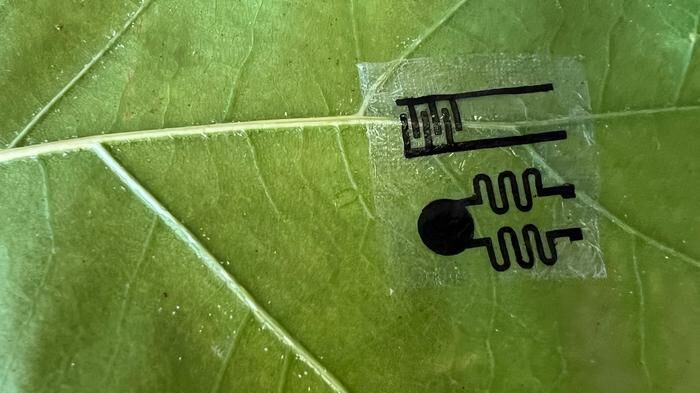
Tattoo-like leaf sensors and stretchable stem bands could help farmers detect drought, salinity and other crop stresses before visible damage appears. Powered by moisture evaporating from the plant, the battery-free wearables monitor water loss and growth in real time.
“The leaf sensor is more of an early warning system showing how the plant is responding in the moment, before visible signs appear,” said Nafize Hossain.
(Source: Nafize Hossain)
By the time farmers see curling leaves or stunted growth in their fields, their crops may already have spent days under stress. A new innovation in plant “wearable” sensors aims to catch those distress signals earlier — before the plant visibly suffers, allowing farmers to respond and help their crops thrive.
In a recent study from Tufts University, researchers created tiny tattoo-like sensors that adhere to leaf surfaces and a stretchable band that wraps around stems. Together, they track two vital signs of plant life — the temperature and humidity beneath the leaf’s surface, and whether the stem is still growing. Even more striking, the system runs without an external battery, scavenging power from moisture evaporating from the plant itself.
“The larger promise is not merely that one plant can wear one sensor,” said Sameer Sonkusale, professor of electrical and computer engineering at Tufts and senior researcher in the project. “It is that fields could one day contain networks of plant-level monitors, each reporting early signs of thirst, salt stress, disease or nutrient imbalance. Satellites and drones already give farmers a bird’s-eye view. Plant wearables could provide something more intimate: the plant’s-eye view.”
Current methods in monitoring crops use satellite imagery and drones to get visible, infrared, and microwave data that map out greenness, uneven growth, temperature, pest damage, soil moisture, and other big picture measurements of crop stress. Soil sensors can measure moisture, temperature, pH, and some nutrient levels. And weather stations provide information on air temperature, humidity, rainfall, wind, and sun exposure.
While those measurements are useful, they focus on conditions that may affect the crops in the future or an assessment of damage already done. “The leaf sensor is more of an early warning system showing how the plant is responding in the moment, before visible signs appear,” said Nafize Hossain, a graduate student at Tufts who led the research in the Sonkusale lab.
The sensors can also be extended to track other important indicators of plant health, such as levels of important nutrients and plant hormones that are early signals of root, leaf, stem, and fruit growth, as well as response to pathogens.
Stress Trackers
Resembling a temporary tattoo, the leaf sensor is thin, flexible, and can sit on uneven surfaces, allowing the plant to breathe and bend in the wind without damaging it. “Other plant sensors exist, but their ability to track multiple stressors and growth-related parameters is limited,” said Hossain, “and the technology often relies on external batteries, which complicate field deployment.”
The sensor first developed by the researchers provides information on the “vapor pressure deficit,” or VPD. It’s a technical term, but it describes something very intuitive — how likely the air is to pull water from the plant. When VPD is high, the air is dry and pulls moisture from leaves more aggressively. Plants respond by closing their stomata, the tiny pores that regulate gas exchange and water loss. That can protect them from dehydration, but it also slows photosynthesis and growth.
The Tufts leaf moisture sensor uses vanadium pentoxide crystals separated into extremely thin “nanosheets.” The nanosheets are stacked into layers and arranged in a membrane. Another layer of graphene (made of carbon atoms) forms a sieve to let moisture through from the plant to the nanosheets. When that happens, the water forms ions, which sweep through sheets creating a current — and voila, it’s not only a sensor, but also a battery. The level of the current is directly proportional to the amount of moisture exchange with the air.
Date: 08.12.2025
Naturally, we always handle your personal data responsibly. Any personal data we receive from you is processed in accordance with applicable data protection legislation. For detailed information please see our privacy policy.
Consent to the use of data for promotional purposes
I hereby consent to Vogel Communications Group GmbH & Co. KG, Max-Planck-Str. 7-9, 97082 Würzburg including any affiliated companies according to §§ 15 et seq. AktG (hereafter: Vogel Communications Group) using my e-mail address to send editorial newsletters. A list of all affiliated companies can be found here
Newsletter content may include all products and services of any companies mentioned above, including for example specialist journals and books, events and fairs as well as event-related products and services, print and digital media offers and services such as additional (editorial) newsletters, raffles, lead campaigns, market research both online and offline, specialist webportals and e-learning offers. In case my personal telephone number has also been collected, it may be used for offers of aforementioned products, for services of the companies mentioned above, and market research purposes.
Additionally, my consent also includes the processing of my email address and telephone number for data matching for marketing purposes with select advertising partners such as LinkedIn, Google, and Meta. For this, Vogel Communications Group may transmit said data in hashed form to the advertising partners who then use said data to determine whether I am also a member of the mentioned advertising partner portals. Vogel Communications Group uses this feature for the purposes of re-targeting (up-selling, cross-selling, and customer loyalty), generating so-called look-alike audiences for acquisition of new customers, and as basis for exclusion for on-going advertising campaigns. Further information can be found in section “data matching for marketing purposes”.
In case I access protected data on Internet portals of Vogel Communications Group including any affiliated companies according to §§ 15 et seq. AktG, I need to provide further data in order to register for the access to such content. In return for this free access to editorial content, my data may be used in accordance with this consent for the purposes stated here. This does not apply to data matching for marketing purposes.
Right of revocation
I understand that I can revoke my consent at will. My revocation does not change the lawfulness of data processing that was conducted based on my consent leading up to my revocation. One option to declare my revocation is to use the contact form found at https://contact.vogel.de. In case I no longer wish to receive certain newsletters, I have subscribed to, I can also click on the unsubscribe link included at the end of a newsletter. Further information regarding my right of revocation and the implementation of it as well as the consequences of my revocation can be found in the data protection declaration, section editorial newsletter.
The power is tiny — microwatts — but enough, with low-power electronics and energy storage to support periodic sensing.
The stem-based device borrows from kirigami, the Japanese art of cutting paper so it can stretch and deform in controlled ways. The sensor is coated with a eutectogel, a soft, ion-conducting gel that changes electrical resistance as the stem expands or contracts. In healthy growth, the stem diameter tends to increase. Under stress, growth may slow or the stem may even shrink.
Pairing the two types of sensors is important, because plants can show stress on more than one time scale. Leaf sensors, for example, can show if the plant is facing immediate conditions that drive water loss, while stem growth captures a slower biological process.
In tests on bell pepper plants, the system distinguished healthy plants from plants facing water deficit and salinity stress. Healthy plants showed rhythmic VPD changes over time, following normal daily cycles of air moisture.
Water-stressed plants showed a rising VPD trend. Salinity-stressed plants showed a different pattern, with reduced VPD compared with controls, likely linked to altered water uptake and stomatal behavior. Meanwhile, the stem sensor tracked growth in healthy plants and shrinking or reduced diameter in stressed plants.
The sensors are built with field conditions in mind. The leaf sensor is designed to tolerate bending and stretching, while ethe stem sensor’s kirigami pattern helps distribute strain and reduces the effects of abrupt disturbances like strong winds.
The team is currently working on a fully functional wireless communication platform for the sensors using LoRa (long range) or Bluetooth-based communication standards.
Original Article: In-Planta Tattoo and Kirigami Sensors for Moisture-Powered Monitoring of Vapor Pressure Deficit and Growth Dynamics; ACS Applied Materials & Interfaces; DOI:10.1021/acsami.6c03190




:quality(80)/p7i.vogel.de/wcms/c6/f2/c6f2e2b4753a0d0cec682c03df4ed37c/0133088650v2.jpeg "PMBC vials for immunology and oncology research. (Source: Amsbio)")
:quality(80)/p7i.vogel.de/wcms/e0/72/e0728dc8dcadfc4d79a734e08cf6ced3/0133088641v2.jpeg "LM20 Microfluidizer and Cambridge CNT dispersion produced by the LM20 microfluidizer. (Source: Analytik)")
:quality(80)/p7i.vogel.de/wcms/55/f2/55f26cfb29878f58625b4697bacff0b9/0132894544v2.jpeg "The programme is designed to build an integrated R&D platform for sustainable specialty polymers. (Source: NUS)")
:quality(80)/p7i.vogel.de/wcms/2d/9e/2d9ea6bd89a718c2eb6a99172c3b92ad/0132813039v2.jpeg "A new nontargeted chemical analysis of 113 personal care and cleaning products in the US found that nearly all contained unlabeled chemicals. (Source: free licensed)")
:quality(80)/p7i.vogel.de/wcms/0b/0f/0b0f8ed042dfc91f32582e10d54c2c7e/0133087444v2.jpeg "Offering advanced automation to increase your throughput, the Intellixcap provides secure sealing – eliminating the need for manual intervention, while preserving vital sample integrity. (Source: Azenta Life Sciences)")
:quality(80)/p7i.vogel.de/wcms/13/d3/13d35105f74a1c2e22b9c7a270e8e9b3/0132611155v2.jpeg "Circulating cell free DNA. (Source: Amsbio)")
:quality(80)/p7i.vogel.de/wcms/bc/ed/bced6850297a04dbea471a66cb6bb6fe/0132611405v2.jpeg "The latest addition to the range is a peristaltic tubing stop adapter that eliminates the need for fixed stoppers and allows custom cut lengths of peristaltic tubing to be installed on any pump head size. (Source: Biotech Fluidics )")
:quality(80)/p7i.vogel.de/wcms/c2/34/c234a6626d4f6360382ca7f1f440bebb/0132611196v2.jpeg "Testa Analytical's Trinity – a powerful new triple detector for Gel Permeation Chromatography / Size Exclusion Chromatography. (Source: Testa Analytical)")
:quality(80)/p7i.vogel.de/wcms/32/80/3280aa3d44708962943c96fe2d466744/0133088560v2.jpeg "A bumble bee in flight at the University of Bristol Botanic Garden. (Source: Phil Savoie)")
:quality(80)/p7i.vogel.de/wcms/7b/e5/7be5c735140cbe28f3af0ec3d88274b9/0133045403v2.jpeg "After being buried in the ground for two months and broken down by soil organisms, a new pair of cotton underwear (left) shows clear signs of decomposition (right). (Source: Nicolas Zonvi)")
:quality(80)/p7i.vogel.de/wcms/c7/5e/c75e9b334a94b8b5c2a758f20ba080a8/0133039712v1.jpeg "Researchers have developed a microaerobic activated sludge process that enables ammonium to be recovered from fermentation industry wastewater instead of releasing nitrogen into the atmosphere. (Source: free licensed)")
:quality(80)/p7i.vogel.de/wcms/9a/a0/9aa0a7f2d93c4f3a9c6297fb39a5c756/0133018161v2.jpeg "Volcanic activity and hydroclimatic anomalies. Eruptions produce a repeating wave pattern in high-altitude winds (left panels) that line up with widespread drying across Asia (right panels). This pattern appears regardless of background climate conditions. (Source: ©2026 Nie et al. CC-BY-ND)")
:quality(80)/p7i.vogel.de/wcms/d4/61/d461ce0bd5743897993c6475f69e7ad6/0133067478v2.jpeg "In Harris County, 50 % of households with children reported food insecurity, compared with 33 % of households without children. (Source: Rice University)")
:quality(80)/p7i.vogel.de/wcms/79/76/7976d17b980bedfe35acaa532d690046/0132713841v2.jpeg "Observed rice yield losses from 1°C warming are more than twice as high as model estimates due to underestimated heat stress. (Source: AdobeStock/ducvien)")
:quality(80)/p7i.vogel.de/wcms/28/b6/28b6114fc9915c5dadee94d5c89bd129/0132593216v2.jpeg "Eating foods that contain common preservative food additives may increase the risks of high blood pressure and cardiovascular disease. (Source: Unsplash)")
:quality(80)/p7i.vogel.de/wcms/01/bc/01bcb16a3381a1d46533861eedbbae71/0132371290v1.jpeg "Adding spice may help people eat less by slowing them down. (Source: free licensed)")
:quality(80)/p7i.vogel.de/wcms/e4/07/e407a7ca05d57041aac21e3d716c48f5/0133100475v2.jpeg "Exercise-based cardiac rehabilitation is strongly recommended for patients after a MI in the ESC Guidelines on acute coronary syndromes and in the new ESC Guidelines on cardiac rehabilitation. (Source: Unsplash)")
:quality(80)/p7i.vogel.de/wcms/54/c2/54c20d95b1b4b4cc7d56674ef58b7c25/0133097847v2.jpeg "Staree was a double-blind trial conducted among people aged 70 years and over with no history of clinical cardiovascular disease, diabetes or dementia recruited from Australian general practice. (Source: Unsplash)")
:quality(80)/p7i.vogel.de/wcms/1c/64/1c64bf757ace04243990f44dce11f5ed/0133067501v2.jpeg "Despite the proven benefits of blood pressure-lowering medication in reducing cardiovascular events, around half of patients do not take them as prescribed. (Source: Pixabay)")
:quality(80)/p7i.vogel.de/wcms/13/7a/137a844cf32c194b2c3d8227b6970b1d/0133067490v2.jpeg "The wearable U-Rhythm device, developed by the University of Bristol. (Source: David Hills (Glude.tv))")
:quality(80)/images.vogel.de/vogelonline/bdb/1710600/1710675/original.jpg "Discover how to set yourself up for success when performing balance-based density determination of solids such as jewelry and precious metals. (Mettler Toledo)")
:quality(80)/images.vogel.de/vogelonline/bdb/1682500/1682579/original.jpg "The new XPR Analytical balance redesigned to meet the needs of laboratory technicians of working fast and lean. (Mettler Toledo)")
:quality(80)/images.vogel.de/vogelonline/bdb/1677000/1677080/original.jpg "Enhance your weighing accuracy, comfort and productivity with the redesigned XPR Analytical balance. (Mettler Toledo)")
:fill(fff,0)/images.vogel.de/vogelonline/companyimg/107800/107832/65.jpg "logoDueperthal.jpg ()")
:fill(fff,0)/images.vogel.de/vogelonline/companyimg/131900/131910/65.jpg "Xylem_tag_rgb.jpg ()")
:quality(80)/p7i.vogel.de/wcms/b3/72/b372f81b010d83cf454f3d6ffe0bc34c/0130648368v2.jpeg "The electronic tattoo uses hyperflexible and sustainable material graphene to track hydration levels. (Source: The University of Texas at Austin )")
:quality(80)/p7i.vogel.de/wcms/f6/3d/f63d5aa4c99a79e3cfe9e1bf8c1595f3/0130484550v1.jpeg "A robot designed to assist with precision irrigation in action, in a citrus orchard. (Source: Elia Scudiero/ UCR)")
:quality(80)/p7i.vogel.de/wcms/b3/72/b372f81b010d83cf454f3d6ffe0bc34c/0130648368v2.jpeg "The electronic tattoo uses hyperflexible and sustainable material graphene to track hydration levels. (Source: The University of Texas at Austin )")
:quality(80)/p7i.vogel.de/wcms/f6/3d/f63d5aa4c99a79e3cfe9e1bf8c1595f3/0130484550v1.jpeg "A robot designed to assist with precision irrigation in action, in a citrus orchard. (Source: Elia Scudiero/ UCR)")