Humanity may have spoken fewer languages before farming than we do today — and tens of thousands more at the height of ancient empires. A new study in Science reconstructs 12,000 years of linguistic history, revealing a surprising "golden age" of language diversity roughly 1,000 to 3,000 years ago, followed by a dramatic collapse that began long before European colonialism.
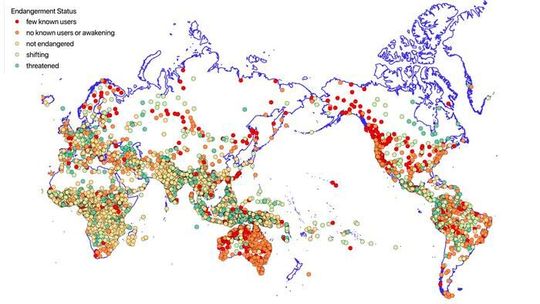
Contemporary languages and endangerment status. Made with a Natural Earth base map using data from Glottolog 5.3 and information adapted from Glottoscope.
(Source: Claire Bowern)
Today, people speak or sign around 7,500 languages. Yet this figure provides only a snapshot of a constantly changing history. How many languages existed before written records? Did agriculture reduce linguistic diversity by allowing expanding farming populations to replace smaller hunter-gatherer groups? Or did population growth initially create more opportunities for new languages to emerge?
An international research team involving researchers from Spain, the USA and Germany have reconstructed plausible trajectories of global language diversity across the last 12,000 years. Their study, published in Science, suggests that language diversity increased for most of the Holocene, reached a remarkable peak between approximately 1,000 and 3,000 years ago, and then declined rapidly thereafter.
Reconstructing a history without written records
“This paper presents an innovative approach to understanding the dynamics of human cultural diversity in the past, addressing one of the central yet least accessible questions in the human sciences. Progress has been limited not by a lack of theoretical interest but by the exceptional difficulty of observing the relevant dynamics empirically”, says Marcus Hamilton of the University of Texas at San Antonio.
Direct evidence for the number of languages is almost entirely absent before the appearance of writing around 6,000 years ago, and remains fragmentary until quite recently. The researchers therefore combined ethnographic information, estimates of prehistoric population size, and statistical and social-computational modelling.
They began with ethnographic data from 171 hunter-gatherer and fisher societies whose traditional subsistence and mobility had not been profoundly transformed by contact with food-producing populations. These data allowed the researchers to estimate the likely distribution of ethnolinguistic group sizes near the beginning of the Holocene.
The team then combined these estimates with reconstructions suggesting that the global human population 12,000 years ago was between approximately 4.4 and seven million. Assuming that ethnolinguistic groups at that time generally corresponded to distinct languages, the models produced an early-Holocene estimate centred on roughly 4,500 to 6,200 languages, although broader plausible estimates ranged from around 3,300 to 7,800.
“One of the first surprises was that the world immediately before agriculture was probably not exceptionally rich in languages. There were most likely fewer languages than there are today. Linguistic diversity then grew alongside the human population for thousands of years”, says Russell Gray, Director of the Department of Linguistic and Cultural Evolution at the Max Planck Institute for Evolutionary Anthropology in Leipzig.
Tens of thousands of languages
Agriculture, technological innovation and more stable food production allowed the global population to expand dramatically. At the same time, however, societies became larger, meaning that progressively more people could share the same language.
To capture these opposing processes, the researchers modelled thousands of possible trajectories connecting estimates at the beginning of the Holocene with the present. The models allowed the number of people per language to increase over time, while incorporating independent reconstructions of global population growth.
Although the precise trajectory remains uncertain, the models consistently produced a striking general pattern. Language diversity increased over most of the Holocene and typically peaked between 1,000 and 3,000 years ago. Many trajectories imply an approximately tenfold increase from early-Holocene levels, placing the peak number of languages in the tens of thousands.
“The most unexpected result is how recent the peak appears to have been. The period of greatest linguistic diversity may have occurred not in the remote Palaeolithic, but during the era of expanding states and early empires”, says Claire Bowern of Yale University.
Date: 08.12.2025
Naturally, we always handle your personal data responsibly. Any personal data we receive from you is processed in accordance with applicable data protection legislation. For detailed information please see our privacy policy.
Consent to the use of data for promotional purposes
I hereby consent to Vogel Communications Group GmbH & Co. KG, Max-Planck-Str. 7-9, 97082 Würzburg including any affiliated companies according to §§ 15 et seq. AktG (hereafter: Vogel Communications Group) using my e-mail address to send editorial newsletters. A list of all affiliated companies can be found here
Newsletter content may include all products and services of any companies mentioned above, including for example specialist journals and books, events and fairs as well as event-related products and services, print and digital media offers and services such as additional (editorial) newsletters, raffles, lead campaigns, market research both online and offline, specialist webportals and e-learning offers. In case my personal telephone number has also been collected, it may be used for offers of aforementioned products, for services of the companies mentioned above, and market research purposes.
Additionally, my consent also includes the processing of my email address and telephone number for data matching for marketing purposes with select advertising partners such as LinkedIn, Google, and Meta. For this, Vogel Communications Group may transmit said data in hashed form to the advertising partners who then use said data to determine whether I am also a member of the mentioned advertising partner portals. Vogel Communications Group uses this feature for the purposes of re-targeting (up-selling, cross-selling, and customer loyalty), generating so-called look-alike audiences for acquisition of new customers, and as basis for exclusion for on-going advertising campaigns. Further information can be found in section “data matching for marketing purposes”.
In case I access protected data on Internet portals of Vogel Communications Group including any affiliated companies according to §§ 15 et seq. AktG, I need to provide further data in order to register for the access to such content. In return for this free access to editorial content, my data may be used in accordance with this consent for the purposes stated here. This does not apply to data matching for marketing purposes.
Right of revocation
I understand that I can revoke my consent at will. My revocation does not change the lawfulness of data processing that was conducted based on my consent leading up to my revocation. One option to declare my revocation is to use the contact form found at https://contact.vogel.de. In case I no longer wish to receive certain newsletters, I have subscribed to, I can also click on the unsubscribe link included at the end of a newsletter. Further information regarding my right of revocation and the implementation of it as well as the consequences of my revocation can be found in the data protection declaration, section editorial newsletter.
The authors describe this period as a linguistic “golden age”. It has largely escaped previous discussion because most surviving historical records were produced by the expanding societies whose languages eventually became dominant.
The linguistic golden age was followed by a rapid decline, particularly during the last two millennia. The results therefore challenge the view that the present language-endangerment crisis began only with European colonial expansion around 500 years ago.
European colonialism unquestionably intensified language replacement on an enormous scale. The new models suggest, however, that the process had deeper roots in the expansion of earlier multinational states and empires. Such expansions brought previously separated populations into sustained contact and spread dominant languages together with political institutions, technologies, cultural practices and pathogens.
The model does not identify which particular empires, regions or historical events caused the global decline. Rather, it shows that a very large reduction in linguistic diversity must have taken place before the present.
Today’s languages passed through a bottleneck
This loss means that the languages spoken today are not a representative sample of those that once existed. Languages associated with expanding populations were disproportionately likely to survive, while the languages of absorbed, displaced or declining populations disappeared.
This historical bottleneck may also have altered the global frequency of grammatical structures, speech sounds and other linguistic features. Researchers often explain common features by suggesting that they are especially easy to learn, efficient to communicate or well suited to human cognition. The new study suggests that demographic expansion and extinction must also be considered.
“The languages we see today are the survivors of a massive and highly selective historical bottleneck. A linguistic feature may be common not because it is inherently superior, but because it happened to be carried by populations that expanded. Extinction may have shaped linguistic diversity much more profoundly than we previously appreciated”, says Damian Blasi, lead author of the study and researcher at the Catalan Institution for Research and Advanced Studies (Icrea) and Harvard University.
Because languages are often transmitted together with religious practices, kinship systems, social institutions and other forms of cultural knowledge, the authors argue that this bottleneck extended beyond language. Many cultural traditions may also have vanished without leaving direct historical evidence.
The researchers emphasise that the study provides a coarse global reconstruction rather than a direct count of prehistoric languages. Its estimates depend on assumptions about early ethnolinguistic group sizes and the long-term relationship between population and language numbers. Regional histories undoubtedly differed, and short-term collapses caused by warfare, disease and environmental disruption cannot be individually reconstructed by the model.
Nevertheless, the central pattern persisted across a wide range of modelling conditions and alternative assumptions. The results suggest that the history of language diversity was not a simple, continuous decline from a highly diverse Palaeolithic world. Instead, linguistic diversity rose with human population growth, reached an extraordinary but short-lived peak, and then underwent a severe global contraction.
Original Article: The rise and fall of language diversity through the Holocene; Science; DOI:10.1126/science.adx4343




:quality(80)/p7i.vogel.de/wcms/62/32/62327aaae1415beeed47db6201e79661/0133375912v2.jpeg "A cotton trailer outfitted with benches and a sunshade offers farmworkers a reprieve from the sun as they take a break from picking cantaloupe melons in Firebaugh, Calif.
(Source: Joe Proudman/ Regents of the University of California)")
:quality(80)/p7i.vogel.de/wcms/e6/c8/e6c8bd554776ee1ad2f1f0723fb243a7/0133369387v1.jpeg "Roman road (Source: Queen Mary University of London)")
:quality(80)/p7i.vogel.de/wcms/51/68/51687ac4cc19f2757c138498b877de57/0133167039v2.jpeg "CMFs are foams that consist of hollow spheres – made of materials such as stainless steel, nickel, or other metals and alloys – embedded in a metallic matrix. The resulting material is both lightweight and remarkably strong at absorbing compressive forces. (Source: Jie Sun/ NC State University)")
:quality(80)/p7i.vogel.de/wcms/cd/c0/cdc09efd1e5b3b8f83224e7729d66c10/0133105276v2.jpeg "From the data presented in this report, the authors show how TF3-MALS-RI is uniquely able to separate large polyacrylate molecules and provide precise molecular weight and Rg values. (Source: Postnova Analytics)")
:quality(80)/p7i.vogel.de/wcms/86/01/86014d3d2a28cefc852f65c8d68317e4/0133104231v2.jpeg "Single-handed tube reading using a Handheld 2. (Source: Azenta Life Sciences)")
:quality(80)/p7i.vogel.de/wcms/0b/0f/0b0f8ed042dfc91f32582e10d54c2c7e/0133087444v2.jpeg "Offering advanced automation to increase your throughput, the Intellixcap provides secure sealing – eliminating the need for manual intervention, while preserving vital sample integrity. (Source: Azenta Life Sciences)")
:quality(80)/p7i.vogel.de/wcms/13/d3/13d35105f74a1c2e22b9c7a270e8e9b3/0132611155v2.jpeg "Circulating cell free DNA. (Source: Amsbio)")
:quality(80)/p7i.vogel.de/wcms/bc/ed/bced6850297a04dbea471a66cb6bb6fe/0132611405v2.jpeg "The latest addition to the range is a peristaltic tubing stop adapter that eliminates the need for fixed stoppers and allows custom cut lengths of peristaltic tubing to be installed on any pump head size. (Source: Biotech Fluidics )")
:quality(80)/p7i.vogel.de/wcms/8d/5c/8d5c6c7f897f91d6784825eee20b5584/0133321225v1.jpeg "Empa researcher Christoph Hüglin collects samples of particles that are washed out of the air by rain and snow or settle due to gravity. (Source: Empa)")
:quality(80)/p7i.vogel.de/wcms/a1/af/a1afbc7c8a067bbe94749ec680b4bafd/0133163762v2.jpeg "The study found in murkier water, fish took longer to move towards the food than those in clear water, but individuals in larger groups responded more quickly overall. (Source: Christos Ioannou)")
:quality(80)/p7i.vogel.de/wcms/32/80/3280aa3d44708962943c96fe2d466744/0133088560v2.jpeg "A bumble bee in flight at the University of Bristol Botanic Garden. (Source: Phil Savoie)")
:quality(80)/p7i.vogel.de/wcms/7b/e5/7be5c735140cbe28f3af0ec3d88274b9/0133045403v2.jpeg "After being buried in the ground for two months and broken down by soil organisms, a new pair of cotton underwear (left) shows clear signs of decomposition (right). (Source: Nicolas Zonvi)")
:quality(80)/p7i.vogel.de/wcms/ef/68/ef68375729607984e5bb0c143afdae70/0133375119v2.jpeg "Printed Rice-Lentil 3D structures
(Source: SUTD)")
:quality(80)/p7i.vogel.de/wcms/bf/d0/bfd087349a85956a7aefad57ac1204c7/0133241961v2.jpeg "The Thermo Scientific Suretect Beverage Spoilage Multiplex PCR Assay provides a fast, broad-range molecular solution for detecting key spoilage microorganisms that threaten beverage quality. (Source: © OlegDoroshin - stock.adobe.com)")
:quality(80)/p7i.vogel.de/wcms/d4/61/d461ce0bd5743897993c6475f69e7ad6/0133067478v2.jpeg "In Harris County, 50 % of households with children reported food insecurity, compared with 33 % of households without children. (Source: Rice University)")
:quality(80)/p7i.vogel.de/wcms/79/76/7976d17b980bedfe35acaa532d690046/0132713841v2.jpeg "Observed rice yield losses from 1°C warming are more than twice as high as model estimates due to underestimated heat stress. (Source: AdobeStock/ducvien)")
:quality(80)/p7i.vogel.de/wcms/22/49/224964dd6850b62cccdbc4bde2d34693/0133372964v1.jpeg "Brain activity recorded during a video game helped researchers predict whether participants would take or avoid a risk half a second before they acted. (Source: free licensed)")
:quality(80)/p7i.vogel.de/wcms/48/a7/48a761934161543f70fef2403b44d714/0133372328v2.jpeg "The link between pollution and coughing persisted in the data, even when pollution levels were below the WHO’s recommended safe daily exposure limit. (Source: free licensed)")
:quality(80)/p7i.vogel.de/wcms/83/b4/83b4563a65c6036b61990931507428b4/0133363611v2.jpeg "Magnesium sulphate uptake and the north / south divide for the Precept program. (Source: University of Bristol )")
:quality(80)/p7i.vogel.de/wcms/bb/06/bb06c1c3c5d250f3f93016366c56525d/0133363201v2.jpeg "The team identified more than 1,200 associated genetic variants and found that these influences are remarkably consistent across countries, ages and methods of measuring personality. (Source: Pixabay - PublicDomainPictures)")
:quality(80)/images.vogel.de/vogelonline/bdb/1710600/1710675/original.jpg "Discover how to set yourself up for success when performing balance-based density determination of solids such as jewelry and precious metals. (Mettler Toledo)")
:quality(80)/images.vogel.de/vogelonline/bdb/1682500/1682579/original.jpg "The new XPR Analytical balance redesigned to meet the needs of laboratory technicians of working fast and lean. (Mettler Toledo)")
:quality(80)/images.vogel.de/vogelonline/bdb/1677000/1677080/original.jpg "Enhance your weighing accuracy, comfort and productivity with the redesigned XPR Analytical balance. (Mettler Toledo)")
:fill(fff,0)/images.vogel.de/vogelonline/companyimg/107800/107832/65.jpg "logoDueperthal.jpg ()")
:quality(80)/p7i.vogel.de/wcms/23/72/2372477ab2157f8d3cbbfbff8e71e631/0113094126.jpeg "The scientists investigated processes of word meaning extension across populations and within individuals. (Source: free licensed)")
:quality(80)/p7i.vogel.de/wcms/6f/cd/6fcd456c6031a20b33bb7db5c1e76984/0128355923v2.jpeg "The Matjes River Rockshelter in the Western Cape, South Africa, 540 km east of Cape Town. Eight people who lived here between 10,200 and 3000 years ago contributed DNA to this study. (Source: Nicholas Wiltshire)")
:quality(80)/p7i.vogel.de/wcms/d6/25/d625408f8628b90bf08a73d0c6d57fe7/0131163821v2.jpeg "Borrowing from chatbots, researchers create first language model for population genetics. (Source: free licensed)")
:quality(80)/p7i.vogel.de/wcms/e6/c8/e6c8bd554776ee1ad2f1f0723fb243a7/0133369387v1.jpeg "Roman road (Source: Queen Mary University of London)")