AI-Powered BiologyAI Bio-Design to Explore New Possibilities in Biology
Source:
Allen Institute
4 min Reading Time
A new Seattle-based research accelerator aims to combine artificial intelligence with large-scale biological experiments. AI Bio-Design will develop openly available models, datasets and tools that could support applications ranging from new medicines and plastic-degrading enzymes to energy-efficient biological computers.
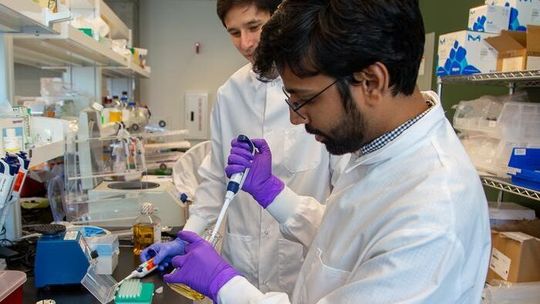
Sud Pinglay, principal investigator with AI Biodesign
(Source: Allen Institute)
“Endless forms most beautiful” was how Charles Darwin described the spectacular diversity of nature from which our current understanding of life emerged. But that diversity, which evolved over billions of years, is only a fraction of what could exist given the trillions of DNA sequences available in nature, suggesting that our natural world represents only a small slice of what could have been.
Early September 2026, AI Bio-Design — a bold new collaborative accelerator that will use artificial intelligence, large-scale experiments, and open science to explore that uncharted design space — was announced. It is a collaboration between the Allen Institute, University of Washington and Fred Hutch Cancer Center.
Working together, the AI Bio-Design team will generate open models, datasets, assays, and tools that scientists can use to create new biological solutions to improve human health, address environmental challenges, and spur advanced technologies. The goal is to learn and model the rules biology uses to build life, enabling the potential development of everything from new drugs to treat cancer and neurodegeneration, to enzymes that can break down plastics in the ocean, to biological computers that use vastly less power than current silicon chips.
“For the first time, the speed of AI is beginning to match the experimental power of synthetic biology,” said Nobel laureate David Baker, lead scientific director of AI Bio-Design, director of the UW Medicine Institute for Protein Design, and a Howard Hughes Medical Institute investigator. “That changes the question from ‘what has nature already made?’ to ‘what else is possible, and how can we test it?’ AI Bio-Design can help turn that vast unknown into models that can help us solve some of humanity’s hardest problems.”
Supported by Fund for Science and Technology (FFST), a private foundation in the Paul G. Allen philanthropic ecosystem, AI Bio-Design brings together complementary strengths across Seattle’s scientific ecosystem: the Allen Institute’s experience building large-scale, open-science platforms; the University of Washington’s expertise in synthetic biology and genome science, such as the Institute for Protein Design and UW Medicine Brotman Baty Institute for Precision Medicine; and Fred Hutch’s depth in cellular systems, genomics, and translational medicine.
“What excites me about AI Bio-Design is that it brings together the right people and the right institutions at the right time to advance biological design with AI in the loop,” said Rui Costa, president and CEO of the Allen Institute. “The Allen Institute was built for this kind of work: big science, team science, and open science that creates resources entire fields can use. AI Bio-Design combines this approach with AI models to guide which data we generate next, so experiments and models improve together in a continuous cycle of learning and testing. Ultimately, that can help us design new biological functions with greater precision.”
“AI Bio-Design is exactly the kind of ambitious, collaborative science FFST was created to support,” said Marc Malandro, chief programs officer and co-lead at Fund for Science and Technology. “As a foundation, we’re looking for projects and to create environments of not just a single discovery but for multiple discoveries and platforms of knowledge that we can share openly.”
How AI Bio-Design Will Work: Designing New Building Blocks of Life
AI Bio-Design will create a continuous learning platform for biological design. AI models will propose new biological designs, scientists will build and test those designs at scale, and the results will feed back into the models such that each round becomes more accurate and informative. Over time, this design-build-measure-learn cycle will help researchers move from trial and error toward more predictable biological engineering.
“Over the last two centuries, engineering has transformed the world at least three times: the Industrial Revolution, electrification and mechanization, and the digital revolution,” said Jay Shendure, lead scientific director of AI Bio-Design, scientific director of the UW Medicine Brotman Baty Institute for Precision Medicine, scientific director of the Seattle Hub for Synthetic Biology, and a Howard Hughes Medical Institute investigator. “We believe engineering’s fourth act lies at the intersection of AI and biology. Biology is code that builds: DNA carries digital instructions, and cells turn those instructions into physical systems with extraordinary precision. AI Bio-Design gives us a way to learn that instruction set more systematically, test it at scale, and begin designing new biological functions.”
Date: 08.12.2025
Naturally, we always handle your personal data responsibly. Any personal data we receive from you is processed in accordance with applicable data protection legislation. For detailed information please see our privacy policy.
Consent to the use of data for promotional purposes
I hereby consent to Vogel Communications Group GmbH & Co. KG, Max-Planck-Str. 7-9, 97082 Würzburg including any affiliated companies according to §§ 15 et seq. AktG (hereafter: Vogel Communications Group) using my e-mail address to send editorial newsletters. A list of all affiliated companies can be found here
Newsletter content may include all products and services of any companies mentioned above, including for example specialist journals and books, events and fairs as well as event-related products and services, print and digital media offers and services such as additional (editorial) newsletters, raffles, lead campaigns, market research both online and offline, specialist webportals and e-learning offers. In case my personal telephone number has also been collected, it may be used for offers of aforementioned products, for services of the companies mentioned above, and market research purposes.
Additionally, my consent also includes the processing of my email address and telephone number for data matching for marketing purposes with select advertising partners such as LinkedIn, Google, and Meta. For this, Vogel Communications Group may transmit said data in hashed form to the advertising partners who then use said data to determine whether I am also a member of the mentioned advertising partner portals. Vogel Communications Group uses this feature for the purposes of re-targeting (up-selling, cross-selling, and customer loyalty), generating so-called look-alike audiences for acquisition of new customers, and as basis for exclusion for on-going advertising campaigns. Further information can be found in section “data matching for marketing purposes”.
In case I access protected data on Internet portals of Vogel Communications Group including any affiliated companies according to §§ 15 et seq. AktG, I need to provide further data in order to register for the access to such content. In return for this free access to editorial content, my data may be used in accordance with this consent for the purposes stated here. This does not apply to data matching for marketing purposes.
Right of revocation
I understand that I can revoke my consent at will. My revocation does not change the lawfulness of data processing that was conducted based on my consent leading up to my revocation. One option to declare my revocation is to use the contact form found at https://contact.vogel.de. In case I no longer wish to receive certain newsletters, I have subscribed to, I can also click on the unsubscribe link included at the end of a newsletter. Further information regarding my right of revocation and the implementation of it as well as the consequences of my revocation can be found in the data protection declaration, section editorial newsletter.
A Distinct yet Complementary Approach to AI-Powered Biology
AI Bio-Design joins a fast-moving field. Around the world, teams are building foundation models, virtual-cell systems, lab-in-the-loop platforms, and AI-enabled discovery pipelines. AI Bio-Design is designed to complement those efforts by creating an open, experimentally grounded research accelerator that produces reusable resources for the broader scientific community.
Its distinction lies in the combination of multiple modular models built from tractable biological problems; new data generated from designed biological sequences and perturbations; multiplex experiments that test many designs at once; and the open sharing of models, datasets, assays, reagents, and benchmarks.
“For me, biology is ultimately a design challenge,” said Sanjay Srivatsan, an AI Bio-Design principal investigator and assistant professor at the Fred Hutch Cancer Center. “As part of AI Bio-Design, our team plans to vastly scale up the number of genomic datasets available to researchers. We can then use AI to understand biological patterns in those datasets and use those patterns to inspire solutions to biological problems, such as designing cells that can remove cancer from the body.”




:quality(80)/p7i.vogel.de/wcms/51/68/51687ac4cc19f2757c138498b877de57/0133167039v2.jpeg "CMFs are foams that consist of hollow spheres – made of materials such as stainless steel, nickel, or other metals and alloys – embedded in a metallic matrix. The resulting material is both lightweight and remarkably strong at absorbing compressive forces. (Source: Jie Sun/ NC State University)")
:quality(80)/p7i.vogel.de/wcms/cd/c0/cdc09efd1e5b3b8f83224e7729d66c10/0133105276v2.jpeg "From the data presented in this report, the authors show how TF3-MALS-RI is uniquely able to separate large polyacrylate molecules and provide precise molecular weight and Rg values. (Source: Postnova Analytics)")
:quality(80)/p7i.vogel.de/wcms/c6/f2/c6f2e2b4753a0d0cec682c03df4ed37c/0133088650v2.jpeg "PMBC vials for immunology and oncology research. (Source: Amsbio)")
:quality(80)/p7i.vogel.de/wcms/e0/72/e0728dc8dcadfc4d79a734e08cf6ced3/0133088641v2.jpeg "LM20 Microfluidizer and Cambridge CNT dispersion produced by the LM20 microfluidizer. (Source: Analytik)")
:quality(80)/p7i.vogel.de/wcms/86/01/86014d3d2a28cefc852f65c8d68317e4/0133104231v2.jpeg "Single-handed tube reading using a Handheld 2. (Source: Azenta Life Sciences)")
:quality(80)/p7i.vogel.de/wcms/0b/0f/0b0f8ed042dfc91f32582e10d54c2c7e/0133087444v2.jpeg "Offering advanced automation to increase your throughput, the Intellixcap provides secure sealing – eliminating the need for manual intervention, while preserving vital sample integrity. (Source: Azenta Life Sciences)")
:quality(80)/p7i.vogel.de/wcms/13/d3/13d35105f74a1c2e22b9c7a270e8e9b3/0132611155v2.jpeg "Circulating cell free DNA. (Source: Amsbio)")
:quality(80)/p7i.vogel.de/wcms/bc/ed/bced6850297a04dbea471a66cb6bb6fe/0132611405v2.jpeg "The latest addition to the range is a peristaltic tubing stop adapter that eliminates the need for fixed stoppers and allows custom cut lengths of peristaltic tubing to be installed on any pump head size. (Source: Biotech Fluidics )")
:quality(80)/p7i.vogel.de/wcms/a1/af/a1afbc7c8a067bbe94749ec680b4bafd/0133163762v2.jpeg "The study found in murkier water, fish took longer to move towards the food than those in clear water, but individuals in larger groups responded more quickly overall. (Source: Christos Ioannou)")
:quality(80)/p7i.vogel.de/wcms/32/80/3280aa3d44708962943c96fe2d466744/0133088560v2.jpeg "A bumble bee in flight at the University of Bristol Botanic Garden. (Source: Phil Savoie)")
:quality(80)/p7i.vogel.de/wcms/7b/e5/7be5c735140cbe28f3af0ec3d88274b9/0133045403v2.jpeg "After being buried in the ground for two months and broken down by soil organisms, a new pair of cotton underwear (left) shows clear signs of decomposition (right). (Source: Nicolas Zonvi)")
:quality(80)/p7i.vogel.de/wcms/c7/5e/c75e9b334a94b8b5c2a758f20ba080a8/0133039712v1.jpeg "Researchers have developed a microaerobic activated sludge process that enables ammonium to be recovered from fermentation industry wastewater instead of releasing nitrogen into the atmosphere. (Source: free licensed)")
:quality(80)/p7i.vogel.de/wcms/d4/61/d461ce0bd5743897993c6475f69e7ad6/0133067478v2.jpeg "In Harris County, 50 % of households with children reported food insecurity, compared with 33 % of households without children. (Source: Rice University)")
:quality(80)/p7i.vogel.de/wcms/79/76/7976d17b980bedfe35acaa532d690046/0132713841v2.jpeg "Observed rice yield losses from 1°C warming are more than twice as high as model estimates due to underestimated heat stress. (Source: AdobeStock/ducvien)")
:quality(80)/p7i.vogel.de/wcms/28/b6/28b6114fc9915c5dadee94d5c89bd129/0132593216v2.jpeg "Eating foods that contain common preservative food additives may increase the risks of high blood pressure and cardiovascular disease. (Source: Unsplash)")
:quality(80)/p7i.vogel.de/wcms/01/bc/01bcb16a3381a1d46533861eedbbae71/0132371290v1.jpeg "Adding spice may help people eat less by slowing them down. (Source: free licensed)")
:quality(80)/p7i.vogel.de/wcms/6a/d8/6ad838b20e80c36d04940b5a6bc8ccf1/0133167025v2.jpeg "Dr Kassandra Giragosian and a chimp (Source: Kassandra Giragosian)")
:quality(80)/p7i.vogel.de/wcms/6b/30/6b30243e240851f135c1f7cf4fd41c29/0133166867v1.jpeg "5-HT2A-PET (Source: Mikael Palner/ University of Southern Denmark)")
:quality(80)/p7i.vogel.de/wcms/11/29/112984f0c5d11cd5daf58fbfbc1d3aac/0133166885v1.jpeg "Researchers develop a parametric design tool that converts the desired dimensions of a body part into a printable 2D pattern for a self-folding paper wearable device. This approach integrated with copper tape electrodes allows biosignal measurements. (Source: Dr. Hiroki Shigemune/ Shibaura Institute of Technology)")
:quality(80)/p7i.vogel.de/wcms/23/9f/239f474c3e568804360678fbd48f8008/0133166989v2.jpeg "Sud Pinglay, principal investigator with AI Biodesign (Source: Allen Institute)")
:quality(80)/images.vogel.de/vogelonline/bdb/1710600/1710675/original.jpg "Discover how to set yourself up for success when performing balance-based density determination of solids such as jewelry and precious metals. (Mettler Toledo)")
:quality(80)/images.vogel.de/vogelonline/bdb/1682500/1682579/original.jpg "The new XPR Analytical balance redesigned to meet the needs of laboratory technicians of working fast and lean. (Mettler Toledo)")
:quality(80)/images.vogel.de/vogelonline/bdb/1677000/1677080/original.jpg "Enhance your weighing accuracy, comfort and productivity with the redesigned XPR Analytical balance. (Mettler Toledo)")
:quality(80)/p7i.vogel.de/wcms/df/88/df8835c56e846aa705d3b9c250a7fa4e/0130918703v1.jpeg "From left: Denise Catacutan, Jon Stokes and Gary Liu recently created a new AI model for drug development, and used it to design a new topical antibiotic. (Source: McMaster University)")