A wirelessly powered implant has regulated blood sugar in diabetic mice by converting glucose into gluconate using an inorganic catalyst. Developed by ETH Zurich researchers, the system offers a potential approach to diabetes management without drugs, but has yet to be tested in humans.
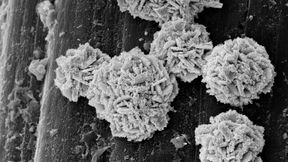
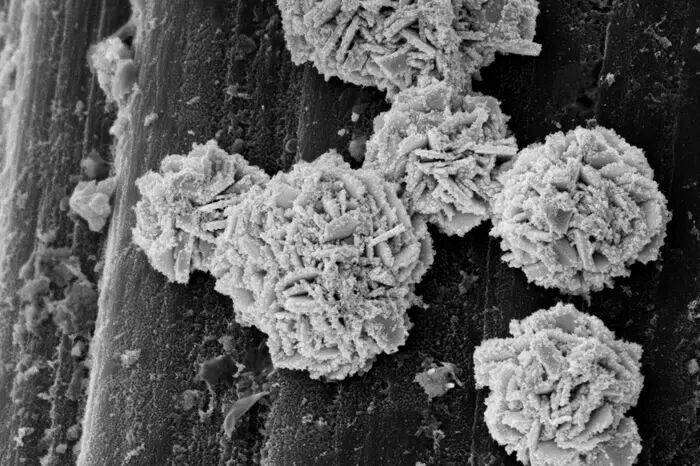
The spherical structures resemble desert roses and consist of tiny gold platelets “dusted” with platinum particles.
(Source: Debasis Maity, Biotechnology and Bioengineering Group / ETH Zurich)
Type 2 diabetes is becoming increasingly common worldwide. Unlike type 1 diabetes, it is often linked to obesity, a sedentary lifestyle and excess energy intake over many years. Although insulin injections can bring blood sugar levels down, they do not address the body’s chronic energy surplus. Insulin merely helps muscle cells take up glucose from the bloodstream, but if the body does not use that energy, the excess is converted into fat. This helps explain why many patients continue to gain weight despite treatment.
Now, a team led by Martin Fussenegger has developed a potential new way to treat diabetes: an implantable system that uses an electrically powered catalyst to lower blood glucose. Fussenegger is a professor in ETH Zurich’s Department of Biosystems Science and Engineering in Basel. The team’s findings have been published in Science.
New Approach Uses Electronics Instead of Biomolecules
For years, the Basel-based team of researchers has been exploring ways to tackle diabetes with systems that regulate blood sugar. Earlier approaches relied on specially developed genetic networks. However, these systems depend on biological components, which pose additional challenges in areas such as immune tolerance, stability, manufacturing and regulatory approval.
The new system gets around this problem with a catalyst made entirely from inorganic materials, which needs no cells, enzymes or other biological components. It consists of graphite felt studded with gold nanoclusters, which are themselves decorated with even smaller platinum particles. The materials showed excellent biocompatibility in the experimental study, says Fussenegger. The team developed the catalyst’s nanostructured surface themselves.
The implant also contains an electronic control unit housed in a 3D-printed casing. Power is supplied wirelessly at a frequency of 13.56 MHz, which is internationally designated for industrial, scientific and medical applications.
Converting Glucose into Gluconate
The catalyst converts excess glucose in the blood into gluconate. This means that some of the glucose is no longer metabolised and stored in tissue, which also helps limit the build-up of body fat. The gluconate is then excreted in the urine.
The catalyst is controlled wirelessly through a closed-loop system. A standard glucose sensor, like those commonly worn on the upper arm by people with diabetes, continuously monitors glucose levels in the tissue. If blood sugar rises too high after a meal, the sensor sends a signal via Bluetooth to a smartphone or smartwatch. The smart device then activates the catalyst, which uses electrical energy to convert the glucose. Once glucose levels have fallen to the desired level, the device switches itself off automatically, protecting patients from dangerously low blood sugar.
Successfully Tested in Mice
In a laboratory experiment, Fussenegger’s team tested the system in a reservoir holding 5 litres of a glucose-containing nutrient solution – roughly the volume of blood in the human body. This showed that the catalyst was capable of converting glucose in this volume of solution. The researchers also tested the system in diabetic mice and found that the animals’ blood sugar could be precisely regulated. The mice lost weight, the implant was well tolerated and it operated reliably during a six-week period. “The system operates at a very low voltage, and our experiments showed no evidence of tissue damage from either electrical or thermal effects,” says Fussenegger. The team has not yet tested the device on humans.
Paradigm Shift: From Conventional Drugs to an Electronic Device
Fussenegger sees the approach as a paradigm shift away from conventional drugs and towards scalable, electronically controlled treatments that can be integrated into digital environments such as the Internet of Things. “
Date: 08.12.2025
Naturally, we always handle your personal data responsibly. Any personal data we receive from you is processed in accordance with applicable data protection legislation. For detailed information please see our privacy policy.
Consent to the use of data for promotional purposes
I hereby consent to Vogel Communications Group GmbH & Co. KG, Max-Planck-Str. 7-9, 97082 Würzburg including any affiliated companies according to §§ 15 et seq. AktG (hereafter: Vogel Communications Group) using my e-mail address to send editorial newsletters. A list of all affiliated companies can be found here
Newsletter content may include all products and services of any companies mentioned above, including for example specialist journals and books, events and fairs as well as event-related products and services, print and digital media offers and services such as additional (editorial) newsletters, raffles, lead campaigns, market research both online and offline, specialist webportals and e-learning offers. In case my personal telephone number has also been collected, it may be used for offers of aforementioned products, for services of the companies mentioned above, and market research purposes.
Additionally, my consent also includes the processing of my email address and telephone number for data matching for marketing purposes with select advertising partners such as LinkedIn, Google, and Meta. For this, Vogel Communications Group may transmit said data in hashed form to the advertising partners who then use said data to determine whether I am also a member of the mentioned advertising partner portals. Vogel Communications Group uses this feature for the purposes of re-targeting (up-selling, cross-selling, and customer loyalty), generating so-called look-alike audiences for acquisition of new customers, and as basis for exclusion for on-going advertising campaigns. Further information can be found in section “data matching for marketing purposes”.
In case I access protected data on Internet portals of Vogel Communications Group including any affiliated companies according to §§ 15 et seq. AktG, I need to provide further data in order to register for the access to such content. In return for this free access to editorial content, my data may be used in accordance with this consent for the purposes stated here. This does not apply to data matching for marketing purposes.
Right of revocation
I understand that I can revoke my consent at will. My revocation does not change the lawfulness of data processing that was conducted based on my consent leading up to my revocation. One option to declare my revocation is to use the contact form found at https://contact.vogel.de. In case I no longer wish to receive certain newsletters, I have subscribed to, I can also click on the unsubscribe link included at the end of a newsletter. Further information regarding my right of revocation and the implementation of it as well as the consequences of my revocation can be found in the data protection declaration, section editorial newsletter.
For decades, we have treated diabetes by telling the body how to manage glucose. We are now showing that we can take control of glucose directly, using electronics rather than drugs,” he says. “And the catalyst only activates when glucose levels are too high.”
The team now plans to develop the system into a medical device. Because the glucose-lowering mechanism itself works without cells or enzymes, technical development could be more straightforward.
Another advantage is that the components needed to build such a device, including external control and wireless power transmission devices, have already been developed and are commercially available.
Original Article: Wireless electrocatalytic closed-loop system for drug-free management of diabesity; Science; DOI:10.1126/science.ady8560