Learning in Virtual RealityVR Study Suggests Movement Can Shape How People Learn
Source: Press release
Florida Atlantic University
4 min Reading Time
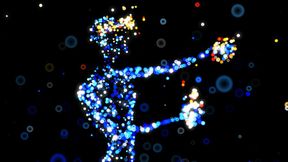
Punching a virtual response box or swinging a virtual lightsaber can dramatically improve learning on certain tasks, according to new research from Florida Atlantic University’s College of Engineering and Computer Science, which challenges long-standing assumptions about how people learn.
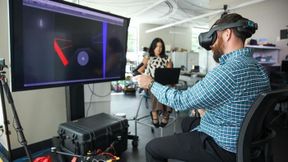
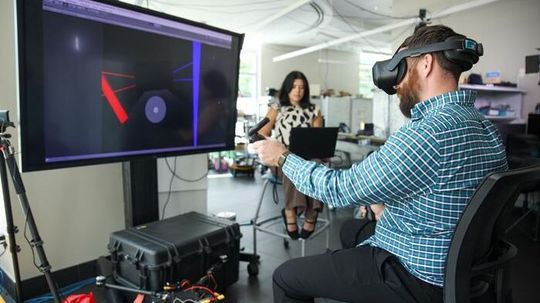
Luke Rosedahl, Ph.D., and Isabella Cabaleiro, research lab specialist, participate in a virtual reality experiment examining how movement affects learning.
(Source: Florida Atlantic University)
Deciding whether a road is slippery, recognizing a potentially dangerous lesion on a medical scan or determining whether a piece of fruit is ripe may seem like tasks of the mind alone. But in everyday life, categorizing what we see is often closely tied to how we move and interact with the world around us.
Despite this connection, decades of research have largely treated category learning as a cognitive process, with physical movement serving only to express a decision after it has been made. Surprisingly, little research has examined whether the physical actions people make while categorizing information can actually influence how well they learn.
Now, Florida Atlantic and Brown University researchers have found that larger movements can significantly improve learning. However, the benefit depends on the type of category being learned.
The findings, published in Science Advances, challenge traditional theories of category learning, which generally focus on how people mentally represent and recognize objects, treating movement as the final step in the process. Instead, the research suggests that physical responses may play an active role in shaping what people learn.
To investigate, the researchers developed an immersive virtual reality experiment in which participants learned to categorize visual patterns using either simple button presses or larger arm movements. Participants either swung a virtual lightsaber to hit a target or punched a response box without directly interacting with the visual stimulus. Researchers tested two types of category learning. One relies on explicit rules, such as identifying an object based on specific features. The other requires people to recognize patterns and integrate multiple features to make a judgment, often without being able to articulate exactly how they reach a decision.
Our findings suggest movement can also shape learning itself.
Luke Rosedahl, Ph.D.
The results revealed a striking difference. Participants who used larger arm movements learned the similarity-based categories more effectively and achieved greater accuracy than those who responded with simple button presses. However, larger movements provided no meaningful benefit for learning categories based on explicit rules, even when the researchers made that task more challenging.
“What surprised me most was how selective the effect was,” said Luke Rosedahl, Ph.D., corresponding author, an assistant professor in FAU’s Department of Biomedical Engineering, a faculty fellow of FAU’s Institute for Smarter Cities, Spaces, and Health, and a member of the FAU Stiles-Nicholson Brain Institute. “We found that larger movements substantially improved learning when people had to recognize patterns by integrating multiple features, but provided no meaningful benefit when people learned categories using explicit rules. Even more intriguing, the benefit occurred whether participants swung at the target or punched a separate response box. The movement itself appeared to matter, not whether it directly interacted with what they were learning.”
The researchers conducted additional experiments to determine whether the improvement could be explained by other factors. They controlled the amount of time participants viewed each image, accounted for differences in response speed and made the rule-based task more complex. The advantage for larger movements remained specific to similarity-based learning.
Perhaps most tellingly, participants who trained using larger movements retained their advantage even after switching to simple button presses. This suggests that movement helped strengthen learning itself, rather than simply making it easier to respond correctly in the moment.
“For decades, category learning has been studied largely as a process in which the brain decides what something is and then directs the body how to respond,” said Rosedahl. “Our findings suggest movement can also shape learning itself. By showing that movement benefits some types of learning but not others, we can refine existing theories and better understand how perception, decision-making and motor systems work together. We also need to ask whether traditional button-press tasks have overlooked ways to improve learning.”
Date: 08.12.2025
Naturally, we always handle your personal data responsibly. Any personal data we receive from you is processed in accordance with applicable data protection legislation. For detailed information please see our privacy policy.
Consent to the use of data for promotional purposes
I hereby consent to Vogel Communications Group GmbH & Co. KG, Max-Planck-Str. 7-9, 97082 Würzburg including any affiliated companies according to §§ 15 et seq. AktG (hereafter: Vogel Communications Group) using my e-mail address to send editorial newsletters. A list of all affiliated companies can be found here
Newsletter content may include all products and services of any companies mentioned above, including for example specialist journals and books, events and fairs as well as event-related products and services, print and digital media offers and services such as additional (editorial) newsletters, raffles, lead campaigns, market research both online and offline, specialist webportals and e-learning offers. In case my personal telephone number has also been collected, it may be used for offers of aforementioned products, for services of the companies mentioned above, and market research purposes.
Additionally, my consent also includes the processing of my email address and telephone number for data matching for marketing purposes with select advertising partners such as LinkedIn, Google, and Meta. For this, Vogel Communications Group may transmit said data in hashed form to the advertising partners who then use said data to determine whether I am also a member of the mentioned advertising partner portals. Vogel Communications Group uses this feature for the purposes of re-targeting (up-selling, cross-selling, and customer loyalty), generating so-called look-alike audiences for acquisition of new customers, and as basis for exclusion for on-going advertising campaigns. Further information can be found in section “data matching for marketing purposes”.
In case I access protected data on Internet portals of Vogel Communications Group including any affiliated companies according to §§ 15 et seq. AktG, I need to provide further data in order to register for the access to such content. In return for this free access to editorial content, my data may be used in accordance with this consent for the purposes stated here. This does not apply to data matching for marketing purposes.
Right of revocation
I understand that I can revoke my consent at will. My revocation does not change the lawfulness of data processing that was conducted based on my consent leading up to my revocation. One option to declare my revocation is to use the contact form found at https://contact.vogel.de. In case I no longer wish to receive certain newsletters, I have subscribed to, I can also click on the unsubscribe link included at the end of a newsletter. Further information regarding my right of revocation and the implementation of it as well as the consequences of my revocation can be found in the data protection declaration, section editorial newsletter.
The findings could inform training for complex tasks that require people to integrate information and recognize patterns, including medical diagnosis and aviation. These tasks can be difficult to learn and resistant to traditional teaching methods. In earlier research, Rosedahl found that providing written instructions on exactly how to perform a task did not improve performance.
“Incorporating movement could offer a simple way to improve learning in situations where conventional approaches fall short,” said Rosedahl.
The findings also challenge traditional training designs that minimize movement, suggesting that doing so may inadvertently limit performance. Immersive virtual reality could offer a way to incorporate purposeful movement into training, though further research is needed to determine whether the benefits extend to real-world settings.
“This study challenges us to rethink something fundamental about learning: the relationship between thought and action,” said Stella Batalama, Ph.D., dean of FAU’s College of Engineering and Computer Science. “Understanding how movement shapes learning could lead to new approaches for teaching complex skills and preparing people to make decisions in demanding, real-world situations.”