The blood–brain barrier remains one of the biggest obstacles to treating neurological diseases. Researchers at Caltech have developed light-activated nanorobots that can cross this protective barrier, increasing drug delivery to the brain fivefold in preclinical experiments.
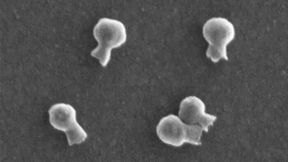
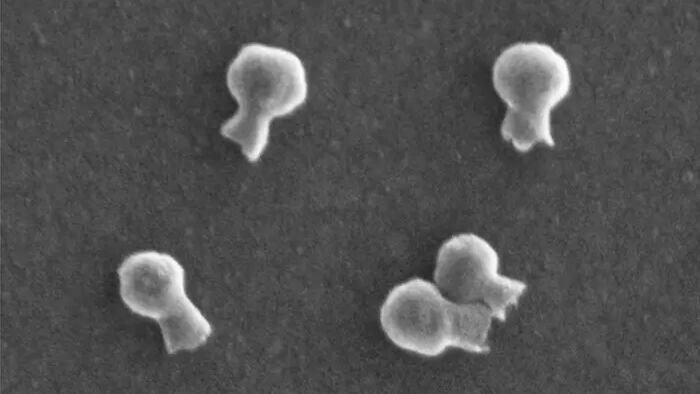
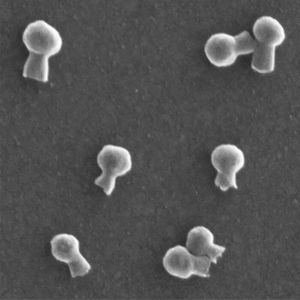
Scanning electron microscopy of BrainBots shows their asymmetric structure and size distribution.
(Source: Wei Gao lab / Caltech)
As the primary command center of our bodies, human brains have several layers of protection to help keep them safe from dangerous invaders. Unfortunately, some of these safeguards — in particular, the blood–brain barrier (BBB) — make it hard to deliver medications to this essential organ.
Researchers led by Caltech’s Wei Gao, professor of medical engineering and a Heritage Medical Research Institute Investigator, have developed a nanorobotic system called Brainbots that can successfully cross the BBB to deliver lifesaving therapeutics for neurological disorders and other diseases, including cancer.
Gallery
“We showed that our Brainbots can carry medication through the bloodstream and help deliver it across the blood–brain barrier, one of the biggest challenges in treating brain diseases,” Gao says. In the study, light-activated Brainbots delivered approximately five times more medication to the brain than nonactivated counterparts.
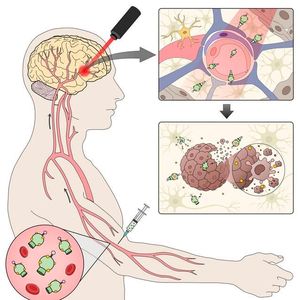
The BBB is a protective filter that lines the brain’s blood vessels and is notoriously hard to penetrate, making the treatment of brain disorders very difficult. Many medications are delivered through intravenous (IV) injection, but the BBB prevents most drugs from entering the brain in sufficient amounts. To address this issue, Gao and the team used established biocompatible and biodegradable materials to build nanoscale “robots“ that can be activated by light to self-propel, pushing them toward the cells on the BBB, so they can then be ushered into the brain.
Brainbots, which look like tiny, asymmetric balloons, work like this: A chamber is loaded with ammonium bicarbonate, a gas-generating fuel, then encapsulated in a shell with a temperature-sensitive gate and attached to the medication payload. The capsules, which are approximately 250 nanometers in size, or hundreds of times smaller than the width of a human hair, are injected into the bloodstream. Near-infrared light is then directed through the skull to activate the Brainbots near the BBB. The light generates localized heat that melts the gate and triggers the production of gas, propelling the Brainbots to make contact with BBB cells. The Brainbots are equipped with specialized DNA molecules called aptamers, which help them recognize and bind to cells lining the BBB, meaning they can be taken up by these cells and transported across the barrier into the brain. Once inside, the nanobot further degrades to release medication, and the entire structure eventually disintegrates.
The team tested Brainbots in mouse models of glioblastoma, the most common type of brain cancer, and showed that the bots' ability to move closer to their BBB cell targets greatly enhanced their ability to deliver doxorubicin, a powerful chemotherapy drug, to the brain. The treatment slowed tumor growth and prolonged survival in mice without detectable disruption of the BBB. It also reduced systemic toxicity compared with conventional administration of the chemotherapy drug alone.
“Because the Brainbots are so small and the blood circulation is so fast, we initially were not sure how much a method based on nanoscale propulsion would increase the passage of drugs through the BBB,” Gao says. “We are thrilled to see it worked so well.”
In recent collaborations with Mikhail Shapiro, Caltech’s Max Delbrück Professor of Chemical Engineering and Medical Engineering and a Howard Hughes Medical Institute (HHMI) Investigator, Gao and his lab developed nanobots for targeted drug delivery and tested a version that could autonomously carry anti-tumor therapeutics to bladder tumors. The new study extends this approach to the brain using light-activated nanorobots to help drugs cross the BBB.
“Our new nanorobot is not limited to brain delivery, but we are trying to address one of the biggest problems in medicine — crossing the blood–brain barrier — as a starting point,” Gao explains. “We targeted cancer, but there are a lot of neurological diseases, such as Parkinson’s, for example, that we hope could benefit from this technology.”
Date: 08.12.2025
Naturally, we always handle your personal data responsibly. Any personal data we receive from you is processed in accordance with applicable data protection legislation. For detailed information please see our privacy policy.
Consent to the use of data for promotional purposes
I hereby consent to Vogel Communications Group GmbH & Co. KG, Max-Planck-Str. 7-9, 97082 Würzburg including any affiliated companies according to §§ 15 et seq. AktG (hereafter: Vogel Communications Group) using my e-mail address to send editorial newsletters. A list of all affiliated companies can be found here
Newsletter content may include all products and services of any companies mentioned above, including for example specialist journals and books, events and fairs as well as event-related products and services, print and digital media offers and services such as additional (editorial) newsletters, raffles, lead campaigns, market research both online and offline, specialist webportals and e-learning offers. In case my personal telephone number has also been collected, it may be used for offers of aforementioned products, for services of the companies mentioned above, and market research purposes.
Additionally, my consent also includes the processing of my email address and telephone number for data matching for marketing purposes with select advertising partners such as LinkedIn, Google, and Meta. For this, Vogel Communications Group may transmit said data in hashed form to the advertising partners who then use said data to determine whether I am also a member of the mentioned advertising partner portals. Vogel Communications Group uses this feature for the purposes of re-targeting (up-selling, cross-selling, and customer loyalty), generating so-called look-alike audiences for acquisition of new customers, and as basis for exclusion for on-going advertising campaigns. Further information can be found in section “data matching for marketing purposes”.
In case I access protected data on Internet portals of Vogel Communications Group including any affiliated companies according to §§ 15 et seq. AktG, I need to provide further data in order to register for the access to such content. In return for this free access to editorial content, my data may be used in accordance with this consent for the purposes stated here. This does not apply to data matching for marketing purposes.
Right of revocation
I understand that I can revoke my consent at will. My revocation does not change the lawfulness of data processing that was conducted based on my consent leading up to my revocation. One option to declare my revocation is to use the contact form found at https://contact.vogel.de. In case I no longer wish to receive certain newsletters, I have subscribed to, I can also click on the unsubscribe link included at the end of a newsletter. Further information regarding my right of revocation and the implementation of it as well as the consequences of my revocation can be found in the data protection declaration, section editorial newsletter.
While only a fraction of the Brainbots made it into the brain, the technology represents a major step in improving the delivery of therapeutics across the BBB. Those that remained in other parts of the body were expected to degrade as they are taken up by organs such as the liver and spleen, as is typical for most nanoparticle-based drug carriers, Gao says. Next, the team plans to further improve the nanorobotic system and evaluate its potential for future clinical applications.
“We’re working on optimizing the near-infrared light delivery and evaluating the long-term safety, stability, and degradation of the nanorobots in the body,” Gao says. “Although more research is needed before we can move toward human studies, we’re excited about the potential of this technology for treating brain diseases.”
Original Article: Photothermally gated nanorobots for active blood-brain barrier transcytosis and brain delivery; Science Robotics; DOI:10.1126/scirobotics.aef1928