Metal nanoparticles undergo continuous structural changes during catalytic reactions. Using an advanced electron microscopy technique, researchers have revealed how these changes could contribute to more efficient carbon dioxide conversion into methanol and the development of longer-lasting industrial catalysts.
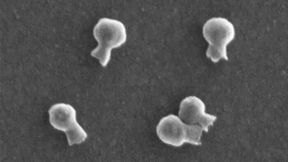
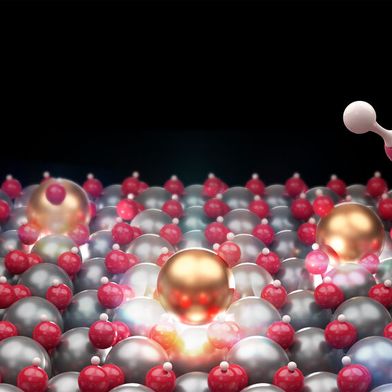
Image represents a catalyst particle wrapped in a protective shell with windows, which help stabilise the catalyst while retaining its activity.
(Source: Dr Anabel Lanterna/ University of Nottingham)
Catalyst particles, long thought of as relatively static materials, are in fact living a surprisingly dynamic existence. Researchers at the University of Nottingham and Cardiff University with collaborators across the UK, have captured this hidden world by following individual catalyst nanoparticles through the key stages of a chemical reaction that converts carbon dioxide into methanol, a sustainable fuel and industrial feedstock, for the first time. This study has been published today in ACS Nano.
The discovery reveals that catalyst particles move, merge, rotate, grow, shrink and even wrap themselves in atomically thin protective shells that open and close tiny pores only billionths of a metre wide. These remarkable behaviours were invisible to conventional techniques and only became apparent when scientists used a specialised “identical-location“ electron microscopy approach, returning repeatedly to exactly the same nanoparticles at carefully chosen moments during the reaction.
The findings provide an unprecedented glimpse into what researchers describe as the “private life“ of catalyst particles and could help accelerate the development of more efficient catalysts for sustainable fuel production and other industrially important reactions.
Watching the Same Particles Through Time
Catalysts are the unsung heroes of modern industry. They speed up chemical reactions used to manufacture fuels, fertilisers, medicines and countless everyday products. Yet despite their importance, scientists have struggled to understand exactly how individual catalyst particles change while they are working.
Most analytical techniques average the behaviour of millions of particles, much like trying to understand a football match by looking only at the final score. The Nottingham team took a very different approach. They tracked the same nanoparticles before activation, after hydrogen treatment, and again after carbon dioxide hydrogenation, effectively creating an atomic-scale time-lapse record of the catalysts' evolution.
“What we discovered was astonishing,” said Dr Yifan Chen, who carried out electron microscopy experiments at the University of Nottingham. “The catalyst particles are constantly changing. They travel across the surface, combine with their neighbours, rotate relative to the support beneath them and even change local environment around themselves. None of this could be understood by looking at averages. We had to follow individual particles through the reaction to reveal their story.“
A Dramatic Transformation
The biggest surprise came during catalyst activation, the preparatory stage before the main reaction begins. The researchers observed that roughly half of the visible nanoparticles disappeared as neighbouring particles migrated and merged together. Others grew by consuming atoms released from nearby particles. At the same time, the nanoparticles became more ordered and crystalline, forming the active structures needed for efficient catalysis.
“But the most striking discovery was what happened next,” said Professor Andrei Khlobystov, expert in imaging atoms in action, University of Nottingham. “As the catalyst converted carbon dioxide and hydrogen into methanol, the zinc oxide support material began to creep over the metal nanoparticles, creating atomically thin shells. Rather than sealing the particles away, these shells developed tiny dynamic openings, less than a nanometre across, that continuously changed position during the reaction.”
Nature's Own Nanoscale Engineering
The team found that these self-assembled shells perform a delicate balancing act. They prevent the particles from moving and colliding with one another, helping preserve the catalyst's structure and longevity. Yet the shells remain flexible enough to allow subtle reshaping of the nanoparticles and continued access for reacting molecules.
“This is a beautiful example of self-organisation at the nanoscale,” said Dr Jesum Alves Fernandes, catalyst nanofabrication expert who lead the study. “The catalyst essentially restructures itself into a more effective form during operation, a phenomenon similar to our recent discovery of a self-improving catalyst for hydrogen generation from ammonia. In the case, however, the oxide shell maximises the interface between the metal and its support, which is where much of the chemistry occurs, while maintaining pathways for molecules to enter and leave.“
Date: 08.12.2025
Naturally, we always handle your personal data responsibly. Any personal data we receive from you is processed in accordance with applicable data protection legislation. For detailed information please see our privacy policy.
Consent to the use of data for promotional purposes
I hereby consent to Vogel Communications Group GmbH & Co. KG, Max-Planck-Str. 7-9, 97082 Würzburg including any affiliated companies according to §§ 15 et seq. AktG (hereafter: Vogel Communications Group) using my e-mail address to send editorial newsletters. A list of all affiliated companies can be found here
Newsletter content may include all products and services of any companies mentioned above, including for example specialist journals and books, events and fairs as well as event-related products and services, print and digital media offers and services such as additional (editorial) newsletters, raffles, lead campaigns, market research both online and offline, specialist webportals and e-learning offers. In case my personal telephone number has also been collected, it may be used for offers of aforementioned products, for services of the companies mentioned above, and market research purposes.
Additionally, my consent also includes the processing of my email address and telephone number for data matching for marketing purposes with select advertising partners such as LinkedIn, Google, and Meta. For this, Vogel Communications Group may transmit said data in hashed form to the advertising partners who then use said data to determine whether I am also a member of the mentioned advertising partner portals. Vogel Communications Group uses this feature for the purposes of re-targeting (up-selling, cross-selling, and customer loyalty), generating so-called look-alike audiences for acquisition of new customers, and as basis for exclusion for on-going advertising campaigns. Further information can be found in section “data matching for marketing purposes”.
In case I access protected data on Internet portals of Vogel Communications Group including any affiliated companies according to §§ 15 et seq. AktG, I need to provide further data in order to register for the access to such content. In return for this free access to editorial content, my data may be used in accordance with this consent for the purposes stated here. This does not apply to data matching for marketing purposes.
Right of revocation
I understand that I can revoke my consent at will. My revocation does not change the lawfulness of data processing that was conducted based on my consent leading up to my revocation. One option to declare my revocation is to use the contact form found at https://contact.vogel.de. In case I no longer wish to receive certain newsletters, I have subscribed to, I can also click on the unsubscribe link included at the end of a newsletter. Further information regarding my right of revocation and the implementation of it as well as the consequences of my revocation can be found in the data protection declaration, section editorial newsletter.
The researchers believe this dynamic architecture helps explain why the catalyst shows high productivity for methanol synthesis from carbon dioxide.
Implications for Net-Zero Technologies
Methanol is increasingly viewed as a key component of future sustainable energy systems because it can be produced from captured carbon dioxide and renewable hydrogen. “Understanding how catalysts behave under working conditions is therefore essential for improving technologies that recycle greenhouse gases into useful products, said Professor Graham Hutchings, Cardiff University, a leading catalysis expert. “Beyond methanol synthesis, the discovery may influence the design of catalysts for processes ranging from ammonia production to hydrogenation reactions used throughout the chemical industry. The principle of dynamic nanoporous oxide shells could provide a general strategy for creating catalysts that are both highly active and long-lasting.”
Perhaps most importantly, the work demonstrates the power of identical-location electron microscopy as a new way to observe materials in action. “For decades, catalyst particles have hidden their behaviour from us because we were looking at different particles before and after the reaction,” said Professor Khlobystov. “By returning to exactly the same nanoparticles at critical stages, and treating them as individuals, we can finally watch their private lives unfold. It's like moving from still photographs to a movie, and that opens an entirely new way of understanding how catalysts really work.“
Original Article: Formation of Dynamic Nanoporous Shells on Bimetallic Particles During Carbon Dioxide Hydrogenation; ACS Nano; DOI:10.1021/acsnano.6c14509