Could the ingredients for life have arrived on a comet? Cambridge-led simulations suggest that delivering useful concentrations of a key prebiotic molecule to early Earth would have required an exceptionally rare combination of impact conditions and rapid chemistry.
Comets didn’t seed life on Earth after all, a new study suggests, potentially overturning a century-old idea.
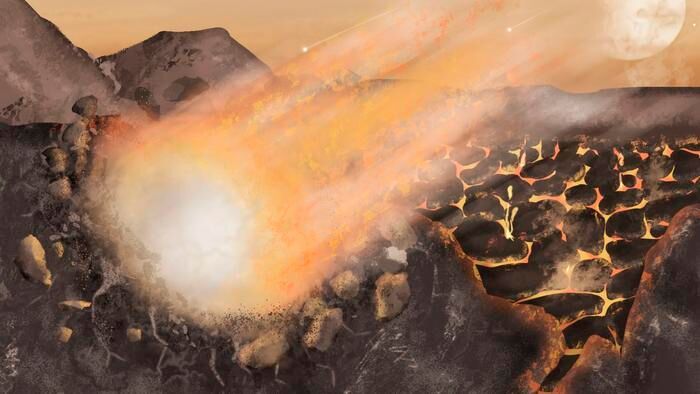
(Source: Scarlett White)
The theory that comets delivered the molecular building blocks for life on Earth is a long-standing one, since comets are known to carry many of these molecules. However, a new study challenges this idea. The researchers, led by the University of Cambridge, found the cometary delivery of these building blocks would be — at best — a ‘one-off fluke’, and not the steady rain of prebiotic molecules that had been theorised.
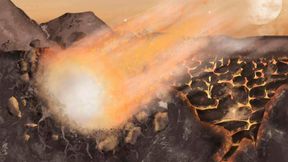
Using computer modelling, the researchers determined that comets travel too fast and at too sharp an angle to Earth’s atmosphere for the fragile organic molecules to survive: they would almost certainly vaporise on impact with the surface. However, the researchers also found that another planet in our system — Mars — could be a slightly more promising candidate for cometary delivery of prebiotic molecules, although this is still highly unlikely. The results are published in the journal Scientific Reports.
“Historically, scientists thought that comets were important for the origin of life on Earth, because they carried carbon and nitrogen-bearing molecules, so these giant space snowballs were almost like a ‘get out of jail free card’ that brought all the molecules a planet would need to seed life,” said lead author Dr Richard Anslow from Cambridge’s Institute of Astronomy. “It’s kind of a romantic idea, but our results suggest it’s highly unlikely.”
In 2023, Anslow and several of his co-authors on the current paper theorised that in systems where planets orbit closely together, comets might slow down by ‘bouncing’ from one planet to the next, delivering organic molecules as they went.
Building on the earlier study, Anslow and his colleagues investigated whether such a scenario might be possible in our own Solar System. “We’re learning more and more all the time about how our Solar System and the Earth formed, and pulling this together with lots of different advances in modelling, which allowed us to investigate this idea that has been around for close to a century,” he said.
However, the new study shows just how rare that scenario is. The researchers used recent advances in comet impact simulations, comet-atmosphere interactions, and dynamic modelling of the origin and evolution of comets, to conduct their study. Taken together, the researchers found that the while the successful delivery of prebiotic molecules cannot be ruled out completely, it would be extremely unlikely.
For their study, the researchers focused on hydrogen cyanide (HCN), an important prebiotic molecule that is regularly found on Solar System comets. Their simulations showed that even in the rare event that HCN molecules survived impact with Earth, impacts delivering a useful concentration were extremely uncommon.
The number of comets hitting the Earth declined rapidly in our planet’s first 500 million years, and there were, at most, a handful of opportunities in Earth’s early history for HCN delivery on a comet. Even if HCN carried on a comet made it to the Earth’s surface, it would not have stayed concentrated for long, meaning that any prebiotic chemistry would have needed to progress very quickly from impact, which the researchers say is highly unlikely.
“It would really have to be a one-in-a-million occurrence, because not only would you need an impact at just the right speed and just the right angle, you would also need everything to happen after that point, in terms of the concentration and the speed at which the chemical origins of life got going,” said Anslow.
We can’t rule out for certain that it happened that way. But it seems to be a really rare occurrence — at best, a one-off fluke.
Dr Richard Anslow; Cambridge Institute of Astronomy
So where did the molecular seeds of life on Earth come from? The researchers say there are several possibilities, including the synthesis of these molecules following the impact of asteroids, which hit the Earth far more frequently than comets. Or the chemical precursors formed from processes that occurred on Earth itself, without any outside interference.
Although cometary delivery of HCN and other prebiotic molecules to Earth seems highly unlikely, the researchers found that one of our closest neighbours could be a better candidate. Since Mars is smaller than Earth, and currently has a much thinner atmosphere, comets would be much more likely to make it to the planet’s surface during the period of the Solar System’s development when comets were far more frequent visitors.
Date: 08.12.2025
Naturally, we always handle your personal data responsibly. Any personal data we receive from you is processed in accordance with applicable data protection legislation. For detailed information please see our privacy policy.
Consent to the use of data for promotional purposes
I hereby consent to Vogel Communications Group GmbH & Co. KG, Max-Planck-Str. 7-9, 97082 Würzburg including any affiliated companies according to §§ 15 et seq. AktG (hereafter: Vogel Communications Group) using my e-mail address to send editorial newsletters. A list of all affiliated companies can be found here
Newsletter content may include all products and services of any companies mentioned above, including for example specialist journals and books, events and fairs as well as event-related products and services, print and digital media offers and services such as additional (editorial) newsletters, raffles, lead campaigns, market research both online and offline, specialist webportals and e-learning offers. In case my personal telephone number has also been collected, it may be used for offers of aforementioned products, for services of the companies mentioned above, and market research purposes.
Additionally, my consent also includes the processing of my email address and telephone number for data matching for marketing purposes with select advertising partners such as LinkedIn, Google, and Meta. For this, Vogel Communications Group may transmit said data in hashed form to the advertising partners who then use said data to determine whether I am also a member of the mentioned advertising partner portals. Vogel Communications Group uses this feature for the purposes of re-targeting (up-selling, cross-selling, and customer loyalty), generating so-called look-alike audiences for acquisition of new customers, and as basis for exclusion for on-going advertising campaigns. Further information can be found in section “data matching for marketing purposes”.
In case I access protected data on Internet portals of Vogel Communications Group including any affiliated companies according to §§ 15 et seq. AktG, I need to provide further data in order to register for the access to such content. In return for this free access to editorial content, my data may be used in accordance with this consent for the purposes stated here. This does not apply to data matching for marketing purposes.
Right of revocation
I understand that I can revoke my consent at will. My revocation does not change the lawfulness of data processing that was conducted based on my consent leading up to my revocation. One option to declare my revocation is to use the contact form found at https://contact.vogel.de. In case I no longer wish to receive certain newsletters, I have subscribed to, I can also click on the unsubscribe link included at the end of a newsletter. Further information regarding my right of revocation and the implementation of it as well as the consequences of my revocation can be found in the data protection declaration, section editorial newsletter.
“This is not to say it definitely happened on Mars, of course, but suggests it would be unlikely if it happened on Earth and didn’t happen on Mars,” said Anslow. “Or the other, perhaps more likely, alternative, is that it didn’t happen on either planet.”
The researchers say their results could be useful when searching for life in other systems, especially when the successors to the James Webb Space Telescope (JWST), such as the proposed Habitable Worlds Observatory, come online. Identifying systems where ‘bouncing’ comets could exist could be one way that future astronomers could narrow their search.
Original Article: Cometary impacts an unlikely pathway towards the origins of life on Earth; Scientific Reports; DOI:10.1038/s41598-026-74214-y