This year’s ‘Bee and Pollination Festival’ is scheduled to place on the weekend of 5-6 September and will feature honey tastings, specialist talks, workshops, and more than a dozen different demonstrations including flight displays from a live hive.
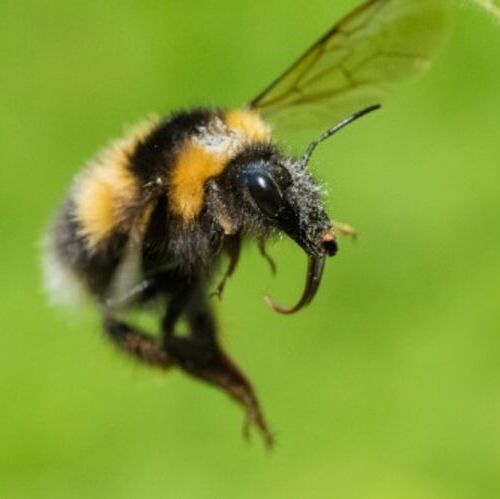
A bumble bee in flight at the University of Bristol Botanic Garden.
(Source: Phil Savoie)
Bristol/UK – Although honey bees are remarkably resilient and adept at keeping their colony cool, most of the 270 native species – namely the bumble and solitary bees – have likely struggled. Unlike honey bees, these species don’t travel far so if nectar and pollen from plants and flowers are less abundant locally due to very hot, drought conditions this could hit their own food supply.
The festival, which joins forces with Bristol Beekeepers and takes place on the weekend of 5-6 September, features honey tastings, specialist talks, workshops, and more than a dozen different demonstrations including flight displays from a live hive.
Apiarist Paul Moorhouse, Chair of Avon Beekeepers Association, said: “Honey bees only account for less than 10 % of pollination – it’s the many dozens of bumble and solitary native species which pollinate most crops. If these species suffer, their own food supply will be negatively affected and as they pollinate for around a third of what we eat, our food supplies will be down.
“Results of national surveys on honey production this year aren’t available yet. Anecdotally, spring has produced a strong yield of honey and the summer has also been good. The difference this year is that the nectar flow seems to have started and finished earlier than normal and the impact on all species of bee is uncertain. Honey bees have the advantage they can travel a few miles to reach a good source of nectar.
“But the 270 or so other species of bees in the UK tend to forage much more locally and could therefore have been impacted significantly, especially in parts of the country which have experienced prolonged excess heat and drought conditions.”
Although the scorching temperatures have proved challenging for beekeepers, the ingenious honey bee hasn’t come unstuck.
Paul said: “Inspecting hives in a sealed bee suit is no fun in 35 degrees! Fortunately, honey bees themselves seem to have coped better. They cleverly manage the climate of their colony by collecting water and spreading it on the combs to evaporate, creating a cooling effect. They also ventilate the excess moisture using their wings to create air currents.
“At average UK temperatures, the cooling can largely be achieved by the evaporation of water from nectar, but this summer bees have been resourceful as ever by visiting ponds and other sources of water. Collection of water is something that is normally only seen in the spring when they collect water to dilute winter stores of honey to consume and fuel their spring build-up.”
The event next month will also play host to Bristol Beekeepers’ 98th Annual Honey Show, which attracts experts and enthusiasts at all levels from across the region. They will be competing for the coveted Bristol Silver Queen trophy awarded to the entrant who excels most in honey wax and mead craftmanship.
Jean Vernon, author of best-selling book ‘The Secret Life of bees’, will be leading a bee safari around the garden as well as sharing insights about native bumble and solitary bees. Award-winning Bristol wildlife filmmaker Dr Steve Nicholls is giving a talk on ‘Dragonflies, Damselflies, Darters and Chasers.’ Other talks will cover topics such as the importance of pollinators in farming and agroforestry, the transformative role of beekeeping, and the power of bees globally.
Avon Organic Group is poised to offer tips on growing fresh produce and local nurseries are on hand to answer questions and give advice on plant health. People of all ages will be able to try their hand at willow making and plants, seeds, honey, beeswax candles and clay pots are among the souvenirs on sale.
Biologists, ecologists, entomologists, and conservationists at the University of Bristol conduct pioneering research into flora and fauna, studying a wide range of different aspects including pollinator insect populations, land management, and ecosystems.
Date: 08.12.2025
Naturally, we always handle your personal data responsibly. Any personal data we receive from you is processed in accordance with applicable data protection legislation. For detailed information please see our privacy policy.
Consent to the use of data for promotional purposes
I hereby consent to Vogel Communications Group GmbH & Co. KG, Max-Planck-Str. 7-9, 97082 Würzburg including any affiliated companies according to §§ 15 et seq. AktG (hereafter: Vogel Communications Group) using my e-mail address to send editorial newsletters. A list of all affiliated companies can be found here
Newsletter content may include all products and services of any companies mentioned above, including for example specialist journals and books, events and fairs as well as event-related products and services, print and digital media offers and services such as additional (editorial) newsletters, raffles, lead campaigns, market research both online and offline, specialist webportals and e-learning offers. In case my personal telephone number has also been collected, it may be used for offers of aforementioned products, for services of the companies mentioned above, and market research purposes.
Additionally, my consent also includes the processing of my email address and telephone number for data matching for marketing purposes with select advertising partners such as LinkedIn, Google, and Meta. For this, Vogel Communications Group may transmit said data in hashed form to the advertising partners who then use said data to determine whether I am also a member of the mentioned advertising partner portals. Vogel Communications Group uses this feature for the purposes of re-targeting (up-selling, cross-selling, and customer loyalty), generating so-called look-alike audiences for acquisition of new customers, and as basis for exclusion for on-going advertising campaigns. Further information can be found in section “data matching for marketing purposes”.
In case I access protected data on Internet portals of Vogel Communications Group including any affiliated companies according to §§ 15 et seq. AktG, I need to provide further data in order to register for the access to such content. In return for this free access to editorial content, my data may be used in accordance with this consent for the purposes stated here. This does not apply to data matching for marketing purposes.
Right of revocation
I understand that I can revoke my consent at will. My revocation does not change the lawfulness of data processing that was conducted based on my consent leading up to my revocation. One option to declare my revocation is to use the contact form found at https://contact.vogel.de. In case I no longer wish to receive certain newsletters, I have subscribed to, I can also click on the unsubscribe link included at the end of a newsletter. Further information regarding my right of revocation and the implementation of it as well as the consequences of my revocation can be found in the data protection declaration, section editorial newsletter.
Nick Wray Curator of the University of Bristol Botanic Garden said: “The importance of insects as pollinators in maintaining healthy ecosystems and agricultural systems is well understood. Insects’ alarming population decline affects us all and is the subject of pioneering research and changes in land management here at the University, which is helping to improve habitats for all insects.
“This year’s Bee and Pollination Festival brings together science and research with a focus on Asian Hornet and beekeepers to provide a stimulating event for everyone, together with exhibits and live demonstrations, workshops and children’s trails. What’s good for pollinators is good for people’s wellbeing too – flowers, interesting people to engage with, lots of plants and a beautiful garden – so come along and enjoy the festival!”
Entry costs £10 (£11 with Gift Aid) for adults and is free for under 18s, students and Friends of the Garden and the festivities run daily over the weekend from 10am until 5pm. Entry on door and in advance available, for more information and/or to book visit https://botanic-garden.bristol.ac.uk/event/bee-pol-26/
Avon Beekeepers Association is the charity which encompasses Bristol Beekeepers as well as Bath, Keynsham, North Somerset and Weston-super-Mare branches.




:quality(80)/p7i.vogel.de/wcms/22/58/22584fa21fdb1f4c62a2a284c4ce30df/0134111278v1.jpeg "The electronic nose sampled odours from the burial site and surrounding control areas, while police dogs searched the site independently. (Source: Grainger Films)")
:quality(80)/p7i.vogel.de/wcms/6a/18/6a18a078bc95ab7164079cfe842b9bde/0134110022v1.jpeg "Artificial intelligence-powered lasers, robotic tillers and precision sprayers could revolutionize how farmers manage weeds, but a recent review from the University of Mississippi and Cornell University found that these technologies could also present financial and ecological challenges. (Source: Sarah Tewolde/University Marketing and Communications)")
:quality(80)/p7i.vogel.de/wcms/61/89/618990ef2cb2d4456da6f260c03343e3/0133981905v2.jpeg "Workers who were worried about the future of their occupation were more likely to morally disengage at work. (Source: free licensed)")
:quality(80)/p7i.vogel.de/wcms/a7/df/a7df32474d451da816851d9a8f52a22d/0133906333v2.jpeg "The Nobel Prize in Physiology or Medicine 2026 is awarded for optogenetics — a method that makes it possible to show how nerve cells shape memories, feelings and behaviours in the living brain. (Source: © The Nobel Committee for Physiology or Medicine. Ill. Mattias Karlén)")
:quality(80)/p7i.vogel.de/wcms/3e/3c/3e3cc29b52fedebf1c97dea23b92a760/0133673542v2.jpeg "Fig.1: The path to accurate pH measurements starts with precise calibration. Use fresh buffers and verify mV response for optimal electrode performance. (Source: METTLER TOLEDO)")
:quality(80)/p7i.vogel.de/wcms/2d/92/2d9231a37601aa58b40d4688f609f004/0133687591v2.jpeg "Horiba’s new CE IVDR certified Yumizen H500 CRP benchtop hematology analyzer delivers a simultaneous complete blood count with 5-part extended differential and rapid CRP whole blood measurement. (Source: Horiba )")
:quality(80)/p7i.vogel.de/wcms/e5/e9/e5e97a3c76cbf47308ce21c4a567a812/0133686320v2.jpeg "The picture shows the Kern PDS precision scale in combination with Kern Balanceconnection software. (Source: Kern & Sohn)")
:quality(80)/p7i.vogel.de/wcms/a8/6e/a86e9b1f1561a67038b6d8a9fe629117/0133465534v2.jpeg "Clean, calibrate, and store pH electrodes properly to ensure accurate, reliable measurements every time. (Source: METTLER TOLEDO)")
:quality(80)/p7i.vogel.de/wcms/2e/f5/2ef5c7b1206d1a2957f965f97d1f8ddd/0133980521v1.jpeg "Alaska glacier (Source: Oregon State University)")
:quality(80)/p7i.vogel.de/wcms/60/9c/609c1bc8643d2eed0b26431c12186f98/0133981015v1.jpeg "Microplastics can generate reactive oxygen species at their surfaces when interacting with water, according to a new study, suggesting a potential mechanism for biological harm. (Source: Dall-E / KI-generiert)")
:quality(80)/p7i.vogel.de/wcms/7b/db/7bdb5608f8d1d8ddb29abd8817d35872/0133981301v2.jpeg "A Vienna team investigated whether discarded plastics could provide the starting material for these molecular sponges. (Source: free licensed)")
:quality(80)/p7i.vogel.de/wcms/b1/b7/b1b7778bcba4902f4b7226a2707562d2/0133966790v2.jpeg "Insects are an important source of food for birds, fish, reptiles, amphibians and mammals. (Source: Sami Kivelä, LUKE)")
:quality(80)/p7i.vogel.de/wcms/08/a0/08a0abab260283b970da227fe72a5dbd/0134110272v1.jpeg "Coffee with milk
(Source: Alonso Nichols/ Tufts University)")
:quality(80)/p7i.vogel.de/wcms/e1/f4/e1f48a0c4b6d5c00059370affdc13113/0133694409v2.jpeg "Broccoli growing beneath semi-transparent, colored solar panels at the experimental site at Kärrbo Prästgård farm in Sweden. (Source: Silvia Ma Lu)")
:quality(80)/p7i.vogel.de/wcms/95/3e/953e490f1819f6638bc08fe3d4d43e87/0133566684v1.jpeg "The soy protein isolate the researchers fed to the mice. (Source: KyotoU / Tomoko T. Asai)")
:quality(80)/p7i.vogel.de/wcms/ba/38/ba38179dbcd20fbc3887b2709193d0a8/0133566669v2.jpeg "Consumers in a Cornell study showed no consistent bias against the colour of hybrid red wines, with several ranking among the most visually appealing. (Source: free licensed)")
:quality(80)/p7i.vogel.de/wcms/6d/69/6d69a418ac0b21ffafa6bf373663c03a/0134107258v1.jpeg "Eye tracking combined with AI could help future virtual reality therapies adapt to patients’ mental workload, potentially supporting more personalised chronic pain treatment. (Source: free licensed)")
:quality(80)/p7i.vogel.de/wcms/9c/0f/9c0fdb99dabd1adb7b41d2859819e6ee/0134113622v1.jpeg "Okara, a soybean by-product, can be transformed into 3D-printed biomaterials for treatment of skin repair.
(Source: Politecnico di Milano)")
:quality(80)/p7i.vogel.de/wcms/7f/90/7f90cbfba445fb1790cdf272b7b0dfce/0133980752v1.jpeg "Because prenatal depression is both common and treatable, improving access to evidence-based mental health interventions during pregnancy could benefit the mothers’ mental wellbeing as well as the next generation. (Source: free licensed)")
:quality(80)/p7i.vogel.de/wcms/48/9f/489f0d616f59fbb57401babe0b161ac5/0133966222v2.jpeg "Glassteng prototype next to one of the tiny, thin, lightweight sensors. (Source: Northwestern University)")
:quality(80)/images.vogel.de/vogelonline/bdb/1710600/1710675/original.jpg "Discover how to set yourself up for success when performing balance-based density determination of solids such as jewelry and precious metals. (Mettler Toledo)")
:quality(80)/images.vogel.de/vogelonline/bdb/1682500/1682579/original.jpg "The new XPR Analytical balance redesigned to meet the needs of laboratory technicians of working fast and lean. (Mettler Toledo)")
:quality(80)/images.vogel.de/vogelonline/bdb/1677000/1677080/original.jpg "Enhance your weighing accuracy, comfort and productivity with the redesigned XPR Analytical balance. (Mettler Toledo)")
:fill(fff,0)/images.vogel.de/vogelonline/companyimg/131900/131910/65.jpg "Xylem_tag_rgb.jpg (Xylem Analytics Germany Sales GmbH & Co. KG)")
:quality(80)/p7i.vogel.de/wcms/ef/7c/ef7cd23997787d020fc225c2677625cf/0133621949v2.jpeg "The team recorded over 1.6 million individual flowers and more than 5,000 plant-pollinator interactions across 58 plant species and 405 pollinator species. (Source: University of Bristol)")
:quality(80)/p7i.vogel.de/wcms/83/77/83773682aa1440dc70c1bc5482369e72/0131301726v2.jpeg "The study reveals for the first time how the decline of insect pollinators undermines essential ecosystem services that support human nutrition and livelihoods. (Source: Thomas Timberlake, University of Bristol)")