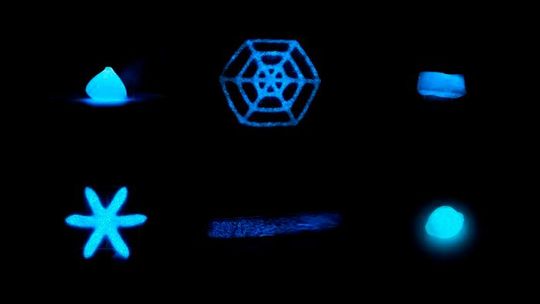
Researchers from the University of California San Diego have crafted materials that illuminate upon experiencing mechanical stress, inspired by bioluminescent waves from dinoflagellates observed during red tide events. These innovative materials, made from dinoflagellates and a seaweed polymer, require no external power and can be shaped using 3D printers.
These soft, living materials glow in response to mechanical stress, such as compression, stretching or twisting.
(Source: UC San Diego Jacobs School of Engineering)
A team of researchers led by the University of California San Diego has developed soft yet durable materials that glow in response to mechanical stress, such as compression, stretching or twisting. The materials derive their luminescence from single-celled algae known as dinoflagellates. The work, inspired by the bioluminescent waves observed during red tide events at San Diego’s beaches, was published Oct. 20 in Science Advances.
“An exciting feature of these materials is their inherent simplicity — they need no electronics, no external power source,” said study senior author Shengqiang Cai, a professor of mechanical and aerospace engineering at the UC San Diego Jacobs School of Engineering. “We demonstrate how we can harness the power of nature to directly convert mechanical stimuli into light emission.”
This study was a multi-disciplinary collaboration involving engineers and materials scientists in Cai’s lab, marine biologist Michael Latz at UC San Diego’s Scripps Institution of Oceanography, and physics professor Maziyar Jalaal at University of Amsterdam.
The primary ingredients of the bioluminescent materials are dinoflagellates and a seaweed-based polymer called alginate. These elements were mixed to form a solution, which was then processed with a 3D printer to create a diverse array of shapes, such as grids, spirals, spiderwebs, balls, blocks and pyramid-like structures. The 3D-printed structures were then cured as a final step.
When the materials are subjected to compression, stretching or twisting, the dinoflagellates within them respond by emitting light. This response mimics what happens in the ocean, when dinoflagellates produce flashes of light as part of a predator defense strategy. In tests, the materials glowed when the researchers pressed on them and traced patterns on their surface. The materials were even sensitive enough to glow under the weight of a foam ball rolling on their surface.
The greater the applied stress, the brighter the glow. The researchers were able to quantify this behavior and developed a mathematical model that can predict the intensity of the glow based on the magnitude of the mechanical stress applied.
The researchers also demonstrated techniques to make these materials resilient in various experimental conditions. To reinforce the materials so that they can bear substantial mechanical loads, a second polymer, poly(ethylene glycol) diacrylate, was added to the original blend. Also, coating the materials with a stretchy rubber-like polymer called Ecoflex provided protection in acidic and basic solutions. With this protective layer, the materials could even be stored in seawater for up to five months without losing their form or bioluminescent properties.
Another beneficial feature of these materials is their minimal maintenance requirements. To keep working, the dinoflagellates within the materials need periodic cycles of light and darkness. During the light phase, they photosynthesize to produce food and energy, which are then used in the dark phase to emit light when mechanical stress is applied. This behavior mirrors the natural processes at play when the dinoflagellates cause bioluminescence in the ocean during red tide events.
“This current work demonstrates a simple method to combine living organisms with non-living components to fabricate novel materials that are self-sustaining and are sensitive to fundamental mechanical stimuli found in nature,” said study first author Chenghai Li, a mechanical and aerospace engineering Ph.D. candidate in Cai’s lab.
The researchers envision that these materials could potentially be used as mechanical sensors to gauge pressure, strain or stress. Other potential applications include soft robotics and biomedical devices that use light signals to perform treatment or controlled drug release. However, there is much work to be done before these applications can be realized. The researchers are working on further improving and optimizing the materials.
Date: 08.12.2025
Naturally, we always handle your personal data responsibly. Any personal data we receive from you is processed in accordance with applicable data protection legislation. For detailed information please see our privacy policy.
Consent to the use of data for promotional purposes
I hereby consent to Vogel Communications Group GmbH & Co. KG, Max-Planck-Str. 7-9, 97082 Würzburg including any affiliated companies according to §§ 15 et seq. AktG (hereafter: Vogel Communications Group) using my e-mail address to send editorial newsletters. A list of all affiliated companies can be found here
Newsletter content may include all products and services of any companies mentioned above, including for example specialist journals and books, events and fairs as well as event-related products and services, print and digital media offers and services such as additional (editorial) newsletters, raffles, lead campaigns, market research both online and offline, specialist webportals and e-learning offers. In case my personal telephone number has also been collected, it may be used for offers of aforementioned products, for services of the companies mentioned above, and market research purposes.
Additionally, my consent also includes the processing of my email address and telephone number for data matching for marketing purposes with select advertising partners such as LinkedIn, Google, and Meta. For this, Vogel Communications Group may transmit said data in hashed form to the advertising partners who then use said data to determine whether I am also a member of the mentioned advertising partner portals. Vogel Communications Group uses this feature for the purposes of re-targeting (up-selling, cross-selling, and customer loyalty), generating so-called look-alike audiences for acquisition of new customers, and as basis for exclusion for on-going advertising campaigns. Further information can be found in section “data matching for marketing purposes”.
In case I access protected data on Internet portals of Vogel Communications Group including any affiliated companies according to §§ 15 et seq. AktG, I need to provide further data in order to register for the access to such content. In return for this free access to editorial content, my data may be used in accordance with this consent for the purposes stated here. This does not apply to data matching for marketing purposes.
Right of revocation
I understand that I can revoke my consent at will. My revocation does not change the lawfulness of data processing that was conducted based on my consent leading up to my revocation. One option to declare my revocation is to use the contact form found at https://contact.vogel.de. In case I no longer wish to receive certain newsletters, I have subscribed to, I can also click on the unsubscribe link included at the end of a newsletter. Further information regarding my right of revocation and the implementation of it as well as the consequences of my revocation can be found in the data protection declaration, section editorial newsletter.
Original Publication: “Ultrasensitive and robust mechanoluminescent living composites.” Co-authors include Zijun Wang and Nada F. Qari, UC San Diego; and Nico Schramma, University of Amsterdam.




:quality(80)/p7i.vogel.de/wcms/22/58/22584fa21fdb1f4c62a2a284c4ce30df/0134111278v1.jpeg "The electronic nose sampled odours from the burial site and surrounding control areas, while police dogs searched the site independently. (Source: Grainger Films)")
:quality(80)/p7i.vogel.de/wcms/6a/18/6a18a078bc95ab7164079cfe842b9bde/0134110022v1.jpeg "Artificial intelligence-powered lasers, robotic tillers and precision sprayers could revolutionize how farmers manage weeds, but a recent review from the University of Mississippi and Cornell University found that these technologies could also present financial and ecological challenges. (Source: Sarah Tewolde/University Marketing and Communications)")
:quality(80)/p7i.vogel.de/wcms/61/89/618990ef2cb2d4456da6f260c03343e3/0133981905v2.jpeg "Workers who were worried about the future of their occupation were more likely to morally disengage at work. (Source: free licensed)")
:quality(80)/p7i.vogel.de/wcms/a7/df/a7df32474d451da816851d9a8f52a22d/0133906333v2.jpeg "The Nobel Prize in Physiology or Medicine 2026 is awarded for optogenetics — a method that makes it possible to show how nerve cells shape memories, feelings and behaviours in the living brain. (Source: © The Nobel Committee for Physiology or Medicine. Ill. Mattias Karlén)")
:quality(80)/p7i.vogel.de/wcms/3e/3c/3e3cc29b52fedebf1c97dea23b92a760/0133673542v2.jpeg "Fig.1: The path to accurate pH measurements starts with precise calibration. Use fresh buffers and verify mV response for optimal electrode performance. (Source: METTLER TOLEDO)")
:quality(80)/p7i.vogel.de/wcms/2d/92/2d9231a37601aa58b40d4688f609f004/0133687591v2.jpeg "Horiba’s new CE IVDR certified Yumizen H500 CRP benchtop hematology analyzer delivers a simultaneous complete blood count with 5-part extended differential and rapid CRP whole blood measurement. (Source: Horiba )")
:quality(80)/p7i.vogel.de/wcms/e5/e9/e5e97a3c76cbf47308ce21c4a567a812/0133686320v2.jpeg "The picture shows the Kern PDS precision scale in combination with Kern Balanceconnection software. (Source: Kern & Sohn)")
:quality(80)/p7i.vogel.de/wcms/a8/6e/a86e9b1f1561a67038b6d8a9fe629117/0133465534v2.jpeg "Clean, calibrate, and store pH electrodes properly to ensure accurate, reliable measurements every time. (Source: METTLER TOLEDO)")
:quality(80)/p7i.vogel.de/wcms/2e/f5/2ef5c7b1206d1a2957f965f97d1f8ddd/0133980521v1.jpeg "Alaska glacier (Source: Oregon State University)")
:quality(80)/p7i.vogel.de/wcms/60/9c/609c1bc8643d2eed0b26431c12186f98/0133981015v1.jpeg "Microplastics can generate reactive oxygen species at their surfaces when interacting with water, according to a new study, suggesting a potential mechanism for biological harm. (Source: Dall-E / KI-generiert)")
:quality(80)/p7i.vogel.de/wcms/7b/db/7bdb5608f8d1d8ddb29abd8817d35872/0133981301v2.jpeg "A Vienna team investigated whether discarded plastics could provide the starting material for these molecular sponges. (Source: free licensed)")
:quality(80)/p7i.vogel.de/wcms/b1/b7/b1b7778bcba4902f4b7226a2707562d2/0133966790v2.jpeg "Insects are an important source of food for birds, fish, reptiles, amphibians and mammals. (Source: Sami Kivelä, LUKE)")
:quality(80)/p7i.vogel.de/wcms/08/a0/08a0abab260283b970da227fe72a5dbd/0134110272v1.jpeg "Coffee with milk
(Source: Alonso Nichols/ Tufts University)")
:quality(80)/p7i.vogel.de/wcms/e1/f4/e1f48a0c4b6d5c00059370affdc13113/0133694409v2.jpeg "Broccoli growing beneath semi-transparent, colored solar panels at the experimental site at Kärrbo Prästgård farm in Sweden. (Source: Silvia Ma Lu)")
:quality(80)/p7i.vogel.de/wcms/95/3e/953e490f1819f6638bc08fe3d4d43e87/0133566684v1.jpeg "The soy protein isolate the researchers fed to the mice. (Source: KyotoU / Tomoko T. Asai)")
:quality(80)/p7i.vogel.de/wcms/ba/38/ba38179dbcd20fbc3887b2709193d0a8/0133566669v2.jpeg "Consumers in a Cornell study showed no consistent bias against the colour of hybrid red wines, with several ranking among the most visually appealing. (Source: free licensed)")
:quality(80)/p7i.vogel.de/wcms/6d/69/6d69a418ac0b21ffafa6bf373663c03a/0134107258v1.jpeg "Eye tracking combined with AI could help future virtual reality therapies adapt to patients’ mental workload, potentially supporting more personalised chronic pain treatment. (Source: free licensed)")
:quality(80)/p7i.vogel.de/wcms/9c/0f/9c0fdb99dabd1adb7b41d2859819e6ee/0134113622v1.jpeg "Okara, a soybean by-product, can be transformed into 3D-printed biomaterials for treatment of skin repair.
(Source: Politecnico di Milano)")
:quality(80)/p7i.vogel.de/wcms/7f/90/7f90cbfba445fb1790cdf272b7b0dfce/0133980752v1.jpeg "Because prenatal depression is both common and treatable, improving access to evidence-based mental health interventions during pregnancy could benefit the mothers’ mental wellbeing as well as the next generation. (Source: free licensed)")
:quality(80)/p7i.vogel.de/wcms/48/9f/489f0d616f59fbb57401babe0b161ac5/0133966222v2.jpeg "Glassteng prototype next to one of the tiny, thin, lightweight sensors. (Source: Northwestern University)")
:quality(80)/images.vogel.de/vogelonline/bdb/1710600/1710675/original.jpg "Discover how to set yourself up for success when performing balance-based density determination of solids such as jewelry and precious metals. (Mettler Toledo)")
:quality(80)/images.vogel.de/vogelonline/bdb/1682500/1682579/original.jpg "The new XPR Analytical balance redesigned to meet the needs of laboratory technicians of working fast and lean. (Mettler Toledo)")
:quality(80)/images.vogel.de/vogelonline/bdb/1677000/1677080/original.jpg "Enhance your weighing accuracy, comfort and productivity with the redesigned XPR Analytical balance. (Mettler Toledo)")
:fill(fff,0)/p7i.vogel.de/companies/69/b7/69b7f63f311d9/logo-bimos-tif--2-.jpeg "logo-bimos-tif--2- (https://www.bimos.com/de-de/)")
:quality(80)/p7i.vogel.de/wcms/08/89/0889115963b144f7ec7a4bb237bdfe4c/0130612552v1.jpeg "Experiment with six pucks with chambers suspended in a bath of motile E. coli. All pucks spin clockwise, marking a first step towards the development of chiral fluids of spinners. (Source: Grober et al./Nature Physics; DOI: 10.1038/s41567-026-03189-4)")
:quality(80)/p7i.vogel.de/wcms/24/31/24319808d44e55ba97ce10223c21791b/0133864445v1.jpeg "This new battery binder could reduce the toxic ingredients, energy use and waste when building and recycling lithium-ion batteries. (Source: David Baillot | UC San Diego Jacobs School of Engineering (CC BY-ND 4.0))")