Why did mollusks survive Earth’s largest mass extinction while many brachiopods disappeared? A Stanford-led study links the unequal losses to differences in metabolic tolerance, showing how rapidly warming, oxygen-poor oceans reshaped marine life 252 million years ago.
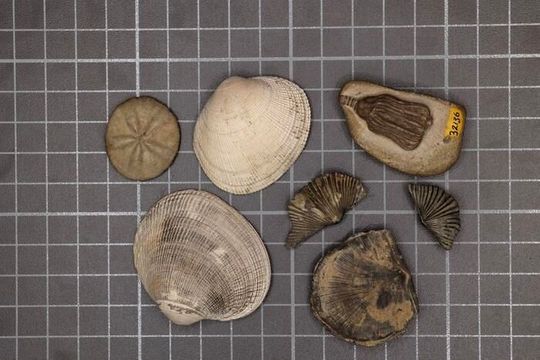
Representative samples of the modern fauna (left three samples) and the Paleozoic fauna (right four samples).
(Source: Sarah Leibovitz)
A new Stanford-led study offers the clearest picture yet of how some ocean life survived our planet’s biggest mass extinction while most animals did not.
About 252 million years ago, 96% of marine species and 70% of land animals died off during the Permian–Triassic extinction event, known as the “Great Dying.” Not all branches of the evolutionary tree were affected evenly, however.
In the ancient oceans, the extinction wiped out nearly all brachiopods, which resemble clams, and certain types of seafloor-dwellers like sea lilies (crinoids). These were the animals that dominated seafloors for roughly the first 280 million years of animal life on Earth. However, only about half of the mollusks, like clams and snails, died out. Ever since, Earth’s oceans have been dominated by mollusks, fish, and echinoderms such as starfish and sea urchins that survived.
The new study, published July 6 in Proceedings of the National Academy of Sciences, for the first time incorporates biological responses of the animal groups that were decimated in the extinction and those that fared better. The groups hit hardest were those whose metabolisms could least tolerate warm, poorly oxygenated water. Such conditions prevailed throughout much of the world’s oceans as the Great Dying unfolded, caused by a surge of volcanic activity that released gargantuan amounts of planet-warming gases like carbon dioxide and methane into the atmosphere.
“With this study, we essentially wanted to solve the mystery of why, when you go to the beach, you collect the shells of clams and snails rather than those of brachiopods,” said lead study author Jose Andres Marquez, a former PhD student in the lab of Erik Anders Sperling at Stanford. “Our findings show that, across different organism groups, extinctions happened at much higher rates for those more vulnerable to increases in water temperature and decreases in oxygen availability.”
The findings serve as a warning of sorts. Conditions preceding the extinction event are very similar to the climate of the past tens of millions of years, which is being altered by emissions from burning fossil fuels and other human activities.
“This study is really the final nail in the coffin for what caused the Permian–Triassic mass extinction,” said Sperling, the study’s senior author and an associate professor of Earth and planetary sciences in the Stanford Doerr School of Sustainability. “The biggest mass extinction of all time started from a world that is very similar to today in having a relatively cool, relatively well-oxygenated ocean, and then there was a giant injection of carbon dioxide into the Earth system. Understanding how Earth and Earth’s biota responded back then could inform us of what’s to come.”
Ancient vs. Modern Metabolisms
Metabolism refers to all the chemical processes happening inside an organism’s body to obtain energy and sustain life. During the Paleozoic period, which ended with the Great Dying, much of the oceanic life consisted of slow-metabolizing, bottom-dwelling, mostly immobile, filter-feeding animals such as brachiopods, crinoids (sea lilies, related to starfish), and certain corals and sea anemones.
In contrast, animal groups that persisted after the Paleozoic display greater mobility and predatory behavior, requiring faster metabolisms. These more modern ocean creatures include fish — obvious frequent, fast movers — as well as slow but mobile snails, sea urchins, and bivalves, such as clams, oysters, and mussels.
Compared to brachiopods, bivalves possess much faster metabolisms and greater energy needs because they often have bulkier bodies and muscular “foot” extensions to dig and crawl. “This is why we eat clam chowder and we don’t eat brachiopod chowder,” Sperling said. “Brachiopods have almost no meat.”
Date: 08.12.2025
Naturally, we always handle your personal data responsibly. Any personal data we receive from you is processed in accordance with applicable data protection legislation. For detailed information please see our privacy policy.
Consent to the use of data for promotional purposes
I hereby consent to Vogel Communications Group GmbH & Co. KG, Max-Planck-Str. 7-9, 97082 Würzburg including any affiliated companies according to §§ 15 et seq. AktG (hereafter: Vogel Communications Group) using my e-mail address to send editorial newsletters. A list of all affiliated companies can be found here
Newsletter content may include all products and services of any companies mentioned above, including for example specialist journals and books, events and fairs as well as event-related products and services, print and digital media offers and services such as additional (editorial) newsletters, raffles, lead campaigns, market research both online and offline, specialist webportals and e-learning offers. In case my personal telephone number has also been collected, it may be used for offers of aforementioned products, for services of the companies mentioned above, and market research purposes.
Additionally, my consent also includes the processing of my email address and telephone number for data matching for marketing purposes with select advertising partners such as LinkedIn, Google, and Meta. For this, Vogel Communications Group may transmit said data in hashed form to the advertising partners who then use said data to determine whether I am also a member of the mentioned advertising partner portals. Vogel Communications Group uses this feature for the purposes of re-targeting (up-selling, cross-selling, and customer loyalty), generating so-called look-alike audiences for acquisition of new customers, and as basis for exclusion for on-going advertising campaigns. Further information can be found in section “data matching for marketing purposes”.
In case I access protected data on Internet portals of Vogel Communications Group including any affiliated companies according to §§ 15 et seq. AktG, I need to provide further data in order to register for the access to such content. In return for this free access to editorial content, my data may be used in accordance with this consent for the purposes stated here. This does not apply to data matching for marketing purposes.
Right of revocation
I understand that I can revoke my consent at will. My revocation does not change the lawfulness of data processing that was conducted based on my consent leading up to my revocation. One option to declare my revocation is to use the contact form found at https://contact.vogel.de. In case I no longer wish to receive certain newsletters, I have subscribed to, I can also click on the unsubscribe link included at the end of a newsletter. Further information regarding my right of revocation and the implementation of it as well as the consequences of my revocation can be found in the data protection declaration, section editorial newsletter.
Prior to the Great Dying, brachiopods outnumbered bivalves. Nowadays, only around 400 brachiopod species still exist, compared to about 10,000-15,000 bivalve species. Sperling said this dramatic turnover compares to the extinction of the non-avian dinosaurs 65 million years ago during what is probably the most famous mass extinction, “where mammals essentially took over and never gave up that niche to reptiles again.”
The new research builds on a 2018 study led by researchers at Princeton and Stanford — including Sperling and Jon Payne, also a co-author of the new study — that found evidence indicating oxygen loss and warming in Earth’s oceans were the primary cause for the Great Dying. However, the physiological data in that study came only from modern ocean species measured by other scientists, skewing the results toward economically important fish and crustaceans versus the kinds of animals that went extinct at higher rates during the mass die-off.
“In our new study, we filled in this gap about the physiology of the Paleozoic fauna to see if we could explain not only the biogeography of the extinction but the taxonomic selectivity of the extinction,” said Sperling.
Fieldwork to gather information on impacted organismal groups took place over the years since the earlier study, including in the San Juan Islands of Washington state, where brachiopods are still common. The researchers collected a diverse set of ocean animal groups representative of those that dominated oceans before and after the Great Dying. They performed experiments at field stations and in Sperling’s lab at Stanford to monitor organisms’ oxygen use in a chamber and how that usage changed with water temperature. As temperature rises, animals’ metabolic rates increase as the extra energy makes reactions occur faster, and they require more oxygen.
The lab work showed that the Paleozoic fauna can live in water with less oxygen, under conditions that would asphyxiate ocean animals from the modern groups. But when the temperature increases, the Paleozoic fauna’s slow metabolisms cannot keep pace and their oxygen needs increase much faster than modern fauna’s. This outcome is ultimately related to their different body plans — the more active and athletic modern fauna require more oxygen at a minimum, but when oxygen requirements rise (as during warming), they have the muscles and gills to match.
“Warming and oxygen loss are the key drivers,” said Sperling. Other research has strongly implicated ocean acidification as well, whereby reactions with atmospheric carbon dioxide render ocean water more acidic, making it tougher for organisms to grow their shells. However, while the new findings suggest acidification may have contributed to the extinction, it was nowhere near the most devastating factor, Sperling added.
Warming Today
The Stanford researchers plan to examine more marine animal groups to further understand the intertwined impacts of the three stressors of warming, lack of oxygen, and acidification, which are growing in severity today.
The researchers emphasize that history could well repeat itself, as changing ocean conditions threaten modern species that are vulnerable to warmer, oxygen-depleted waters.
“The bad news is, we are on track for Permian-Triassic levels of warming in worst-case scenario projections,” said Sperling. Temperatures increased 8-12° Celsius over thousands of years to cause the Great Dying, and today, over just 100-200 years, temperatures are projected to be 1.5-4° Celsius warmer than pre-industrial times by 2100. “But the good news is, we’re still at the point where we can change things and do something about it.”
Original Article: Differences in physiological tolerance to global warming caused the Permian–Triassic transition between the Paleozoic and Modern faunas; Proceedings of the National Academy of Sciences; DOI:10.1073/pnas.2533086123




:quality(80)/p7i.vogel.de/wcms/62/32/62327aaae1415beeed47db6201e79661/0133375912v2.jpeg "A cotton trailer outfitted with benches and a sunshade offers farmworkers a reprieve from the sun as they take a break from picking cantaloupe melons in Firebaugh, Calif.
(Source: Joe Proudman/ Regents of the University of California)")
:quality(80)/p7i.vogel.de/wcms/e6/c8/e6c8bd554776ee1ad2f1f0723fb243a7/0133369387v1.jpeg "Roman road (Source: Queen Mary University of London)")
:quality(80)/p7i.vogel.de/wcms/51/68/51687ac4cc19f2757c138498b877de57/0133167039v2.jpeg "CMFs are foams that consist of hollow spheres – made of materials such as stainless steel, nickel, or other metals and alloys – embedded in a metallic matrix. The resulting material is both lightweight and remarkably strong at absorbing compressive forces. (Source: Jie Sun/ NC State University)")
:quality(80)/p7i.vogel.de/wcms/cd/c0/cdc09efd1e5b3b8f83224e7729d66c10/0133105276v2.jpeg "From the data presented in this report, the authors show how TF3-MALS-RI is uniquely able to separate large polyacrylate molecules and provide precise molecular weight and Rg values. (Source: Postnova Analytics)")
:quality(80)/p7i.vogel.de/wcms/86/01/86014d3d2a28cefc852f65c8d68317e4/0133104231v2.jpeg "Single-handed tube reading using a Handheld 2. (Source: Azenta Life Sciences)")
:quality(80)/p7i.vogel.de/wcms/0b/0f/0b0f8ed042dfc91f32582e10d54c2c7e/0133087444v2.jpeg "Offering advanced automation to increase your throughput, the Intellixcap provides secure sealing – eliminating the need for manual intervention, while preserving vital sample integrity. (Source: Azenta Life Sciences)")
:quality(80)/p7i.vogel.de/wcms/13/d3/13d35105f74a1c2e22b9c7a270e8e9b3/0132611155v2.jpeg "Circulating cell free DNA. (Source: Amsbio)")
:quality(80)/p7i.vogel.de/wcms/bc/ed/bced6850297a04dbea471a66cb6bb6fe/0132611405v2.jpeg "The latest addition to the range is a peristaltic tubing stop adapter that eliminates the need for fixed stoppers and allows custom cut lengths of peristaltic tubing to be installed on any pump head size. (Source: Biotech Fluidics )")
:quality(80)/p7i.vogel.de/wcms/8d/5c/8d5c6c7f897f91d6784825eee20b5584/0133321225v1.jpeg "Empa researcher Christoph Hüglin collects samples of particles that are washed out of the air by rain and snow or settle due to gravity. (Source: Empa)")
:quality(80)/p7i.vogel.de/wcms/a1/af/a1afbc7c8a067bbe94749ec680b4bafd/0133163762v2.jpeg "The study found in murkier water, fish took longer to move towards the food than those in clear water, but individuals in larger groups responded more quickly overall. (Source: Christos Ioannou)")
:quality(80)/p7i.vogel.de/wcms/32/80/3280aa3d44708962943c96fe2d466744/0133088560v2.jpeg "A bumble bee in flight at the University of Bristol Botanic Garden. (Source: Phil Savoie)")
:quality(80)/p7i.vogel.de/wcms/7b/e5/7be5c735140cbe28f3af0ec3d88274b9/0133045403v2.jpeg "After being buried in the ground for two months and broken down by soil organisms, a new pair of cotton underwear (left) shows clear signs of decomposition (right). (Source: Nicolas Zonvi)")
:quality(80)/p7i.vogel.de/wcms/ef/68/ef68375729607984e5bb0c143afdae70/0133375119v2.jpeg "Printed Rice-Lentil 3D structures
(Source: SUTD)")
:quality(80)/p7i.vogel.de/wcms/bf/d0/bfd087349a85956a7aefad57ac1204c7/0133241961v2.jpeg "The Thermo Scientific Suretect Beverage Spoilage Multiplex PCR Assay provides a fast, broad-range molecular solution for detecting key spoilage microorganisms that threaten beverage quality. (Source: © OlegDoroshin - stock.adobe.com)")
:quality(80)/p7i.vogel.de/wcms/d4/61/d461ce0bd5743897993c6475f69e7ad6/0133067478v2.jpeg "In Harris County, 50 % of households with children reported food insecurity, compared with 33 % of households without children. (Source: Rice University)")
:quality(80)/p7i.vogel.de/wcms/79/76/7976d17b980bedfe35acaa532d690046/0132713841v2.jpeg "Observed rice yield losses from 1°C warming are more than twice as high as model estimates due to underestimated heat stress. (Source: AdobeStock/ducvien)")
:quality(80)/p7i.vogel.de/wcms/22/49/224964dd6850b62cccdbc4bde2d34693/0133372964v1.jpeg "Brain activity recorded during a video game helped researchers predict whether participants would take or avoid a risk half a second before they acted. (Source: free licensed)")
:quality(80)/p7i.vogel.de/wcms/48/a7/48a761934161543f70fef2403b44d714/0133372328v2.jpeg "The link between pollution and coughing persisted in the data, even when pollution levels were below the WHO’s recommended safe daily exposure limit. (Source: free licensed)")
:quality(80)/p7i.vogel.de/wcms/83/b4/83b4563a65c6036b61990931507428b4/0133363611v2.jpeg "Magnesium sulphate uptake and the north / south divide for the Precept program. (Source: University of Bristol )")
:quality(80)/p7i.vogel.de/wcms/bb/06/bb06c1c3c5d250f3f93016366c56525d/0133363201v2.jpeg "The team identified more than 1,200 associated genetic variants and found that these influences are remarkably consistent across countries, ages and methods of measuring personality. (Source: Pixabay - PublicDomainPictures)")
:quality(80)/images.vogel.de/vogelonline/bdb/1710600/1710675/original.jpg "Discover how to set yourself up for success when performing balance-based density determination of solids such as jewelry and precious metals. (Mettler Toledo)")
:quality(80)/images.vogel.de/vogelonline/bdb/1682500/1682579/original.jpg "The new XPR Analytical balance redesigned to meet the needs of laboratory technicians of working fast and lean. (Mettler Toledo)")
:quality(80)/images.vogel.de/vogelonline/bdb/1677000/1677080/original.jpg "Enhance your weighing accuracy, comfort and productivity with the redesigned XPR Analytical balance. (Mettler Toledo)")
:fill(fff,0)/images.vogel.de/vogelonline/companyimg/107800/107832/65.jpg "logoDueperthal.jpg ()")
:fill(fff,0)/images.vogel.de/vogelonline/companyimg/131900/131910/65.jpg "Xylem_tag_rgb.jpg ()")
:fill(fff,0)/p7i.vogel.de/companies/69/b7/69b7f63f311d9/logo-bimos-tif--2-.jpeg "logo-bimos-tif--2- (https://www.bimos.com/de-de/)")
:quality(80)/p7i.vogel.de/wcms/34/a4/34a44fab2ba6af4b5f7cb8c3ecfc6362/0129207768v1.jpeg "AI generated image of the New Zealand cave (Source: P Scofield, Canterbury Museum)")
:quality(80)/p7i.vogel.de/wcms/5e/2f/5e2feeb75b56dd3354c754f0b197132f/0131984138v2.jpeg "Stable populations of at-risk species are of key conservation interest, while declining trends might highlight species that are missing from extinction risk assessments. (Source: University of St Andrews)")
:quality(80)/p7i.vogel.de/wcms/84/63/84635219e0523dca3e936f6e8206d67a/0131958389v2.jpeg "A new study offers a 500-million-year perspective on how photosymbiosis has shaped coral success. (Source: University of Bristol )")
:quality(80)/p7i.vogel.de/wcms/db/8a/db8a3845a858bf4732eb2908623b678c/0131445664v1.jpeg "Delicate microfossils don’t last when exposed to the surface. But they remain preserved in deeper rock layers. (Source: UC Santa Barbara)")