Effort, Reward and LearningSocial Media Could Make Effort Feel Less Rewarding
Source:
Estonian Research Council
4 min Reading Time
Digital media may not make people less capable of concentration, but they could change when effort feels worthwhile. A new paper in Nature Human Behaviour argues that smartphones, social media and instant digital rewards may recalibrate how the brain weighs effort against reward, with consequences for learning, attention and persistence.
Instead of asking whether digital media simply reduce cognitive capacity, the paper asks how they may reshape the choices people make about where to invest their limited mental energy.
Imagine opening a difficult book in a quiet room. The first page is dense. You read one paragraph, then reread it. Nothing “clicks” yet. Your brain is doing what learning often requires: spending effort before the reward arrives. Then your phone lights up. One thumb movement, and the situation changes completely. A joke, a message, a clip, a tiny social reward: all available instantly, all requiring almost no effort. The book has not become harder and, definitely, your intelligence has not disappeared. But the book now feels more expensive, because another activity nearby offers a much better bargain: reward now, effort almost zero.
That is the central idea of the paper An Effort Recalibration Framework for Digital Media Use and Cognition that just appeared in Nature Human Behavior. It argues that the most important effect of social media might be that repeated exposure to effortless digital rewards changes how we value effort itself. Over time, the authors suggest, digital media may recalibrate our internal sense of what effort is worth. Difficult work then begins to feel less attractive, not because we can no longer do it, but because our everyday decision system has learned to expect faster returns.
This matters because public debate about smartphones and social media often swings between extremes. One side warns that screens are destroying attention, learning, and childhood. The other points out that the evidence is mixed, effect sizes are often small, and digital media can also support connection, creativity, learning, and political participation. The result is a frustrating argument: are phones harmful or not? Are teenagers addicted or just living in the world adults built for them? Are we distracted, multitasking, or morally panicking?
The paper proposes a way out of that debate. Instead of asking whether digital media simply reduce cognitive capacity, it asks how they may reshape the choices people make about where to invest their limited mental energy.
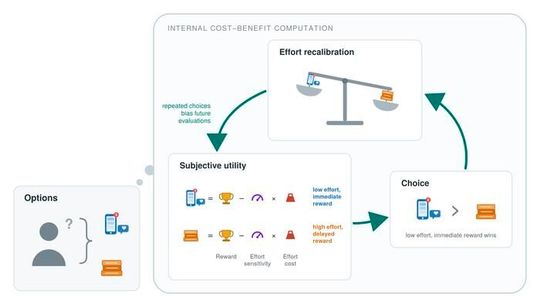
The effort recalibration framework illustrates a choice between low-effort social media and a more demanding task, such as studying. Each option's subjective utility is based on expected reward minus effort cost, weighted by effort sensitivity. Because social media offers immediate rewards with little effort, it is chosen more often. Repeated selection increases effort sensitivity over time, making demanding tasks feel harder and further reinforcing preference for low-effort activities such as digital media consumption.
(Source: Wisnu Wiradhany, Kristjan-Julius Laak)
Our brains are constantly weighing costs and benefits: Is this worth concentrating on? Should I persist? Should I switch? Should I keep reading, or check something easier? Digital platforms enter this weighing process with an attractive offer. Infinite scroll, notifications, algorithmic feeds, likes, and short videos reduce friction and deliver rapid, personalized rewards. They make exploration cheap.
The authors build their framework around the distinction between exploration and exploitation. Exploration means sampling the world: looking around, browsing, trying new sources, seeing what is out there. Exploitation means staying with something long enough to use it deeply: studying a chapter, practicing an instrument, solving a hard problem, writing a careful argument. Both are necessary. Exploration helps us discover possibilities; exploitation builds mastery. But learning often requires a painful transition: you must stop sampling and stay with one demanding thing before its rewards become visible.
The authors argue that digital media may tilt this balance. Digital media make exploration extraordinarily easy and frequently rewarding. A swipe brings novelty. A tap brings social feedback. A recommendation system anticipates what might hold you. The danger is that repeated low-effort reward loops may train the mind to abandon effortful tasks before their delayed benefits arrive.
One of the paper’s novel contributions is that it treats users as active agents. A smartphone can be used to read a long essay, write to a friend, learn a language, or organize collective action. The relevant issue is the effort-and-reward structure of the activity. Is the platform encouraging deliberate engagement or rapid sampling? Is it helping people pursue goals, or making goal-free switching feel constantly worthwhile?
Date: 08.12.2025
Naturally, we always handle your personal data responsibly. Any personal data we receive from you is processed in accordance with applicable data protection legislation. For detailed information please see our privacy policy.
Consent to the use of data for promotional purposes
I hereby consent to Vogel Communications Group GmbH & Co. KG, Max-Planck-Str. 7-9, 97082 Würzburg including any affiliated companies according to §§ 15 et seq. AktG (hereafter: Vogel Communications Group) using my e-mail address to send editorial newsletters. A list of all affiliated companies can be found here
Newsletter content may include all products and services of any companies mentioned above, including for example specialist journals and books, events and fairs as well as event-related products and services, print and digital media offers and services such as additional (editorial) newsletters, raffles, lead campaigns, market research both online and offline, specialist webportals and e-learning offers. In case my personal telephone number has also been collected, it may be used for offers of aforementioned products, for services of the companies mentioned above, and market research purposes.
Additionally, my consent also includes the processing of my email address and telephone number for data matching for marketing purposes with select advertising partners such as LinkedIn, Google, and Meta. For this, Vogel Communications Group may transmit said data in hashed form to the advertising partners who then use said data to determine whether I am also a member of the mentioned advertising partner portals. Vogel Communications Group uses this feature for the purposes of re-targeting (up-selling, cross-selling, and customer loyalty), generating so-called look-alike audiences for acquisition of new customers, and as basis for exclusion for on-going advertising campaigns. Further information can be found in section “data matching for marketing purposes”.
In case I access protected data on Internet portals of Vogel Communications Group including any affiliated companies according to §§ 15 et seq. AktG, I need to provide further data in order to register for the access to such content. In return for this free access to editorial content, my data may be used in accordance with this consent for the purposes stated here. This does not apply to data matching for marketing purposes.
Right of revocation
I understand that I can revoke my consent at will. My revocation does not change the lawfulness of data processing that was conducted based on my consent leading up to my revocation. One option to declare my revocation is to use the contact form found at https://contact.vogel.de. In case I no longer wish to receive certain newsletters, I have subscribed to, I can also click on the unsubscribe link included at the end of a newsletter. Further information regarding my right of revocation and the implementation of it as well as the consequences of my revocation can be found in the data protection declaration, section editorial newsletter.
A second contribution is that the framework explains why research findings can look inconsistent. In laboratory studies, people may perform perfectly well when asked to focus, especially if the task is structured and the stakes are clear. That does not mean nothing has changed in daily life. It may mean people can still summon effort when the context demands it. The problem may appear less as a measurable collapse in cognitive ability and more as a real-world change in when people choose to deploy that ability. In other words, the engine still works, but the driver increasingly takes the easier road.
A third contribution is the paper’s formal model. The authors describe effort recalibration as a value-based choice process: people compare the expected reward of an activity with its expected effort cost. Digital media often increase expected reward and lower effort cost. With repetition, the subjective weight of effort may increase, making demanding tasks feel less worthwhile in future choices. This model gives researchers something testable. It moves the discussion toward precise questions: Does repeated low-effort digital reward reduce persistence on later demanding tasks? Does it lower the threshold for switching? Who is most vulnerable? Can design changes reverse the pattern?
This paper provides a more humane and scientifically useful story about technology and the mind. It shows how environments teach us what to value. If our tools repeatedly teach us that reward should be immediate and effort should be minimal, we may gradually become less willing to endure the slow, awkward, effortful beginnings of understanding. The framework gives researchers, educators, designers, and policymakers a shared language for studying that possibility. Its central warning is simple: the future of cognition may depend not only on what information we consume, but on whether our daily environments still train us to find effort worthwhile.
Original Article: An effort recalibration framework for digital media use and cognition; Nature Human Behaviour; DOI:10.1038/s41562-026-02500-w




:quality(80)/p7i.vogel.de/wcms/22/58/22584fa21fdb1f4c62a2a284c4ce30df/0134111278v1.jpeg "The electronic nose sampled odours from the burial site and surrounding control areas, while police dogs searched the site independently. (Source: Grainger Films)")
:quality(80)/p7i.vogel.de/wcms/6a/18/6a18a078bc95ab7164079cfe842b9bde/0134110022v1.jpeg "Artificial intelligence-powered lasers, robotic tillers and precision sprayers could revolutionize how farmers manage weeds, but a recent review from the University of Mississippi and Cornell University found that these technologies could also present financial and ecological challenges. (Source: Sarah Tewolde/University Marketing and Communications)")
:quality(80)/p7i.vogel.de/wcms/61/89/618990ef2cb2d4456da6f260c03343e3/0133981905v2.jpeg "Workers who were worried about the future of their occupation were more likely to morally disengage at work. (Source: free licensed)")
:quality(80)/p7i.vogel.de/wcms/a7/df/a7df32474d451da816851d9a8f52a22d/0133906333v2.jpeg "The Nobel Prize in Physiology or Medicine 2026 is awarded for optogenetics — a method that makes it possible to show how nerve cells shape memories, feelings and behaviours in the living brain. (Source: © The Nobel Committee for Physiology or Medicine. Ill. Mattias Karlén)")
:quality(80)/p7i.vogel.de/wcms/3e/3c/3e3cc29b52fedebf1c97dea23b92a760/0133673542v2.jpeg "Fig.1: The path to accurate pH measurements starts with precise calibration. Use fresh buffers and verify mV response for optimal electrode performance. (Source: METTLER TOLEDO)")
:quality(80)/p7i.vogel.de/wcms/2d/92/2d9231a37601aa58b40d4688f609f004/0133687591v2.jpeg "Horiba’s new CE IVDR certified Yumizen H500 CRP benchtop hematology analyzer delivers a simultaneous complete blood count with 5-part extended differential and rapid CRP whole blood measurement. (Source: Horiba )")
:quality(80)/p7i.vogel.de/wcms/e5/e9/e5e97a3c76cbf47308ce21c4a567a812/0133686320v2.jpeg "The picture shows the Kern PDS precision scale in combination with Kern Balanceconnection software. (Source: Kern & Sohn)")
:quality(80)/p7i.vogel.de/wcms/a8/6e/a86e9b1f1561a67038b6d8a9fe629117/0133465534v2.jpeg "Clean, calibrate, and store pH electrodes properly to ensure accurate, reliable measurements every time. (Source: METTLER TOLEDO)")
:quality(80)/p7i.vogel.de/wcms/2e/f5/2ef5c7b1206d1a2957f965f97d1f8ddd/0133980521v1.jpeg "Alaska glacier (Source: Oregon State University)")
:quality(80)/p7i.vogel.de/wcms/60/9c/609c1bc8643d2eed0b26431c12186f98/0133981015v1.jpeg "Microplastics can generate reactive oxygen species at their surfaces when interacting with water, according to a new study, suggesting a potential mechanism for biological harm. (Source: Dall-E / KI-generiert)")
:quality(80)/p7i.vogel.de/wcms/7b/db/7bdb5608f8d1d8ddb29abd8817d35872/0133981301v2.jpeg "A Vienna team investigated whether discarded plastics could provide the starting material for these molecular sponges. (Source: free licensed)")
:quality(80)/p7i.vogel.de/wcms/b1/b7/b1b7778bcba4902f4b7226a2707562d2/0133966790v2.jpeg "Insects are an important source of food for birds, fish, reptiles, amphibians and mammals. (Source: Sami Kivelä, LUKE)")
:quality(80)/p7i.vogel.de/wcms/08/a0/08a0abab260283b970da227fe72a5dbd/0134110272v1.jpeg "Coffee with milk
(Source: Alonso Nichols/ Tufts University)")
:quality(80)/p7i.vogel.de/wcms/e1/f4/e1f48a0c4b6d5c00059370affdc13113/0133694409v2.jpeg "Broccoli growing beneath semi-transparent, colored solar panels at the experimental site at Kärrbo Prästgård farm in Sweden. (Source: Silvia Ma Lu)")
:quality(80)/p7i.vogel.de/wcms/95/3e/953e490f1819f6638bc08fe3d4d43e87/0133566684v1.jpeg "The soy protein isolate the researchers fed to the mice. (Source: KyotoU / Tomoko T. Asai)")
:quality(80)/p7i.vogel.de/wcms/ba/38/ba38179dbcd20fbc3887b2709193d0a8/0133566669v2.jpeg "Consumers in a Cornell study showed no consistent bias against the colour of hybrid red wines, with several ranking among the most visually appealing. (Source: free licensed)")
:quality(80)/p7i.vogel.de/wcms/6d/69/6d69a418ac0b21ffafa6bf373663c03a/0134107258v1.jpeg "Eye tracking combined with AI could help future virtual reality therapies adapt to patients’ mental workload, potentially supporting more personalised chronic pain treatment. (Source: free licensed)")
:quality(80)/p7i.vogel.de/wcms/9c/0f/9c0fdb99dabd1adb7b41d2859819e6ee/0134113622v1.jpeg "Okara, a soybean by-product, can be transformed into 3D-printed biomaterials for treatment of skin repair.
(Source: Politecnico di Milano)")
:quality(80)/p7i.vogel.de/wcms/7f/90/7f90cbfba445fb1790cdf272b7b0dfce/0133980752v1.jpeg "Because prenatal depression is both common and treatable, improving access to evidence-based mental health interventions during pregnancy could benefit the mothers’ mental wellbeing as well as the next generation. (Source: free licensed)")
:quality(80)/p7i.vogel.de/wcms/48/9f/489f0d616f59fbb57401babe0b161ac5/0133966222v2.jpeg "Glassteng prototype next to one of the tiny, thin, lightweight sensors. (Source: Northwestern University)")
:quality(80)/images.vogel.de/vogelonline/bdb/1710600/1710675/original.jpg "Discover how to set yourself up for success when performing balance-based density determination of solids such as jewelry and precious metals. (Mettler Toledo)")
:quality(80)/images.vogel.de/vogelonline/bdb/1682500/1682579/original.jpg "The new XPR Analytical balance redesigned to meet the needs of laboratory technicians of working fast and lean. (Mettler Toledo)")
:quality(80)/images.vogel.de/vogelonline/bdb/1677000/1677080/original.jpg "Enhance your weighing accuracy, comfort and productivity with the redesigned XPR Analytical balance. (Mettler Toledo)")

:quality(80)/p7i.vogel.de/wcms/2c/1b/2c1b204a2e37ba6d0564e27d3e0aab83/0128811555v1.jpeg "A specific brain pathway acts like a brake on motivation, making it harder to start unpleasant or stressful tasks. (Source: free licensed)")
:quality(80)/p7i.vogel.de/wcms/13/1e/131e0ece5c6d043f909ce7da5c536c97/0131478860v1.jpeg "Shared laughter can help children build emotional bonds, regulate stress and become more open to learning, according to child development expert Dr Jacqueline Harding. (Source: free licensed)")