Researchers have demonstrated an innovative approach for breast cancer treatment by making use of localised and non-invasive pulsed electromagnetic fields to reprogram immune cells, turning them from tumor helpers to cancer killers.
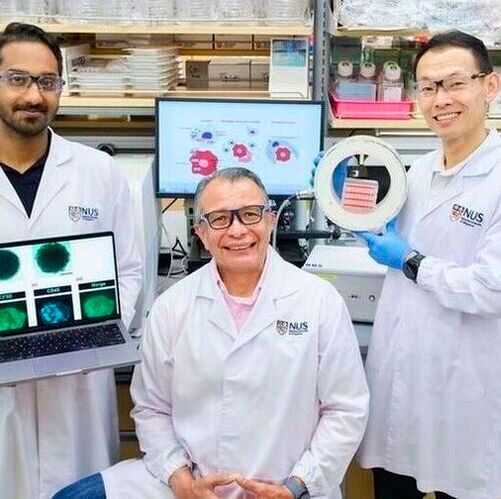
NUS researchers Viresh Krishnan Sukumar (left), Associate Professor Alfredo Franco-Obregón (centre), and Dr Alex Tai (right) showed that the application of brief, intermittent and low intensity magnetic pulses can reprogram immune cells to eradicate breast cancer.
(Source: NUS)
Queenstown/Singapore – NUS researchers have demonstrated an innovative approach for targeted breast cancer therapy using pulsed electromagnetic fields (PEMFs). The NUS team successfully reprogrammed tumor-associated macrophages (TAMs), a corrupted class of immune cells that typically promote cancer growth, into an active anti-tumor state that attacks and destroys cancer cells.
The study, led by Associate Professor Alfredo Franco-Obregón from the Department of Surgery at the NUS Yong Loo Lin School of Medicine and the NUS Institute for Health Innovation & Technology, was published in the journal Smart Medicine on 4 June 2026. This discovery builds on their previous work, where they showed that brief PEMF exposure enhances uptake of doxorubicin (DOX), a chemotherapy drug, by breast cancer cells.
PEMF therapy applies intermittent, low-intensity magnetic pulses to targeted regions of the body over a short period of time. Assoc Prof Franco-Obregón has previously explored the effect of PEMFs on muscle development and oncology. In their latest study, the NUS team demonstrated that even without chemotherapy, PEMFs completely eradicated tumors in 75 per cent of tested preclinical models after just four 30-minute sessions.
“Our study represents a major advancement in breast cancer treatment by demonstrating the potential of PEMFs as a stand-alone, drug-free therapy, offering a possible future where patients could avoid chemotherapy and its debilitating side effects,” said Assoc Prof Franco-Obregón.
Breast cancer cases are projected to rise by a third, from 2.3 million in 2023 to more than 3.5 million by 2050, while annual deaths may nearly double from 764,000 to nearly 1.4 million. Cancer treatment faces challenges such as tumor heterogeneity, drug resistance, and treatment-related toxicities. Approaches targeting TAMs also faced difficulties such as off-target effects. The growing burden underscores the urgent need for innovative therapies to improve patient outcomes and save lives.
From cancer’s friends to foes
Breast cancer occurs when cells in the breast mutate and grow uncontrollably, forming a solid tumor. These cancer cells recruit and hijack nearby immune cells, corrupting them to protect the tumor, accelerate tumor growth, and encourage the spread of cancer (metastasis). Prominent among these recruited immune cells are TAMs, which are abundant in nearly all solid tumors.
There are two primary types of macrophages, M1 and M2. M1 macrophages are pro-inflammatory – the “soldiers” that eliminate threats like bacteria and viruses. M2 macrophages are anti-inflammatory – the “medics” that orchestrate wound healing and tissue repair once threats are cleared. Cancer cells corrupt most TAMs into adopting the M2 “medic” state, suppressing immune attacks against the tumor while facilitating tumor growth and metastasis.
The key to this macrophage reprogramming lies in a protein called TRPC1 (Transient Receptor Potential Canonical 1), which regulates the M1 state. Crucially, TRPC1 also allows cells to sense and respond to magnetic fields. In their experiments, the NUS team confirmed that a brief 10-minute exposure to PEMFs activated TRPC1 channels on M2-like TAMs, setting off a signalling cascade that converted them to the M1 state – essentially turning TAMs from helpful “medics” to aggressive cancer-killing “soldiers”. These activated TAMs then selectively target cancer cells while sparing healthy tissue. Furthermore, the same magnetic signature disrupts cancer's ability to hijack TAMs, altering the TAM-cancer communication loop in both directions.
Date: 08.12.2025
Naturally, we always handle your personal data responsibly. Any personal data we receive from you is processed in accordance with applicable data protection legislation. For detailed information please see our privacy policy.
Consent to the use of data for promotional purposes
I hereby consent to Vogel Communications Group GmbH & Co. KG, Max-Planck-Str. 7-9, 97082 Würzburg including any affiliated companies according to §§ 15 et seq. AktG (hereafter: Vogel Communications Group) using my e-mail address to send editorial newsletters. A list of all affiliated companies can be found here
Newsletter content may include all products and services of any companies mentioned above, including for example specialist journals and books, events and fairs as well as event-related products and services, print and digital media offers and services such as additional (editorial) newsletters, raffles, lead campaigns, market research both online and offline, specialist webportals and e-learning offers. In case my personal telephone number has also been collected, it may be used for offers of aforementioned products, for services of the companies mentioned above, and market research purposes.
Additionally, my consent also includes the processing of my email address and telephone number for data matching for marketing purposes with select advertising partners such as LinkedIn, Google, and Meta. For this, Vogel Communications Group may transmit said data in hashed form to the advertising partners who then use said data to determine whether I am also a member of the mentioned advertising partner portals. Vogel Communications Group uses this feature for the purposes of re-targeting (up-selling, cross-selling, and customer loyalty), generating so-called look-alike audiences for acquisition of new customers, and as basis for exclusion for on-going advertising campaigns. Further information can be found in section “data matching for marketing purposes”.
In case I access protected data on Internet portals of Vogel Communications Group including any affiliated companies according to §§ 15 et seq. AktG, I need to provide further data in order to register for the access to such content. In return for this free access to editorial content, my data may be used in accordance with this consent for the purposes stated here. This does not apply to data matching for marketing purposes.
Right of revocation
I understand that I can revoke my consent at will. My revocation does not change the lawfulness of data processing that was conducted based on my consent leading up to my revocation. One option to declare my revocation is to use the contact form found at https://contact.vogel.de. In case I no longer wish to receive certain newsletters, I have subscribed to, I can also click on the unsubscribe link included at the end of a newsletter. Further information regarding my right of revocation and the implementation of it as well as the consequences of my revocation can be found in the data protection declaration, section editorial newsletter.
“We have identified a molecular “switch”, the specific cell signalling pathway that allows us to reprogram TAMs. Once reprogrammed, these immune cells actively hunt and devour cancer cells, obliterating the tumor,” said Assoc Prof Franco-Obregón. “With the non-invasive and targeted nature of PEMF therapy, we hope to provide patients an effective and safe alternative treatment, with fewer undesirable side effects.”
Pulses of hope for cancer patients
Assoc Prof Franco-Obregón shared that the same PEMF device used in this study has just successfully completed Phase 1 clinical trials, demonstrating its safety in humans. The team is now seeking partners to conduct Phase 2 efficacy trials to evaluate how well the PEMF treatment works in patients and to further advance its development towards clinical use.
“Since we previously showed that PEMFs selectively increased the uptake of DOX in breast cancer cells, we will be evaluating if our PEMF immunotherapy can work synergistically with chemotherapy for better results,” added Assoc Prof Franco-Obregón. “As the immune cells we reprogram are commonly found in most solid tumors, we are optimistic that our PEMF therapy could potentially be a complementary treatment for other cancers beyond breast cancer.”




:quality(80)/p7i.vogel.de/wcms/62/32/62327aaae1415beeed47db6201e79661/0133375912v2.jpeg "A cotton trailer outfitted with benches and a sunshade offers farmworkers a reprieve from the sun as they take a break from picking cantaloupe melons in Firebaugh, Calif.
(Source: Joe Proudman/ Regents of the University of California)")
:quality(80)/p7i.vogel.de/wcms/e6/c8/e6c8bd554776ee1ad2f1f0723fb243a7/0133369387v1.jpeg "Roman road (Source: Queen Mary University of London)")
:quality(80)/p7i.vogel.de/wcms/51/68/51687ac4cc19f2757c138498b877de57/0133167039v2.jpeg "CMFs are foams that consist of hollow spheres – made of materials such as stainless steel, nickel, or other metals and alloys – embedded in a metallic matrix. The resulting material is both lightweight and remarkably strong at absorbing compressive forces. (Source: Jie Sun/ NC State University)")
:quality(80)/p7i.vogel.de/wcms/cd/c0/cdc09efd1e5b3b8f83224e7729d66c10/0133105276v2.jpeg "From the data presented in this report, the authors show how TF3-MALS-RI is uniquely able to separate large polyacrylate molecules and provide precise molecular weight and Rg values. (Source: Postnova Analytics)")
:quality(80)/p7i.vogel.de/wcms/86/01/86014d3d2a28cefc852f65c8d68317e4/0133104231v2.jpeg "Single-handed tube reading using a Handheld 2. (Source: Azenta Life Sciences)")
:quality(80)/p7i.vogel.de/wcms/0b/0f/0b0f8ed042dfc91f32582e10d54c2c7e/0133087444v2.jpeg "Offering advanced automation to increase your throughput, the Intellixcap provides secure sealing – eliminating the need for manual intervention, while preserving vital sample integrity. (Source: Azenta Life Sciences)")
:quality(80)/p7i.vogel.de/wcms/13/d3/13d35105f74a1c2e22b9c7a270e8e9b3/0132611155v2.jpeg "Circulating cell free DNA. (Source: Amsbio)")
:quality(80)/p7i.vogel.de/wcms/bc/ed/bced6850297a04dbea471a66cb6bb6fe/0132611405v2.jpeg "The latest addition to the range is a peristaltic tubing stop adapter that eliminates the need for fixed stoppers and allows custom cut lengths of peristaltic tubing to be installed on any pump head size. (Source: Biotech Fluidics )")
:quality(80)/p7i.vogel.de/wcms/8d/5c/8d5c6c7f897f91d6784825eee20b5584/0133321225v1.jpeg "Empa researcher Christoph Hüglin collects samples of particles that are washed out of the air by rain and snow or settle due to gravity. (Source: Empa)")
:quality(80)/p7i.vogel.de/wcms/a1/af/a1afbc7c8a067bbe94749ec680b4bafd/0133163762v2.jpeg "The study found in murkier water, fish took longer to move towards the food than those in clear water, but individuals in larger groups responded more quickly overall. (Source: Christos Ioannou)")
:quality(80)/p7i.vogel.de/wcms/32/80/3280aa3d44708962943c96fe2d466744/0133088560v2.jpeg "A bumble bee in flight at the University of Bristol Botanic Garden. (Source: Phil Savoie)")
:quality(80)/p7i.vogel.de/wcms/7b/e5/7be5c735140cbe28f3af0ec3d88274b9/0133045403v2.jpeg "After being buried in the ground for two months and broken down by soil organisms, a new pair of cotton underwear (left) shows clear signs of decomposition (right). (Source: Nicolas Zonvi)")
:quality(80)/p7i.vogel.de/wcms/ee/ad/eead38ab1e3c36f262bd889dfc8c5039/0133409909v2.jpeg "Eating a diet rich in wholegrain food is likely to prevent heart disease by reducing body weight, blood pressure and the levels of cholesterol and glucose in the blood. (Source: Unsplash)")
:quality(80)/p7i.vogel.de/wcms/ef/68/ef68375729607984e5bb0c143afdae70/0133375119v2.jpeg "Printed Rice-Lentil 3D structures
(Source: SUTD)")
:quality(80)/p7i.vogel.de/wcms/bf/d0/bfd087349a85956a7aefad57ac1204c7/0133241961v2.jpeg "The Thermo Scientific Suretect Beverage Spoilage Multiplex PCR Assay provides a fast, broad-range molecular solution for detecting key spoilage microorganisms that threaten beverage quality. (Source: © OlegDoroshin - stock.adobe.com)")
:quality(80)/p7i.vogel.de/wcms/d4/61/d461ce0bd5743897993c6475f69e7ad6/0133067478v2.jpeg "In Harris County, 50 % of households with children reported food insecurity, compared with 33 % of households without children. (Source: Rice University)")
:quality(80)/p7i.vogel.de/wcms/d1/bb/d1bb6479bcfc0601c97b579081801328/0133492613v2.jpeg "Vitamin D deficiency was the most common, identified in 12.4 % of children within one year of GLP-1 treatment, the study found. (Source: Unsplash)")
:quality(80)/p7i.vogel.de/wcms/b4/be/b4be197454de6583c081ec202a277000/0133490787v2.jpeg "NUS researchers Viresh Krishnan Sukumar (left), Associate Professor Alfredo Franco-Obregón (centre), and Dr Alex Tai (right) showed that the application of brief, intermittent and low intensity magnetic pulses can reprogram immune cells to eradicate breast cancer. (Source: NUS)")
:quality(80)/p7i.vogel.de/wcms/f5/d3/f5d3af7b7479d0573bec5c1fb9f1fd7b/0133409927v2.jpeg "The Match study looked at over 500 cancer survivors with varying types and stages of cancer and found that patients experienced less pain, fatigue, and sleep problems after participating in the interventions. (Source: Unsplash)")
:quality(80)/images.vogel.de/vogelonline/bdb/1710600/1710675/original.jpg "Discover how to set yourself up for success when performing balance-based density determination of solids such as jewelry and precious metals. (Mettler Toledo)")
:quality(80)/images.vogel.de/vogelonline/bdb/1682500/1682579/original.jpg "The new XPR Analytical balance redesigned to meet the needs of laboratory technicians of working fast and lean. (Mettler Toledo)")
:quality(80)/images.vogel.de/vogelonline/bdb/1677000/1677080/original.jpg "Enhance your weighing accuracy, comfort and productivity with the redesigned XPR Analytical balance. (Mettler Toledo)")
:fill(fff,0)/p7i.vogel.de/companies/5f/3f/5f3f63ceedc78/knf-logo.jpg "KNF_Logo.jpg (www.knf.com)")
:fill(fff,0)/images.vogel.de/vogelonline/companyimg/107800/107832/65.jpg "logoDueperthal.jpg ()")
:fill(fff,0)/p7i.vogel.de/companies/69/b7/69b7f63f311d9/logo-bimos-tif--2-.jpeg "logo-bimos-tif--2- (https://www.bimos.com/de-de/)")
:quality(80)/p7i.vogel.de/wcms/a1/fa/a1fa8b58dec1480da3b20c7b9ffabb2d/0131301715v2.jpeg "By tagging nanoparticles with unique DNA “barcodes”, the NUS research team was able to track and compare dozens of designs simultaneously in living tumor models, rapidly identifying those most effective at reaching mitochondria (energy centres inside cancer cells). (Source: NUS)")
:quality(80)/p7i.vogel.de/wcms/6a/6d/6a6dcde919c7ddcd0b38c082e67d7096/0131442912v2.jpeg "The findings in mice as well as human cells and tumor samples point to a practical, new way to improve treatment for tough tumors, such as triple-negative breast cancer, where immunotherapy often fails. (Source: Unsplash)")