Lighter vehicle structures do not necessarily have to compromise crash protection. Simulations indicate that front rails made with composite metal foam could reduce deceleration, crash severity and head injury risk during frontal collisions without adding weight.
CMFs are foams that consist of hollow spheres – made of materials such as stainless steel, nickel, or other metals and alloys – embedded in a metallic matrix. The resulting material is both lightweight and remarkably strong at absorbing compressive forces.
(Source: Jie Sun/ NC State University)
A new study finds that composite metal foam (CMF) could significantly improve automobile safety during frontal collisions. Using computational models to run detailed simulations, researchers found that incorporating CMF into automobile “front rails” would allow them to absorb more energy during high-velocity impacts.
CMFs are foams that consist of hollow spheres — made of metals or alloys such as steel — embedded in a metallic matrix. The resulting material is both lightweight and remarkably strong at absorbing compressive and impact forces, with potential applications ranging from aircraft wings to vehicle armor to body armor.
Gallery
“CMF is lighter than conventional metals without sacrificing strength, and our work here tells us that its unique structure allows it to better absorb energy during high velocity impacts,” says Afsaneh Rabiei, corresponding author of the study and a professor of mechanical and aerospace engineering at North Carolina State University. “This is important, because it slows the rate at which a vehicle decelerates during a crash — and slowing deceleration improves driver and passenger safety.”
During a high-velocity, frontal car crash, the bumper system of an automobile transfers the impact energy to the front rails, which are designed to absorb that energy. These front rails are meant to deform in a way that limits the amount of energy that is transferred to people in the vehicle, and to stop the vehicle from decelerating too rapidly. If deceleration is too sudden, vehicle occupants can sustain severe injuries, including head injuries.
Two common front rail designs in commercially-available vehicles are “rectangular cross-section” and “double-octagonal cross-section.” Rectangular cross-section rails are long, hollow steel rectangles. Double-octagonal rails consist of two long, hollow aluminum octagons stacked on top of one another.
For this study, researchers wanted to see how those common front rail designs would perform compared to front rails consisting of an aluminum tube with a steel CMF core. The researchers drew on extensive experimental data on CMF and publicly-available material and design data for the conventional front rails in order to conduct detailed computational modeling of how the rails perform during high-velocity frontal impacts.
Simulations Show Lower Deceleration and Injury Risk
In simple terms, the CMF front rails allowed the vehicle to withstand much higher impact speeds before reaching critical safety limits. Compared with conventional double-octagon front rails, the vehicle could travel about 34% faster before reaching the critical crash-severity limit and about 40% faster before reaching the head-injury limit. Compared with rectangular front rails, those limits increased by about 32% and 48%, respectively.
“CMF outperformed the conventional rails across the board,” Rabiei says. “And the higher the speed, the better the CMF performed compared to the conventional front rails. Comparing front rail performance during a 55 mph crash offers a good overview of the difference between designs.”
Compared with double-octagon rails, CMF of the same weight and length reduced the maximum deceleration experienced during the crash by about 38%, reduced overall crash severity by about 45%, and reduced the Head Injury Criterion (HIC) — a measure of the likelihood of serious head injury — by about 45%. Compared with rectangular rails at the same 55 mph impact speed, CMF of the same weight and length, reduced maximum deceleration by about 84%, crash severity by about 94%, and HIC by about 83%.
Date: 08.12.2025
Naturally, we always handle your personal data responsibly. Any personal data we receive from you is processed in accordance with applicable data protection legislation. For detailed information please see our privacy policy.
Consent to the use of data for promotional purposes
I hereby consent to Vogel Communications Group GmbH & Co. KG, Max-Planck-Str. 7-9, 97082 Würzburg including any affiliated companies according to §§ 15 et seq. AktG (hereafter: Vogel Communications Group) using my e-mail address to send editorial newsletters. A list of all affiliated companies can be found here
Newsletter content may include all products and services of any companies mentioned above, including for example specialist journals and books, events and fairs as well as event-related products and services, print and digital media offers and services such as additional (editorial) newsletters, raffles, lead campaigns, market research both online and offline, specialist webportals and e-learning offers. In case my personal telephone number has also been collected, it may be used for offers of aforementioned products, for services of the companies mentioned above, and market research purposes.
Additionally, my consent also includes the processing of my email address and telephone number for data matching for marketing purposes with select advertising partners such as LinkedIn, Google, and Meta. For this, Vogel Communications Group may transmit said data in hashed form to the advertising partners who then use said data to determine whether I am also a member of the mentioned advertising partner portals. Vogel Communications Group uses this feature for the purposes of re-targeting (up-selling, cross-selling, and customer loyalty), generating so-called look-alike audiences for acquisition of new customers, and as basis for exclusion for on-going advertising campaigns. Further information can be found in section “data matching for marketing purposes”.
In case I access protected data on Internet portals of Vogel Communications Group including any affiliated companies according to §§ 15 et seq. AktG, I need to provide further data in order to register for the access to such content. In return for this free access to editorial content, my data may be used in accordance with this consent for the purposes stated here. This does not apply to data matching for marketing purposes.
Right of revocation
I understand that I can revoke my consent at will. My revocation does not change the lawfulness of data processing that was conducted based on my consent leading up to my revocation. One option to declare my revocation is to use the contact form found at https://contact.vogel.de. In case I no longer wish to receive certain newsletters, I have subscribed to, I can also click on the unsubscribe link included at the end of a newsletter. Further information regarding my right of revocation and the implementation of it as well as the consequences of my revocation can be found in the data protection declaration, section editorial newsletter.
Combined with CMF’s previously demonstrated resistance to heat and fire, the new findings also point to potential applications in electric vehicles, including structures designed to help protect high-voltage battery packs from crash-induced damage.
And the improved safety does not require sacrificing fuel economy: the CMF front rails were the same length and weight as the conventional front rails they were being compared to.
“This also means that you could reduce the length of the front rails, still improve safety, and also make the vehicles more fuel efficient,” Rabiei says.
“We are open to working with the automobile industry to conduct testing of rails that make use of CMF in their existing front rail designs — or to develop new rail designs that make use of CMF to improve safety and fuel efficiency,” says Rabiei.
“We are also interested in working with automakers, suppliers and battery manufacturers to evaluate CMF-based structures for electric vehicles, including battery protection systems. CMF’s combination of lightweight impact-energy absorption and resistance to heat and fire creates opportunities to address multiple vehicle safety challenges with a single material system.”
Original Article: Enhancing Safety and Crashworthiness of Vehicles Using Composite Metal Foam; Journal of Composites Science; DOI:10.3390/jcs10090474




:quality(80)/p7i.vogel.de/wcms/61/89/618990ef2cb2d4456da6f260c03343e3/0133981905v2.jpeg "Workers who were worried about the future of their occupation were more likely to morally disengage at work. (Source: free licensed)")
:quality(80)/p7i.vogel.de/wcms/a7/df/a7df32474d451da816851d9a8f52a22d/0133906333v2.jpeg "The Nobel Prize in Physiology or Medicine 2026 is awarded for optogenetics — a method that makes it possible to show how nerve cells shape memories, feelings and behaviours in the living brain. (Source: © The Nobel Committee for Physiology or Medicine. Ill. Mattias Karlén)")
:quality(80)/p7i.vogel.de/wcms/3f/2b/3f2b75ae816c4c7d2834642c675d1b72/0133864426v1.jpeg "Researchers recently found that spending just 10 minutes relying on an AI tool significantly impairs the user's ability to focus and persist with difficult tasks. A preliminary draft made waves earlier this year, and the team presented the updated, peer-reviewed paper this week at the Conference on Language Modeling. (Source: free licensed)")
:quality(80)/p7i.vogel.de/wcms/24/31/24319808d44e55ba97ce10223c21791b/0133864445v1.jpeg "This new battery binder could reduce the toxic ingredients, energy use and waste when building and recycling lithium-ion batteries. (Source: David Baillot | UC San Diego Jacobs School of Engineering (CC BY-ND 4.0))")
:quality(80)/p7i.vogel.de/wcms/3e/3c/3e3cc29b52fedebf1c97dea23b92a760/0133673542v2.jpeg "Fig.1: The path to accurate pH measurements starts with precise calibration. Use fresh buffers and verify mV response for optimal electrode performance. (Source: METTLER TOLEDO)")
:quality(80)/p7i.vogel.de/wcms/2d/92/2d9231a37601aa58b40d4688f609f004/0133687591v2.jpeg "Horiba’s new CE IVDR certified Yumizen H500 CRP benchtop hematology analyzer delivers a simultaneous complete blood count with 5-part extended differential and rapid CRP whole blood measurement. (Source: Horiba )")
:quality(80)/p7i.vogel.de/wcms/e5/e9/e5e97a3c76cbf47308ce21c4a567a812/0133686320v2.jpeg "The picture shows the Kern PDS precision scale in combination with Kern Balanceconnection software. (Source: Kern & Sohn)")
:quality(80)/p7i.vogel.de/wcms/a8/6e/a86e9b1f1561a67038b6d8a9fe629117/0133465534v2.jpeg "Clean, calibrate, and store pH electrodes properly to ensure accurate, reliable measurements every time. (Source: METTLER TOLEDO)")
:quality(80)/p7i.vogel.de/wcms/2e/f5/2ef5c7b1206d1a2957f965f97d1f8ddd/0133980521v1.jpeg "Alaska glacier (Source: Oregon State University)")
:quality(80)/p7i.vogel.de/wcms/60/9c/609c1bc8643d2eed0b26431c12186f98/0133981015v1.jpeg "Microplastics can generate reactive oxygen species at their surfaces when interacting with water, according to a new study, suggesting a potential mechanism for biological harm. (Source: Dall-E / KI-generiert)")
:quality(80)/p7i.vogel.de/wcms/7b/db/7bdb5608f8d1d8ddb29abd8817d35872/0133981301v2.jpeg "A Vienna team investigated whether discarded plastics could provide the starting material for these molecular sponges. (Source: free licensed)")
:quality(80)/p7i.vogel.de/wcms/b1/b7/b1b7778bcba4902f4b7226a2707562d2/0133966790v2.jpeg "Insects are an important source of food for birds, fish, reptiles, amphibians and mammals. (Source: Sami Kivelä, LUKE)")
:quality(80)/p7i.vogel.de/wcms/e1/f4/e1f48a0c4b6d5c00059370affdc13113/0133694409v2.jpeg "Broccoli growing beneath semi-transparent, colored solar panels at the experimental site at Kärrbo Prästgård farm in Sweden. (Source: Silvia Ma Lu)")
:quality(80)/p7i.vogel.de/wcms/95/3e/953e490f1819f6638bc08fe3d4d43e87/0133566684v1.jpeg "The soy protein isolate the researchers fed to the mice. (Source: KyotoU / Tomoko T. Asai)")
:quality(80)/p7i.vogel.de/wcms/ba/38/ba38179dbcd20fbc3887b2709193d0a8/0133566669v2.jpeg "Consumers in a Cornell study showed no consistent bias against the colour of hybrid red wines, with several ranking among the most visually appealing. (Source: free licensed)")
:quality(80)/p7i.vogel.de/wcms/ac/d1/acd1a8888f6e78206f11f2b4eb33926f/0133566582v1.jpeg "A claim on the front of a box of food products is a hint, not a verdict. The nutrition label on the back – added sugars, sodium, saturated fat, all of it together – still tells the fuller story. (Source: free licensed)")
:quality(80)/p7i.vogel.de/wcms/7f/90/7f90cbfba445fb1790cdf272b7b0dfce/0133980752v1.jpeg "Because prenatal depression is both common and treatable, improving access to evidence-based mental health interventions during pregnancy could benefit the mothers’ mental wellbeing as well as the next generation. (Source: free licensed)")
:quality(80)/p7i.vogel.de/wcms/48/9f/489f0d616f59fbb57401babe0b161ac5/0133966222v2.jpeg "Glassteng prototype next to one of the tiny, thin, lightweight sensors. (Source: Northwestern University)")
:quality(80)/p7i.vogel.de/wcms/e4/5b/e45b74e986e325695415f633d2094673/0133908923v2.jpeg "The report brings together all the existing research on how to prevent deaths and hospitalizations during heatwaves in people with different forms of cardiovascular disease. (Source: Unsplash)")
:quality(80)/p7i.vogel.de/wcms/79/e7/79e7c5ee90d19fe72bdae3627024c168/0133864685v2.jpeg "Findings suggest cannabis-related sleep disruptions may go unnoticed by users themselves (Source: free licensed)")
:quality(80)/images.vogel.de/vogelonline/bdb/1710600/1710675/original.jpg "Discover how to set yourself up for success when performing balance-based density determination of solids such as jewelry and precious metals. (Mettler Toledo)")
:quality(80)/images.vogel.de/vogelonline/bdb/1682500/1682579/original.jpg "The new XPR Analytical balance redesigned to meet the needs of laboratory technicians of working fast and lean. (Mettler Toledo)")
:quality(80)/images.vogel.de/vogelonline/bdb/1677000/1677080/original.jpg "Enhance your weighing accuracy, comfort and productivity with the redesigned XPR Analytical balance. (Mettler Toledo)")
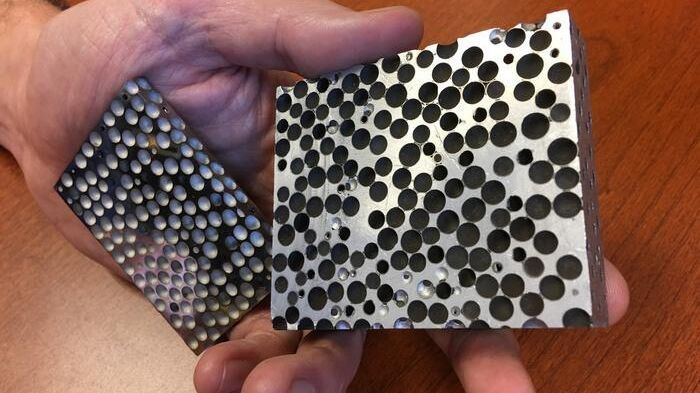
:quality(80)/p7i.vogel.de/wcms/2d/d1/2dd1e64125e1dbc4b3bed50a4fdcff4f/0133166785v1.jpeg "CMFs are foams that consist of hollow spheres – made of materials such as stainless steel, nickel, or other metals and alloys – embedded in a metallic matrix. The resulting material is both lightweight and remarkably strong at absorbing compressive forces.(Source: Jie Sun/ NC State University)")
:quality(80)/p7i.vogel.de/wcms/68/1f/681f107e64fd1b75f28f0c49348e1523/0133166786v1.jpeg "At 55 mph, replacing a conventional front rail with an equal-length, equal-weight composite metal foam (CMF) rail significantly reduced vehicle damage and predicted occupant head injury. By progressively absorbing crash energy between the bumper and chassis, the CMF front rail transmitted less severe impact loading to the passenger compartment.(Source: Jie Sun/ NC State University)")
:quality(80)/p7i.vogel.de/wcms/a0/22/a0220cebf4618cef31ba3a3c28411770/0133693882v1.jpeg "Researchers have demonstrated a technique that uses powdered eggshells to produce high-quality magnesium alloys, which have a wide variety of automotive, aerospace and biomedical applications. The eggshells are used as a low-cost, environmentally sustainable alternative to conventional calcium materials, which are manufactured from ore using an energy-intensive process. This photo shows an eggshell next to a rod of egg-shell modified magnesium alloy. (Source: Bharat Gwalani, NC State University)")
:quality(80)/p7i.vogel.de/wcms/45/47/4547a006853506f31157fb435ce1449f/0129504589v1.jpeg "Elephant trunk whiskers shine (Source: MPI-IS/A. Posada)")