Scientists have uncovered a fungal toxin that halts the cell’s protein factories. Beyond revealing how protein production works at its core, the findings may pave the way for innovative treatments in the long run.
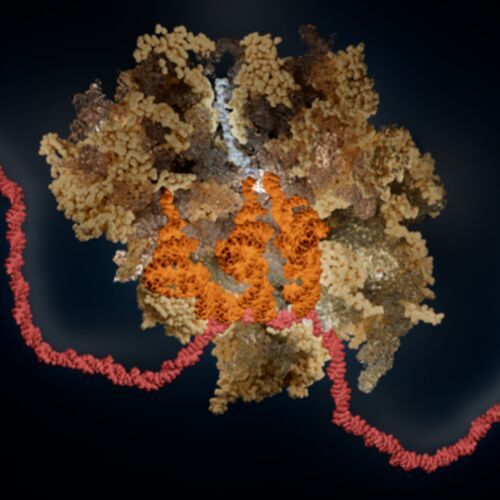
A human ribosome, shown in gold, translating an mRNA molecule (red). Three tRNAs (orange) help assemble the growing protein chain, shown in silver-white. The image is based on cryo-electron microscopy structures of human ribosomes.
Bern/Switzerland – Every cell in our body depends on proteins for growth, repair, defense against pathogens, and nearly all other life processes. These proteins are produced by tiny “protein factories”, the so-called ribosomes. Disruptions in protein production are linked to diseases such as cancer, developmental disorders, and viral infections. Researchers worldwide are therefore searching for substances that specifically influence protein production, to better understand how ribosomes function and to develop new therapeutic approaches.
A research team at the Department of Chemistry, Biochemistry and Pharmaceutical Sciences (DCBP) at the University of Bern has now developed a new method for specifically identifying substances that influence ribosome function. The study revealed that a specific fungal toxin slows down protein production and puts the cell’s “protein factories” into a sort of dormant state. The study was conducted in collaboration with the Biomolecular Screening Facility at EPFL and the Cryo-EM Knowledge Hub at ETH Zurich, and was recently published in the journal Communications Biology.
28,000 different substances tested using the Bernese method
In order to search specifically for substances that influence protein production, the researchers at the University of Bern did not use traditional tests involving living cells. These are too complex to demonstrate a direct effect. Instead, they developed a test system that mimics human protein production outside living cells. Using this system, they tested 28,000 different substances, measuring how much protein was produced in each case. “By reducing the cells to their essentials, so to speak, we can examine very precisely whether a substance directly influences human protein production,” explains Nino Schwaller, first author of the study and a master’s student at the DCBP. He adds: “Thanks to our new method, we can investigate the effects of environmental toxins and potential active compounds on one of life’s most fundamental biological processes, namely protein production, with much greater precision than before.”
Cereal mycotoxin targets specific targets
Among the many substances tested, the mycotoxin NT‑2, produced by cereal fungi of the genus Fusarium, was particularly striking. These fungi infect wheat, barley, oats and corn, damaging crops and contaminating food and animal feed. The research team has now shown that this NT-2 mycotoxin binds directly to the ribosomes. “We were particularly impressed by how precisely this natural toxin targets the cell’s protein factories,” says Schwaller. Even more surprising was the following observation: “Ribosomes are fundamentally very similar in structure across plants, animals, and fungi, so it would be expected that NT-2 also binds to ribosomes in these organisms and blocks their protein production. Interestingly, the cells of the toxin-producing fungi however appear to be protected themselves from NT-2,” explains Schwaller. The study helps us understand how fungal toxins from contaminated grain can disrupt key processes in human cells.
Ribosomes remain in “sleep mode”
The team made its most surprising discovery when it examined ribosomes from NT‑2‑treated cells more closely. A large proportion of the ribosomes were in a stable but inactive state. “You can imagine the cell’s protein factories being switched into a sleep mode from which they can no longer wake up on their own,” explains Dr. Evangelos Karousis, lead author of the study and research group leader at the DCBP at the University of Bern. “Our observations could explain why certain environmental toxins or medications leave long-term traces in cells,” he adds.
The new study links several research fields: it shows how a toxin from cereal fungi interferes with one of the most fundamental processes in human cells, provides new insights into ribosome function, and at the same time introduces a method for specifically identifying substances that influence protein production. “Many serious diseases are associated with cells producing too many, too few, or the wrong proteins,” says Karousis. “If we better understand how these protein factories can be slowed down or deliberately put into a resting state, this could ultimately help develop new treatments.” The University of Bern is one of the leading centers in the development of innovative methods for analyzing cellular processes. The test platform now presented is a prime example of how researchers in Bern create tools that more closely link basic research with future medical applications. As a next step, the researchers plan to investigate under which conditions “sleeping” ribosomes can be reactivated and how widespread this special resting state is in cells – for example during stress, disease, or exposure to other environmental toxins.
Date: 08.12.2025
Naturally, we always handle your personal data responsibly. Any personal data we receive from you is processed in accordance with applicable data protection legislation. For detailed information please see our privacy policy.
Consent to the use of data for promotional purposes
I hereby consent to Vogel Communications Group GmbH & Co. KG, Max-Planck-Str. 7-9, 97082 Würzburg including any affiliated companies according to §§ 15 et seq. AktG (hereafter: Vogel Communications Group) using my e-mail address to send editorial newsletters. A list of all affiliated companies can be found here
Newsletter content may include all products and services of any companies mentioned above, including for example specialist journals and books, events and fairs as well as event-related products and services, print and digital media offers and services such as additional (editorial) newsletters, raffles, lead campaigns, market research both online and offline, specialist webportals and e-learning offers. In case my personal telephone number has also been collected, it may be used for offers of aforementioned products, for services of the companies mentioned above, and market research purposes.
Additionally, my consent also includes the processing of my email address and telephone number for data matching for marketing purposes with select advertising partners such as LinkedIn, Google, and Meta. For this, Vogel Communications Group may transmit said data in hashed form to the advertising partners who then use said data to determine whether I am also a member of the mentioned advertising partner portals. Vogel Communications Group uses this feature for the purposes of re-targeting (up-selling, cross-selling, and customer loyalty), generating so-called look-alike audiences for acquisition of new customers, and as basis for exclusion for on-going advertising campaigns. Further information can be found in section “data matching for marketing purposes”.
In case I access protected data on Internet portals of Vogel Communications Group including any affiliated companies according to §§ 15 et seq. AktG, I need to provide further data in order to register for the access to such content. In return for this free access to editorial content, my data may be used in accordance with this consent for the purposes stated here. This does not apply to data matching for marketing purposes.
Right of revocation
I understand that I can revoke my consent at will. My revocation does not change the lawfulness of data processing that was conducted based on my consent leading up to my revocation. One option to declare my revocation is to use the contact form found at https://contact.vogel.de. In case I no longer wish to receive certain newsletters, I have subscribed to, I can also click on the unsubscribe link included at the end of a newsletter. Further information regarding my right of revocation and the implementation of it as well as the consequences of my revocation can be found in the data protection declaration, section editorial newsletter.




:quality(80)/p7i.vogel.de/wcms/47/aa/47aa3f86498782fc62cba3fc50a423fa/0133690841v2.jpeg "Making new biological discoveries with minimal human intervention is an important advance in self-driving laboratories. (Source: NIH Image Gallery / Chalmers University of Technology)")
:quality(80)/p7i.vogel.de/wcms/09/cc/09cc110fbf9e50608616dde34a418e57/0133688419v2.jpeg "HiPSCs cultured on iMatrix Laminin-511 with Stemfit Basic03. (Source: Amsbio)")
:quality(80)/p7i.vogel.de/wcms/a3/54/a354c6a0d95edd343bbe949baa8dc145/0133687489v2.jpeg "Analytichem’s Digitube disposable digestion tubes are certified for volume and trace metals for quality, efficient sample preparation workflows for highly sensitive ICP analyses. (Source: Analytichem)")
:quality(80)/p7i.vogel.de/wcms/85/a4/85a42b221b3fcc2f9f0901516ad359f9/0133684975v2.jpeg "By combining Pulpfixin’s biodegradable rack platform with established Fluid X sample management workflows, the company is enabling laboratories to reduce reliance on conventional plastic lab consumables. (Source: Azenta Life Sciences)")
:quality(80)/p7i.vogel.de/wcms/2d/92/2d9231a37601aa58b40d4688f609f004/0133687591v2.jpeg "Horiba’s new CE IVDR certified Yumizen H500 CRP benchtop hematology analyzer delivers a simultaneous complete blood count with 5-part extended differential and rapid CRP whole blood measurement. (Source: Horiba )")
:quality(80)/p7i.vogel.de/wcms/e5/e9/e5e97a3c76cbf47308ce21c4a567a812/0133686320v2.jpeg "The picture shows the Kern PDS precision scale in combination with Kern Balanceconnection software. (Source: Kern & Sohn)")
:quality(80)/p7i.vogel.de/wcms/a8/6e/a86e9b1f1561a67038b6d8a9fe629117/0133465534v2.jpeg "Clean, calibrate, and store pH electrodes properly to ensure accurate, reliable measurements every time. (Source: METTLER TOLEDO)")
:quality(80)/p7i.vogel.de/wcms/86/01/86014d3d2a28cefc852f65c8d68317e4/0133104231v2.jpeg "Single-handed tube reading using a Handheld 2. (Source: Azenta Life Sciences)")
:quality(80)/p7i.vogel.de/wcms/ef/7c/ef7cd23997787d020fc225c2677625cf/0133621949v2.jpeg "The team recorded over 1.6 million individual flowers and more than 5,000 plant-pollinator interactions across 58 plant species and 405 pollinator species. (Source: University of Bristol)")
:quality(80)/p7i.vogel.de/wcms/6f/ea/6feaf3edd34eb4a9f1df201dc2e6448d/0133548706v2.jpeg "The researchers studied people’s perceptions, beliefs and knowledge about climate change in two coastal regions, one low-lying island and the other a mainland coast. (Source: P Afna)")
:quality(80)/p7i.vogel.de/wcms/8d/5c/8d5c6c7f897f91d6784825eee20b5584/0133321225v1.jpeg "Empa researcher Christoph Hüglin collects samples of particles that are washed out of the air by rain and snow or settle due to gravity. (Source: Empa)")
:quality(80)/p7i.vogel.de/wcms/a1/af/a1afbc7c8a067bbe94749ec680b4bafd/0133163762v2.jpeg "The study found in murkier water, fish took longer to move towards the food than those in clear water, but individuals in larger groups responded more quickly overall. (Source: Christos Ioannou)")
:quality(80)/p7i.vogel.de/wcms/95/3e/953e490f1819f6638bc08fe3d4d43e87/0133566684v1.jpeg "The soy protein isolate the researchers fed to the mice. (Source: KyotoU / Tomoko T. Asai)")
:quality(80)/p7i.vogel.de/wcms/ba/38/ba38179dbcd20fbc3887b2709193d0a8/0133566669v2.jpeg "Consumers in a Cornell study showed no consistent bias against the colour of hybrid red wines, with several ranking among the most visually appealing. (Source: free licensed)")
:quality(80)/p7i.vogel.de/wcms/ac/d1/acd1a8888f6e78206f11f2b4eb33926f/0133566582v1.jpeg "A claim on the front of a box of food products is a hint, not a verdict. The nutrition label on the back – added sugars, sodium, saturated fat, all of it together – still tells the fuller story. (Source: free licensed)")
:quality(80)/p7i.vogel.de/wcms/84/10/8410a026021778497197d21ef6987940/0133532147v2.jpeg "Fig. 1: Behind every sweet, tangy, or refreshing fruit lies a unique pH balance that shapes its flavor, freshness, and quality. (Source: METTLER TOLEDO)")
:quality(80)/p7i.vogel.de/wcms/fe/8c/fe8c5f140f67c0f66456686c5a7f68c8/0133693408v2.jpeg "The scientists used single-cell RNA sequencing and genetically engineered mouse models to identify a signaling pathway linking cardiac lymphatics, the heart’s outer lining, and key growth genes that together help regulate cardiac growth. (Source: Unsplash)")
:quality(80)/p7i.vogel.de/wcms/47/2d/472d0c14306eb683ebaa90ce7db42a9a/0133693184v2.jpeg "A human ribosome, shown in gold, translating an mRNA molecule (red). Three tRNAs (orange) help assemble the growing protein chain, shown in silver-white. The image is based on cryo-electron microscopy structures of human ribosomes. (Source: © Adrian Bothe)")
:quality(80)/p7i.vogel.de/wcms/c8/66/c866dcdcc681fb5466b43ac994f5b2d9/0133693165v2.jpeg "The key research findings showed that exposure to parental smoking during childhood was linked to changes in heart structure and poorer cognitive performance in middle age. (Source: Unsplash)")
:quality(80)/p7i.vogel.de/wcms/d5/3e/d53ebc42426252ce2961600d879b0e27/0133692128v2.jpeg "The study found that people spent 45 minutes longer sitting and/or lying down on remote workdays. (Source: Unsplash)")
:quality(80)/images.vogel.de/vogelonline/bdb/1710600/1710675/original.jpg "Discover how to set yourself up for success when performing balance-based density determination of solids such as jewelry and precious metals. (Mettler Toledo)")
:quality(80)/images.vogel.de/vogelonline/bdb/1682500/1682579/original.jpg "The new XPR Analytical balance redesigned to meet the needs of laboratory technicians of working fast and lean. (Mettler Toledo)")
:quality(80)/images.vogel.de/vogelonline/bdb/1677000/1677080/original.jpg "Enhance your weighing accuracy, comfort and productivity with the redesigned XPR Analytical balance. (Mettler Toledo)")
:fill(fff,0)/p7i.vogel.de/companies/69/b7/69b7f63f311d9/logo-bimos-tif--2-.jpeg "logo-bimos-tif--2- (https://www.bimos.com/de-de/)")
:quality(80)/p7i.vogel.de/wcms/5c/58/5c58f24c61b1227b6c98fcf475ea1e03/0129749456v2.jpeg "A new study provides evidence for the first time that skin temperature plays a central role in controlling brain states. (Source: Pixabay)")
:quality(80)/p7i.vogel.de/wcms/6e/b4/6eb490e9ca40cb42034b3052a874e46e/0129778274v2.jpeg "The researchers tested a specific class of these PLPs, called Hydracs (Hybrid Degrading Copolymers), on two particularly problematic proteins: MYC and KRAS. (Source: Nathan Gianneschi/Northwestern University)")