Fruit pH plays a key role in determining flavour, ripeness, quality, shelf life, and safety by influencing the balance between sweetness and acidity as well as microbial and enzymatic activity. This article explores the importance of pH throughout fruit harvesting, preservation, processing, and quality control.
Fig. 1: Behind every sweet, tangy, or refreshing fruit lies a unique pH balance that shapes its flavor, freshness, and quality.
(Source: METTLER TOLEDO)
Every fruit has its own unique flavour, and that's what makes eating them so enjoyable. Think about biting into a juicy orange that delivers a burst of tanginess, compared to a ripe banana with its smooth, naturally sweet taste that lingers on your palate. Have you ever wondered why some fruits become sweeter as they ripen, while others continue to retain a pleasant tartness? Or why can two equally fresh fruits taste so different?
Acidity Levels of Common Fruits
Here are the acidity leves for some fruits:
Pineapple: pH 3.20–4.00
Apples: pH 3.30–4.30
Oranges: pH 3.69–4.34
Bananas: pH 4.50–5.29
Watermelon: pH 5.18–5.60
Papaya: pH 5.20–6.00
Note: Fruit pH values may vary depending on variety, ripeness, growing conditions, storage conditions, and processing methods.
The answer lies in the delicate balance between sugars and acids within the fruit. As fruits ripen, starches are converted into sugars and acidity often decreases, changing the fruit's flavour profile. This is where pH, a measure of acidity, comes into play. By influencing how sweet, sour, or balanced a fruit tastes, pH plays an important role in flavour development, ripening, shelf life, and overall fruit quality.
What is pH and Why Does it Matter in Fruits?
At its simplest, pH is a measure of how acidic or alkaline a substance is. In fruits, acidity mainly comes from naturally occurring organic acids such as citric, malic, and tartaric acids. The amount of these acids varies depending on:
The type of fruit
The stage of ripeness
Storage and handling conditions
Microbial activity during storage and ripening
Environmental and growing conditions
Most fruits have a pH ranging from approximately 3 to 6, making them mildly to moderately acidic.
Influence of pH on Fruit Taste
Fruits with lower pH values contain higher concentrations of organic acids and therefore exhibit a sharper, more tangy taste. pH affects the ionization state of these organic acids, influencing the perceived sourness. Citrus fruits such as lemons, limes, oranges, and grapefruits are well-known examples, with their high acidity contributing to their distinctive sour flavour. Conversely, fruits with higher pH values are less acidic and are often perceived as sweeter and milder. Examples include bananas, melons, papayas, and ripe pears, whose lower acidity contributes to a smoother and sweeter taste profile.
How pH Affects Fruit Quality
The pH of fruits significantly influences their taste, quality, and safety, making it much more important than a simple measure of acidity. It helps determine the balance between sweetness and sourness that defines a fruit's flavour profile. Beyond taste, pH affects nutrient stability and retention, as well as the bioavailability of certain nutrients. pH also plays a critical role in controlling microbial growth, which directly impacts fruit freshness, shelf life, and food safety during storage and processing. Additionally, pH influences enzymatic activities related to ripening and spoilage. As a result, maintaining the natural pH balance of fruits is essential not only for preserving their characteristic flavour but also for ensuring their nutritional value, quality, and safety for consumption.
Importance of pH in Fruit Ripening and Harvesting
The importance of fruit pH extends far beyond what consumers experience. In the fruit industry, pH is one of the key indicators used to evaluate fruit quality, ripeness, freshness and harvest readiness. As fruits ripen, the concentration of natural organic acids gradually changes, causing shifts in their pH. These changes not only affect flavour but also help determine the ideal stage for harvesting.
If fruits are left to ripen for too long, microbial activity increases, and certain biochemical changes occur, resulting in pH variations that may reflect the early stages of quality deterioration.
Regular monitoring of pH levels helps growers and producers:
Identify the optimal harvest time
Maintain the ideal balance of taste and texture
Preserve nutritional value
Improve storage performance
Extend shelf life during transportation
Deliver fresher and safer products to consumers
Role of pH in Fruit Preservation and Processing
While freshly harvested fruits offer the best flavour and nutritional benefits, consuming them immediately is not always practical. To extend their availability and maintain quality, fruits often undergo different preservation processes such as canning, pickling, fermentation, juice production, and jam and jelly manufacturing. An important factor behind the success of these methods is careful control of pH levels. For instance, in pickled fruits, maintaining a pH below 4.6 creates an acidic environment that helps prevent the growth of harmful microorganisms.
Date: 08.12.2025
Naturally, we always handle your personal data responsibly. Any personal data we receive from you is processed in accordance with applicable data protection legislation. For detailed information please see our privacy policy.
Consent to the use of data for promotional purposes
I hereby consent to Vogel Communications Group GmbH & Co. KG, Max-Planck-Str. 7-9, 97082 Würzburg including any affiliated companies according to §§ 15 et seq. AktG (hereafter: Vogel Communications Group) using my e-mail address to send editorial newsletters. A list of all affiliated companies can be found here
Newsletter content may include all products and services of any companies mentioned above, including for example specialist journals and books, events and fairs as well as event-related products and services, print and digital media offers and services such as additional (editorial) newsletters, raffles, lead campaigns, market research both online and offline, specialist webportals and e-learning offers. In case my personal telephone number has also been collected, it may be used for offers of aforementioned products, for services of the companies mentioned above, and market research purposes.
Additionally, my consent also includes the processing of my email address and telephone number for data matching for marketing purposes with select advertising partners such as LinkedIn, Google, and Meta. For this, Vogel Communications Group may transmit said data in hashed form to the advertising partners who then use said data to determine whether I am also a member of the mentioned advertising partner portals. Vogel Communications Group uses this feature for the purposes of re-targeting (up-selling, cross-selling, and customer loyalty), generating so-called look-alike audiences for acquisition of new customers, and as basis for exclusion for on-going advertising campaigns. Further information can be found in section “data matching for marketing purposes”.
In case I access protected data on Internet portals of Vogel Communications Group including any affiliated companies according to §§ 15 et seq. AktG, I need to provide further data in order to register for the access to such content. In return for this free access to editorial content, my data may be used in accordance with this consent for the purposes stated here. This does not apply to data matching for marketing purposes.
Right of revocation
I understand that I can revoke my consent at will. My revocation does not change the lawfulness of data processing that was conducted based on my consent leading up to my revocation. One option to declare my revocation is to use the contact form found at https://contact.vogel.de. In case I no longer wish to receive certain newsletters, I have subscribed to, I can also click on the unsubscribe link included at the end of a newsletter. Further information regarding my right of revocation and the implementation of it as well as the consequences of my revocation can be found in the data protection declaration, section editorial newsletter.
Challenges in Measuring Fruit pH
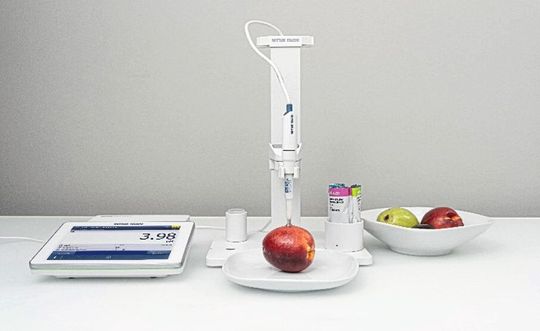
Although pH is a critical quality parameter in fruits, its measurement presents several challenges. Unlike liquid samples, fruits are solid or possess semi-solid structures, making the direct insertion of conventional pH electrodes difficult and often prone to interference. The complex nature of fruit matrices, along with the presence of pulp and fibrous materials, can lead to electrode clogging, slow response times, and unstable readings.
Fig.2: pH Measurement of Fruit Using the InLab™ Solids Pro-ISM™ Sensor and SevenDirect™ Benchtop pH Meter.
(Source: METTLER TOLEDO)
In many cases, additional sample preparation is required before analysis, further increasing the complexity of the measurement process. To overcome these issues, traditional methods often involve homogenizing the fruit with water prior to analysis. However, this dilution step may alter the actual pH of the sample and increase overall sample preparation time.
Recent Advances in Fruit pH Measurement
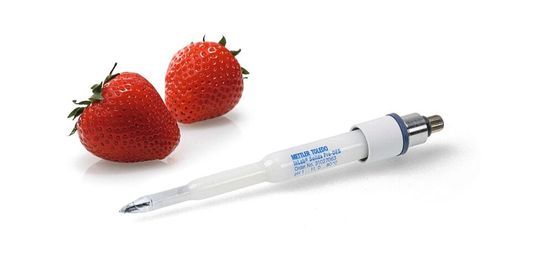
Recent advancements in pH measurement technology have significantly addressed many of the challenges associated with analysing fruits and fruit-based products. Specialized sensors designed for solid and semi-solid samples now enable direct pH measurement without extensive sample preparation. A notable example of these technological advancements is the InLab Solids Pro-DES™ pH sensor from METTLER TOLEDO.
Fig.3: InLab Solids Pro-DES Sensor for solid and semisolid samples.
(Source: METTLER TOLEDO)
Its features, such as a spear-shaped sensor tip, allow direct penetration into fruit tissue, while open-junction electrode designs minimize clogging caused by pulp and suspended particles. In addition, durable glass membranes provide rapid and accurate measurements, integrated temperature sensors enable automatic temperature compensation, and digital technology enhances measurement reliability and traceability. Together, these innovations improve measurement accuracy, reduce analysis time, and minimize the need for sample preparation.
Reliable pH Measurement in Fruit Juices
Accurate pH measurement of fruit juices presents its own set of challenges, particularly due to the presence of pulp and suspended particles that can clog conventional pH sensors equipped with ceramic fritted junctions. To address this issue, the InLab Max Pro-DES™ sensor features an innovative design that supports the direct analysis of undiluted fruit juice samples. Its construction minimizes the risk of junction clogging while providing stable, reliable, and repeatable measurements with minimal maintenance requirements. As a result, the sensor is well suited for routine quality control testing and helps ensure consistent batch-to-batch quality during juice production.
Importance in Fruit Processing Industries
Fruit-based industries rely heavily on pH monitoring to achieve consistent product quality.
By carefully adjusting pH levels, manufacturers can:
Control fermentation processes
Enhance flavour
Maintain desirable texture
Improve product stability
Ensure consistency across production batches
To learn more about pH measurement in fruits and vegetables, explore the application note. It offers detailed guidance on measurement techniques, sensor selection, and best practices that can help improve accuracy, efficiency, and reliability in routine quality analysis.




:quality(80)/p7i.vogel.de/wcms/62/32/62327aaae1415beeed47db6201e79661/0133375912v2.jpeg "A cotton trailer outfitted with benches and a sunshade offers farmworkers a reprieve from the sun as they take a break from picking cantaloupe melons in Firebaugh, Calif.
(Source: Joe Proudman/ Regents of the University of California)")
:quality(80)/p7i.vogel.de/wcms/e6/c8/e6c8bd554776ee1ad2f1f0723fb243a7/0133369387v1.jpeg "Roman road (Source: Queen Mary University of London)")
:quality(80)/p7i.vogel.de/wcms/51/68/51687ac4cc19f2757c138498b877de57/0133167039v2.jpeg "CMFs are foams that consist of hollow spheres – made of materials such as stainless steel, nickel, or other metals and alloys – embedded in a metallic matrix. The resulting material is both lightweight and remarkably strong at absorbing compressive forces. (Source: Jie Sun/ NC State University)")
:quality(80)/p7i.vogel.de/wcms/cd/c0/cdc09efd1e5b3b8f83224e7729d66c10/0133105276v2.jpeg "From the data presented in this report, the authors show how TF3-MALS-RI is uniquely able to separate large polyacrylate molecules and provide precise molecular weight and Rg values. (Source: Postnova Analytics)")
:quality(80)/p7i.vogel.de/wcms/a8/6e/a86e9b1f1561a67038b6d8a9fe629117/0133465534v2.jpeg "Clean, calibrate, and store pH electrodes properly to ensure accurate, reliable measurements every time. (Source: METTLER TOLEDO)")
:quality(80)/p7i.vogel.de/wcms/86/01/86014d3d2a28cefc852f65c8d68317e4/0133104231v2.jpeg "Single-handed tube reading using a Handheld 2. (Source: Azenta Life Sciences)")
:quality(80)/p7i.vogel.de/wcms/0b/0f/0b0f8ed042dfc91f32582e10d54c2c7e/0133087444v2.jpeg "Offering advanced automation to increase your throughput, the Intellixcap provides secure sealing – eliminating the need for manual intervention, while preserving vital sample integrity. (Source: Azenta Life Sciences)")
:quality(80)/p7i.vogel.de/wcms/13/d3/13d35105f74a1c2e22b9c7a270e8e9b3/0132611155v2.jpeg "Circulating cell free DNA. (Source: Amsbio)")
:quality(80)/p7i.vogel.de/wcms/6f/ea/6feaf3edd34eb4a9f1df201dc2e6448d/0133548706v2.jpeg "The researchers studied people’s perceptions, beliefs and knowledge about climate change in two coastal regions, one low-lying island and the other a mainland coast. (Source: P Afna)")
:quality(80)/p7i.vogel.de/wcms/8d/5c/8d5c6c7f897f91d6784825eee20b5584/0133321225v1.jpeg "Empa researcher Christoph Hüglin collects samples of particles that are washed out of the air by rain and snow or settle due to gravity. (Source: Empa)")
:quality(80)/p7i.vogel.de/wcms/a1/af/a1afbc7c8a067bbe94749ec680b4bafd/0133163762v2.jpeg "The study found in murkier water, fish took longer to move towards the food than those in clear water, but individuals in larger groups responded more quickly overall. (Source: Christos Ioannou)")
:quality(80)/p7i.vogel.de/wcms/32/80/3280aa3d44708962943c96fe2d466744/0133088560v2.jpeg "A bumble bee in flight at the University of Bristol Botanic Garden. (Source: Phil Savoie)")
:quality(80)/p7i.vogel.de/wcms/84/10/8410a026021778497197d21ef6987940/0133532147v2.jpeg "Fig. 1: Behind every sweet, tangy, or refreshing fruit lies a unique pH balance that shapes its flavor, freshness, and quality. (Source: METTLER TOLEDO)")
:quality(80)/p7i.vogel.de/wcms/ee/ad/eead38ab1e3c36f262bd889dfc8c5039/0133409909v2.jpeg "Eating a diet rich in wholegrain food is likely to prevent heart disease by reducing body weight, blood pressure and the levels of cholesterol and glucose in the blood. (Source: Unsplash)")
:quality(80)/p7i.vogel.de/wcms/ef/68/ef68375729607984e5bb0c143afdae70/0133375119v2.jpeg "Printed Rice-Lentil 3D structures
(Source: SUTD)")
:quality(80)/p7i.vogel.de/wcms/bf/d0/bfd087349a85956a7aefad57ac1204c7/0133241961v2.jpeg "The Thermo Scientific Suretect Beverage Spoilage Multiplex PCR Assay provides a fast, broad-range molecular solution for detecting key spoilage microorganisms that threaten beverage quality. (Source: © OlegDoroshin - stock.adobe.com)")
:quality(80)/p7i.vogel.de/wcms/b2/3c/b23c5aedafa5afc1788f81e6f3b9f4fd/0133548748v2.jpeg "A team led by Prof. Dr. Bahtiyar Yilmaz from the Department for Visceral Surgery and Medicine at Inselspital, Bern University Hospital, and the DBMR at the University of Bern has now investigated what happens in the gut after a fecal microbiota transplant. (Source: Unsplash)")
:quality(80)/p7i.vogel.de/wcms/d1/bb/d1bb6479bcfc0601c97b579081801328/0133492613v2.jpeg "Vitamin D deficiency was the most common, identified in 12.4 % of children within one year of GLP-1 treatment, the study found. (Source: Unsplash)")
:quality(80)/p7i.vogel.de/wcms/b4/be/b4be197454de6583c081ec202a277000/0133490787v2.jpeg "NUS researchers Viresh Krishnan Sukumar (left), Associate Professor Alfredo Franco-Obregón (centre), and Dr Alex Tai (right) showed that the application of brief, intermittent and low intensity magnetic pulses can reprogram immune cells to eradicate breast cancer. (Source: NUS)")
:quality(80)/p7i.vogel.de/wcms/f5/d3/f5d3af7b7479d0573bec5c1fb9f1fd7b/0133409927v2.jpeg "The Match study looked at over 500 cancer survivors with varying types and stages of cancer and found that patients experienced less pain, fatigue, and sleep problems after participating in the interventions. (Source: Unsplash)")
:quality(80)/images.vogel.de/vogelonline/bdb/1710600/1710675/original.jpg "Discover how to set yourself up for success when performing balance-based density determination of solids such as jewelry and precious metals. (Mettler Toledo)")
:quality(80)/images.vogel.de/vogelonline/bdb/1682500/1682579/original.jpg "The new XPR Analytical balance redesigned to meet the needs of laboratory technicians of working fast and lean. (Mettler Toledo)")
:quality(80)/images.vogel.de/vogelonline/bdb/1677000/1677080/original.jpg "Enhance your weighing accuracy, comfort and productivity with the redesigned XPR Analytical balance. (Mettler Toledo)")
:fill(fff,0)/images.vogel.de/vogelonline/companyimg/107800/107832/65.jpg "logoDueperthal.jpg ()")

:quality(80)/p7i.vogel.de/wcms/4c/df/4cdf172835be728c9ecb68ec309acca1/0130465673v2.jpeg "Peaches are climacteric fruits, which means they continue to ripen after being picked. The recommended storage temperature is 0°C, otherwise there is a risk of cold damage. (Source: Dall-e)")
:quality(80)/p7i.vogel.de/wcms/6c/19/6c19712454c1ea447b855ac8104bdca4/0128418996v2.jpeg "Impact of silver nitrate on the performance of solar panels (Source: © Awais - stock.adobe.com)")