A molecular material developed at Kyushu University can convert visible sunlight into ultraviolet light under ordinary outdoor conditions. The solid-state system uses photon upconversion to generate UV light from lower-energy photons, opening potential applications in air purification, photocatalysis and low-intensity 3D printing.
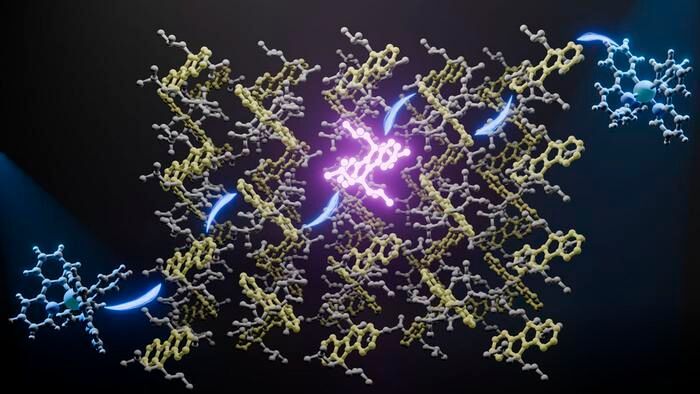
A new solid-state material from Kyushu University turns visible light into high-energy UV at sunlight intensity. By attaching alkyl chains to the sp³ carbon atoms of an organic molecule, the researchers create precisely controlled gaps between neighboring molecules. This spacing enables efficient triplet energy transfer, achieving a quantum yield above 60% in the solid state.
(Source: Naoyuki Harada / Kyushu University)
Two cups of warm water don’t make one cup of boiling water. But in the quantum world, multiple low-energy photons can combine to produce a single, higher-energy photon.
A research team at Kyushu University has developed a solid-state molecular material that “upgrades” visible light into ultraviolet (UV) light under ordinary outdoor sunlight, achieving a conversion efficiency of 1.9%. The study was published in Nature Communications on June 23.
Harsh UV light is something most people try to avoid in summer, yet it is indispensable across fields ranging from air purification and resin curing in 3D printing to gel hardening in dental fillings and nail art. Despite its importance, UV accounts for only about 6% of the sunlight reaching Earth’s surface, with only a fraction of that being practically usable.
“What we do here is ‘add together’ the energy from two visible light photons to make one ultraviolet photon. It’s a fascinating process called photo upconversion,” explains Yoichi Sasaki, Associate Professor at Kyushu University’s Faculty of Engineering and the study’s corresponding author.
One mechanism that enables such upconversion is triplet-triplet annihilation (TTA). A “donor” molecule absorbs visible light and excites its electrons into a high-energy triplet state, then passes it to a neighboring “acceptor” molecule. When two triplets meet, they annihilate each other, releasing their combined energy as a UV photon. TTA works well in liquids, where molecules move freely, and triplets collide easily. But those systems often rely on toxic solvents and can evaporate, limiting their practical use. That is why scientists have long searched for solid alternatives.
“In solids, molecules are packed tightly, and the π electron clouds — regions of high electron density hovering above and below each molecular plane — can overlap,” says Sasaki. “When that happens, triplets easily fizzle out before they ever meet. Molecules must be close enough for energy to transfer but separated enough to prevent quenching of excitons.”
The team found their answer in an organic semiconductor called dihydroindenoindenedene (DHI). By attaching alkyl chains to DHI’s sp³ carbon atoms — which have four bonds pointing in fixed 3D directions — the researchers created precisely controlled gaps between neighboring molecules, keeping them close enough for energy transfer without unwanted strong electronic interaction.
This discovery is the culmination of over 14 years of our research and marks a major milestone in photon-upconversion and molecular self-assembly research.
Nobuo Kimizuka, Professor Emeritus, Kyushu University
The optimized material shows strong light emission, long-lived excited states, and efficient energy transfer, achieving a solid-state fluorescence quantum yield above 60%. With a donor molecule, the system reaches an upconversion efficiency of 1.9%.
“This means roughly two UV photons are produced for every hundred visible-light photons absorbed,” Sasaki adds. “It may sound low, but it runs on natural sunlight alone. Most solid-state materials cannot realize this even at much higher light intensity.”
The material has been filed for a patent. Beyond efficiency, it offers advantages for real-world use, including straightforward synthesis and low-cost starting materials. The team sees potential applications in solar-driven photocatalysis, indoor air purification, and low-intensity 3D printing.
For the research team, the work also carries personal weight.
In 2012, Nobuo Kimizuka, now Professor Emeritus at Kyushu University’s Research Center for Negative Emissions Technologies, pioneered research into photon upconversion via triplet energy migration in self-assemblies, seeking to establish a molecular systems chemistry where self-assembly performs useful functions. His team made steady progress in both solution and gel systems, yet developing efficient solid-state upconversion systems remained challenging. A breakthrough finally came in May 2024, less than a year before Kimizuka’s retirement.
Date: 08.12.2025
Naturally, we always handle your personal data responsibly. Any personal data we receive from you is processed in accordance with applicable data protection legislation. For detailed information please see our privacy policy.
Consent to the use of data for promotional purposes
I hereby consent to Vogel Communications Group GmbH & Co. KG, Max-Planck-Str. 7-9, 97082 Würzburg including any affiliated companies according to §§ 15 et seq. AktG (hereafter: Vogel Communications Group) using my e-mail address to send editorial newsletters. A list of all affiliated companies can be found here
Newsletter content may include all products and services of any companies mentioned above, including for example specialist journals and books, events and fairs as well as event-related products and services, print and digital media offers and services such as additional (editorial) newsletters, raffles, lead campaigns, market research both online and offline, specialist webportals and e-learning offers. In case my personal telephone number has also been collected, it may be used for offers of aforementioned products, for services of the companies mentioned above, and market research purposes.
Additionally, my consent also includes the processing of my email address and telephone number for data matching for marketing purposes with select advertising partners such as LinkedIn, Google, and Meta. For this, Vogel Communications Group may transmit said data in hashed form to the advertising partners who then use said data to determine whether I am also a member of the mentioned advertising partner portals. Vogel Communications Group uses this feature for the purposes of re-targeting (up-selling, cross-selling, and customer loyalty), generating so-called look-alike audiences for acquisition of new customers, and as basis for exclusion for on-going advertising campaigns. Further information can be found in section “data matching for marketing purposes”.
In case I access protected data on Internet portals of Vogel Communications Group including any affiliated companies according to §§ 15 et seq. AktG, I need to provide further data in order to register for the access to such content. In return for this free access to editorial content, my data may be used in accordance with this consent for the purposes stated here. This does not apply to data matching for marketing purposes.
Right of revocation
I understand that I can revoke my consent at will. My revocation does not change the lawfulness of data processing that was conducted based on my consent leading up to my revocation. One option to declare my revocation is to use the contact form found at https://contact.vogel.de. In case I no longer wish to receive certain newsletters, I have subscribed to, I can also click on the unsubscribe link included at the end of a newsletter. Further information regarding my right of revocation and the implementation of it as well as the consequences of my revocation can be found in the data protection declaration, section editorial newsletter.
What followed was a sprint driven as much by shared bonds and gratitude as by science. At that time, graduate students Naoyuki Harada, Hayato Shoyama, Nutnicha Boonmong, along with then-Assistant Professor Kiichi Mizukami of Kyushu University’s Faculty of Engineering, worked alongside Sasaki to compress years of work into one.
“We handed the draft to Professor Kimizuka just 11 days before he left the lab, which for us felt like a heartfelt retirement gift,” Sasaki notes.




:quality(80)/p7i.vogel.de/wcms/62/32/62327aaae1415beeed47db6201e79661/0133375912v2.jpeg "A cotton trailer outfitted with benches and a sunshade offers farmworkers a reprieve from the sun as they take a break from picking cantaloupe melons in Firebaugh, Calif.
(Source: Joe Proudman/ Regents of the University of California)")
:quality(80)/p7i.vogel.de/wcms/e6/c8/e6c8bd554776ee1ad2f1f0723fb243a7/0133369387v1.jpeg "Roman road (Source: Queen Mary University of London)")
:quality(80)/p7i.vogel.de/wcms/51/68/51687ac4cc19f2757c138498b877de57/0133167039v2.jpeg "CMFs are foams that consist of hollow spheres – made of materials such as stainless steel, nickel, or other metals and alloys – embedded in a metallic matrix. The resulting material is both lightweight and remarkably strong at absorbing compressive forces. (Source: Jie Sun/ NC State University)")
:quality(80)/p7i.vogel.de/wcms/cd/c0/cdc09efd1e5b3b8f83224e7729d66c10/0133105276v2.jpeg "From the data presented in this report, the authors show how TF3-MALS-RI is uniquely able to separate large polyacrylate molecules and provide precise molecular weight and Rg values. (Source: Postnova Analytics)")
:quality(80)/p7i.vogel.de/wcms/a8/6e/a86e9b1f1561a67038b6d8a9fe629117/0133465534v2.jpeg "Clean, calibrate, and store pH electrodes properly to ensure accurate, reliable measurements every time. (Source: METTLER TOLEDO)")
:quality(80)/p7i.vogel.de/wcms/86/01/86014d3d2a28cefc852f65c8d68317e4/0133104231v2.jpeg "Single-handed tube reading using a Handheld 2. (Source: Azenta Life Sciences)")
:quality(80)/p7i.vogel.de/wcms/0b/0f/0b0f8ed042dfc91f32582e10d54c2c7e/0133087444v2.jpeg "Offering advanced automation to increase your throughput, the Intellixcap provides secure sealing – eliminating the need for manual intervention, while preserving vital sample integrity. (Source: Azenta Life Sciences)")
:quality(80)/p7i.vogel.de/wcms/13/d3/13d35105f74a1c2e22b9c7a270e8e9b3/0132611155v2.jpeg "Circulating cell free DNA. (Source: Amsbio)")
:quality(80)/p7i.vogel.de/wcms/6f/ea/6feaf3edd34eb4a9f1df201dc2e6448d/0133548706v2.jpeg "The researchers studied people’s perceptions, beliefs and knowledge about climate change in two coastal regions, one low-lying island and the other a mainland coast. (Source: P Afna)")
:quality(80)/p7i.vogel.de/wcms/8d/5c/8d5c6c7f897f91d6784825eee20b5584/0133321225v1.jpeg "Empa researcher Christoph Hüglin collects samples of particles that are washed out of the air by rain and snow or settle due to gravity. (Source: Empa)")
:quality(80)/p7i.vogel.de/wcms/a1/af/a1afbc7c8a067bbe94749ec680b4bafd/0133163762v2.jpeg "The study found in murkier water, fish took longer to move towards the food than those in clear water, but individuals in larger groups responded more quickly overall. (Source: Christos Ioannou)")
:quality(80)/p7i.vogel.de/wcms/32/80/3280aa3d44708962943c96fe2d466744/0133088560v2.jpeg "A bumble bee in flight at the University of Bristol Botanic Garden. (Source: Phil Savoie)")
:quality(80)/p7i.vogel.de/wcms/95/3e/953e490f1819f6638bc08fe3d4d43e87/0133566684v1.jpeg "The soy protein isolate the researchers fed to the mice. (Source: KyotoU / Tomoko T. Asai)")
:quality(80)/p7i.vogel.de/wcms/ba/38/ba38179dbcd20fbc3887b2709193d0a8/0133566669v2.jpeg "Consumers in a Cornell study showed no consistent bias against the colour of hybrid red wines, with several ranking among the most visually appealing. (Source: free licensed)")
:quality(80)/p7i.vogel.de/wcms/ac/d1/acd1a8888f6e78206f11f2b4eb33926f/0133566582v1.jpeg "A claim on the front of a box of food products is a hint, not a verdict. The nutrition label on the back – added sugars, sodium, saturated fat, all of it together – still tells the fuller story. (Source: free licensed)")
:quality(80)/p7i.vogel.de/wcms/84/10/8410a026021778497197d21ef6987940/0133532147v2.jpeg "Fig. 1: Behind every sweet, tangy, or refreshing fruit lies a unique pH balance that shapes its flavor, freshness, and quality. (Source: METTLER TOLEDO)")
:quality(80)/p7i.vogel.de/wcms/f3/32/f332f826e9c6b84c66c63c6a79fd9e68/0133566559v2.jpeg "An analysis of 1.4 million adults in England found that 59% of participants with high blood pressure had not been diagnosed and were not taking blood pressure-lowering medication. (Source: free licensed)")
:quality(80)/p7i.vogel.de/wcms/5b/68/5b68667dfbf7bae351f864f0590cc985/0133566532v2.jpeg "Blood pressure normally falls during sleep. A modelling study suggests that a delay in the kidneys’ salt-processing rhythm could disrupt this overnight dip, a mechanism that still needs experimental and clinical testing. (Source: free licensed)")
:quality(80)/p7i.vogel.de/wcms/a9/11/a911e9abe761c9bcf5221cd218e14e80/0133560426v2.jpeg "With direct ties to the trade show, the Medica Labmed Forum bridges the gap between current scientific developments and practical healthcare issues. (Source: Constanze Tillmann/Messe Düsseldorf)")
:quality(80)/p7i.vogel.de/wcms/b2/3c/b23c5aedafa5afc1788f81e6f3b9f4fd/0133548748v2.jpeg "A team led by Prof. Dr. Bahtiyar Yilmaz from the Department for Visceral Surgery and Medicine at Inselspital, Bern University Hospital, and the DBMR at the University of Bern has now investigated what happens in the gut after a fecal microbiota transplant. (Source: Unsplash)")
:quality(80)/images.vogel.de/vogelonline/bdb/1710600/1710675/original.jpg "Discover how to set yourself up for success when performing balance-based density determination of solids such as jewelry and precious metals. (Mettler Toledo)")
:quality(80)/images.vogel.de/vogelonline/bdb/1682500/1682579/original.jpg "The new XPR Analytical balance redesigned to meet the needs of laboratory technicians of working fast and lean. (Mettler Toledo)")
:quality(80)/images.vogel.de/vogelonline/bdb/1677000/1677080/original.jpg "Enhance your weighing accuracy, comfort and productivity with the redesigned XPR Analytical balance. (Mettler Toledo)")
:fill(fff,0)/images.vogel.de/vogelonline/companyimg/107800/107832/65.jpg "logoDueperthal.jpg ()")
:fill(fff,0)/images.vogel.de/vogelonline/companyimg/131900/131910/65.jpg "Xylem_tag_rgb.jpg ()")
:fill(fff,0)/p7i.vogel.de/companies/69/b7/69b7f63f311d9/logo-bimos-tif--2-.jpeg "logo-bimos-tif--2- (https://www.bimos.com/de-de/)")
:quality(80)/p7i.vogel.de/wcms/fe/64/fe649767c802d53ac63ee2c2a40b7e0d/0130060830v2.jpeg "Sample tube with light-active substance (Source: Elvira Eberhardt / Ulm University)")
:quality(80)/p7i.vogel.de/wcms/fe/64/fe649767c802d53ac63ee2c2a40b7e0d/0130060830v2.jpeg "Sample tube with light-active substance (Source: Elvira Eberhardt / Ulm University)")
:quality(80)/p7i.vogel.de/wcms/e2/50/e25060efc5d415df36685fce9e64f047/0128496870v2.jpeg "SFG microscopy image of boron nitride monolayer flakes. (Source: FHI)")