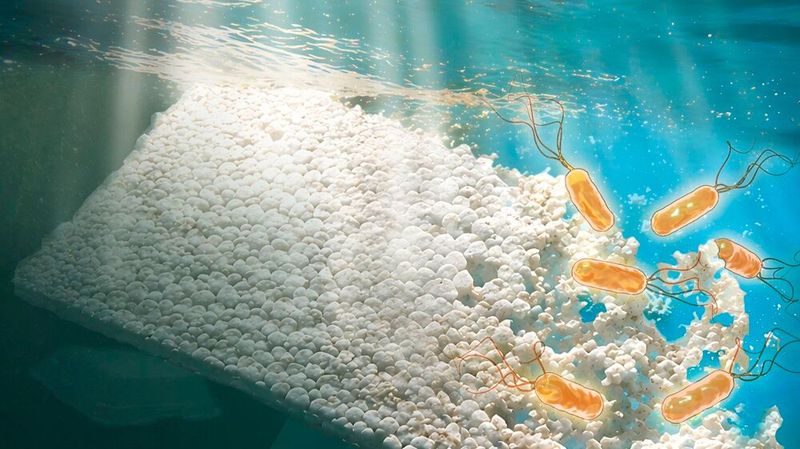
Scientists have long known that sunlight helps break down plastic. So, why do plastic products linger for decades and even centuries in rivers, lakes and oceans — even when bathed in direct sunlight? Northwestern University engineers have uncovered an unexpected answer. The surprising culprit is the water itself.
Salts, organic matter and other chemical constituents in natural fresh water and seawater suppress sunlight's ability to degrade plastic. Because sunlight cannot effectively initiate the degradation process, microbes cannot finish the job. That means nature’s cleanup process slows down, allowing plastics to accumulate and persist in waterways around the world.
In a new study designed to mimic real environmental conditions, researchers found that the chemical makeup of natural waters — especially combinations of salt and organic matter — significantly delays the breakdown of polystyrene, a common plastic used in packaging and food containers.
Because sunlight cannot effectively initiate the degradation process, microbes cannot finish the job. That means nature’s cleanup process slows down, allowing plastics to accumulate and persist in waterways around the world.
The findings show that solving plastic pollution isn’t only about the material itself but also about the environment it enters. These insights could be used to design new types of plastic that degrade even in salty, complex environments or that don’t rely on sunlight to jump-start the breakdown process.
“In the scientific literature, it’s widely reported that ultraviolet light can facilitate significant breakdown of plastics in a process called photodegradation,” said Northwestern’s Ludmilla Aristilde, who led the study. “If that’s the case, then why is plastic debris so slow to degrade in our surface waters? It turns out a lot of lab experiments use pure water or water that does not represent natural water chemistry and artificial light that does not reflect full spectrum of solar radiation. We wondered whether those studies were missing part of the story by overlooking the complexity of natural environments.”
An expert in the dynamics of organics in environmental processes, Aristilde is a professor of civil and environmental engineering at Northwestern’s McCormick School of Engineering and a member of the Center for Synthetic Biology, the International Institute for Nanotechnology and the Paula M. Trienens Institute for Sustainability and Energy. This work was led by postdoctoral researcher Nasrin Naderi Beni and doctoral student Cara Flynn, both members of the Aristilde Research Group.
To find the missing piece to the puzzle, Aristilde and her team created multiple realistic scenarios in the lab. For ocean-like water, the researchers added salt and other dissolved ions like chloride, bromide, bicarbonate and sulfate. To mimic freshwater, the team created a solution with lower salt levels and a different mix of dissolved ions found in lakes and rivers. In some experiments, the team also added organic matter — similar to what’s found in natural rivers — from decaying plants and microbial material.
For comparison and to reflect past studies, the researchers also set up an experiment with purified water that contained none of these ingredients. Then, they added thin strips of polystyrene plastics to each mixture and exposed them to simulated, full-spectrum sunlight for roughly three months.
Across all conditions, sunlight triggered the early stages of degradation. The surfaces of the plastic became rougher, cracked and chemically altered. But the extent of that damage varied dramatically depending on the water. Plastic degraded the most in purified water, less in freshwater and the least in seawater.
“We used multiple techniques to examine the plastic surfaces at the microscopic and molecular levels,” Aristilde said. “For the samples in the pure water, we saw really obvious ‘mountains and valleys’ emerging on the plastic surface after exposure to continuous sunlight simulation. We captured evidence of the polymer breaking down, new surface chemistry occurring from oxidation of plastics, and release of products into the water.”
Competing for Sunlight
When researchers added natural organic matter, it further suppressed degradation in solutions representing both freshwater and seawater chemistries. In other words, the more realistic the water became, the less the plastic broke down. Aristilde concluded that, although sunlight triggers reactive chemistry in plastics, salts dampen that effect. Meanwhile, the combined effect of organic matter and salts can block sunlight or neutralize reactive molecules.
Date: 08.12.2025
Naturally, we always handle your personal data responsibly. Any personal data we receive from you is processed in accordance with applicable data protection legislation. For detailed information please see our privacy policy.
Consent to the use of data for promotional purposes
I hereby consent to Vogel Communications Group GmbH & Co. KG, Max-Planck-Str. 7-9, 97082 Würzburg including any affiliated companies according to §§ 15 et seq. AktG (hereafter: Vogel Communications Group) using my e-mail address to send editorial newsletters. A list of all affiliated companies can be found here
Newsletter content may include all products and services of any companies mentioned above, including for example specialist journals and books, events and fairs as well as event-related products and services, print and digital media offers and services such as additional (editorial) newsletters, raffles, lead campaigns, market research both online and offline, specialist webportals and e-learning offers. In case my personal telephone number has also been collected, it may be used for offers of aforementioned products, for services of the companies mentioned above, and market research purposes.
Additionally, my consent also includes the processing of my email address and telephone number for data matching for marketing purposes with select advertising partners such as LinkedIn, Google, and Meta. For this, Vogel Communications Group may transmit said data in hashed form to the advertising partners who then use said data to determine whether I am also a member of the mentioned advertising partner portals. Vogel Communications Group uses this feature for the purposes of re-targeting (up-selling, cross-selling, and customer loyalty), generating so-called look-alike audiences for acquisition of new customers, and as basis for exclusion for on-going advertising campaigns. Further information can be found in section “data matching for marketing purposes”.
In case I access protected data on Internet portals of Vogel Communications Group including any affiliated companies according to §§ 15 et seq. AktG, I need to provide further data in order to register for the access to such content. In return for this free access to editorial content, my data may be used in accordance with this consent for the purposes stated here. This does not apply to data matching for marketing purposes.
Right of revocation
I understand that I can revoke my consent at will. My revocation does not change the lawfulness of data processing that was conducted based on my consent leading up to my revocation. One option to declare my revocation is to use the contact form found at https://contact.vogel.de. In case I no longer wish to receive certain newsletters, I have subscribed to, I can also click on the unsubscribe link included at the end of a newsletter. Further information regarding my right of revocation and the implementation of it as well as the consequences of my revocation can be found in the data protection declaration, section editorial newsletter.
“We think that, in pure water, sunlight goes through the water and directly to the plastic,” Aristilde said. “But when you have water with dissolved ions and organic matter floating around, the sunlight reacts with those components. So, those components compete with the plastics for the reactions driven by sunlight.”
While sunlight doesn’t fully degrade plastic materials, it can prepare them for further degradation by microbes. As polystyrene breaks down, it releases fragments and small molecules that microbes can use as food, and rougher surfaces give bacteria a foothold. After examining the plastic’s reaction to sunlight alone, Aristilde’s team introduced an environmental bacterium, known to degrade plastics, to each water sample.
The team found that plastic exposed to sunlight in freshwater solution showed more microbial breakdown than the plastic exposed in seawater solution. So, because seawater stifled initial damage from sunlight, microbes have less to work with.
“The sun does the first step of the degradation process to help the microbes chew up the plastic,” Aristilde said. “By changing the chemistry of plastic surface, it becomes more attractive to bacteria.”
The study not only provides an explanation for why plastics remain in the environment for so long, but it also highlights a broader challenge. Solutions that appear promising under simplified lab conditions may not perform the same way in complex natural systems. Understanding true, real-world constraints, Aristilde said, is essential for predicting what will happen to plastic materials, designing degradable versions of plastic materials and developing effective strategies to address plastic pollution.
“Our first motivation was to understand natural processes that we observe outside the lab,” Aristilde said. “But we’re also motivated to find new processes that can inform engineering solutions. This new information could help engineers design plastics with characteristics that make them biodegradable eventually. For example, if we can make plastic more susceptible to sunlight, it might make it easier for microbes to take care of the rest.”
The study, titled “Polystyrene photooxidation in natural waters as a precursor to microbial degradation,” was funded by the National Science Foundation.
Original Article: Polystyrene photooxidation in natural waters as a precursor to microbial degradation; npj Materials Degradation; DOI:10.1038/s41529-026-00788-7




:quality(80)/p7i.vogel.de/wcms/62/32/62327aaae1415beeed47db6201e79661/0133375912v2.jpeg "A cotton trailer outfitted with benches and a sunshade offers farmworkers a reprieve from the sun as they take a break from picking cantaloupe melons in Firebaugh, Calif.
(Source: Joe Proudman/ Regents of the University of California)")
:quality(80)/p7i.vogel.de/wcms/e6/c8/e6c8bd554776ee1ad2f1f0723fb243a7/0133369387v1.jpeg "Roman road (Source: Queen Mary University of London)")
:quality(80)/p7i.vogel.de/wcms/51/68/51687ac4cc19f2757c138498b877de57/0133167039v2.jpeg "CMFs are foams that consist of hollow spheres – made of materials such as stainless steel, nickel, or other metals and alloys – embedded in a metallic matrix. The resulting material is both lightweight and remarkably strong at absorbing compressive forces. (Source: Jie Sun/ NC State University)")
:quality(80)/p7i.vogel.de/wcms/cd/c0/cdc09efd1e5b3b8f83224e7729d66c10/0133105276v2.jpeg "From the data presented in this report, the authors show how TF3-MALS-RI is uniquely able to separate large polyacrylate molecules and provide precise molecular weight and Rg values. (Source: Postnova Analytics)")
:quality(80)/p7i.vogel.de/wcms/86/01/86014d3d2a28cefc852f65c8d68317e4/0133104231v2.jpeg "Single-handed tube reading using a Handheld 2. (Source: Azenta Life Sciences)")
:quality(80)/p7i.vogel.de/wcms/0b/0f/0b0f8ed042dfc91f32582e10d54c2c7e/0133087444v2.jpeg "Offering advanced automation to increase your throughput, the Intellixcap provides secure sealing – eliminating the need for manual intervention, while preserving vital sample integrity. (Source: Azenta Life Sciences)")
:quality(80)/p7i.vogel.de/wcms/13/d3/13d35105f74a1c2e22b9c7a270e8e9b3/0132611155v2.jpeg "Circulating cell free DNA. (Source: Amsbio)")
:quality(80)/p7i.vogel.de/wcms/bc/ed/bced6850297a04dbea471a66cb6bb6fe/0132611405v2.jpeg "The latest addition to the range is a peristaltic tubing stop adapter that eliminates the need for fixed stoppers and allows custom cut lengths of peristaltic tubing to be installed on any pump head size. (Source: Biotech Fluidics )")
:quality(80)/p7i.vogel.de/wcms/8d/5c/8d5c6c7f897f91d6784825eee20b5584/0133321225v1.jpeg "Empa researcher Christoph Hüglin collects samples of particles that are washed out of the air by rain and snow or settle due to gravity. (Source: Empa)")
:quality(80)/p7i.vogel.de/wcms/a1/af/a1afbc7c8a067bbe94749ec680b4bafd/0133163762v2.jpeg "The study found in murkier water, fish took longer to move towards the food than those in clear water, but individuals in larger groups responded more quickly overall. (Source: Christos Ioannou)")
:quality(80)/p7i.vogel.de/wcms/32/80/3280aa3d44708962943c96fe2d466744/0133088560v2.jpeg "A bumble bee in flight at the University of Bristol Botanic Garden. (Source: Phil Savoie)")
:quality(80)/p7i.vogel.de/wcms/7b/e5/7be5c735140cbe28f3af0ec3d88274b9/0133045403v2.jpeg "After being buried in the ground for two months and broken down by soil organisms, a new pair of cotton underwear (left) shows clear signs of decomposition (right). (Source: Nicolas Zonvi)")
:quality(80)/p7i.vogel.de/wcms/ef/68/ef68375729607984e5bb0c143afdae70/0133375119v2.jpeg "Printed Rice-Lentil 3D structures
(Source: SUTD)")
:quality(80)/p7i.vogel.de/wcms/bf/d0/bfd087349a85956a7aefad57ac1204c7/0133241961v2.jpeg "The Thermo Scientific Suretect Beverage Spoilage Multiplex PCR Assay provides a fast, broad-range molecular solution for detecting key spoilage microorganisms that threaten beverage quality. (Source: © OlegDoroshin - stock.adobe.com)")
:quality(80)/p7i.vogel.de/wcms/d4/61/d461ce0bd5743897993c6475f69e7ad6/0133067478v2.jpeg "In Harris County, 50 % of households with children reported food insecurity, compared with 33 % of households without children. (Source: Rice University)")
:quality(80)/p7i.vogel.de/wcms/79/76/7976d17b980bedfe35acaa532d690046/0132713841v2.jpeg "Observed rice yield losses from 1°C warming are more than twice as high as model estimates due to underestimated heat stress. (Source: AdobeStock/ducvien)")
:quality(80)/p7i.vogel.de/wcms/22/49/224964dd6850b62cccdbc4bde2d34693/0133372964v1.jpeg "Brain activity recorded during a video game helped researchers predict whether participants would take or avoid a risk half a second before they acted. (Source: free licensed)")
:quality(80)/p7i.vogel.de/wcms/48/a7/48a761934161543f70fef2403b44d714/0133372328v2.jpeg "The link between pollution and coughing persisted in the data, even when pollution levels were below the WHO’s recommended safe daily exposure limit. (Source: free licensed)")
:quality(80)/p7i.vogel.de/wcms/83/b4/83b4563a65c6036b61990931507428b4/0133363611v2.jpeg "Magnesium sulphate uptake and the north / south divide for the Precept program. (Source: University of Bristol )")
:quality(80)/p7i.vogel.de/wcms/bb/06/bb06c1c3c5d250f3f93016366c56525d/0133363201v2.jpeg "The team identified more than 1,200 associated genetic variants and found that these influences are remarkably consistent across countries, ages and methods of measuring personality. (Source: Pixabay - PublicDomainPictures)")
:quality(80)/images.vogel.de/vogelonline/bdb/1710600/1710675/original.jpg "Discover how to set yourself up for success when performing balance-based density determination of solids such as jewelry and precious metals. (Mettler Toledo)")
:quality(80)/images.vogel.de/vogelonline/bdb/1682500/1682579/original.jpg "The new XPR Analytical balance redesigned to meet the needs of laboratory technicians of working fast and lean. (Mettler Toledo)")
:quality(80)/images.vogel.de/vogelonline/bdb/1677000/1677080/original.jpg "Enhance your weighing accuracy, comfort and productivity with the redesigned XPR Analytical balance. (Mettler Toledo)")
:fill(fff,0)/images.vogel.de/vogelonline/companyimg/107800/107832/65.jpg "logoDueperthal.jpg ()")
:fill(fff,0)/images.vogel.de/vogelonline/companyimg/131900/131910/65.jpg "Xylem_tag_rgb.jpg ()")
:fill(fff,0)/p7i.vogel.de/companies/69/b7/69b7f63f311d9/logo-bimos-tif--2-.jpeg "logo-bimos-tif--2- (https://www.bimos.com/de-de/)")
:quality(80)/p7i.vogel.de/wcms/44/22/4422e2ed3cc872c0ff7db4943df4f885/0128938692v1.jpeg "Certain fertilizers are coated in a thin layer of plastic to delay the release of chemicals, making it last longer. (Source: free licensed)")
:quality(80)/p7i.vogel.de/wcms/ed/07/ed0756a2495cf3591db2f3c23bedd39c/0131055520v2.jpeg "E. coli cultures and other experimental materials used in the study, shown with a 3D-printed model of the engineered phage (extreme left). (Source: National University of Singapore )")
:quality(80)/p7i.vogel.de/wcms/ec/f9/ecf9b6d0dbedde632f2bcd976fa1d334/0128811445v1.jpeg "Biodegradable and conventional plastics host distinct microbial communities in river environments, with the study showing that different polymers create contrasting patterns of antibiotic resistance and virulence as biofilms develop and degrade over time. (Source: free licensed)")
:quality(80)/p7i.vogel.de/wcms/37/77/37779bf078072a8d5d3533eaa0fe3c48/0127289681v1.jpeg "Biochar-driven rhizoremediation of soil contaminated with organic pollutants: engineered solutions, microbiome enrichment, and bioeconomic benefits for ecosystem restoration. (Source: Nandita Das & Piyush Pandey)")