Origin-of-life chemists from Scripps Research and the Georgia Institute of Technology propose that glyoxylate could have been the original source of sugars on the “prebiotic” Earth — a prerequisite for the development of life.
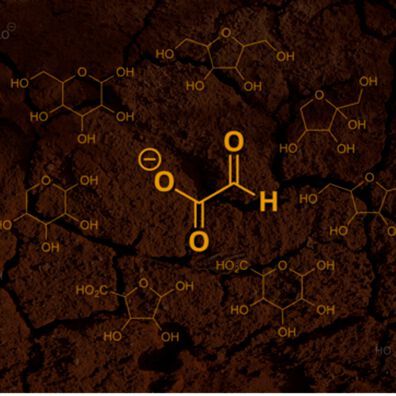
A new hypothesis states that the first sugars emerged from glyoxylate (pictured as the center molecule). In this hypothesis, glyoxylate first reacts with itself and then the byproducts from these reactions, ultimately forming simple sugars and other products (pictured as the surrounding molecules).
(Source: Scripps Research and Unsplash)
Two prominent origin-of-life chemists have published a new hypothesis for how the first sugars — which were necessary for life to evolve — arose on the early Earth. They propose that key sugars needed for making early life forms could have emerged from reactions involving glyoxylate (C2HO3-), a relatively simple chemical that plausibly existed on the Earth before life evolved.
“We show that our new hypothesis has key advantages over the more traditional view that early sugars arose from the chemical formaldehyde,” says Ramanarayanan Krishnamurthy, PhD, a professor in the Department of Chemistry at Scripps Research. Krishnamurthy’s co-author was Charles Liotta, PhD, Regents' Professor Emeritus at the Georgia Institute of Technology’s School of Chemistry and Biochemistry.
Origin-of-life chemists seek to explain how the basic molecular building blocks and reactions necessary for life could have arisen from the simple chemicals that were likely present on the “prebiotic” Earth. The overarching aim of the field is to answer the fundamental question of how our living planet came to be. But its discoveries also can inform—and have informed—many other fields, from atmospheric science and geology to synthetic biology and the search for life on other planets.
The three major classes of biological molecule whose availability needs to be explained by origin-of-life chemistry are: the amino acids that make up proteins, the nucleobases that make up the “letters” of DNA and RNA, and the sugars (also called carbohydrates) that are found throughout biology, including in the twisted backbone structure of DNA and RNA. According to the prevailing theories, amino acids probably arose from ammonia (NH3), while nucleobases arose from hydrogen cyanide (HCN).
The origin of sugars has been less clear. Many scientists believe the first sugars came from reactions involving formaldehyde (CH2O), but this theory has some drawbacks. “The formaldehyde reactions proposed by this theory are quite messy—they have uncontrolled side reactions and other drawbacks due to formaldehyde’s high reactivity under the envisioned early-Earth conditions,” Liotta says.
The chemists’ proposed alternative is a “glyoxylose reaction” scenario in which glyoxylate first reacts with itself, forming a close cousin of formaldehyde known as glycolaldehyde. The researchers suggest that glyoxylate, glycolaldehyde, their byproducts and other simple compounds could have continued to react with one another, ultimately yielding simple sugars and other products — without the drawbacks of formaldehyde-based reactions.
Glyoxylate already has a prominent role in origin-of-life chemistry theories. Swiss chemist Albert Eschenmoser proposed in 2007 that a form of it might have been the source for multiple original biomolecules. Krishnamurthy and Furman University chemist Greg Springsteen, PhD, also suggested in a 2020 Nature Chemistry paper that glyoxylate could have helped initiate a primordial version of the modern (tricarboxylic acid) TCA cycle, a basic metabolic process found in most life forms on Earth.
Krishnamurthy and his team are currently working to demonstrate in the laboratory that the glyoxylose reaction scenario could indeed have yielded the first sugars. “Such a demonstration would expand the role of glyoxylate as a versatile molecule in prebiotic chemistry and further stimulate the search for its own origin on the prebiotic Earth,” Krishnamurthy says.
The chemists are also looking into potential commercial applications of reactions that make glyoxylate, since these effectively consume CO2 and thus can be used to reduce CO2 levels, either locally in industrial settings or globally to combat global warming.
Date: 08.12.2025
Naturally, we always handle your personal data responsibly. Any personal data we receive from you is processed in accordance with applicable data protection legislation. For detailed information please see our privacy policy.
Consent to the use of data for promotional purposes
I hereby consent to Vogel Communications Group GmbH & Co. KG, Max-Planck-Str. 7-9, 97082 Würzburg including any affiliated companies according to §§ 15 et seq. AktG (hereafter: Vogel Communications Group) using my e-mail address to send editorial newsletters. A list of all affiliated companies can be found here
Newsletter content may include all products and services of any companies mentioned above, including for example specialist journals and books, events and fairs as well as event-related products and services, print and digital media offers and services such as additional (editorial) newsletters, raffles, lead campaigns, market research both online and offline, specialist webportals and e-learning offers. In case my personal telephone number has also been collected, it may be used for offers of aforementioned products, for services of the companies mentioned above, and market research purposes.
Additionally, my consent also includes the processing of my email address and telephone number for data matching for marketing purposes with select advertising partners such as LinkedIn, Google, and Meta. For this, Vogel Communications Group may transmit said data in hashed form to the advertising partners who then use said data to determine whether I am also a member of the mentioned advertising partner portals. Vogel Communications Group uses this feature for the purposes of re-targeting (up-selling, cross-selling, and customer loyalty), generating so-called look-alike audiences for acquisition of new customers, and as basis for exclusion for on-going advertising campaigns. Further information can be found in section “data matching for marketing purposes”.
In case I access protected data on Internet portals of Vogel Communications Group including any affiliated companies according to §§ 15 et seq. AktG, I need to provide further data in order to register for the access to such content. In return for this free access to editorial content, my data may be used in accordance with this consent for the purposes stated here. This does not apply to data matching for marketing purposes.
Right of revocation
I understand that I can revoke my consent at will. My revocation does not change the lawfulness of data processing that was conducted based on my consent leading up to my revocation. One option to declare my revocation is to use the contact form found at https://contact.vogel.de. In case I no longer wish to receive certain newsletters, I have subscribed to, I can also click on the unsubscribe link included at the end of a newsletter. Further information regarding my right of revocation and the implementation of it as well as the consequences of my revocation can be found in the data protection declaration, section editorial newsletter.




:quality(80)/p7i.vogel.de/wcms/62/32/62327aaae1415beeed47db6201e79661/0133375912v2.jpeg "A cotton trailer outfitted with benches and a sunshade offers farmworkers a reprieve from the sun as they take a break from picking cantaloupe melons in Firebaugh, Calif.
(Source: Joe Proudman/ Regents of the University of California)")
:quality(80)/p7i.vogel.de/wcms/e6/c8/e6c8bd554776ee1ad2f1f0723fb243a7/0133369387v1.jpeg "Roman road (Source: Queen Mary University of London)")
:quality(80)/p7i.vogel.de/wcms/51/68/51687ac4cc19f2757c138498b877de57/0133167039v2.jpeg "CMFs are foams that consist of hollow spheres – made of materials such as stainless steel, nickel, or other metals and alloys – embedded in a metallic matrix. The resulting material is both lightweight and remarkably strong at absorbing compressive forces. (Source: Jie Sun/ NC State University)")
:quality(80)/p7i.vogel.de/wcms/cd/c0/cdc09efd1e5b3b8f83224e7729d66c10/0133105276v2.jpeg "From the data presented in this report, the authors show how TF3-MALS-RI is uniquely able to separate large polyacrylate molecules and provide precise molecular weight and Rg values. (Source: Postnova Analytics)")
:quality(80)/p7i.vogel.de/wcms/86/01/86014d3d2a28cefc852f65c8d68317e4/0133104231v2.jpeg "Single-handed tube reading using a Handheld 2. (Source: Azenta Life Sciences)")
:quality(80)/p7i.vogel.de/wcms/0b/0f/0b0f8ed042dfc91f32582e10d54c2c7e/0133087444v2.jpeg "Offering advanced automation to increase your throughput, the Intellixcap provides secure sealing – eliminating the need for manual intervention, while preserving vital sample integrity. (Source: Azenta Life Sciences)")
:quality(80)/p7i.vogel.de/wcms/13/d3/13d35105f74a1c2e22b9c7a270e8e9b3/0132611155v2.jpeg "Circulating cell free DNA. (Source: Amsbio)")
:quality(80)/p7i.vogel.de/wcms/bc/ed/bced6850297a04dbea471a66cb6bb6fe/0132611405v2.jpeg "The latest addition to the range is a peristaltic tubing stop adapter that eliminates the need for fixed stoppers and allows custom cut lengths of peristaltic tubing to be installed on any pump head size. (Source: Biotech Fluidics )")
:quality(80)/p7i.vogel.de/wcms/8d/5c/8d5c6c7f897f91d6784825eee20b5584/0133321225v1.jpeg "Empa researcher Christoph Hüglin collects samples of particles that are washed out of the air by rain and snow or settle due to gravity. (Source: Empa)")
:quality(80)/p7i.vogel.de/wcms/a1/af/a1afbc7c8a067bbe94749ec680b4bafd/0133163762v2.jpeg "The study found in murkier water, fish took longer to move towards the food than those in clear water, but individuals in larger groups responded more quickly overall. (Source: Christos Ioannou)")
:quality(80)/p7i.vogel.de/wcms/32/80/3280aa3d44708962943c96fe2d466744/0133088560v2.jpeg "A bumble bee in flight at the University of Bristol Botanic Garden. (Source: Phil Savoie)")
:quality(80)/p7i.vogel.de/wcms/7b/e5/7be5c735140cbe28f3af0ec3d88274b9/0133045403v2.jpeg "After being buried in the ground for two months and broken down by soil organisms, a new pair of cotton underwear (left) shows clear signs of decomposition (right). (Source: Nicolas Zonvi)")
:quality(80)/p7i.vogel.de/wcms/ef/68/ef68375729607984e5bb0c143afdae70/0133375119v2.jpeg "Printed Rice-Lentil 3D structures
(Source: SUTD)")
:quality(80)/p7i.vogel.de/wcms/bf/d0/bfd087349a85956a7aefad57ac1204c7/0133241961v2.jpeg "The Thermo Scientific Suretect Beverage Spoilage Multiplex PCR Assay provides a fast, broad-range molecular solution for detecting key spoilage microorganisms that threaten beverage quality. (Source: © OlegDoroshin - stock.adobe.com)")
:quality(80)/p7i.vogel.de/wcms/d4/61/d461ce0bd5743897993c6475f69e7ad6/0133067478v2.jpeg "In Harris County, 50 % of households with children reported food insecurity, compared with 33 % of households without children. (Source: Rice University)")
:quality(80)/p7i.vogel.de/wcms/79/76/7976d17b980bedfe35acaa532d690046/0132713841v2.jpeg "Observed rice yield losses from 1°C warming are more than twice as high as model estimates due to underestimated heat stress. (Source: AdobeStock/ducvien)")
:quality(80)/p7i.vogel.de/wcms/22/49/224964dd6850b62cccdbc4bde2d34693/0133372964v1.jpeg "Brain activity recorded during a video game helped researchers predict whether participants would take or avoid a risk half a second before they acted. (Source: free licensed)")
:quality(80)/p7i.vogel.de/wcms/48/a7/48a761934161543f70fef2403b44d714/0133372328v2.jpeg "The link between pollution and coughing persisted in the data, even when pollution levels were below the WHO’s recommended safe daily exposure limit. (Source: free licensed)")
:quality(80)/p7i.vogel.de/wcms/83/b4/83b4563a65c6036b61990931507428b4/0133363611v2.jpeg "Magnesium sulphate uptake and the north / south divide for the Precept program. (Source: University of Bristol )")
:quality(80)/p7i.vogel.de/wcms/bb/06/bb06c1c3c5d250f3f93016366c56525d/0133363201v2.jpeg "The team identified more than 1,200 associated genetic variants and found that these influences are remarkably consistent across countries, ages and methods of measuring personality. (Source: Pixabay - PublicDomainPictures)")
:quality(80)/images.vogel.de/vogelonline/bdb/1710600/1710675/original.jpg "Discover how to set yourself up for success when performing balance-based density determination of solids such as jewelry and precious metals. (Mettler Toledo)")
:quality(80)/images.vogel.de/vogelonline/bdb/1682500/1682579/original.jpg "The new XPR Analytical balance redesigned to meet the needs of laboratory technicians of working fast and lean. (Mettler Toledo)")
:quality(80)/images.vogel.de/vogelonline/bdb/1677000/1677080/original.jpg "Enhance your weighing accuracy, comfort and productivity with the redesigned XPR Analytical balance. (Mettler Toledo)")
:fill(fff,0)/images.vogel.de/vogelonline/companyimg/107800/107832/65.jpg "logoDueperthal.jpg ()")
:fill(fff,0)/images.vogel.de/vogelonline/companyimg/131900/131910/65.jpg "Xylem_tag_rgb.jpg ()")
:quality(80)/p7i.vogel.de/wcms/a4/98/a4981ec5893a8784f305d5a1ea4f7be6/0132255321v1.jpeg "A University at Buffalo study used visible light to help build more complex drug molecules in a fewer steps. The method involves blue LED lights activating a catalyst inside solution. (Source: Meredith Forrest Kulwicki/ University at Buffalo)")
:quality(80)/p7i.vogel.de/wcms/2b/23/2b23a3cfe0768c5bfc1386dcb21f47d3/0130918783v2.jpeg "A concept illustration of the development of Synthegy. (Source: Ella Maru Studio)")