New fossil evidence suggests the ecosystems of North and South America were connected long before the Panamanian land bridge fully formed. The findings provide fresh insights into the origins of modern biodiversity and the evolutionary history of mammal migration across the Americas.
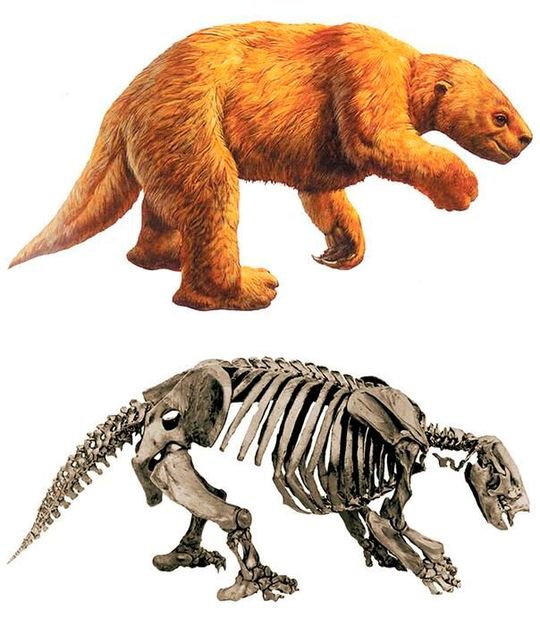
Ground sloths, which could reach the size of small elephants, originated in South America and spread into North America via the Panamanian land bridge.
(Source: Natural History Museum of Los Angeles County)
Until the Panamanian isthmus formed about 2.8 million years ago, North and South America were isolated continents with unique groups of animals. A riot of marsupials — mammals with brood pouches — and sloths in the south contrasted with camels, horses, pronghorn antelopes and saber-toothed cats in the north. Biologists thought that only after the isthmus formed did animals surge north and south, what biologists refer to as the Great American Biotic Interchange or GABI. That resulted in the extinction of a lot of South American species as North American species took over.
Yet this picture of mammal movements across continents is too simple, UC Berkeley paleontologists argue. After assembling and analyzing a new database of fossil mammals discovered in Mexico, they conclude that animals from what is now the U.S. had already migrated into Mexico and beyond by about 10 million years ago, where they waited around in a kind of holding pen until opportunities arose for some of them to continue crossing to the south starting about 7 million years ago.
“Our study demonstrates for the first time that not only was there a set of significant pre-GABI phases that are different from the traditional Great American Biotic Interchange events 3 million years ago, but that this ramp up is much older than people thought or imagined,” said Jack Tseng, a Berkeley professor of integrative biology and leader of the study. “The ramp up began at the latest about 10 million years ago.”
During the holding pen era, 10 to 7 million years ago, mammals that had moved from northern North America into Mexico — mostly larger-bodied animals adapted to relatively dry conditions — continued to diversify, he said, as did mammals on the South American continent. This diversity “primed the pump” for intermittent exchange between 7 and 3 million years ago.
During that pre-GABI time, smaller mammals — heralded by racoon-like coatis and ringtails and small rodents — moved to South America via some kind of intermittent corridor, by island hopping through the Caribbean or by rafting on vegetation. Only one major South American group, the sloths, moved to North America.
Then, 3 million years ago, “the floodgates opened and essentially northward and southward dispersals by mammals were unimpeded, as far as we know,” Tseng said.
The interchange set up the ecosystems that humans encountered when they first entered North America tens of thousands of years ago, before they, in turn, transformed the landscape by helping exterminate the megafauna that by then dominated both continents.
“This helps us to understand what led up to our current biodiversity patterns,” Tseng said, but it can also “help us understand which species are more likely to persist and survive future perturbations in the environment, given what they've already experienced for the past 10 million years.”
Tseng and his colleagues at the Natural History Museum of Los Angeles County and the National Autonomous University of Mexico in Querétaro will publish their findings July 30 in the journal Science.
Tseng and his Mexican collaborators have been collecting fossils in Mexico for nearly 15 years, building on previous decades of work by paper co-author and Mexican paleontologist Oscar Carranza-Castañeda. Together, these collections nearly doubled the number known from about 12 million years ago to the present. As the researchers accumulated these new fossils, they noticed that many were identical to fossils from farther north in North America, even as far back as 10 million years ago. This suggests that North American mammals expanded their range southward much earlier than thought. Mammals may have funneled south into Mexico along corridors much like the grasslands of our current U.S. Southwest and Great Plains, though they eventually ran out of continent.
Date: 08.12.2025
Naturally, we always handle your personal data responsibly. Any personal data we receive from you is processed in accordance with applicable data protection legislation. For detailed information please see our privacy policy.
Consent to the use of data for promotional purposes
I hereby consent to Vogel Communications Group GmbH & Co. KG, Max-Planck-Str. 7-9, 97082 Würzburg including any affiliated companies according to §§ 15 et seq. AktG (hereafter: Vogel Communications Group) using my e-mail address to send editorial newsletters. A list of all affiliated companies can be found here
Newsletter content may include all products and services of any companies mentioned above, including for example specialist journals and books, events and fairs as well as event-related products and services, print and digital media offers and services such as additional (editorial) newsletters, raffles, lead campaigns, market research both online and offline, specialist webportals and e-learning offers. In case my personal telephone number has also been collected, it may be used for offers of aforementioned products, for services of the companies mentioned above, and market research purposes.
Additionally, my consent also includes the processing of my email address and telephone number for data matching for marketing purposes with select advertising partners such as LinkedIn, Google, and Meta. For this, Vogel Communications Group may transmit said data in hashed form to the advertising partners who then use said data to determine whether I am also a member of the mentioned advertising partner portals. Vogel Communications Group uses this feature for the purposes of re-targeting (up-selling, cross-selling, and customer loyalty), generating so-called look-alike audiences for acquisition of new customers, and as basis for exclusion for on-going advertising campaigns. Further information can be found in section “data matching for marketing purposes”.
In case I access protected data on Internet portals of Vogel Communications Group including any affiliated companies according to §§ 15 et seq. AktG, I need to provide further data in order to register for the access to such content. In return for this free access to editorial content, my data may be used in accordance with this consent for the purposes stated here. This does not apply to data matching for marketing purposes.
Right of revocation
I understand that I can revoke my consent at will. My revocation does not change the lawfulness of data processing that was conducted based on my consent leading up to my revocation. One option to declare my revocation is to use the contact form found at https://contact.vogel.de. In case I no longer wish to receive certain newsletters, I have subscribed to, I can also click on the unsubscribe link included at the end of a newsletter. Further information regarding my right of revocation and the implementation of it as well as the consequences of my revocation can be found in the data protection declaration, section editorial newsletter.
“Mexico was not a completely unique geographic region that was generating new species that then dispersed south when the land bridge appeared,” Tseng said. “It really is just a geographic extension of what we already see farther north in North America. By 10 million years ago, the fossil mammals in Mexico look a lot like what you would find in different places up in the U.S.”
During the 3 million years of what Tseng refers to as the holding pen phase, mammals nevertheless continued to evolve to adapt to the neotropical climate. By about 7 million years ago, fossil evidence shows that racoon relatives and small rodents had already arrived in South America from the north, the latter successfully filling new and existing ecological niches in the south. Only sloths made it from south to north, eventually evolving into North American ground sloths the size of small elephants. He calls the era between 7 and 3 million years ago a lag phase, because South American mammals lagged behind those of North American in crossing to the other side.
Only after about 2.8 million years ago — the start of the GABI phase — was free back-and-forth movement possible for all mammals, large and small, Tseng said. One consequence of this interchange is that South American mammals were outcompeted by the North American mammals. The team’s findings support previous analyses showing that over the past 3 million years in South America, animals originally from the north diversified much more than southern groups.
This may well be because the south’s marsupials, which give birth to immature young that need further nurturing in a pouch (think kangaroos and opossums), were not suited to compete with more prolific placental mammals, which bear young that quickly become independent.
“That kind of life history strategy likely gave placentals an upper hand in the face of competition with marsupials,” Tseng said.
The three-phase interchange is in line with increasing evidence from fossils and genomic studies that there was intercontinental mixing prior to 3 million years ago. However, Tseng’s interpretation contradicts some geologists’ claims that a land bridge existed perhaps as long ago as 15 million years, and that climatic conditions primarily caused the pulses of animal movement between the continents.
“We're arguing that that is not supported by the fossil record,” he said. “Otherwise, it’s hard to really imagine, especially in the holding pen phase, 10 to 7 million years ago, what kind of climatic events would prevent any and all of these mammals from crossing.”
Tseng and Natural History Museum of Los Angeles County co-author Xiaoming Wang are now collaborating with colleagues in South America to include more fossils from that continent in the analysis and more clearly define which groups of mammals migrated southward and when over the past 10 million years, and possibly explain the lag in south-to-north migrations.
“Relative to North America, South American fossil records are less abundant,” Wang said. “Continental configuration and environmental differences are obviously one factor, but perhaps a lack of exploration is another important factor. Regardless of the reasons, great potential exists for collaboration with our South American colleagues. Exciting fossils beckon for future expeditions.”
Original Article: A 10-million-year biogeographic holding pen primed the Great American Biotic Interchange; Science; DOI:10.1126/science.aef2893




:quality(80)/p7i.vogel.de/wcms/62/32/62327aaae1415beeed47db6201e79661/0133375912v2.jpeg "A cotton trailer outfitted with benches and a sunshade offers farmworkers a reprieve from the sun as they take a break from picking cantaloupe melons in Firebaugh, Calif.
(Source: Joe Proudman/ Regents of the University of California)")
:quality(80)/p7i.vogel.de/wcms/e6/c8/e6c8bd554776ee1ad2f1f0723fb243a7/0133369387v1.jpeg "Roman road (Source: Queen Mary University of London)")
:quality(80)/p7i.vogel.de/wcms/51/68/51687ac4cc19f2757c138498b877de57/0133167039v2.jpeg "CMFs are foams that consist of hollow spheres – made of materials such as stainless steel, nickel, or other metals and alloys – embedded in a metallic matrix. The resulting material is both lightweight and remarkably strong at absorbing compressive forces. (Source: Jie Sun/ NC State University)")
:quality(80)/p7i.vogel.de/wcms/cd/c0/cdc09efd1e5b3b8f83224e7729d66c10/0133105276v2.jpeg "From the data presented in this report, the authors show how TF3-MALS-RI is uniquely able to separate large polyacrylate molecules and provide precise molecular weight and Rg values. (Source: Postnova Analytics)")
:quality(80)/p7i.vogel.de/wcms/86/01/86014d3d2a28cefc852f65c8d68317e4/0133104231v2.jpeg "Single-handed tube reading using a Handheld 2. (Source: Azenta Life Sciences)")
:quality(80)/p7i.vogel.de/wcms/0b/0f/0b0f8ed042dfc91f32582e10d54c2c7e/0133087444v2.jpeg "Offering advanced automation to increase your throughput, the Intellixcap provides secure sealing – eliminating the need for manual intervention, while preserving vital sample integrity. (Source: Azenta Life Sciences)")
:quality(80)/p7i.vogel.de/wcms/13/d3/13d35105f74a1c2e22b9c7a270e8e9b3/0132611155v2.jpeg "Circulating cell free DNA. (Source: Amsbio)")
:quality(80)/p7i.vogel.de/wcms/bc/ed/bced6850297a04dbea471a66cb6bb6fe/0132611405v2.jpeg "The latest addition to the range is a peristaltic tubing stop adapter that eliminates the need for fixed stoppers and allows custom cut lengths of peristaltic tubing to be installed on any pump head size. (Source: Biotech Fluidics )")
:quality(80)/p7i.vogel.de/wcms/8d/5c/8d5c6c7f897f91d6784825eee20b5584/0133321225v1.jpeg "Empa researcher Christoph Hüglin collects samples of particles that are washed out of the air by rain and snow or settle due to gravity. (Source: Empa)")
:quality(80)/p7i.vogel.de/wcms/a1/af/a1afbc7c8a067bbe94749ec680b4bafd/0133163762v2.jpeg "The study found in murkier water, fish took longer to move towards the food than those in clear water, but individuals in larger groups responded more quickly overall. (Source: Christos Ioannou)")
:quality(80)/p7i.vogel.de/wcms/32/80/3280aa3d44708962943c96fe2d466744/0133088560v2.jpeg "A bumble bee in flight at the University of Bristol Botanic Garden. (Source: Phil Savoie)")
:quality(80)/p7i.vogel.de/wcms/7b/e5/7be5c735140cbe28f3af0ec3d88274b9/0133045403v2.jpeg "After being buried in the ground for two months and broken down by soil organisms, a new pair of cotton underwear (left) shows clear signs of decomposition (right). (Source: Nicolas Zonvi)")
:quality(80)/p7i.vogel.de/wcms/ef/68/ef68375729607984e5bb0c143afdae70/0133375119v2.jpeg "Printed Rice-Lentil 3D structures
(Source: SUTD)")
:quality(80)/p7i.vogel.de/wcms/bf/d0/bfd087349a85956a7aefad57ac1204c7/0133241961v2.jpeg "The Thermo Scientific Suretect Beverage Spoilage Multiplex PCR Assay provides a fast, broad-range molecular solution for detecting key spoilage microorganisms that threaten beverage quality. (Source: © OlegDoroshin - stock.adobe.com)")
:quality(80)/p7i.vogel.de/wcms/d4/61/d461ce0bd5743897993c6475f69e7ad6/0133067478v2.jpeg "In Harris County, 50 % of households with children reported food insecurity, compared with 33 % of households without children. (Source: Rice University)")
:quality(80)/p7i.vogel.de/wcms/79/76/7976d17b980bedfe35acaa532d690046/0132713841v2.jpeg "Observed rice yield losses from 1°C warming are more than twice as high as model estimates due to underestimated heat stress. (Source: AdobeStock/ducvien)")
:quality(80)/p7i.vogel.de/wcms/22/49/224964dd6850b62cccdbc4bde2d34693/0133372964v1.jpeg "Brain activity recorded during a video game helped researchers predict whether participants would take or avoid a risk half a second before they acted. (Source: free licensed)")
:quality(80)/p7i.vogel.de/wcms/48/a7/48a761934161543f70fef2403b44d714/0133372328v2.jpeg "The link between pollution and coughing persisted in the data, even when pollution levels were below the WHO’s recommended safe daily exposure limit. (Source: free licensed)")
:quality(80)/p7i.vogel.de/wcms/83/b4/83b4563a65c6036b61990931507428b4/0133363611v2.jpeg "Magnesium sulphate uptake and the north / south divide for the Precept program. (Source: University of Bristol )")
:quality(80)/p7i.vogel.de/wcms/bb/06/bb06c1c3c5d250f3f93016366c56525d/0133363201v2.jpeg "The team identified more than 1,200 associated genetic variants and found that these influences are remarkably consistent across countries, ages and methods of measuring personality. (Source: Pixabay - PublicDomainPictures)")
:quality(80)/images.vogel.de/vogelonline/bdb/1710600/1710675/original.jpg "Discover how to set yourself up for success when performing balance-based density determination of solids such as jewelry and precious metals. (Mettler Toledo)")
:quality(80)/images.vogel.de/vogelonline/bdb/1682500/1682579/original.jpg "The new XPR Analytical balance redesigned to meet the needs of laboratory technicians of working fast and lean. (Mettler Toledo)")
:quality(80)/images.vogel.de/vogelonline/bdb/1677000/1677080/original.jpg "Enhance your weighing accuracy, comfort and productivity with the redesigned XPR Analytical balance. (Mettler Toledo)")
:fill(fff,0)/p7i.vogel.de/companies/69/b7/69b7f63f311d9/logo-bimos-tif--2-.jpeg "logo-bimos-tif--2- (https://www.bimos.com/de-de/)")
:quality(80)/p7i.vogel.de/wcms/66/b9/66b943e8e2040aa56fe26aa4af267970/0130610299v1.jpeg "Lystrosaurus embryo within its partially preserved shell , reconstruction of the animal (Source: Professor Julien Benoit/ Sophie Vrard)")
:quality(80)/p7i.vogel.de/wcms/34/a4/34a44fab2ba6af4b5f7cb8c3ecfc6362/0129207768v1.jpeg "AI generated image of the New Zealand cave (Source: P Scofield, Canterbury Museum)")
:quality(80)/p7i.vogel.de/wcms/66/b9/66b943e8e2040aa56fe26aa4af267970/0130610299v1.jpeg "Lystrosaurus embryo within its partially preserved shell , reconstruction of the animal (Source: Professor Julien Benoit/ Sophie Vrard)")
:quality(80)/p7i.vogel.de/wcms/6f/cd/6fcd456c6031a20b33bb7db5c1e76984/0128355923v2.jpeg "The Matjes River Rockshelter in the Western Cape, South Africa, 540 km east of Cape Town. Eight people who lived here between 10,200 and 3000 years ago contributed DNA to this study. (Source: Nicholas Wiltshire)")