A research team led by the University of Southampton and UWE Bristol has shown wearable electronic textiles (e-textiles) can be both sustainable and biodegradable.
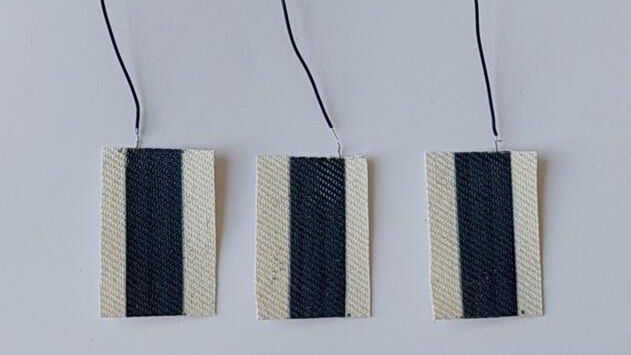
E-textile swatches wired for testing
(Source: Marzia Dulal)
A new study, which also involved the universities of Exeter, Cambridge, Leeds and Bath, describes and tests a new sustainable approach for fully inkjet-printed, eco-friendly e-textiles named ‘Smart, Wearable, and Eco-friendly Electronic Textiles’, or ‘Sweet’.
E-textiles are those with embedded electrical components, such as sensors, batteries or lights. They might be used in fashion, for performance sportwear, or for medical purposes as garments that monitor people’s vital signs.
Gallery
Such textiles need to be durable, safe to wear and comfortable, but also, in an industry which is increasingly concerned with clothing waste, they need to be kind to the environment when no longer required.
Professor Nazmul Karim at the University of Southampton’s Winchester School of Art, who led the study, explains: “Integrating electrical components into conventional textiles complicates the recycling of the material because it often contains metals, such as silver, that don’t easily biodegrade. Our potential ecofriendly approach for selecting sustainable materials and manufacturing overcomes this, enabling the fabric to decompose when it is disposed of.”
The team’s design has three layers, a sensing layer, a layer to interface with the sensors and a base fabric. It uses a textile called Tencel for the base, which is made from renewable wood and is biodegradable. The active electronics in the design are made from graphene, along with a polymer called Pedot: PSS. These conductive materials are precision inkjet-printed onto the fabric.
The researchers tested samples of the material for continuous monitoring of human physiology using five volunteers. Swatches of the fabric, connected to monitoring equipment, were attached to gloves worn by the participants. Results confirmed the material can effectively and reliably measure both heart rate and temperature at the industry standard level.
Dr Shaila Afroj, an Associate Professor of Sustainable Materials from the University of Exeter and a co-author of the study, highlighted the importance of this performance: “Achieving reliable, industry-standard monitoring with eco-friendly materials is a significant milestone. It demonstrates that sustainability doesn’t have to come at the cost of functionality, especially in critical applications like healthcare.”
The project team then buried the e-textiles in soil to measure its biodegradable properties. After four months, the fabric had lost 48 percent of its weight and 98 percent of its strength, suggesting relatively rapid and also effective decomposition. Furthermore, a life cycle assessment revealed the graphene-based electrodes had up to 40 times less impact on the environment than standard electrodes.
Marzia Dulal from UWE Bristol, a Commonwealth PhD Scholar and the first author of the study, highlighted the environmental impact: “Our life cycle analysis shows that graphene-based e-textiles have a fraction of the environmental footprint compared to traditional electronics. This makes them a more responsible choice for industries looking to reduce their ecological impact.”
The ink-jet printing process is also a more sustainable approach for e-textile fabrications, depositing exact numbers of functional materials on textiles as needed, with almost no material waste and less use of water and energy than conventional screen printing.
Professor Karim concludes: “ Amid rising pollution from landfill sites, our study helps to address a lack of research in the area of biodegradation of e-textiles. These materials will become increasingly more important in our lives, particularly in the area of healthcare, so it’s really important we consider how to make them more eco-friendly, both in their manufacturing and disposal.”
Date: 08.12.2025
Naturally, we always handle your personal data responsibly. Any personal data we receive from you is processed in accordance with applicable data protection legislation. For detailed information please see our privacy policy.
Consent to the use of data for promotional purposes
I hereby consent to Vogel Communications Group GmbH & Co. KG, Max-Planck-Str. 7-9, 97082 Würzburg including any affiliated companies according to §§ 15 et seq. AktG (hereafter: Vogel Communications Group) using my e-mail address to send editorial newsletters. A list of all affiliated companies can be found here
Newsletter content may include all products and services of any companies mentioned above, including for example specialist journals and books, events and fairs as well as event-related products and services, print and digital media offers and services such as additional (editorial) newsletters, raffles, lead campaigns, market research both online and offline, specialist webportals and e-learning offers. In case my personal telephone number has also been collected, it may be used for offers of aforementioned products, for services of the companies mentioned above, and market research purposes.
Additionally, my consent also includes the processing of my email address and telephone number for data matching for marketing purposes with select advertising partners such as LinkedIn, Google, and Meta. For this, Vogel Communications Group may transmit said data in hashed form to the advertising partners who then use said data to determine whether I am also a member of the mentioned advertising partner portals. Vogel Communications Group uses this feature for the purposes of re-targeting (up-selling, cross-selling, and customer loyalty), generating so-called look-alike audiences for acquisition of new customers, and as basis for exclusion for on-going advertising campaigns. Further information can be found in section “data matching for marketing purposes”.
In case I access protected data on Internet portals of Vogel Communications Group including any affiliated companies according to §§ 15 et seq. AktG, I need to provide further data in order to register for the access to such content. In return for this free access to editorial content, my data may be used in accordance with this consent for the purposes stated here. This does not apply to data matching for marketing purposes.
Right of revocation
I understand that I can revoke my consent at will. My revocation does not change the lawfulness of data processing that was conducted based on my consent leading up to my revocation. One option to declare my revocation is to use the contact form found at https://contact.vogel.de. In case I no longer wish to receive certain newsletters, I have subscribed to, I can also click on the unsubscribe link included at the end of a newsletter. Further information regarding my right of revocation and the implementation of it as well as the consequences of my revocation can be found in the data protection declaration, section editorial newsletter.
The researchers hope they can now move forward with designing wearable garments made from SWEET for potential use in the healthcare sector, particularly in the area of early detection and prevention of heart-related diseases that 640 million people (source: BHF) suffer from worldwide.
Original Article: Sustainable, Wearable, and Eco-Friendly Electronic Textiles; Energy & Environmental Materials; DOI:10.1002/eem2.12854




:quality(80)/p7i.vogel.de/wcms/62/32/62327aaae1415beeed47db6201e79661/0133375912v2.jpeg "A cotton trailer outfitted with benches and a sunshade offers farmworkers a reprieve from the sun as they take a break from picking cantaloupe melons in Firebaugh, Calif.
(Source: Joe Proudman/ Regents of the University of California)")
:quality(80)/p7i.vogel.de/wcms/e6/c8/e6c8bd554776ee1ad2f1f0723fb243a7/0133369387v1.jpeg "Roman road (Source: Queen Mary University of London)")
:quality(80)/p7i.vogel.de/wcms/51/68/51687ac4cc19f2757c138498b877de57/0133167039v2.jpeg "CMFs are foams that consist of hollow spheres – made of materials such as stainless steel, nickel, or other metals and alloys – embedded in a metallic matrix. The resulting material is both lightweight and remarkably strong at absorbing compressive forces. (Source: Jie Sun/ NC State University)")
:quality(80)/p7i.vogel.de/wcms/cd/c0/cdc09efd1e5b3b8f83224e7729d66c10/0133105276v2.jpeg "From the data presented in this report, the authors show how TF3-MALS-RI is uniquely able to separate large polyacrylate molecules and provide precise molecular weight and Rg values. (Source: Postnova Analytics)")
:quality(80)/p7i.vogel.de/wcms/86/01/86014d3d2a28cefc852f65c8d68317e4/0133104231v2.jpeg "Single-handed tube reading using a Handheld 2. (Source: Azenta Life Sciences)")
:quality(80)/p7i.vogel.de/wcms/0b/0f/0b0f8ed042dfc91f32582e10d54c2c7e/0133087444v2.jpeg "Offering advanced automation to increase your throughput, the Intellixcap provides secure sealing – eliminating the need for manual intervention, while preserving vital sample integrity. (Source: Azenta Life Sciences)")
:quality(80)/p7i.vogel.de/wcms/13/d3/13d35105f74a1c2e22b9c7a270e8e9b3/0132611155v2.jpeg "Circulating cell free DNA. (Source: Amsbio)")
:quality(80)/p7i.vogel.de/wcms/bc/ed/bced6850297a04dbea471a66cb6bb6fe/0132611405v2.jpeg "The latest addition to the range is a peristaltic tubing stop adapter that eliminates the need for fixed stoppers and allows custom cut lengths of peristaltic tubing to be installed on any pump head size. (Source: Biotech Fluidics )")
:quality(80)/p7i.vogel.de/wcms/8d/5c/8d5c6c7f897f91d6784825eee20b5584/0133321225v1.jpeg "Empa researcher Christoph Hüglin collects samples of particles that are washed out of the air by rain and snow or settle due to gravity. (Source: Empa)")
:quality(80)/p7i.vogel.de/wcms/a1/af/a1afbc7c8a067bbe94749ec680b4bafd/0133163762v2.jpeg "The study found in murkier water, fish took longer to move towards the food than those in clear water, but individuals in larger groups responded more quickly overall. (Source: Christos Ioannou)")
:quality(80)/p7i.vogel.de/wcms/32/80/3280aa3d44708962943c96fe2d466744/0133088560v2.jpeg "A bumble bee in flight at the University of Bristol Botanic Garden. (Source: Phil Savoie)")
:quality(80)/p7i.vogel.de/wcms/7b/e5/7be5c735140cbe28f3af0ec3d88274b9/0133045403v2.jpeg "After being buried in the ground for two months and broken down by soil organisms, a new pair of cotton underwear (left) shows clear signs of decomposition (right). (Source: Nicolas Zonvi)")
:quality(80)/p7i.vogel.de/wcms/ef/68/ef68375729607984e5bb0c143afdae70/0133375119v2.jpeg "Printed Rice-Lentil 3D structures
(Source: SUTD)")
:quality(80)/p7i.vogel.de/wcms/bf/d0/bfd087349a85956a7aefad57ac1204c7/0133241961v2.jpeg "The Thermo Scientific Suretect Beverage Spoilage Multiplex PCR Assay provides a fast, broad-range molecular solution for detecting key spoilage microorganisms that threaten beverage quality. (Source: © OlegDoroshin - stock.adobe.com)")
:quality(80)/p7i.vogel.de/wcms/d4/61/d461ce0bd5743897993c6475f69e7ad6/0133067478v2.jpeg "In Harris County, 50 % of households with children reported food insecurity, compared with 33 % of households without children. (Source: Rice University)")
:quality(80)/p7i.vogel.de/wcms/79/76/7976d17b980bedfe35acaa532d690046/0132713841v2.jpeg "Observed rice yield losses from 1°C warming are more than twice as high as model estimates due to underestimated heat stress. (Source: AdobeStock/ducvien)")
:quality(80)/p7i.vogel.de/wcms/22/49/224964dd6850b62cccdbc4bde2d34693/0133372964v1.jpeg "Brain activity recorded during a video game helped researchers predict whether participants would take or avoid a risk half a second before they acted. (Source: free licensed)")
:quality(80)/p7i.vogel.de/wcms/48/a7/48a761934161543f70fef2403b44d714/0133372328v2.jpeg "The link between pollution and coughing persisted in the data, even when pollution levels were below the WHO’s recommended safe daily exposure limit. (Source: free licensed)")
:quality(80)/p7i.vogel.de/wcms/83/b4/83b4563a65c6036b61990931507428b4/0133363611v2.jpeg "Magnesium sulphate uptake and the north / south divide for the Precept program. (Source: University of Bristol )")
:quality(80)/p7i.vogel.de/wcms/bb/06/bb06c1c3c5d250f3f93016366c56525d/0133363201v2.jpeg "The team identified more than 1,200 associated genetic variants and found that these influences are remarkably consistent across countries, ages and methods of measuring personality. (Source: Pixabay - PublicDomainPictures)")
:quality(80)/images.vogel.de/vogelonline/bdb/1710600/1710675/original.jpg "Discover how to set yourself up for success when performing balance-based density determination of solids such as jewelry and precious metals. (Mettler Toledo)")
:quality(80)/images.vogel.de/vogelonline/bdb/1682500/1682579/original.jpg "The new XPR Analytical balance redesigned to meet the needs of laboratory technicians of working fast and lean. (Mettler Toledo)")
:quality(80)/images.vogel.de/vogelonline/bdb/1677000/1677080/original.jpg "Enhance your weighing accuracy, comfort and productivity with the redesigned XPR Analytical balance. (Mettler Toledo)")
:fill(fff,0)/images.vogel.de/vogelonline/companyimg/107800/107832/65.jpg "logoDueperthal.jpg ()")
:fill(fff,0)/p7i.vogel.de/companies/69/b7/69b7f63f311d9/logo-bimos-tif--2-.jpeg "logo-bimos-tif--2- (https://www.bimos.com/de-de/)")
:quality(80)/p7i.vogel.de/wcms/42/1c/421c8267752ef0a12d7ab82e9fa2e6dd/0122323149v1.jpeg "Strip of e-textile demonstrating the flexible qualities of ink-jet printed graphene.(Source: Marzia Dulal)")
:quality(80)/p7i.vogel.de/wcms/c1/6a/c16a3ad8b7c970dcf6cfa0805b3b65c3/0122323145v1.jpeg "Gloves with swatches of e-textile attached inside and wired for sensing testing.(Source: Marzia Dulal)")
:quality(80)/p7i.vogel.de/wcms/c3/b3/c3b3eb8ffe2a6e1497ce5f0d5d335348/0122323143v1.jpeg "E-textile swatches wired for testing(Source: Marzia Dulal)")
:quality(80)/p7i.vogel.de/wcms/2a/a1/2aa199faf702d6f8551b74e4149bcbed/0122323144v1.jpeg "Different layers of e-textile after four months of decomposition.(Source: Marzia Dulal)")
:quality(80)/p7i.vogel.de/wcms/11/29/112984f0c5d11cd5daf58fbfbc1d3aac/0133166885v1.jpeg "Researchers develop a parametric design tool that converts the desired dimensions of a body part into a printable 2D pattern for a self-folding paper wearable device. This approach integrated with copper tape electrodes allows biosignal measurements. (Source: Dr. Hiroki Shigemune/ Shibaura Institute of Technology)")
:quality(80)/p7i.vogel.de/wcms/6e/a8/6ea8f1ae8dd3d2bf84a941bae68e9a16/0130484528v1.jpeg "Highly porous biochar from spent coffee ground for fully green thermal insulating composites with thermal conductivity of 0.04 W m−1 K−1 (Source: Sung Jin Kim/ Seong Yun Kim)")