Researchers at the Karlsruhe Institute of Technology (KIT) have developed a new class of materials by producing enzymes as foams that have enormous durability and activity. The new biomaterials open up versatile avenues for innovations in industrial biotechnology, material sciences or even food technology.
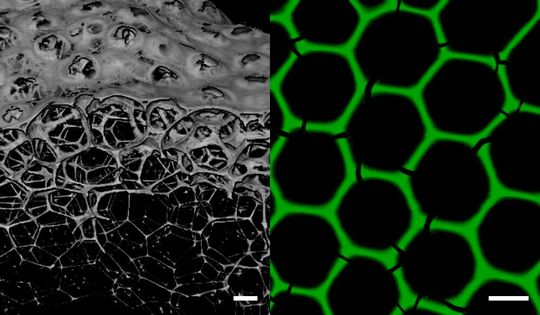
New biomaterials for industrial biocatalysis: enzyme foams form three-dimensional porous networks with a stable hexagonal honeycomb structure.
(Source: Julian Hertel, KIT)
Industrial biocatalysis with enzymes is considered a game changer in the development of a sustainable chemical industry. With the help of enzymes, an impressive range of complex molecules such as pharmaceutical agents can be synthesised under environmentally friendly conditions. Researchers at the Karlsruhe Institute of Technology (KIT) have now developed a new class of materials by producing enzymes as foams that have enormous durability and activity. The researchers report on their results in the scientific journal Advanced Materials. A patent application has already been filed for the novel manufacturing process of the enzyme foams.
In order to further develop the field of industrial biocatalysis, which is mainly used in the production of pharmaceuticals and speciality chemicals, researchers are working intensively on new process technologies. In biocatalysis, enzymes instead of chemical catalysts accelerate the reactions, thus saving raw materials and energy. The goal is now to provide enzyme biocatalysts continuously and in large quantities under the gentlest possible conditions. In order to realise efficient material transformations, the enzymes are immobilised in microstructured flow reactors. They are spatially fixed and bound to a reaction-bearing material and thus have limited mobility, which leads to a higher concentration of enzymes and thus to higher productivity.
Foamed Microdroplets from Self-Assembling Enzymes
Normally, enzymes change their structure during foaming and thus lose their biocatalytic activity. However, the new protein foams have enormous durability and activity. The activity is a measure of the effectiveness of the enzyme, which ensures that starting materials react with each other as quickly as possible. To make the protein foams, two dehydrogenase enzymes are mixed that carry matching linkage sites so that they can spontaneously form a stable protein network. “A gas flow is then added to this mixture in a microfluidic chip so that microscopic bubbles of uniform size form in a controlled manner,” Professor Christof Niemeyer from the Institute of Biological Interfaces-1 explains the process. The foam of uniform bubble size produced in this way is applied directly to plastic chips and dried, causing the proteins to polymerise and form a stable, hexagonal lattice.
“These are monodisperse full enzyme foams, i.e. three-dimensional, porous networks consisting exclusively of biocatalytically active proteins,” Niemeyer characterises the composition of the new materials. The stable hexagonal honeycomb structure of the foams has a mean pore diameter of 160 µm and a lamella thickness of 8 µm and is formed from the freshly produced spherical bubbles of about the same size after a few minutes.
Efficient Use of Active and Stable Full Enzyme Foams
In order to use enzymes efficiently for substance transformations, they must be immobilised in large quantities under conditions that are as gentle as possible in order to preserve their activity. Until now, enzymes have been immobilised on polymers or carrier particles, but this requires valuable reactor space and can impair activity. “Compared to our already developed full enzyme hydrogels, the new foam-based materials create a much larger surface area where the desired reaction can take place,” Niemeyer describes the major improvement. In contrast to theoretically expected results, the new foams surprisingly show a strikingly high durability, mechanical resistance and catalytic activity of the enzymes, which had not been achieved so far in foaming proteins.
The researchers assume that the stability is due to the matching linkage sites with which the enzymes are equipped. This allows them to join together by themselves and thus form a highly cross-linked lattice during drying, which gives the new material a unique stability. “Surprisingly, the newly developed enzyme foams are significantly more stable after drying for four weeks than the same enzymes without foams,” Niemeyer explains the advantages, “this is of great interest for commercialisation, as it greatly simplifies stock production and shipping.”
Date: 08.12.2025
Naturally, we always handle your personal data responsibly. Any personal data we receive from you is processed in accordance with applicable data protection legislation. For detailed information please see our privacy policy.
Consent to the use of data for promotional purposes
I hereby consent to Vogel Communications Group GmbH & Co. KG, Max-Planck-Str. 7-9, 97082 Würzburg including any affiliated companies according to §§ 15 et seq. AktG (hereafter: Vogel Communications Group) using my e-mail address to send editorial newsletters. A list of all affiliated companies can be found here
Newsletter content may include all products and services of any companies mentioned above, including for example specialist journals and books, events and fairs as well as event-related products and services, print and digital media offers and services such as additional (editorial) newsletters, raffles, lead campaigns, market research both online and offline, specialist webportals and e-learning offers. In case my personal telephone number has also been collected, it may be used for offers of aforementioned products, for services of the companies mentioned above, and market research purposes.
Additionally, my consent also includes the processing of my email address and telephone number for data matching for marketing purposes with select advertising partners such as LinkedIn, Google, and Meta. For this, Vogel Communications Group may transmit said data in hashed form to the advertising partners who then use said data to determine whether I am also a member of the mentioned advertising partner portals. Vogel Communications Group uses this feature for the purposes of re-targeting (up-selling, cross-selling, and customer loyalty), generating so-called look-alike audiences for acquisition of new customers, and as basis for exclusion for on-going advertising campaigns. Further information can be found in section “data matching for marketing purposes”.
In case I access protected data on Internet portals of Vogel Communications Group including any affiliated companies according to §§ 15 et seq. AktG, I need to provide further data in order to register for the access to such content. In return for this free access to editorial content, my data may be used in accordance with this consent for the purposes stated here. This does not apply to data matching for marketing purposes.
Right of revocation
I understand that I can revoke my consent at will. My revocation does not change the lawfulness of data processing that was conducted based on my consent leading up to my revocation. One option to declare my revocation is to use the contact form found at https://contact.vogel.de. In case I no longer wish to receive certain newsletters, I have subscribed to, I can also click on the unsubscribe link included at the end of a newsletter. Further information regarding my right of revocation and the implementation of it as well as the consequences of my revocation can be found in the data protection declaration, section editorial newsletter.
The new biomaterials open up versatile avenues for innovations in industrial biotechnology, material sciences or even food technology. For example, the protein foams could be used in biotechnological processes to produce valuable compounds more efficiently and sustainably. The research team was able to show that the foams can be used to produce the industrially valuable sugar tagatose, which is a promising alternative to refined sugar as a sweetener.
Originalpublikation: Julian S. Hertel, Patrick Bitterwolf, Sandra Kröll, Astrid Winterhalter, Annika J. Weber, Maximilian Grösche, Laurenz B. Walkowsky, Stefan Heißler, Matthias Schwotzer, Christof Wöll, Thomas van de Kamp, Marcus Zuber, Tilo Baumbach, Kersten S. Rabe, Christof M. Niemeyer: Biocatalytic Foams from Microdroplet-Formulated Self-Assembling Enzymes. Advanced Materials, 2023. DOI: 10.1002/adma.202303952




:quality(80)/p7i.vogel.de/wcms/fa/78/fa78b1ccc70c783455873102e8906e59/0134193862v2.jpeg "The fibres support the functions early generations of smartphones could perform. The 96 by 54-pixel display can run a calculator, show a photo gallery, play a video, work as a compass, respond to voice commands, receive images over Bluetooth, as well as read and display body temperature. (Source: NUS)")
:quality(80)/p7i.vogel.de/wcms/22/58/22584fa21fdb1f4c62a2a284c4ce30df/0134111278v1.jpeg "The electronic nose sampled odours from the burial site and surrounding control areas, while police dogs searched the site independently. (Source: Grainger Films)")
:quality(80)/p7i.vogel.de/wcms/6a/18/6a18a078bc95ab7164079cfe842b9bde/0134110022v1.jpeg "Artificial intelligence-powered lasers, robotic tillers and precision sprayers could revolutionize how farmers manage weeds, but a recent review from the University of Mississippi and Cornell University found that these technologies could also present financial and ecological challenges. (Source: Sarah Tewolde/University Marketing and Communications)")
:quality(80)/p7i.vogel.de/wcms/61/89/618990ef2cb2d4456da6f260c03343e3/0133981905v2.jpeg "Workers who were worried about the future of their occupation were more likely to morally disengage at work. (Source: free licensed)")
:quality(80)/p7i.vogel.de/wcms/3e/3c/3e3cc29b52fedebf1c97dea23b92a760/0133673542v2.jpeg "Fig.1: The path to accurate pH measurements starts with precise calibration. Use fresh buffers and verify mV response for optimal electrode performance. (Source: METTLER TOLEDO)")
:quality(80)/p7i.vogel.de/wcms/2d/92/2d9231a37601aa58b40d4688f609f004/0133687591v2.jpeg "Horiba’s new CE IVDR certified Yumizen H500 CRP benchtop hematology analyzer delivers a simultaneous complete blood count with 5-part extended differential and rapid CRP whole blood measurement. (Source: Horiba )")
:quality(80)/p7i.vogel.de/wcms/e5/e9/e5e97a3c76cbf47308ce21c4a567a812/0133686320v2.jpeg "The picture shows the Kern PDS precision scale in combination with Kern Balanceconnection software. (Source: Kern & Sohn)")
:quality(80)/p7i.vogel.de/wcms/a8/6e/a86e9b1f1561a67038b6d8a9fe629117/0133465534v2.jpeg "Clean, calibrate, and store pH electrodes properly to ensure accurate, reliable measurements every time. (Source: METTLER TOLEDO)")
:quality(80)/p7i.vogel.de/wcms/2e/3c/2e3c6c079ab3d64ce2ff01ccf67d133e/0134192798v2.jpeg "The findings could have practical implications for government agencies, civil protection authorities and scientific organisations developing - or considering developing - operational earthquake forecasting systems. (Source: Tumisu)")
:quality(80)/p7i.vogel.de/wcms/2e/f5/2ef5c7b1206d1a2957f965f97d1f8ddd/0133980521v1.jpeg "Alaska glacier (Source: Oregon State University)")
:quality(80)/p7i.vogel.de/wcms/60/9c/609c1bc8643d2eed0b26431c12186f98/0133981015v1.jpeg "Microplastics can generate reactive oxygen species at their surfaces when interacting with water, according to a new study, suggesting a potential mechanism for biological harm. (Source: Dall-E / KI-generiert)")
:quality(80)/p7i.vogel.de/wcms/7b/db/7bdb5608f8d1d8ddb29abd8817d35872/0133981301v2.jpeg "A Vienna team investigated whether discarded plastics could provide the starting material for these molecular sponges. (Source: free licensed)")
:quality(80)/p7i.vogel.de/wcms/08/a0/08a0abab260283b970da227fe72a5dbd/0134110272v1.jpeg "Coffee with milk
(Source: Alonso Nichols/ Tufts University)")
:quality(80)/p7i.vogel.de/wcms/e1/f4/e1f48a0c4b6d5c00059370affdc13113/0133694409v2.jpeg "Broccoli growing beneath semi-transparent, colored solar panels at the experimental site at Kärrbo Prästgård farm in Sweden. (Source: Silvia Ma Lu)")
:quality(80)/p7i.vogel.de/wcms/95/3e/953e490f1819f6638bc08fe3d4d43e87/0133566684v1.jpeg "The soy protein isolate the researchers fed to the mice. (Source: KyotoU / Tomoko T. Asai)")
:quality(80)/p7i.vogel.de/wcms/ba/38/ba38179dbcd20fbc3887b2709193d0a8/0133566669v2.jpeg "Consumers in a Cornell study showed no consistent bias against the colour of hybrid red wines, with several ranking among the most visually appealing. (Source: free licensed)")
:quality(80)/p7i.vogel.de/wcms/5c/e4/5ce4b724650b887cc9f109ec31242b17/0134193875v2.jpeg "Researchers carried out detailed assessments of blood samples, blood pressure and how well blood vessels are functioning in healthy smokers before and after they used two tobacco sticks consumed back-to-back with a tobacco heating device. (Source: Unsplash)")
:quality(80)/p7i.vogel.de/wcms/09/3f/093fe52ddfcf999578e2c398d56394e6/0134192559v2.jpeg "Early ECG monitoring initiated in the emergency department has the potential to transform the care of thousands of patients who attend the ED with unexplained fainting. (Source: Unsplash)")
:quality(80)/p7i.vogel.de/wcms/e2/12/e21298503bcc96dffb6264c68f065278/0134190368v2.jpeg "Northwestern Medicine patient Sarah Fishbune. (Source: Northwestern University )")
:quality(80)/p7i.vogel.de/wcms/be/40/be40c968059ca945aeb8119d88f6d0de/0134188670v2.jpeg "The newly discovered NKT-like cells are activated only when they receive both signals: they recognize the GM3 molecule and detect the alarm signals. (Source: Alexas Fotos on Pexels)")
:quality(80)/images.vogel.de/vogelonline/bdb/1710600/1710675/original.jpg "Discover how to set yourself up for success when performing balance-based density determination of solids such as jewelry and precious metals. (Mettler Toledo)")
:quality(80)/images.vogel.de/vogelonline/bdb/1682500/1682579/original.jpg "The new XPR Analytical balance redesigned to meet the needs of laboratory technicians of working fast and lean. (Mettler Toledo)")
:quality(80)/images.vogel.de/vogelonline/bdb/1677000/1677080/original.jpg "Enhance your weighing accuracy, comfort and productivity with the redesigned XPR Analytical balance. (Mettler Toledo)")
:fill(fff,0)/p7i.vogel.de/companies/69/b7/69b7f63f311d9/logo-bimos-tif--2-.jpeg "logo-bimos-tif--2- (https://www.bimos.com/de-de/)")
:quality(80)/p7i.vogel.de/wcms/b6/b9/b6b97ca31aed69478954ad986331ba08/0131479004v1.jpeg "Thanks to plasma technology, organosilicon compounds have been successfully used to produce water-repellent textiles. (Source: Empa)")
:quality(80)/p7i.vogel.de/wcms/15/26/152607648dcaa8226fac9f76c09cdb90/0132741681v2.jpeg "Graduate student Alexander Arnette working in the lab of Jonathan Kuo, assistant professor of chemistry in the Penn State Eberly College of Science. (Source: Jaydyn Isiminger/ Penn State)")