Metrological traceability (traceability) links pH measurement values to national/international standards through an unbroken, documented chain of comparisons (including uncertainties), making results comparable worldwide. It is based on NMIs/primary standards, certified buffer solutions (CoA), and ISO-compliant calibration, documentation, training, and audits—central to quality assurance and compliance.
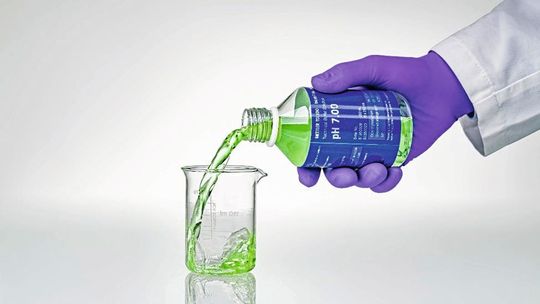
Fig.1: A certified standard pH 7 buffer
(Source: Mettler Toledo)
When it comes to product quality, whether in small laboratories or large-scale industries, accurate measurement of properties such as mass, volume, temperature, light absorbance, or pH is essential to ensure reliable results. Accuracy depends not just on advanced tools but also on an important principle called traceability. Traceability ensures every measurement can be linked back through a documented chain to an internationally recognized reference standard. This connection guarantees that measurements are not only precise locally but also consistent and comparable worldwide.
Imagine the traceability concept like a dictionary: a standard definition ensures everyone understands a word the same way. Similarly, traceability connects measurement results to universally accepted standards, fostering reliable, trusted data that meets regulatory compliance.
An important parameter, pH, is a key indicator of hydrogen ion concentration, affects chemical reactions, product stability, and regulatory adherence. Small pH deviations can alter outcomes significantly. To ensure reliable pH measurements, labs use certified standard buffer solutions with well-defined pH values. These buffers calibrate pH measurement systems, aligning readings to recognized standards. Such traceable measurements boost data confidence, improve quality control, and enable better decision-making.
What is Traceability?
According to VIM (Vocabulary of International Metrology), the term “traceability” is sometimes used for ‘metrological traceability’ as well as for other concepts, such as ‘sample traceability', ‘document traceability’ or ‘instrument traceability’, where the meaning is completely different. Therefore, the full term is preferred. In this article, the term "traceability" will specifically refer to the metrological traceability of pH measurements.
According to ‘IUPAC Recommendations 2002, Pure Appl. Chem., Vol. 74’, traceability is the “property of the result of a measurement or the value of a standard whereby it can be related to stated references, usually national or international standards, through an unbroken chain of comparisons all having stated uncertainties. The concept is often expressed by the adjective traceable. The unbroken chain of comparisons is called a traceability chain”.
Simply put, pH measurement traceability confirms accuracy by connecting results back to national or international standards. It enables comparability of results across different instruments, conditions, or operators. Importantly, each measurement carries an uncertainty margin that must be acknowledged.
To ensure dependable outcomes, standards like ISO/IEC 17025:2017 require labs to maintain documented traceability chains linking measurements to recognized references, usually the International System of Units (SI).
Traceability Chain in pH Measurement
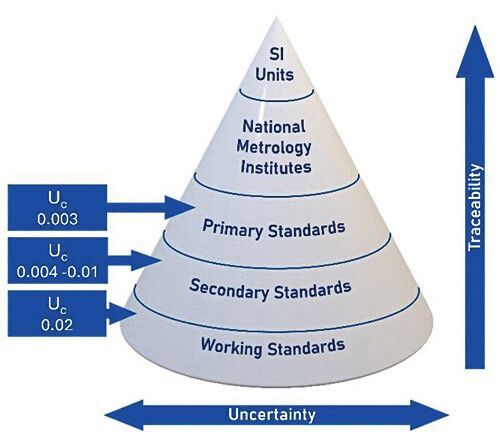
The metrological traceability chain is 'the sequence of measurement standards and calibrations that are used to relate a measurement result to a reference'. This chain, often illustrated as a Traceability Pyramid, starts with the highest precision standards at the top, descending to standards with increasing uncertainty below.
Fig.2: The pH Traceability Pyramid
(Source: Mettler Toledo)
It refers to the requirement that every stage of the calibration chain must be directly or indirectly linked to an accepted reference standard, with measurement uncertainty (Uc) evaluated at each step of the chain. The hierarchy of these stages is organized according to their measurement performance, often depicted in the Traceability Pyramid (Fig. 2).
Think of it like a game of telephone: the message you start with at the top is clear and precise, but as it gets passed down the line (or the pyramid), each person adds their interpretation, which can introduce confusion or errors. To preserve measurement quality at every stage, the traceability chain must be managed with precision and consistency. Even a small lapse—such as incomplete records of calibration dates, reference solutions, or testing conditions can disrupt the chain. Once broken, the link to the original standards is lost, making it impossible to fully trust the accuracy of the results and weakening the reliability of pH measurements.
Date: 08.12.2025
Naturally, we always handle your personal data responsibly. Any personal data we receive from you is processed in accordance with applicable data protection legislation. For detailed information please see our privacy policy.
Consent to the use of data for promotional purposes
I hereby consent to Vogel Communications Group GmbH & Co. KG, Max-Planck-Str. 7-9, 97082 Würzburg including any affiliated companies according to §§ 15 et seq. AktG (hereafter: Vogel Communications Group) using my e-mail address to send editorial newsletters. A list of all affiliated companies can be found here
Newsletter content may include all products and services of any companies mentioned above, including for example specialist journals and books, events and fairs as well as event-related products and services, print and digital media offers and services such as additional (editorial) newsletters, raffles, lead campaigns, market research both online and offline, specialist webportals and e-learning offers. In case my personal telephone number has also been collected, it may be used for offers of aforementioned products, for services of the companies mentioned above, and market research purposes.
Additionally, my consent also includes the processing of my email address and telephone number for data matching for marketing purposes with select advertising partners such as LinkedIn, Google, and Meta. For this, Vogel Communications Group may transmit said data in hashed form to the advertising partners who then use said data to determine whether I am also a member of the mentioned advertising partner portals. Vogel Communications Group uses this feature for the purposes of re-targeting (up-selling, cross-selling, and customer loyalty), generating so-called look-alike audiences for acquisition of new customers, and as basis for exclusion for on-going advertising campaigns. Further information can be found in section “data matching for marketing purposes”.
In case I access protected data on Internet portals of Vogel Communications Group including any affiliated companies according to §§ 15 et seq. AktG, I need to provide further data in order to register for the access to such content. In return for this free access to editorial content, my data may be used in accordance with this consent for the purposes stated here. This does not apply to data matching for marketing purposes.
Right of revocation
I understand that I can revoke my consent at will. My revocation does not change the lawfulness of data processing that was conducted based on my consent leading up to my revocation. One option to declare my revocation is to use the contact form found at https://contact.vogel.de. In case I no longer wish to receive certain newsletters, I have subscribed to, I can also click on the unsubscribe link included at the end of a newsletter. Further information regarding my right of revocation and the implementation of it as well as the consequences of my revocation can be found in the data protection declaration, section editorial newsletter.
Achieving and Sustaining pH Traceability
Traceability relies heavily on the careful selection of standards. To ensure its reliability, the pyramid structure shown in Fig. 2 underscores the critical role of primary standards established by National Metrology Institutes (NMIs) in maintaining a robust pH traceability chain. These primary standards act as the international reference point and form the foundation for global consistency in measurements.
National Metrology Institutes (NMIs) are responsible for developing and maintaining primary measurement standards, which serve as the foundational reference for all measurements within their countries. NMIs define the primary measurement protocols that give quantitative value to the primary standards. For primary pH buffer solutions, value assignment and uncertainty determination follow IUPAC guidelines. The currently accepted primary buffers are based on a multipoint pH protocol introduced by Bates and colleagues at the former National Bureau of Standards (now NIST, National Institute of Standards and Technology). The multipoint protocol involves calibration at different stages, beginning with the Harned cell for primary standards and extending to working standards measured with a pH glass electrode.
The accuracy of national pH measurement methods against international standards (SI) is verified through global comparison exercises. These comparisons are coordinated by the Electrochemical Analysis Working Group (EAWG), which is part of the Consultative Committee on Metrology in Chemistry (CCQM) under the International Bureau of Weights and Measures (BIPM).
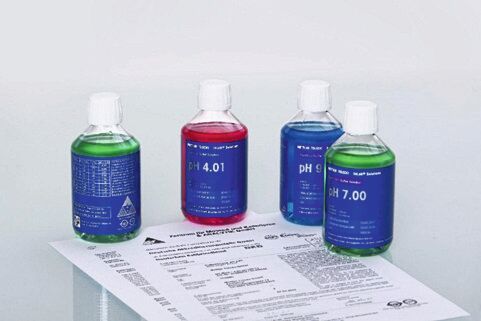
Fig.: Certificate of Analysis for pH buffers
(Source: Mettler Toledo)
Once the pH traceability chain is established, the pH buffers are certified with the following information in a Certificate of Analysis (CoA):
1. The quantitative traceability value and calculated uncertainty
2. Calibration methods used (Standard procedures)
3. Certified Reference Materials (CRMs) used during calibration
4. The lot number of every CRM used during the quality control process
8. Final statement—Traceable to International Standards (SI units)
Having established how standards are verified through accreditation, the next step is to consider the available choices when selecting an appropriate reference standard for pH measurement:
Accredited laboratory certification: Organizations may elect to pursue certification of their primary standards through accredited laboratories. While this approach ensures the highest level of compliance, it is often resource intensive, involving considerable financial investment and extended timelines.
Market-available certified pH buffers: Organizations may instead rely on pre-certified buffer solutions available for purchase like Mettler Toledo’s pH Buffer Solutions for the Lab. These solutions provide guaranteed SI traceability, minimizing cost and effort while delivering consistent reliability. Relying on these ready-to-use solutions can streamline your calibration process without compromising on accuracy and maintaining measurement integrity.
Key Activities for Maintenance
There are several processes which ensure maintenance:
Routine instrument calibration: pH meters and sensors should undergo systematic calibration periodically against recognized reference standards to improve measurement accuracy. Throughout experimental procedures, adherence to proper measurement practices is essential to ensure traceability.
Detailed documentation: Accurate traceability in pH measurement requires thorough documentation of every reading. Records should specify the date and time of measurement, environmental factors such as temperature and humidity, calibration details, etc. and should mention any variations noted during the procedure. Such documentation not only establishes the reliability and origin of data but also aids in troubleshooting and strengthens accountability in measurement practices.
Training programs: Personnel should be educated about traceability and its significance, the correct operational procedures, and the appropriate handling of equipment. Training programs should also emphasize the potential consequences of inaccurate measurements and highlight the necessity of compliance with both regulatory and organizational requirements. Continuous education, including refresher courses, reinforces these concepts and ensures that staff remain aware of the current methodologies and latest information.
Internal evaluations and audits: pH measurement practices should be subject to routine reviews and internal audits to verify compliance with traceability standards. These evaluations must include both procedural aspects and the associated documentation, i.e. Method validation and verification. Audit activities serve to highlight opportunities for improvement, reinforce adherence to traceability requirements, and promote a culture of continual enhancement within the organization. Any issues identified during audits should be resolved promptly to strengthen future performance.
Advanced technologies can greatly simplify the complex steps involved in ensuring traceability of pH measurements. For instance, Mettler Toledo's pH meters and sensors feature automatic traceability maintenance options that accelerate the calibration and documentation process. These instruments employ digital systems to automatically store records of prior measurements, guaranteeing accurate data capture and easy accessibility. In addition, the meters provide guided instructions to support precise experimental execution for the users. Additionally, solutions such as LabX software can provide assistance in method validation, compliance monitoring, and other essential documentation requirements, enabling organizations to not only meet but surpass traceability requirements in their pH measurement workflows.
Traceability refers to the measurement results themselves rather than the instruments, standards, or calibration procedures employed. Its focus lies in ensuring that outcomes can be reliably connected to recognized reference standards, thereby reinforcing both the validity and applicability of the data.
From the beginning, this article emphasized the significance of traceability in meeting regulatory standards. Having established its importance and its underlying concepts, we can now conclude by outlining the key reasons for ensuring traceability in pH measurement processes.
Tip for Ensuring Traceability in pH Buffer Purchases
When purchasing pH buffers, it is critical to review all eight parameters specified in the Certificate of Analysis (CoA) to maintain quality and compliance standards. This practice not only guarantees measurement traceability but also, by adhering to it, you safeguard the integrity of your work and strengthen the likelihood of successful project outcomes.
After the establishment phase, ongoing maintenance becomes essential. This involves systematic monitoring, strict adherence to standardized pH measurement practices, implementing and following protocols for calibration and maintenance, etc.
The Role of Traceability in Compliance
Traceability in pH measurements ensures that results are accurate and reliable, which form the basis for compliance with international standards such as ISO 17025 and ISO 9001. For manufacturers, traceability guarantees that products meet the stringent regulatory standards, reducing the likelihood of performance issues during their use. This level of precision is especially crucial in sectors such as pharmaceuticals, food and beverage, and chemical production, where non-compliance with the regulatory specifications can result in rejected batches, financial setbacks, and unnecessary waste. Traceability not only plays a key role in quality control but also supports innovation in research and development and strengthens risk management strategies. The Calibration certificates that document traceability and measurement uncertainties assure the validity of the results. In summary, establishing and maintaining traceability in pH measurement is fundamental for product safety, reliable quality assurance, and sustainable industrial practice.
R. P. Buck, S. Rondinini, F.G.K. Baucke, C.M.A. Brett, M.F. Camões, A.K. Covington, M.J.T. Milton, T. Mussini, R. Naumann, K.W. Pratt, P. Spitzer, G.S. Wilson, Measurement of pH. Definition, Standards, and Procedures; IUPAC Recommendation 2002, Pure Appl. Chem, 2002, 74, 2169-2200.
Spitzer, Petra & Seitz, Steffen. (2010). Metrological Traceability Chain for pH Measurement Results. Mapan - Journal of Metrology Society of India. 25. 191-196. 10.1007/s12647-010-0019-5.
International vocabulary of metrology – Basic and general concepts and associated terms (VIM) 3rd Edition




:quality(80)/p7i.vogel.de/wcms/e7/f0/e7f06b866dbbb369335253f64c862764/0133943776v2.jpeg "Die mögliche Übernahme von Evonik durch BASF beschäftigt den NRW-Landtag. (Bild: BASF)")
:quality(80)/p7i.vogel.de/wcms/a7/df/a7df32474d451da816851d9a8f52a22d/0133906333v2.jpeg "The Nobel Prize in Physiology or Medicine 2026 is awarded for optogenetics — a method that makes it possible to show how nerve cells shape memories, feelings and behaviours in the living brain. (Source: © The Nobel Committee for Physiology or Medicine. Ill. Mattias Karlén)")
:quality(80)/p7i.vogel.de/wcms/3f/2b/3f2b75ae816c4c7d2834642c675d1b72/0133864426v1.jpeg "Researchers recently found that spending just 10 minutes relying on an AI tool significantly impairs the user's ability to focus and persist with difficult tasks. A preliminary draft made waves earlier this year, and the team presented the updated, peer-reviewed paper this week at the Conference on Language Modeling. (Source: free licensed)")
:quality(80)/p7i.vogel.de/wcms/24/31/24319808d44e55ba97ce10223c21791b/0133864445v1.jpeg "This new battery binder could reduce the toxic ingredients, energy use and waste when building and recycling lithium-ion batteries. (Source: David Baillot | UC San Diego Jacobs School of Engineering (CC BY-ND 4.0))")
:quality(80)/p7i.vogel.de/wcms/3e/3c/3e3cc29b52fedebf1c97dea23b92a760/0133673542v2.jpeg "Fig.1: The path to accurate pH measurements starts with precise calibration. Use fresh buffers and verify mV response for optimal electrode performance. (Source: METTLER TOLEDO)")
:quality(80)/p7i.vogel.de/wcms/2d/92/2d9231a37601aa58b40d4688f609f004/0133687591v2.jpeg "Horiba’s new CE IVDR certified Yumizen H500 CRP benchtop hematology analyzer delivers a simultaneous complete blood count with 5-part extended differential and rapid CRP whole blood measurement. (Source: Horiba )")
:quality(80)/p7i.vogel.de/wcms/e5/e9/e5e97a3c76cbf47308ce21c4a567a812/0133686320v2.jpeg "The picture shows the Kern PDS precision scale in combination with Kern Balanceconnection software. (Source: Kern & Sohn)")
:quality(80)/p7i.vogel.de/wcms/a8/6e/a86e9b1f1561a67038b6d8a9fe629117/0133465534v2.jpeg "Clean, calibrate, and store pH electrodes properly to ensure accurate, reliable measurements every time. (Source: METTLER TOLEDO)")
:quality(80)/p7i.vogel.de/wcms/b1/b7/b1b7778bcba4902f4b7226a2707562d2/0133966790v2.jpeg "Insects are an important source of food for birds, fish, reptiles, amphibians and mammals. (Source: Sami Kivelä, LUKE)")
:quality(80)/p7i.vogel.de/wcms/74/ec/74ec839909060fe2ff901c4459d77a76/0133913487v2.jpeg "The researchers emphasize that as the El Niño cycle can be forecasted months in advance, preparatory measures should be put in place to mitigate the impact, especially in countries most vulnerable. (Source: © Design Store - stock.adobe.com)")
:quality(80)/p7i.vogel.de/wcms/d6/ef/d6ef487a821a27ff89287c75b9a94dec/0133693832v1.jpeg "Extent of ice loss at Konkordiaplatz on the Great Aletsch Glacier, canton Valais between 2022 and 2026, compared with the average of measurements taken between 1953 and 1983. (Source: M. Huss / A. Linsbauer)")
:quality(80)/p7i.vogel.de/wcms/ef/7c/ef7cd23997787d020fc225c2677625cf/0133621949v2.jpeg "The team recorded over 1.6 million individual flowers and more than 5,000 plant-pollinator interactions across 58 plant species and 405 pollinator species. (Source: University of Bristol)")
:quality(80)/p7i.vogel.de/wcms/e1/f4/e1f48a0c4b6d5c00059370affdc13113/0133694409v2.jpeg "Broccoli growing beneath semi-transparent, colored solar panels at the experimental site at Kärrbo Prästgård farm in Sweden. (Source: Silvia Ma Lu)")
:quality(80)/p7i.vogel.de/wcms/95/3e/953e490f1819f6638bc08fe3d4d43e87/0133566684v1.jpeg "The soy protein isolate the researchers fed to the mice. (Source: KyotoU / Tomoko T. Asai)")
:quality(80)/p7i.vogel.de/wcms/ba/38/ba38179dbcd20fbc3887b2709193d0a8/0133566669v2.jpeg "Consumers in a Cornell study showed no consistent bias against the colour of hybrid red wines, with several ranking among the most visually appealing. (Source: free licensed)")
:quality(80)/p7i.vogel.de/wcms/ac/d1/acd1a8888f6e78206f11f2b4eb33926f/0133566582v1.jpeg "A claim on the front of a box of food products is a hint, not a verdict. The nutrition label on the back – added sugars, sodium, saturated fat, all of it together – still tells the fuller story. (Source: free licensed)")
:quality(80)/p7i.vogel.de/wcms/48/9f/489f0d616f59fbb57401babe0b161ac5/0133966222v2.jpeg "Glassteng prototype next to one of the tiny, thin, lightweight sensors. (Source: Northwestern University)")
:quality(80)/p7i.vogel.de/wcms/e4/5b/e45b74e986e325695415f633d2094673/0133908923v2.jpeg "The report brings together all the existing research on how to prevent deaths and hospitalizations during heatwaves in people with different forms of cardiovascular disease. (Source: Unsplash)")
:quality(80)/p7i.vogel.de/wcms/79/e7/79e7c5ee90d19fe72bdae3627024c168/0133864685v2.jpeg "Findings suggest cannabis-related sleep disruptions may go unnoticed by users themselves (Source: free licensed)")
:quality(80)/p7i.vogel.de/wcms/84/a1/84a11f4028b2f1f578f7d8e1f1c717c1/0133864641v1.jpeg "Articulated fossil of Tametara mirim, with part of the skull and spine preserved in rock blocks (Source: Agustín Martinelli)")
:quality(80)/images.vogel.de/vogelonline/bdb/1710600/1710675/original.jpg "Discover how to set yourself up for success when performing balance-based density determination of solids such as jewelry and precious metals. (Mettler Toledo)")
:quality(80)/images.vogel.de/vogelonline/bdb/1682500/1682579/original.jpg "The new XPR Analytical balance redesigned to meet the needs of laboratory technicians of working fast and lean. (Mettler Toledo)")
:quality(80)/images.vogel.de/vogelonline/bdb/1677000/1677080/original.jpg "Enhance your weighing accuracy, comfort and productivity with the redesigned XPR Analytical balance. (Mettler Toledo)")
:quality(80)/p7i.vogel.de/wcms/a3/54/a354c6a0d95edd343bbe949baa8dc145/0133687489v2.jpeg "Analytichem’s Digitube disposable digestion tubes are certified for volume and trace metals for quality, efficient sample preparation workflows for highly sensitive ICP analyses. (Source: Analytichem)")
:quality(80)/p7i.vogel.de/wcms/a8/6e/a86e9b1f1561a67038b6d8a9fe629117/0133465534v2.jpeg "Clean, calibrate, and store pH electrodes properly to ensure accurate, reliable measurements every time. (Source: METTLER TOLEDO)")