Researchers have developed an AI-based platform that can map disease-related changes across the entire mouse body at cellular resolution. Using Mouse Mapper, the team identified widespread inflammation and previously unknown obesity-related damage to facial sensory nerves, and it found corresponding molecular signatures in human tissue.
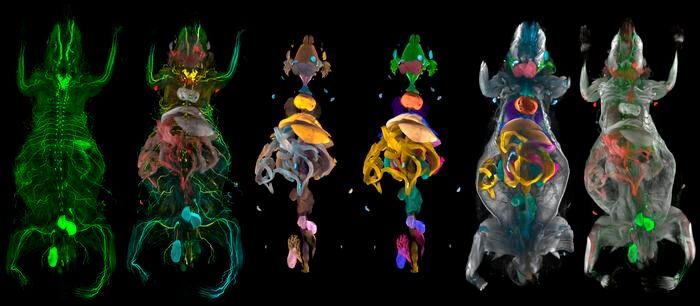
Whole-body 3D reconstruction
(Source: Ali Ertürk Lab/ Helmholtz Munich)
Researchers at Helmholtz Munich, the Ludwig Maximilians University Munich (LMU) and collaborating institutions have developed an artificial intelligence (AI) framework that maps disease-related changes throughout the entire mouse body at cellular resolution. Using the new platform, called Mouse Mapper, the researchers uncovered widespread inflammation and previously unrecognized damage to facial sensory nerves caused by obesity. Importantly, they also identified corresponding molecular signatures in human tissue, suggesting that key features of obesity-associated nerve damage are conserved across species. The findings are published today in the journal Nature.
Obesity affects far more than metabolism and fat storage. It alters immune activity, nerve structure, and tissue organization across multiple organ systems, increasing the risk of diseases including type 2 diabetes, cardiovascular disease, stroke, neuropathy and cancer. Yet despite these systemic effects, researchers have lacked tools capable of studying disease-associated changes across the entire body in intact organisms and at high resolution.
A team led by Prof. Ali Ertürk, Director of the Institute for Biological Intelligence (iBIO) at Helmholtz Munich and Professor at the LMU, has now developed Mouse Mapper, a suite of foundation-model-based deep-learning algorithms designed to analyze whole-body biological imaging data. The framework automatically segments 31 organs and tissue types while quantitatively mapping nerves and immune cells throughout the body, enabling comprehensive multi-system analysis in intact mice.
“Mouse Mapper is built on a foundation model, which means it generalizes far beyond the data it was originally trained on,” says Ying Chen, co-first author of the study.
Looking Inside an Entire Transparent Mouse
To create whole-body maps, the researchers labeled nerves and immune cells in mice with fluorescent markers visible under the microscope. They then used tissue-clearing techniques to render the animals transparent while preserving the fluorescent signals, allowing imaging deep inside intact bodies.
Using specialized light-sheet microscopy, the team captured detailed three-dimensional images of entire mice, producing datasets containing tens of millions of cellular structures across organs and tissues. Mouse Mapper then analyzed these data automatically, identifying nerves, immune-cell clusters, and anatomical regions throughout the body.
This allowed the researchers to determine precisely where inflammation and structural damage occur across different tissues – including fat, muscle, liver, and peripheral nerves – without requiring researchers to preselect specific regions of interest.
New Insights Into Obesity, From Mouse to Human
To investigate how obesity reshapes the body, the researchers fed mice a high-fat diet that induced obesity and metabolic dysfunction similar to that observed in humans. Applying Mouse Mapper revealed widespread changes in both immune-cell organization and nerve architecture across the body.
One of the most striking findings was a structural change to part of the trigeminal nerve, a major facial nerve that is responsible for facial sensation and motor functions. In obese mice, these sensory nerves had far fewer endings and branches, suggesting a loss of normal nerve function. Behavioral experiments further showed that the animals responded less to sensory stimulation than lean mice, linking the structural damage to impaired sensory function.
The researchers next examined the trigeminal ganglion, the structure containing the cell bodies of facial sensory neurons. Using spatial proteomics, they identified molecular alterations associated with nerve remodeling and inflammation. Remarkably, many of the same molecular signatures were also detected in trigeminal tissue from people with obesity, suggesting that the obesity-associated nerve alterations observed in mice also occur in humans.
Date: 08.12.2025
Naturally, we always handle your personal data responsibly. Any personal data we receive from you is processed in accordance with applicable data protection legislation. For detailed information please see our privacy policy.
Consent to the use of data for promotional purposes
I hereby consent to Vogel Communications Group GmbH & Co. KG, Max-Planck-Str. 7-9, 97082 Würzburg including any affiliated companies according to §§ 15 et seq. AktG (hereafter: Vogel Communications Group) using my e-mail address to send editorial newsletters. A list of all affiliated companies can be found here
Newsletter content may include all products and services of any companies mentioned above, including for example specialist journals and books, events and fairs as well as event-related products and services, print and digital media offers and services such as additional (editorial) newsletters, raffles, lead campaigns, market research both online and offline, specialist webportals and e-learning offers. In case my personal telephone number has also been collected, it may be used for offers of aforementioned products, for services of the companies mentioned above, and market research purposes.
Additionally, my consent also includes the processing of my email address and telephone number for data matching for marketing purposes with select advertising partners such as LinkedIn, Google, and Meta. For this, Vogel Communications Group may transmit said data in hashed form to the advertising partners who then use said data to determine whether I am also a member of the mentioned advertising partner portals. Vogel Communications Group uses this feature for the purposes of re-targeting (up-selling, cross-selling, and customer loyalty), generating so-called look-alike audiences for acquisition of new customers, and as basis for exclusion for on-going advertising campaigns. Further information can be found in section “data matching for marketing purposes”.
In case I access protected data on Internet portals of Vogel Communications Group including any affiliated companies according to §§ 15 et seq. AktG, I need to provide further data in order to register for the access to such content. In return for this free access to editorial content, my data may be used in accordance with this consent for the purposes stated here. This does not apply to data matching for marketing purposes.
Right of revocation
I understand that I can revoke my consent at will. My revocation does not change the lawfulness of data processing that was conducted based on my consent leading up to my revocation. One option to declare my revocation is to use the contact form found at https://contact.vogel.de. In case I no longer wish to receive certain newsletters, I have subscribed to, I can also click on the unsubscribe link included at the end of a newsletter. Further information regarding my right of revocation and the implementation of it as well as the consequences of my revocation can be found in the data protection declaration, section editorial newsletter.
“We revealed previously unknown structural and molecular changes in the trigeminal ganglion and its facial branches, and the same molecular signature was conserved in human tissue. This kind of finding simply cannot emerge from studying one organ at a time” says Dr. Doris Kaltenecker, senior scientist at the Institute for Diabetes and Cancer (IDC) at Helmholtz Munich and first author of the study.
A Platform for Studying Systemic Disease
Beyond obesity, the researchers believe Mouse Mapper could transform the study of complex diseases that affect multiple organs systems simultaneously, including diabetes, cancer, neurodegeneration and autoimmune disorders. Unlike earlier methods focused on selected organs or tissues, Mouse Mapper provides an integrated whole-body analysis platform capable of identifying disease “hotspots” throughout the organism.
The team has made whole-body datasets publicly available online, allowing scientists worldwide to explore obesity-associated changes across tissues and organ systems.
“Our goal is to create a comprehensive framework for understanding how diseases affect the body as an interconnected system,” says Ali Ertürk. “Our long-term vision is to build truly realistic digital twins of mice in health and disease: cell-level atlases that we can query, perturb and screen in silico computationally. That would let us pinpoint the earliest changes a disease causes, design interventions to prevent them, and accelerate the discovery of new treatments while reducing the number of physical experiments we need to run.”
Original Publication: Kaltenecker et al., 2026: A deep-learning framework reveals whole-body perturbations at cell level. Nature. DOI: 10.1038/s41586-026-10535-2




:quality(80)/p7i.vogel.de/wcms/cd/c0/cdc09efd1e5b3b8f83224e7729d66c10/0133105276v2.jpeg "From the data presented in this report, the authors show how TF3-MALS-RI is uniquely able to separate large polyacrylate molecules and provide precise molecular weight and Rg values. (Source: Postnova Analytics)")
:quality(80)/p7i.vogel.de/wcms/c6/f2/c6f2e2b4753a0d0cec682c03df4ed37c/0133088650v2.jpeg "PMBC vials for immunology and oncology research. (Source: Amsbio)")
:quality(80)/p7i.vogel.de/wcms/e0/72/e0728dc8dcadfc4d79a734e08cf6ced3/0133088641v2.jpeg "LM20 Microfluidizer and Cambridge CNT dispersion produced by the LM20 microfluidizer. (Source: Analytik)")
:quality(80)/p7i.vogel.de/wcms/55/f2/55f26cfb29878f58625b4697bacff0b9/0132894544v2.jpeg "The programme is designed to build an integrated R&D platform for sustainable specialty polymers. (Source: NUS)")
:quality(80)/p7i.vogel.de/wcms/86/01/86014d3d2a28cefc852f65c8d68317e4/0133104231v2.jpeg "Single-handed tube reading using a Handheld 2. (Source: Azenta Life Sciences)")
:quality(80)/p7i.vogel.de/wcms/0b/0f/0b0f8ed042dfc91f32582e10d54c2c7e/0133087444v2.jpeg "Offering advanced automation to increase your throughput, the Intellixcap provides secure sealing – eliminating the need for manual intervention, while preserving vital sample integrity. (Source: Azenta Life Sciences)")
:quality(80)/p7i.vogel.de/wcms/13/d3/13d35105f74a1c2e22b9c7a270e8e9b3/0132611155v2.jpeg "Circulating cell free DNA. (Source: Amsbio)")
:quality(80)/p7i.vogel.de/wcms/bc/ed/bced6850297a04dbea471a66cb6bb6fe/0132611405v2.jpeg "The latest addition to the range is a peristaltic tubing stop adapter that eliminates the need for fixed stoppers and allows custom cut lengths of peristaltic tubing to be installed on any pump head size. (Source: Biotech Fluidics )")
:quality(80)/p7i.vogel.de/wcms/32/80/3280aa3d44708962943c96fe2d466744/0133088560v2.jpeg "A bumble bee in flight at the University of Bristol Botanic Garden. (Source: Phil Savoie)")
:quality(80)/p7i.vogel.de/wcms/7b/e5/7be5c735140cbe28f3af0ec3d88274b9/0133045403v2.jpeg "After being buried in the ground for two months and broken down by soil organisms, a new pair of cotton underwear (left) shows clear signs of decomposition (right). (Source: Nicolas Zonvi)")
:quality(80)/p7i.vogel.de/wcms/c7/5e/c75e9b334a94b8b5c2a758f20ba080a8/0133039712v1.jpeg "Researchers have developed a microaerobic activated sludge process that enables ammonium to be recovered from fermentation industry wastewater instead of releasing nitrogen into the atmosphere. (Source: free licensed)")
:quality(80)/p7i.vogel.de/wcms/9a/a0/9aa0a7f2d93c4f3a9c6297fb39a5c756/0133018161v2.jpeg "Volcanic activity and hydroclimatic anomalies. Eruptions produce a repeating wave pattern in high-altitude winds (left panels) that line up with widespread drying across Asia (right panels). This pattern appears regardless of background climate conditions. (Source: ©2026 Nie et al. CC-BY-ND)")
:quality(80)/p7i.vogel.de/wcms/d4/61/d461ce0bd5743897993c6475f69e7ad6/0133067478v2.jpeg "In Harris County, 50 % of households with children reported food insecurity, compared with 33 % of households without children. (Source: Rice University)")
:quality(80)/p7i.vogel.de/wcms/79/76/7976d17b980bedfe35acaa532d690046/0132713841v2.jpeg "Observed rice yield losses from 1°C warming are more than twice as high as model estimates due to underestimated heat stress. (Source: AdobeStock/ducvien)")
:quality(80)/p7i.vogel.de/wcms/28/b6/28b6114fc9915c5dadee94d5c89bd129/0132593216v2.jpeg "Eating foods that contain common preservative food additives may increase the risks of high blood pressure and cardiovascular disease. (Source: Unsplash)")
:quality(80)/p7i.vogel.de/wcms/01/bc/01bcb16a3381a1d46533861eedbbae71/0132371290v1.jpeg "Adding spice may help people eat less by slowing them down. (Source: free licensed)")
:quality(80)/p7i.vogel.de/wcms/12/89/12898926c84533b848ef20475b822129/0133103465v2.jpeg "As national MMR vaccination rates among kindergarteners continue to decline, according to a CDC report, the U.S. has recorded its first adult measles-related deaths of 2026 in Pennsylvania. (Source: Pixabay)")
:quality(80)/p7i.vogel.de/wcms/e4/07/e407a7ca05d57041aac21e3d716c48f5/0133100475v2.jpeg "Exercise-based cardiac rehabilitation is strongly recommended for patients after a MI in the ESC Guidelines on acute coronary syndromes and in the new ESC Guidelines on cardiac rehabilitation. (Source: Unsplash)")
:quality(80)/p7i.vogel.de/wcms/54/c2/54c20d95b1b4b4cc7d56674ef58b7c25/0133097847v2.jpeg "Staree was a double-blind trial conducted among people aged 70 years and over with no history of clinical cardiovascular disease, diabetes or dementia recruited from Australian general practice. (Source: Unsplash)")
:quality(80)/p7i.vogel.de/wcms/1c/64/1c64bf757ace04243990f44dce11f5ed/0133067501v2.jpeg "Despite the proven benefits of blood pressure-lowering medication in reducing cardiovascular events, around half of patients do not take them as prescribed. (Source: Pixabay)")
:quality(80)/images.vogel.de/vogelonline/bdb/1710600/1710675/original.jpg "Discover how to set yourself up for success when performing balance-based density determination of solids such as jewelry and precious metals. (Mettler Toledo)")
:quality(80)/images.vogel.de/vogelonline/bdb/1682500/1682579/original.jpg "The new XPR Analytical balance redesigned to meet the needs of laboratory technicians of working fast and lean. (Mettler Toledo)")
:quality(80)/images.vogel.de/vogelonline/bdb/1677000/1677080/original.jpg "Enhance your weighing accuracy, comfort and productivity with the redesigned XPR Analytical balance. (Mettler Toledo)")
:fill(fff,0)/images.vogel.de/vogelonline/companyimg/107800/107832/65.jpg "logoDueperthal.jpg ()")
:quality(80)/p7i.vogel.de/wcms/62/25/62256c97dcdef9c1b14d0cb3a95dfa89/0127424295v2.jpeg "‘Skinny fat’ people — body types that are not visibly obese but still carry fat hidden in the abdomen and liver — are at increased risk of cardiovascular disease, research shows. (Source: free licensed)")
:quality(80)/p7i.vogel.de/wcms/7c/ad/7cad9f6e24173d03be0ce5b66579e4d7/0129134543v2.jpeg "Northwestern University scientists have developed an injectable regenerative nanomaterial that helps protect the brain during this vulnerable window. (Source: Pixabay)")
:quality(80)/p7i.vogel.de/wcms/83/90/839049b296905df2a07deb4e867ff2cb/0129594701v2.jpeg "The full device next to a quarter for scale. (Source: John A. Rogers/Northwestern University)")