Researchers have discovered a process that can contribute to the melting of ice shelves in the Antarctic. An international team of scientists found that adjacent ice shelves play a role in causing instability in others downstream.
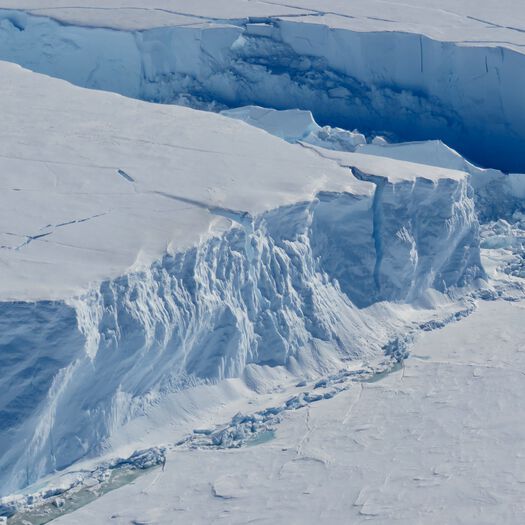
The Thwaites Ice Shelf in Antarctica
(Source: Karen Alley)
The Thwaites Ice Shelf is one of the biggest ice shelves in West Antarctica and buttresses the eastern side of the Thwaites Glacier, which has been retreating rapidly over the last 20 years and is the largest contributor to global sea-level rise among Antarctic glaciers.
Using a unique dataset collected by sensors installed beneath the Thwaites Ice Shelf — which has also thinned and weakened significantly in recent decades — researchers observed that the shallow layers of the ocean underneath it warmed considerably during the period from January 2020 to March 2021. Most of this warming was driven by waters with a high volume of glacial meltwater originating from the Pine Island Ice Shelf, further east, flowing into the area beneath the Thwaites Ice Shelf.
The glacial meltwater mixes with saltwater when the ocean melts the base of ice shelves and can form a buoyant layer of water that is warmer than the surrounding waters. This lighter, relatively fresher and warmer water brings heat that melts the base of the Thwaites Ice Shelf.
Lead author Dr Tiago Dotto, of the Centre for Ocean and Atmospheric Sciences at UEA, said: “We have identified another process that could impact the stability of ice shelves, revealing the importance of local ocean circulation and sea-ice. Circumpolar Deep Water, a warm variety of Antarctic waters, is a key player in melting the base of ice shelves. However, in this study, we show that a great amount of heat at shallow layers beneath one ice shelf can be provided by waters originating from other melting ice shelves nearby. Therefore, what happens to one ice shelf, can impact the adjacent ice shelf, and so on.”
This process is important for regions of high ice shelf melting such as the Amundsen Sea because one ice shelf sits next to the other, and the export of heat from one ice shelf can reach the next one through the ocean circulation. Dr Dotto added: “These atmosphere-sea-ice-ocean interactions are important because they can prolong warm periods beneath ice shelves by allowing warm and meltwater-enriched water to enter adjacent ice-shelf cavities. Gyres potentially existing in other regions around Antarctica may also cause a greater number of ice shelves to be prone to intense basal melting associated with prolonged warm conditions, and as a result further contribute to global sea-level rise.”
In January 2020 colleagues from the US drilled holes in the ice and installed sensors monitoring temperature, salinity and ocean current beneath the Thwaites Ice Shelf. For more than a year these sensors sent, via satellite, the data used to identify the ocean variations, for example how the temperature and meltwater content varied. From these observations, the researchers suspected that the excess of heat could not have originated locally at the Thwaites Ice Shelf because they did not see strong melting at the sites where the sensors were installed. By combining the information with computer simulations to identify the origin of this heat, they found that the water that leaves the Pine Island Ice Shelf can access the areas beneath Thwaites Ice Shelf.
The mechanism that explains how these waters access the Thwaites Ice Shelf was identified by using model simulations and data collected by tags attached to seals. They both showed that a gyre near the Thwaites Ice Shelf weakens in winter, which allows more heat to reach shallow areas beneath the ice shelf. Satellite images also showed that the Southern Hemisphere summer season of 2020/2021 was unusual because it had a high concentration of sea ice in regions near the Thwaites Ice Shelf.
Drawing on the simulations and previous research, the team hypothesised that the gyre was even weaker, so the excess of meltwater from adjacent ice shelves could not be moved away from that region by the currents and instead entered the Thwaites Ice Shelf. This reduced even more the strength of this gyre, which enabled the inflow of water with higher concentration of glacial meltwater beneath the ice shelf.
Date: 08.12.2025
Naturally, we always handle your personal data responsibly. Any personal data we receive from you is processed in accordance with applicable data protection legislation. For detailed information please see our privacy policy.
Consent to the use of data for promotional purposes
I hereby consent to Vogel Communications Group GmbH & Co. KG, Max-Planck-Str. 7-9, 97082 Würzburg including any affiliated companies according to §§ 15 et seq. AktG (hereafter: Vogel Communications Group) using my e-mail address to send editorial newsletters. A list of all affiliated companies can be found here
Newsletter content may include all products and services of any companies mentioned above, including for example specialist journals and books, events and fairs as well as event-related products and services, print and digital media offers and services such as additional (editorial) newsletters, raffles, lead campaigns, market research both online and offline, specialist webportals and e-learning offers. In case my personal telephone number has also been collected, it may be used for offers of aforementioned products, for services of the companies mentioned above, and market research purposes.
Additionally, my consent also includes the processing of my email address and telephone number for data matching for marketing purposes with select advertising partners such as LinkedIn, Google, and Meta. For this, Vogel Communications Group may transmit said data in hashed form to the advertising partners who then use said data to determine whether I am also a member of the mentioned advertising partner portals. Vogel Communications Group uses this feature for the purposes of re-targeting (up-selling, cross-selling, and customer loyalty), generating so-called look-alike audiences for acquisition of new customers, and as basis for exclusion for on-going advertising campaigns. Further information can be found in section “data matching for marketing purposes”.
In case I access protected data on Internet portals of Vogel Communications Group including any affiliated companies according to §§ 15 et seq. AktG, I need to provide further data in order to register for the access to such content. In return for this free access to editorial content, my data may be used in accordance with this consent for the purposes stated here. This does not apply to data matching for marketing purposes.
Right of revocation
I understand that I can revoke my consent at will. My revocation does not change the lawfulness of data processing that was conducted based on my consent leading up to my revocation. One option to declare my revocation is to use the contact form found at https://contact.vogel.de. In case I no longer wish to receive certain newsletters, I have subscribed to, I can also click on the unsubscribe link included at the end of a newsletter. Further information regarding my right of revocation and the implementation of it as well as the consequences of my revocation can be found in the data protection declaration, section editorial newsletter.
References: Ocean variability beneath Thwaites Eastern Ice Shelf driven by the Pine Island Bay Gyre strength; Nature Communications; DOI:10.1038/s41467-022-35499-5




:quality(80)/p7i.vogel.de/wcms/62/32/62327aaae1415beeed47db6201e79661/0133375912v2.jpeg "A cotton trailer outfitted with benches and a sunshade offers farmworkers a reprieve from the sun as they take a break from picking cantaloupe melons in Firebaugh, Calif.
(Source: Joe Proudman/ Regents of the University of California)")
:quality(80)/p7i.vogel.de/wcms/e6/c8/e6c8bd554776ee1ad2f1f0723fb243a7/0133369387v1.jpeg "Roman road (Source: Queen Mary University of London)")
:quality(80)/p7i.vogel.de/wcms/51/68/51687ac4cc19f2757c138498b877de57/0133167039v2.jpeg "CMFs are foams that consist of hollow spheres – made of materials such as stainless steel, nickel, or other metals and alloys – embedded in a metallic matrix. The resulting material is both lightweight and remarkably strong at absorbing compressive forces. (Source: Jie Sun/ NC State University)")
:quality(80)/p7i.vogel.de/wcms/cd/c0/cdc09efd1e5b3b8f83224e7729d66c10/0133105276v2.jpeg "From the data presented in this report, the authors show how TF3-MALS-RI is uniquely able to separate large polyacrylate molecules and provide precise molecular weight and Rg values. (Source: Postnova Analytics)")
:quality(80)/p7i.vogel.de/wcms/86/01/86014d3d2a28cefc852f65c8d68317e4/0133104231v2.jpeg "Single-handed tube reading using a Handheld 2. (Source: Azenta Life Sciences)")
:quality(80)/p7i.vogel.de/wcms/0b/0f/0b0f8ed042dfc91f32582e10d54c2c7e/0133087444v2.jpeg "Offering advanced automation to increase your throughput, the Intellixcap provides secure sealing – eliminating the need for manual intervention, while preserving vital sample integrity. (Source: Azenta Life Sciences)")
:quality(80)/p7i.vogel.de/wcms/13/d3/13d35105f74a1c2e22b9c7a270e8e9b3/0132611155v2.jpeg "Circulating cell free DNA. (Source: Amsbio)")
:quality(80)/p7i.vogel.de/wcms/bc/ed/bced6850297a04dbea471a66cb6bb6fe/0132611405v2.jpeg "The latest addition to the range is a peristaltic tubing stop adapter that eliminates the need for fixed stoppers and allows custom cut lengths of peristaltic tubing to be installed on any pump head size. (Source: Biotech Fluidics )")
:quality(80)/p7i.vogel.de/wcms/8d/5c/8d5c6c7f897f91d6784825eee20b5584/0133321225v1.jpeg "Empa researcher Christoph Hüglin collects samples of particles that are washed out of the air by rain and snow or settle due to gravity. (Source: Empa)")
:quality(80)/p7i.vogel.de/wcms/a1/af/a1afbc7c8a067bbe94749ec680b4bafd/0133163762v2.jpeg "The study found in murkier water, fish took longer to move towards the food than those in clear water, but individuals in larger groups responded more quickly overall. (Source: Christos Ioannou)")
:quality(80)/p7i.vogel.de/wcms/32/80/3280aa3d44708962943c96fe2d466744/0133088560v2.jpeg "A bumble bee in flight at the University of Bristol Botanic Garden. (Source: Phil Savoie)")
:quality(80)/p7i.vogel.de/wcms/7b/e5/7be5c735140cbe28f3af0ec3d88274b9/0133045403v2.jpeg "After being buried in the ground for two months and broken down by soil organisms, a new pair of cotton underwear (left) shows clear signs of decomposition (right). (Source: Nicolas Zonvi)")
:quality(80)/p7i.vogel.de/wcms/ef/68/ef68375729607984e5bb0c143afdae70/0133375119v2.jpeg "Printed Rice-Lentil 3D structures
(Source: SUTD)")
:quality(80)/p7i.vogel.de/wcms/bf/d0/bfd087349a85956a7aefad57ac1204c7/0133241961v2.jpeg "The Thermo Scientific Suretect Beverage Spoilage Multiplex PCR Assay provides a fast, broad-range molecular solution for detecting key spoilage microorganisms that threaten beverage quality. (Source: © OlegDoroshin - stock.adobe.com)")
:quality(80)/p7i.vogel.de/wcms/d4/61/d461ce0bd5743897993c6475f69e7ad6/0133067478v2.jpeg "In Harris County, 50 % of households with children reported food insecurity, compared with 33 % of households without children. (Source: Rice University)")
:quality(80)/p7i.vogel.de/wcms/79/76/7976d17b980bedfe35acaa532d690046/0132713841v2.jpeg "Observed rice yield losses from 1°C warming are more than twice as high as model estimates due to underestimated heat stress. (Source: AdobeStock/ducvien)")
:quality(80)/p7i.vogel.de/wcms/22/49/224964dd6850b62cccdbc4bde2d34693/0133372964v1.jpeg "Brain activity recorded during a video game helped researchers predict whether participants would take or avoid a risk half a second before they acted. (Source: free licensed)")
:quality(80)/p7i.vogel.de/wcms/48/a7/48a761934161543f70fef2403b44d714/0133372328v2.jpeg "The link between pollution and coughing persisted in the data, even when pollution levels were below the WHO’s recommended safe daily exposure limit. (Source: free licensed)")
:quality(80)/p7i.vogel.de/wcms/83/b4/83b4563a65c6036b61990931507428b4/0133363611v2.jpeg "Magnesium sulphate uptake and the north / south divide for the Precept program. (Source: University of Bristol )")
:quality(80)/p7i.vogel.de/wcms/bb/06/bb06c1c3c5d250f3f93016366c56525d/0133363201v2.jpeg "The team identified more than 1,200 associated genetic variants and found that these influences are remarkably consistent across countries, ages and methods of measuring personality. (Source: Pixabay - PublicDomainPictures)")
:quality(80)/images.vogel.de/vogelonline/bdb/1710600/1710675/original.jpg "Discover how to set yourself up for success when performing balance-based density determination of solids such as jewelry and precious metals. (Mettler Toledo)")
:quality(80)/images.vogel.de/vogelonline/bdb/1682500/1682579/original.jpg "The new XPR Analytical balance redesigned to meet the needs of laboratory technicians of working fast and lean. (Mettler Toledo)")
:quality(80)/images.vogel.de/vogelonline/bdb/1677000/1677080/original.jpg "Enhance your weighing accuracy, comfort and productivity with the redesigned XPR Analytical balance. (Mettler Toledo)")
:fill(fff,0)/images.vogel.de/vogelonline/companyimg/107800/107832/65.jpg "logoDueperthal.jpg ()")
:fill(fff,0)/images.vogel.de/vogelonline/companyimg/131900/131910/65.jpg "Xylem_tag_rgb.jpg ()")
:fill(fff,0)/p7i.vogel.de/companies/69/b7/69b7f63f311d9/logo-bimos-tif--2-.jpeg "logo-bimos-tif--2- (https://www.bimos.com/de-de/)")
:quality(80)/p7i.vogel.de/wcms/9e/37/9e3727fadfbd80f121219e02eb1b53d9/0106097125.jpeg "This new research shows that Arctic sea ice is more influenced by wildfire smoke than previously thought. (Source: Public Domain)")
:quality(80)/p7i.vogel.de/wcms/c6/84/c684af6fde3bc61025a7ab458371a274/0127660717v1.jpeg "Nests of the yellowfin notie (Lindbergichthys nudifrons). Each nest would have been guarded by a parent fish, protecting their eggs from predators. This remarkable organization is thought to be a survival strategy.
Some are singular, bottom right, some are in curves, centre top, and others in clusters, top left. All have been cleared of the carpet of phytoplankton detritus that covers surrounding areas – seen starkly in the centre top picture. (Source: Weddell Sea Expedition 2019)")
:quality(80)/p7i.vogel.de/wcms/e4/90/e490504339150fd28bdffc2c062df8a9/0129646170v2.jpeg "“Note the clear nunatak at the mid-right of the glacier,” said Convey. “This is named 'Manhaul Rock' and, when I was first on Signy in 1989-91, it was literally a small rock poking through the ice surface that you could walk/ski/drive a skidoo up to.” (Source: Prof Peter Convey)")