Amazonian dark earth could offer new clues for restoring degraded tropical soils. A field study in Brazil shows that even small amounts of this ancient, human-made soil can significantly boost early tree growth, not primarily through nutrients, but by reshaping the microbial life around the roots.
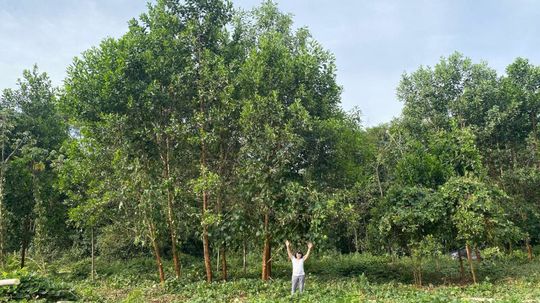
33-month-old acacias in Manaus: ADEs result from the decomposition of organic matter and the use of fire by pre-Columbian populations and continue to be created by present-day peoples
(Source: Tsai Siu Mui/ Cena-USP)
A study conducted in the Brazilian state of Amazonas with support from Fapesp demonstrated that small amounts of Amazonian dark earth (ADE) — an anthropogenic soil created by ancient Amazonian populations — can increase the height and diameter of the pink trumpet tree (Handroanthus avellanedae) by up to 55% and 88%, respectively. This tree also occurs in the Atlantic Forest.
For the Brazilian firetree (Schizolobium amazonicum), the increase was 20% in height and 15% in trunk diameter. These results refer to the first 180 days of life for these plants, compared to other plants of the same species that did not receive dark earth.
“The key factor was not the amount of nutrients per se, which doesn’t vary much, but rather the microorganisms, which were quite different, especially the fungi. In plants treated with dark earth, the microbiota around the roots reorganizes, with more efficient recruitment of beneficial microorganisms and a reduction in pathogens,” explains Anderson Santos de Freitas, the first author of the study. He conducted the research during his doctoral studies at CENA-USP with a scholarship from Fapesp.
In addition to helping to reforest degraded areas and provide ecosystem services, the two analyzed trees can be used for sustainable timber harvesting, especially the pink trumpet tree.
The study is part of the “Soil-plant feedbacks in the Amazon Forest under agricultural systems in the state of Amazonas” project, which is supported by Fapesp and coordinated by Tsai Siu Mui, a professor at CENA-USP.
Ancestral Land
Amazonian dark earths, also known as terras pretas de índio (TPIs), result from the decomposition of organic matter and the use of fire by pre-Columbian populations. These earths continue to be formed by present-day peoples.
The study shows that ADEs harbor a variety of bacteria, archaea, and fungi that help plants absorb nutrients and eliminate other opportunistic and pathogenic microorganisms, creating a more favorable environment for growth.
“We’ve been studying dark earths for over 20 years and have tested various ways of using them. The idea is to understand what makes them best suited for helping trees grow faster and stronger in degraded areas,” says Tsai.
“When land is deforested, especially for pasture, the soil tends to be poorly managed, leading to a rapid loss of microorganisms and nutrients. The goal is to restore the forest and ecosystem services in these areas,” she adds.
Dark earths are protected by law and regulated by the Genetic Heritage Management Council (CGen), a collegiate body chaired by the Ministry of the Environment and Climate Change.
“We use small amounts in our experiments after obtaining authorization from CGen. The idea isn’t for people to use it directly, which is prohibited, but rather to understand how it’s formed, what its composition is, and which microorganisms and processes make it so special. With this knowledge, we could reproduce it or isolate its useful components,” says Freitas.
In a previous study, the group compared the growth of seedlings from other tree species and Brachiaria grass in a greenhouse with and without the addition of dark earth.
In the current study, seedling growth was measured in the field. Seeds from the two species were grown in the Embrapa Eastern Amazon nursery in Itacoatiara, Amazonas, under two treatments: dark earth or coconut fiber.
Fifteen days later, the seeds had germinated and developed into seedlings. These seedlings were then transferred to the experimental field of the same institution in Manaus. The seedlings were planted in the soil and received no fertilizer or herbicide; they relied solely on rainwater and manual weed control.
Date: 08.12.2025
Naturally, we always handle your personal data responsibly. Any personal data we receive from you is processed in accordance with applicable data protection legislation. For detailed information please see our privacy policy.
Consent to the use of data for promotional purposes
I hereby consent to Vogel Communications Group GmbH & Co. KG, Max-Planck-Str. 7-9, 97082 Würzburg including any affiliated companies according to §§ 15 et seq. AktG (hereafter: Vogel Communications Group) using my e-mail address to send editorial newsletters. A list of all affiliated companies can be found here
Newsletter content may include all products and services of any companies mentioned above, including for example specialist journals and books, events and fairs as well as event-related products and services, print and digital media offers and services such as additional (editorial) newsletters, raffles, lead campaigns, market research both online and offline, specialist webportals and e-learning offers. In case my personal telephone number has also been collected, it may be used for offers of aforementioned products, for services of the companies mentioned above, and market research purposes.
Additionally, my consent also includes the processing of my email address and telephone number for data matching for marketing purposes with select advertising partners such as LinkedIn, Google, and Meta. For this, Vogel Communications Group may transmit said data in hashed form to the advertising partners who then use said data to determine whether I am also a member of the mentioned advertising partner portals. Vogel Communications Group uses this feature for the purposes of re-targeting (up-selling, cross-selling, and customer loyalty), generating so-called look-alike audiences for acquisition of new customers, and as basis for exclusion for on-going advertising campaigns. Further information can be found in section “data matching for marketing purposes”.
In case I access protected data on Internet portals of Vogel Communications Group including any affiliated companies according to §§ 15 et seq. AktG, I need to provide further data in order to register for the access to such content. In return for this free access to editorial content, my data may be used in accordance with this consent for the purposes stated here. This does not apply to data matching for marketing purposes.
Right of revocation
I understand that I can revoke my consent at will. My revocation does not change the lawfulness of data processing that was conducted based on my consent leading up to my revocation. One option to declare my revocation is to use the contact form found at https://contact.vogel.de. In case I no longer wish to receive certain newsletters, I have subscribed to, I can also click on the unsubscribe link included at the end of a newsletter. Further information regarding my right of revocation and the implementation of it as well as the consequences of my revocation can be found in the data protection declaration, section editorial newsletter.
After six months, all the plants were alive. However, the ADE-treated plants showed significant differences. Although the firetrees showed proportionally slower growth than the pink trumpet trees, they were about 1.5 meters tall 180 days after the seedlings were transferred to the field.
The researchers observed an increase in fungal diversity in the soil of the plants treated with dark earth, which was more pronounced in the purple trumpet trees. This may be explained by the high adaptability of firetrees to degraded soils, meaning the species does not require as many nutrients and microorganisms.
“Fungi respond more quickly because they’re more complex microorganisms. With the addition of dark earth, there’s an immediate increase in organic matter and, therefore, decomposing fungi, which cycle nutrients more efficiently and make them more available to plants,” Freitas explains.
The results, which have now been published, refer to the first 180 days of life for the plants. The experiment lasted a total of three years. Currently, the researchers are analyzing data from the entire period, which will lead to new studies.
Over the course of more than 20 years of studying dark earths, the laboratory led by Tsai at CENA-USP has isolated over 200 microorganisms from these formations. These microorganisms are currently being analyzed for their functions. The goal is to develop solutions for restoring degraded soils for reforestation.
Original Article: Boosting tree growth in the Amazon rainforest using Amazonian Dark Earths; BMC Ecology and Evolution; DOI:10.1186/s12862-026-02495-y




:quality(80)/p7i.vogel.de/wcms/62/32/62327aaae1415beeed47db6201e79661/0133375912v2.jpeg "A cotton trailer outfitted with benches and a sunshade offers farmworkers a reprieve from the sun as they take a break from picking cantaloupe melons in Firebaugh, Calif.
(Source: Joe Proudman/ Regents of the University of California)")
:quality(80)/p7i.vogel.de/wcms/e6/c8/e6c8bd554776ee1ad2f1f0723fb243a7/0133369387v1.jpeg "Roman road (Source: Queen Mary University of London)")
:quality(80)/p7i.vogel.de/wcms/51/68/51687ac4cc19f2757c138498b877de57/0133167039v2.jpeg "CMFs are foams that consist of hollow spheres – made of materials such as stainless steel, nickel, or other metals and alloys – embedded in a metallic matrix. The resulting material is both lightweight and remarkably strong at absorbing compressive forces. (Source: Jie Sun/ NC State University)")
:quality(80)/p7i.vogel.de/wcms/cd/c0/cdc09efd1e5b3b8f83224e7729d66c10/0133105276v2.jpeg "From the data presented in this report, the authors show how TF3-MALS-RI is uniquely able to separate large polyacrylate molecules and provide precise molecular weight and Rg values. (Source: Postnova Analytics)")
:quality(80)/p7i.vogel.de/wcms/86/01/86014d3d2a28cefc852f65c8d68317e4/0133104231v2.jpeg "Single-handed tube reading using a Handheld 2. (Source: Azenta Life Sciences)")
:quality(80)/p7i.vogel.de/wcms/0b/0f/0b0f8ed042dfc91f32582e10d54c2c7e/0133087444v2.jpeg "Offering advanced automation to increase your throughput, the Intellixcap provides secure sealing – eliminating the need for manual intervention, while preserving vital sample integrity. (Source: Azenta Life Sciences)")
:quality(80)/p7i.vogel.de/wcms/13/d3/13d35105f74a1c2e22b9c7a270e8e9b3/0132611155v2.jpeg "Circulating cell free DNA. (Source: Amsbio)")
:quality(80)/p7i.vogel.de/wcms/bc/ed/bced6850297a04dbea471a66cb6bb6fe/0132611405v2.jpeg "The latest addition to the range is a peristaltic tubing stop adapter that eliminates the need for fixed stoppers and allows custom cut lengths of peristaltic tubing to be installed on any pump head size. (Source: Biotech Fluidics )")
:quality(80)/p7i.vogel.de/wcms/8d/5c/8d5c6c7f897f91d6784825eee20b5584/0133321225v1.jpeg "Empa researcher Christoph Hüglin collects samples of particles that are washed out of the air by rain and snow or settle due to gravity. (Source: Empa)")
:quality(80)/p7i.vogel.de/wcms/a1/af/a1afbc7c8a067bbe94749ec680b4bafd/0133163762v2.jpeg "The study found in murkier water, fish took longer to move towards the food than those in clear water, but individuals in larger groups responded more quickly overall. (Source: Christos Ioannou)")
:quality(80)/p7i.vogel.de/wcms/32/80/3280aa3d44708962943c96fe2d466744/0133088560v2.jpeg "A bumble bee in flight at the University of Bristol Botanic Garden. (Source: Phil Savoie)")
:quality(80)/p7i.vogel.de/wcms/7b/e5/7be5c735140cbe28f3af0ec3d88274b9/0133045403v2.jpeg "After being buried in the ground for two months and broken down by soil organisms, a new pair of cotton underwear (left) shows clear signs of decomposition (right). (Source: Nicolas Zonvi)")
:quality(80)/p7i.vogel.de/wcms/ef/68/ef68375729607984e5bb0c143afdae70/0133375119v2.jpeg "Printed Rice-Lentil 3D structures
(Source: SUTD)")
:quality(80)/p7i.vogel.de/wcms/bf/d0/bfd087349a85956a7aefad57ac1204c7/0133241961v2.jpeg "The Thermo Scientific Suretect Beverage Spoilage Multiplex PCR Assay provides a fast, broad-range molecular solution for detecting key spoilage microorganisms that threaten beverage quality. (Source: © OlegDoroshin - stock.adobe.com)")
:quality(80)/p7i.vogel.de/wcms/d4/61/d461ce0bd5743897993c6475f69e7ad6/0133067478v2.jpeg "In Harris County, 50 % of households with children reported food insecurity, compared with 33 % of households without children. (Source: Rice University)")
:quality(80)/p7i.vogel.de/wcms/79/76/7976d17b980bedfe35acaa532d690046/0132713841v2.jpeg "Observed rice yield losses from 1°C warming are more than twice as high as model estimates due to underestimated heat stress. (Source: AdobeStock/ducvien)")
:quality(80)/p7i.vogel.de/wcms/22/49/224964dd6850b62cccdbc4bde2d34693/0133372964v1.jpeg "Brain activity recorded during a video game helped researchers predict whether participants would take or avoid a risk half a second before they acted. (Source: free licensed)")
:quality(80)/p7i.vogel.de/wcms/48/a7/48a761934161543f70fef2403b44d714/0133372328v2.jpeg "The link between pollution and coughing persisted in the data, even when pollution levels were below the WHO’s recommended safe daily exposure limit. (Source: free licensed)")
:quality(80)/p7i.vogel.de/wcms/83/b4/83b4563a65c6036b61990931507428b4/0133363611v2.jpeg "Magnesium sulphate uptake and the north / south divide for the Precept program. (Source: University of Bristol )")
:quality(80)/p7i.vogel.de/wcms/bb/06/bb06c1c3c5d250f3f93016366c56525d/0133363201v2.jpeg "The team identified more than 1,200 associated genetic variants and found that these influences are remarkably consistent across countries, ages and methods of measuring personality. (Source: Pixabay - PublicDomainPictures)")
:quality(80)/images.vogel.de/vogelonline/bdb/1710600/1710675/original.jpg "Discover how to set yourself up for success when performing balance-based density determination of solids such as jewelry and precious metals. (Mettler Toledo)")
:quality(80)/images.vogel.de/vogelonline/bdb/1682500/1682579/original.jpg "The new XPR Analytical balance redesigned to meet the needs of laboratory technicians of working fast and lean. (Mettler Toledo)")
:quality(80)/images.vogel.de/vogelonline/bdb/1677000/1677080/original.jpg "Enhance your weighing accuracy, comfort and productivity with the redesigned XPR Analytical balance. (Mettler Toledo)")
:fill(fff,0)/images.vogel.de/vogelonline/companyimg/107800/107832/65.jpg "logoDueperthal.jpg ()")
:fill(fff,0)/images.vogel.de/vogelonline/companyimg/131900/131910/65.jpg "Xylem_tag_rgb.jpg ()")
:fill(fff,0)/p7i.vogel.de/companies/69/b7/69b7f63f311d9/logo-bimos-tif--2-.jpeg "logo-bimos-tif--2- (https://www.bimos.com/de-de/)")
:quality(80)/p7i.vogel.de/wcms/22/b5/22b52946fc26d915ae5f72fb33825d0f/0121561469v2.jpeg "The study tracked regrowth between 2000 and 2012, and then checked if the regrowth was maintained through 2015. (Source: free licensed)")
:quality(80)/p7i.vogel.de/wcms/1a/7b/1a7b16e533bb31951724ccb8682f9125/0111291160.jpeg "Amazonian dark earth (ADE) soil profile. Note that there is a black and a yellow layer. ADE corresponds only to the black layer. (Source: Luís Felipe Guandalin Zagatto)")
:quality(80)/p7i.vogel.de/wcms/12/17/12175a26ff75d1735d096a5edb589f00/0129926433v1.jpeg "The researchers chose the ‘Myles’ variety of chickpea for this study. Its compact size and resiliency support crop production in space-limited mission environments. (Source: University of Texas Institute for Geophysics)")
:quality(80)/p7i.vogel.de/wcms/37/77/37779bf078072a8d5d3533eaa0fe3c48/0127289681v1.jpeg "Biochar-driven rhizoremediation of soil contaminated with organic pollutants: engineered solutions, microbiome enrichment, and bioeconomic benefits for ecosystem restoration. (Source: Nandita Das & Piyush Pandey)")