Beneath the ice of Antarctica’s Weddell Sea, scientists have discovered a hidden world — thousands of perfectly arranged fish nests forming vast, geometric colonies on the seafloor. The finding reveals an extraordinary survival strategy and underscores the urgency of protecting these fragile marine ecosystems.
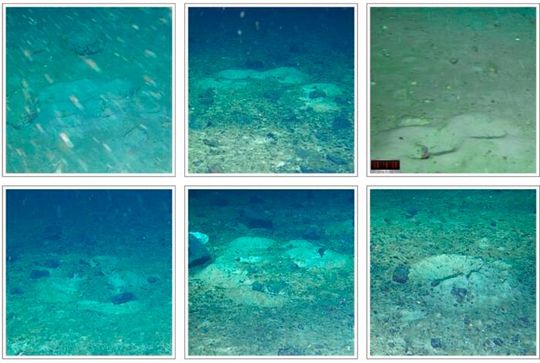
Nests of the yellowfin notie (Lindbergichthys nudifrons). Each nest would have been guarded by a parent fish, protecting their eggs from predators. This remarkable organization is thought to be a survival strategy. Some are singular, bottom right, some are in curves, centre top, and others in clusters, top left. All have been cleared of the carpet of phytoplankton detritus that covers surrounding areas – seen starkly in the centre top picture.
(Source: Weddell Sea Expedition 2019)
In a remote part of Antarctica’s Western Weddell Sea, an area once hidden beneath a 200-metre-thick ice shelf, scientists have uncovered a new and unusual phenomena: extensive maintained fish nesting grounds arranged in patterns.
When the A68 iceberg, measuring 5,800 square kilometres, calved from Larsen C Ice Shelf in 2017, it opened new access for research. A remotely operated vehicle (ROV) exploring the seafloor revealed more than 1,000 circular nests, each cleared of the layer of plankton detritus that blanketed surrounding areas. These nests were not randomly scattered, instead they were organised into distinct patterns, forming a vast, geometric fish neighbourhood on the seafloor.
The dimples in the sand are the cleaned fish nests. Some are singular, bottom right, some are in curves, centre top, and others in clusters, top left. All have been cleared of the carpet of phytoplankton detritus that covers surrounding areas – seen starkly in the centre top picture.
The Expedition
The Weddell Sea Expedition 2019 had two aims: to conduct an interdisciplinary scientific programme in the waters surrounding the Larsen C Ice Shelf, and to locate, survey, and image the wreck of Sir Ernest Shackleton's ship, the Endurance, which sank in 1915. The scientific motivation was driven by the critical importance of Antarctica's floating ice shelves. These ice shelves play a crucial global role, acting to support and restrain ice flow from the vast interior of the Antarctic Ice Sheet. When ice shelves thin or collapse, this restraint is lost, leading to accelerated ice flow from the continent, which in turn contributes to global sea-level rise. The expedition was particularly timely, following the major calving of iceberg A68. That calving event provided a unique opportunity to study a region undergoing rapid environmental change, specifically the first chance to study previously inaccessible areas of the seabed that were once underneath A68.
Equipped with autonomous underwater vehicles (AUVs) and a remotely operated underwater vehicle (ROV) aboard the South African polar research vessel SA Agulhas II, the team faced the same extreme sea-ice conditions that had crushed the Endurance vessel more than a century earlier. The immense pressure of the thick multi-year pack ice thwarted the 2019 search effort for the Endurance. Although this expedition did not locate the wreckage, the invaluable experience gained in navigating the treacherous ice and deploying submersible technology assisted with the planning and execution of the subsequent Endurance22 expedition on the same ship, which successfully located the remarkably well-preserved wreck in March 2022 at 3,008 meters below sea level.
A Story of Survival
The architects of these nests are a species of rockcod known as the yellowfin notie (Lindbergichthys nudifrons). Each nest would have been guarded by a parent fish, protecting their eggs from predators. This remarkable organisation is thought to be a survival strategy. The dense clusters demonstrate the ‘selfish herd’ theory in action: individuals in the centre of the group gain protection, shielded by their neighbours. The solitary nests on the outskirts are thought to be occupied by larger, stronger individuals better able to defend their nests. The entire community is a dynamic interplay between cooperation and self-preservation.
Why the Discovery Matters
This find is more than a scientific observation; it has critical implications for conservation. It provides evidence that this area contains a Vulnerable Marine Ecosystem, a unique and fragile habitat that is crucial for biodiversity. Importantly, it builds on previous work in the Weddell Sea, such as Purser et al. (2022), who revealed one of the largest known fish breeding colonies on Earth. These discoveries are vital to support the formal designation of the Weddell Sea as a Marine Protected Area. Protecting this area means safeguarding not just the iconic penguins and seals, but also these hidden nurseries that form part of the Antarctic food web. These underwater environments are a powerful reminder that even in the planet's most extremes, life finds a way to build complex, resilient communities.
Date: 08.12.2025
Naturally, we always handle your personal data responsibly. Any personal data we receive from you is processed in accordance with applicable data protection legislation. For detailed information please see our privacy policy.
Consent to the use of data for promotional purposes
I hereby consent to Vogel Communications Group GmbH & Co. KG, Max-Planck-Str. 7-9, 97082 Würzburg including any affiliated companies according to §§ 15 et seq. AktG (hereafter: Vogel Communications Group) using my e-mail address to send editorial newsletters. A list of all affiliated companies can be found here
Newsletter content may include all products and services of any companies mentioned above, including for example specialist journals and books, events and fairs as well as event-related products and services, print and digital media offers and services such as additional (editorial) newsletters, raffles, lead campaigns, market research both online and offline, specialist webportals and e-learning offers. In case my personal telephone number has also been collected, it may be used for offers of aforementioned products, for services of the companies mentioned above, and market research purposes.
Additionally, my consent also includes the processing of my email address and telephone number for data matching for marketing purposes with select advertising partners such as LinkedIn, Google, and Meta. For this, Vogel Communications Group may transmit said data in hashed form to the advertising partners who then use said data to determine whether I am also a member of the mentioned advertising partner portals. Vogel Communications Group uses this feature for the purposes of re-targeting (up-selling, cross-selling, and customer loyalty), generating so-called look-alike audiences for acquisition of new customers, and as basis for exclusion for on-going advertising campaigns. Further information can be found in section “data matching for marketing purposes”.
In case I access protected data on Internet portals of Vogel Communications Group including any affiliated companies according to §§ 15 et seq. AktG, I need to provide further data in order to register for the access to such content. In return for this free access to editorial content, my data may be used in accordance with this consent for the purposes stated here. This does not apply to data matching for marketing purposes.
Right of revocation
I understand that I can revoke my consent at will. My revocation does not change the lawfulness of data processing that was conducted based on my consent leading up to my revocation. One option to declare my revocation is to use the contact form found at https://contact.vogel.de. In case I no longer wish to receive certain newsletters, I have subscribed to, I can also click on the unsubscribe link included at the end of a newsletter. Further information regarding my right of revocation and the implementation of it as well as the consequences of my revocation can be found in the data protection declaration, section editorial newsletter.
Original Article: A Finding of Maintained Cryonotothenioid Nesting Sites in the Western Weddell Sea; Frontiers in Marine Science; DOI:10.3389/fmars.2025.1648168




:quality(80)/p7i.vogel.de/wcms/62/32/62327aaae1415beeed47db6201e79661/0133375912v2.jpeg "A cotton trailer outfitted with benches and a sunshade offers farmworkers a reprieve from the sun as they take a break from picking cantaloupe melons in Firebaugh, Calif.
(Source: Joe Proudman/ Regents of the University of California)")
:quality(80)/p7i.vogel.de/wcms/e6/c8/e6c8bd554776ee1ad2f1f0723fb243a7/0133369387v1.jpeg "Roman road (Source: Queen Mary University of London)")
:quality(80)/p7i.vogel.de/wcms/51/68/51687ac4cc19f2757c138498b877de57/0133167039v2.jpeg "CMFs are foams that consist of hollow spheres – made of materials such as stainless steel, nickel, or other metals and alloys – embedded in a metallic matrix. The resulting material is both lightweight and remarkably strong at absorbing compressive forces. (Source: Jie Sun/ NC State University)")
:quality(80)/p7i.vogel.de/wcms/cd/c0/cdc09efd1e5b3b8f83224e7729d66c10/0133105276v2.jpeg "From the data presented in this report, the authors show how TF3-MALS-RI is uniquely able to separate large polyacrylate molecules and provide precise molecular weight and Rg values. (Source: Postnova Analytics)")
:quality(80)/p7i.vogel.de/wcms/86/01/86014d3d2a28cefc852f65c8d68317e4/0133104231v2.jpeg "Single-handed tube reading using a Handheld 2. (Source: Azenta Life Sciences)")
:quality(80)/p7i.vogel.de/wcms/0b/0f/0b0f8ed042dfc91f32582e10d54c2c7e/0133087444v2.jpeg "Offering advanced automation to increase your throughput, the Intellixcap provides secure sealing – eliminating the need for manual intervention, while preserving vital sample integrity. (Source: Azenta Life Sciences)")
:quality(80)/p7i.vogel.de/wcms/13/d3/13d35105f74a1c2e22b9c7a270e8e9b3/0132611155v2.jpeg "Circulating cell free DNA. (Source: Amsbio)")
:quality(80)/p7i.vogel.de/wcms/bc/ed/bced6850297a04dbea471a66cb6bb6fe/0132611405v2.jpeg "The latest addition to the range is a peristaltic tubing stop adapter that eliminates the need for fixed stoppers and allows custom cut lengths of peristaltic tubing to be installed on any pump head size. (Source: Biotech Fluidics )")
:quality(80)/p7i.vogel.de/wcms/8d/5c/8d5c6c7f897f91d6784825eee20b5584/0133321225v1.jpeg "Empa researcher Christoph Hüglin collects samples of particles that are washed out of the air by rain and snow or settle due to gravity. (Source: Empa)")
:quality(80)/p7i.vogel.de/wcms/a1/af/a1afbc7c8a067bbe94749ec680b4bafd/0133163762v2.jpeg "The study found in murkier water, fish took longer to move towards the food than those in clear water, but individuals in larger groups responded more quickly overall. (Source: Christos Ioannou)")
:quality(80)/p7i.vogel.de/wcms/32/80/3280aa3d44708962943c96fe2d466744/0133088560v2.jpeg "A bumble bee in flight at the University of Bristol Botanic Garden. (Source: Phil Savoie)")
:quality(80)/p7i.vogel.de/wcms/7b/e5/7be5c735140cbe28f3af0ec3d88274b9/0133045403v2.jpeg "After being buried in the ground for two months and broken down by soil organisms, a new pair of cotton underwear (left) shows clear signs of decomposition (right). (Source: Nicolas Zonvi)")
:quality(80)/p7i.vogel.de/wcms/ee/ad/eead38ab1e3c36f262bd889dfc8c5039/0133409909v2.jpeg "Eating a diet rich in wholegrain food is likely to prevent heart disease by reducing body weight, blood pressure and the levels of cholesterol and glucose in the blood. (Source: Unsplash)")
:quality(80)/p7i.vogel.de/wcms/ef/68/ef68375729607984e5bb0c143afdae70/0133375119v2.jpeg "Printed Rice-Lentil 3D structures
(Source: SUTD)")
:quality(80)/p7i.vogel.de/wcms/bf/d0/bfd087349a85956a7aefad57ac1204c7/0133241961v2.jpeg "The Thermo Scientific Suretect Beverage Spoilage Multiplex PCR Assay provides a fast, broad-range molecular solution for detecting key spoilage microorganisms that threaten beverage quality. (Source: © OlegDoroshin - stock.adobe.com)")
:quality(80)/p7i.vogel.de/wcms/d4/61/d461ce0bd5743897993c6475f69e7ad6/0133067478v2.jpeg "In Harris County, 50 % of households with children reported food insecurity, compared with 33 % of households without children. (Source: Rice University)")
:quality(80)/p7i.vogel.de/wcms/f5/d3/f5d3af7b7479d0573bec5c1fb9f1fd7b/0133409927v2.jpeg "The Match study looked at over 500 cancer survivors with varying types and stages of cancer and found that patients experienced less pain, fatigue, and sleep problems after participating in the interventions. (Source: Unsplash)")
:quality(80)/p7i.vogel.de/wcms/22/49/224964dd6850b62cccdbc4bde2d34693/0133372964v1.jpeg "Brain activity recorded during a video game helped researchers predict whether participants would take or avoid a risk half a second before they acted. (Source: free licensed)")
:quality(80)/p7i.vogel.de/wcms/48/a7/48a761934161543f70fef2403b44d714/0133372328v2.jpeg "The link between pollution and coughing persisted in the data, even when pollution levels were below the WHO’s recommended safe daily exposure limit. (Source: free licensed)")
:quality(80)/images.vogel.de/vogelonline/bdb/1710600/1710675/original.jpg "Discover how to set yourself up for success when performing balance-based density determination of solids such as jewelry and precious metals. (Mettler Toledo)")
:quality(80)/images.vogel.de/vogelonline/bdb/1682500/1682579/original.jpg "The new XPR Analytical balance redesigned to meet the needs of laboratory technicians of working fast and lean. (Mettler Toledo)")
:quality(80)/images.vogel.de/vogelonline/bdb/1677000/1677080/original.jpg "Enhance your weighing accuracy, comfort and productivity with the redesigned XPR Analytical balance. (Mettler Toledo)")
:fill(fff,0)/images.vogel.de/vogelonline/companyimg/107800/107832/65.jpg "logoDueperthal.jpg ()")
:fill(fff,0)/p7i.vogel.de/companies/69/b7/69b7f63f311d9/logo-bimos-tif--2-.jpeg "logo-bimos-tif--2- (https://www.bimos.com/de-de/)")
:quality(80)/p7i.vogel.de/wcms/60/54/6054287023c79b93d166c8b7802f9ad4/0130972957v2.jpeg "Scientists have discovered extensive, ancient and modern deep-sea coral reefs within the Galápagos Marine Reserve – the first of their kind ever to be documented inside the marine protected area since it was established in 1998. (Source: WHOI/NSF)")
:quality(80)/p7i.vogel.de/wcms/e4/90/e490504339150fd28bdffc2c062df8a9/0129646170v2.jpeg "“Note the clear nunatak at the mid-right of the glacier,” said Convey. “This is named 'Manhaul Rock' and, when I was first on Signy in 1989-91, it was literally a small rock poking through the ice surface that you could walk/ski/drive a skidoo up to.” (Source: Prof Peter Convey)")