Modern laboratory diagnostics is the first step toward successful patient treatment. During the MEDICA LABMED FORUM from November 17 to 20, experts will discuss what will shape laboratory medicine in the coming years.
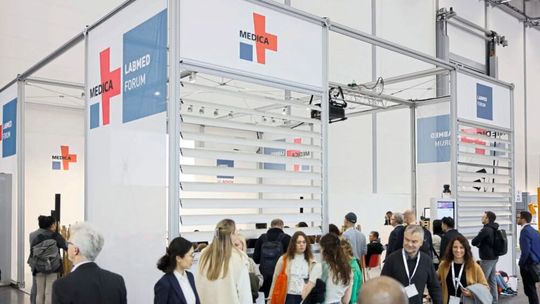
International expert meeting for trends and innovations in laboratory medicine — the Medica Labmed Forum at Medica.
(Source: Constanze Tillmann/ Messe Düsseldorf)
Laboratory medicine forms a bridge between clinical practice, research, and patient care. This makes it a key driver for a progressive healthcare system. As a result, the MEDICA LABMED FORUM has developed in recent years into a particularly noteworthy scientific program element of MEDICA in Düsseldorf, the world's leading trade fair for the healthcare industry and medical technology. Under the direction of Prof. Dr. Stefan Holdenrieder, German Heart Centre (Technical University of Munich), the forum will once again offer a varied agenda on all days of MEDICA 2025 from 17 to 20 November in the middle of the exhibition area for laboratory equipment and diagnostics in Hall 1. Thanks to the central role that blood tests and other laboratory medical procedures play in medicine, the high-calibre stage program will provide in-depth knowledge transfer, in-depth discussions, and thus impulses relevant to almost all specialist disciplines.
Digitalisation, AI and Automation Take Center Stage
While the coronavirus pandemic and its virological, diagnostic, and clinical aspects were the focus of attention in 2021 and 2022, the focus has shifted towards digitalisation, artificial intelligence, and automation since 2023. Large language models and artificially intelligent robots not only fascinate visionaries and technologists — they also solve very specific everyday problems that arise from a shortage of skilled workers and increasing demands on medical laboratories. In this context, there are regular reports on current legal challenges for clinics and industry — for example, through the In Vitro Diagnostics Regulation (IVDR).
Regardless of current trends, the MEDICA LABMED FORUM has always paid particular attention to cardiological and oncological diseases as the leading causes of death in the Western world, flanked since 2024 by the latest findings from research into aging and longevity.
This year's key topics and highlights on the individual days of the event are:
Monday, 17 November: Skills shortage & IVDR led by Prof. Dr Thomas Streichert (University of Cologne)
Tuesday, 18 November: Cardiogenetics & oncology led by Prof. Dr. Stefan Holdenrieder (Technical University of Munich)
Wednesday, 19 November: Young scientists, AI & tele-lab care led by PD Dr. Verena Haselmann (University of Mannheim)
Thursday, 20 November: Healthy ageing and longevity led by Dr Kai Prager and Dr Peter Quick (VDGH Berlin)
The morning sessions of the forum begin at 10:30 a.m. and end at 12:30 p.m. After a lunch break with selected industry presentations, the afternoon sessions continue from 2:00 p.m. to 4:00 p.m. On Thursday, the schedule will be slightly different due to the shortened exhibition hours (10:30 a.m. to 12:00 p.m. and 12:30 p.m. to 2:30 p.m.).
Day 1: Skilled Labour Shortage and In Vitro Regulation
According to recent surveys of medical laboratories, staff shortages are currently the biggest challenge to maintaining regular laboratory operations. Prof. Thomas Streichert, chair of the Monday session, explains: ‘The ongoing shortage of qualified specialists is making it increasingly difficult for hospital laboratories to ensure fast, high-quality results in the face of rising sample numbers and increasingly complex diagnostics.’ On the forum stage, experts from the fields of practice, management, and training will discuss:
Causes and current developments in staff shortages,
Innovative approaches to employee recruitment and retention,
Digitalisation and automation as a relief in everyday life.
During the session, best practices will be presented for laboratories that are ready to break new ground for a secure future.
The afternoon session will focus on the latest developments in the field of In Vitro Diagnostics Regulation (IVDR), a European Union regulation governing the approval, marketing, and monitoring of tests for laboratory examinations on humans. Among other things, the panel will address new developments in cybersecurity and the use of artificial intelligence (AI) and will deal with consumer protection in direct-to-consumer testing (DTCT), a relatively new form of direct marketing of laboratory tests via the internet and pharmacies without medical supervision.
Day 2: Cardiology and Oncology
The Tuesday session will be chaired by Prof. Stefan Holdenrieder, who is also the organizer of the overall scientific program. Traditionally, on the second day of the exhibition, he presents current developments in laboratory medicine for the two disease complexes that determine mortality in the Western world: cardiovascular disease and cancer.
Date: 08.12.2025
Naturally, we always handle your personal data responsibly. Any personal data we receive from you is processed in accordance with applicable data protection legislation. For detailed information please see our privacy policy.
Consent to the use of data for promotional purposes
I hereby consent to Vogel Communications Group GmbH & Co. KG, Max-Planck-Str. 7-9, 97082 Würzburg including any affiliated companies according to §§ 15 et seq. AktG (hereafter: Vogel Communications Group) using my e-mail address to send editorial newsletters. A list of all affiliated companies can be found here
Newsletter content may include all products and services of any companies mentioned above, including for example specialist journals and books, events and fairs as well as event-related products and services, print and digital media offers and services such as additional (editorial) newsletters, raffles, lead campaigns, market research both online and offline, specialist webportals and e-learning offers. In case my personal telephone number has also been collected, it may be used for offers of aforementioned products, for services of the companies mentioned above, and market research purposes.
Additionally, my consent also includes the processing of my email address and telephone number for data matching for marketing purposes with select advertising partners such as LinkedIn, Google, and Meta. For this, Vogel Communications Group may transmit said data in hashed form to the advertising partners who then use said data to determine whether I am also a member of the mentioned advertising partner portals. Vogel Communications Group uses this feature for the purposes of re-targeting (up-selling, cross-selling, and customer loyalty), generating so-called look-alike audiences for acquisition of new customers, and as basis for exclusion for on-going advertising campaigns. Further information can be found in section “data matching for marketing purposes”.
In case I access protected data on Internet portals of Vogel Communications Group including any affiliated companies according to §§ 15 et seq. AktG, I need to provide further data in order to register for the access to such content. In return for this free access to editorial content, my data may be used in accordance with this consent for the purposes stated here. This does not apply to data matching for marketing purposes.
Right of revocation
I understand that I can revoke my consent at will. My revocation does not change the lawfulness of data processing that was conducted based on my consent leading up to my revocation. One option to declare my revocation is to use the contact form found at https://contact.vogel.de. In case I no longer wish to receive certain newsletters, I have subscribed to, I can also click on the unsubscribe link included at the end of a newsletter. Further information regarding my right of revocation and the implementation of it as well as the consequences of my revocation can be found in the data protection declaration, section editorial newsletter.
This year, he will focus on the emerging field of cardiogenetics in the morning session. ‘At the German Heart Centre at the Technical University of Munich, we not only record and examine mono- and polygenic risk factors that promote the development of coronary heart disease in our young patients with congenital heart defects and cardiomyopathies, but also increasingly in adults,’ says Holdenrieder. The aim here is to intervene in good time to prevent serious long-term damage. Two renowned experts from his institute, Prof. Dr. Cordula Wolf and PD Dr. Teresa Trenkwalder, will discuss these topics with Prof. Eric Schulze-Bahr, Director of the Institute for Genetics of Heart Diseases (IfGH) at Münster University Hospital.
In oncological diagnostics, Prof. Holdenrieder addresses the ‘hot topic’ of ‘multi-cancer early detection’ (MCED). This involves highly sensitive and highly parallelised techniques that enable the early detection of cancer from blood. The basis for this are DNA molecules that are released from cancer cells into the circulation – known as cell-free or cfDNA – and which, due to certain biochemical characteristics such as methylation and fragment length patterns, can provide information about which tumours they originate from, even before these become clinically or radiologically detectable. Advanced bioinformatic techniques are required to evaluate the flood of data generated in this process.
Day 4: Healthy Aging and Longevity
To conclude this year's MEDICA LABMED FORUM, Dr Kai Prager (DiaSys Diagnostic Systems GmbH) and Dr Peter Quick from the Association of the Diagnostics Industry (VDGH) will continue the exciting discussion on healthy ageing and new approaches to prolonging human life, which they launched with great success in 2024. Anti-ageing is a controversial topic in medicine because the boundaries between serious science and dubious commercial promises are blurred.
The two chairmen have set themselves the task of strengthening confidence in this branch of research with scientifically sound contributions. Dr Kai Prager comments: ‘This year, we are focusing specifically on the question of how cellular processes and epigenetic changes influence our ageing and what role stem cells play in this.’ Another focus is the prevention of dementia and the treatment of neurodegenerative diseases through personalised diagnostics and therapy. (xx)




:quality(80)/p7i.vogel.de/wcms/62/32/62327aaae1415beeed47db6201e79661/0133375912v2.jpeg "A cotton trailer outfitted with benches and a sunshade offers farmworkers a reprieve from the sun as they take a break from picking cantaloupe melons in Firebaugh, Calif.
(Source: Joe Proudman/ Regents of the University of California)")
:quality(80)/p7i.vogel.de/wcms/e6/c8/e6c8bd554776ee1ad2f1f0723fb243a7/0133369387v1.jpeg "Roman road (Source: Queen Mary University of London)")
:quality(80)/p7i.vogel.de/wcms/51/68/51687ac4cc19f2757c138498b877de57/0133167039v2.jpeg "CMFs are foams that consist of hollow spheres – made of materials such as stainless steel, nickel, or other metals and alloys – embedded in a metallic matrix. The resulting material is both lightweight and remarkably strong at absorbing compressive forces. (Source: Jie Sun/ NC State University)")
:quality(80)/p7i.vogel.de/wcms/cd/c0/cdc09efd1e5b3b8f83224e7729d66c10/0133105276v2.jpeg "From the data presented in this report, the authors show how TF3-MALS-RI is uniquely able to separate large polyacrylate molecules and provide precise molecular weight and Rg values. (Source: Postnova Analytics)")
:quality(80)/p7i.vogel.de/wcms/86/01/86014d3d2a28cefc852f65c8d68317e4/0133104231v2.jpeg "Single-handed tube reading using a Handheld 2. (Source: Azenta Life Sciences)")
:quality(80)/p7i.vogel.de/wcms/0b/0f/0b0f8ed042dfc91f32582e10d54c2c7e/0133087444v2.jpeg "Offering advanced automation to increase your throughput, the Intellixcap provides secure sealing – eliminating the need for manual intervention, while preserving vital sample integrity. (Source: Azenta Life Sciences)")
:quality(80)/p7i.vogel.de/wcms/13/d3/13d35105f74a1c2e22b9c7a270e8e9b3/0132611155v2.jpeg "Circulating cell free DNA. (Source: Amsbio)")
:quality(80)/p7i.vogel.de/wcms/bc/ed/bced6850297a04dbea471a66cb6bb6fe/0132611405v2.jpeg "The latest addition to the range is a peristaltic tubing stop adapter that eliminates the need for fixed stoppers and allows custom cut lengths of peristaltic tubing to be installed on any pump head size. (Source: Biotech Fluidics )")
:quality(80)/p7i.vogel.de/wcms/8d/5c/8d5c6c7f897f91d6784825eee20b5584/0133321225v1.jpeg "Empa researcher Christoph Hüglin collects samples of particles that are washed out of the air by rain and snow or settle due to gravity. (Source: Empa)")
:quality(80)/p7i.vogel.de/wcms/a1/af/a1afbc7c8a067bbe94749ec680b4bafd/0133163762v2.jpeg "The study found in murkier water, fish took longer to move towards the food than those in clear water, but individuals in larger groups responded more quickly overall. (Source: Christos Ioannou)")
:quality(80)/p7i.vogel.de/wcms/32/80/3280aa3d44708962943c96fe2d466744/0133088560v2.jpeg "A bumble bee in flight at the University of Bristol Botanic Garden. (Source: Phil Savoie)")
:quality(80)/p7i.vogel.de/wcms/7b/e5/7be5c735140cbe28f3af0ec3d88274b9/0133045403v2.jpeg "After being buried in the ground for two months and broken down by soil organisms, a new pair of cotton underwear (left) shows clear signs of decomposition (right). (Source: Nicolas Zonvi)")
:quality(80)/p7i.vogel.de/wcms/ef/68/ef68375729607984e5bb0c143afdae70/0133375119v2.jpeg "Printed Rice-Lentil 3D structures
(Source: SUTD)")
:quality(80)/p7i.vogel.de/wcms/bf/d0/bfd087349a85956a7aefad57ac1204c7/0133241961v2.jpeg "The Thermo Scientific Suretect Beverage Spoilage Multiplex PCR Assay provides a fast, broad-range molecular solution for detecting key spoilage microorganisms that threaten beverage quality. (Source: © OlegDoroshin - stock.adobe.com)")
:quality(80)/p7i.vogel.de/wcms/d4/61/d461ce0bd5743897993c6475f69e7ad6/0133067478v2.jpeg "In Harris County, 50 % of households with children reported food insecurity, compared with 33 % of households without children. (Source: Rice University)")
:quality(80)/p7i.vogel.de/wcms/79/76/7976d17b980bedfe35acaa532d690046/0132713841v2.jpeg "Observed rice yield losses from 1°C warming are more than twice as high as model estimates due to underestimated heat stress. (Source: AdobeStock/ducvien)")
:quality(80)/p7i.vogel.de/wcms/22/49/224964dd6850b62cccdbc4bde2d34693/0133372964v1.jpeg "Brain activity recorded during a video game helped researchers predict whether participants would take or avoid a risk half a second before they acted. (Source: free licensed)")
:quality(80)/p7i.vogel.de/wcms/48/a7/48a761934161543f70fef2403b44d714/0133372328v2.jpeg "The link between pollution and coughing persisted in the data, even when pollution levels were below the WHO’s recommended safe daily exposure limit. (Source: free licensed)")
:quality(80)/p7i.vogel.de/wcms/83/b4/83b4563a65c6036b61990931507428b4/0133363611v2.jpeg "Magnesium sulphate uptake and the north / south divide for the Precept program. (Source: University of Bristol )")
:quality(80)/p7i.vogel.de/wcms/bb/06/bb06c1c3c5d250f3f93016366c56525d/0133363201v2.jpeg "The team identified more than 1,200 associated genetic variants and found that these influences are remarkably consistent across countries, ages and methods of measuring personality. (Source: Pixabay - PublicDomainPictures)")
:quality(80)/images.vogel.de/vogelonline/bdb/1710600/1710675/original.jpg "Discover how to set yourself up for success when performing balance-based density determination of solids such as jewelry and precious metals. (Mettler Toledo)")
:quality(80)/images.vogel.de/vogelonline/bdb/1682500/1682579/original.jpg "The new XPR Analytical balance redesigned to meet the needs of laboratory technicians of working fast and lean. (Mettler Toledo)")
:quality(80)/images.vogel.de/vogelonline/bdb/1677000/1677080/original.jpg "Enhance your weighing accuracy, comfort and productivity with the redesigned XPR Analytical balance. (Mettler Toledo)")
:fill(fff,0)/p7i.vogel.de/companies/69/b7/69b7f63f311d9/logo-bimos-tif--2-.jpeg "logo-bimos-tif--2- (https://www.bimos.com/de-de/)")
:quality(80)/p7i.vogel.de/wcms/41/9f/419f846b7f9a3f7db2d93b9bc006348d/0127521209v2.jpeg "After six years, Achemasia, the international trade fair and innovation forum for sustainable chemical production, has returned with renewed vigor, bringing together global expertise, Chinese innovation, and a shared commitment to a greener industrial future—according to the organizers of the fair. (Source:PROCESS China)")
:quality(80)/p7i.vogel.de/wcms/47/13/4713969ee1fed4c9d6cd932df7c82482/0131588920v2.jpeg "My Genius Pro installed at a leading European transplant center supporting routine infectious disease testing. (Source: Elitech Group)")