Researchers from Brazil showed that Amazonian dark earth (ADE), soils enriched by Amerindian people thousands of years ago, increases the establishment and growth of seedlings of tree species important for reforestation. By copying the composition of ADE, especially its microbes, reforestation in Brazil and elsewhere could be sped up.
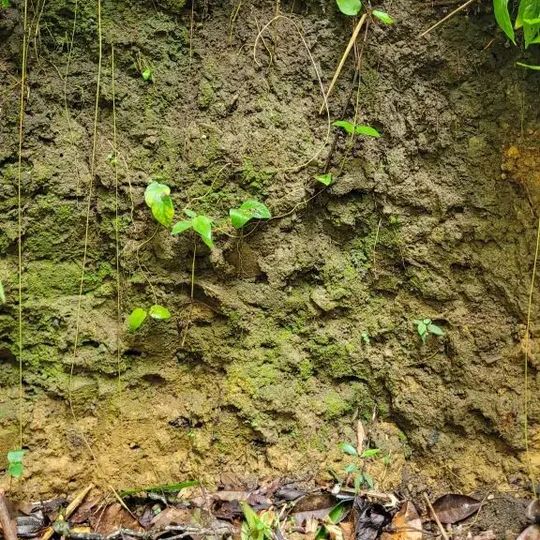
Amazonian dark earth (ADE) soil profile. Note that there is a black and a yellow layer. ADE corresponds only to the black layer.
(Source: Luís Felipe Guandalin Zagatto)
Between approximately 450 BCE and 950 CE, millions of Amerindian people living in today’s Amazonia transformed the originally poor soil through various processes. Over many human generations, soils were enriched with charcoal from their low-intensity fires for cooking and burning refuse, animal bones, broken pottery, compost, and manure. The result is Amazonian dark earth (ADE) or terra preta, exceptionally fertile because rich in nutrients and stable organic matter derived from charcoal, which gives it its black color.
Scientists from Brazil show that Amazonian dark earth could be a secret weapon to boost reforestation — not only in the Amazon, where 18 percent or approximately 780,000 km2 has been lost since the 1970s — but around the world. The results are published in Frontiers in Soil Science.
“Here we show that the use of ADEs can enhance the growth of pasture and trees due to their high levels of nutrients, as well as to the presence of beneficial bacteria and archaea in the soil microbial community,” said joint lead author Luís Felipe Zagatto, a graduate student at the Center for Nuclear Energy in Agriculture of São Paulo University, Brazil. “This means that knowledge of the ingredient’ that make ADEs so very fertile could be applied to help speed up ecological restoration projects.”
Mimicking Reforestation in Miniature
The researchers conducted controlled experiments to mimic the ecological succession and changes to the soil that happen when pasture in deforested areas is actively restored to forest. Their aim was to study how ADEs, or ultimately soils of which the microbiome has been artificially composed to imitate them, can boost this process.
Zagatto and colleagues sampled ADE from the Caldeirão Experimental Research Station in the Brazilian state of Amazonas, and as a control, agricultural soil from the Luiz de Queiróz Superior School of Agriculture in the state of São Paulo. They filled each of 36 four-liter pots with 3 kg soil, inside a greenhouse with a mean temperature of 34°C to anticipate global warming beyond current temperatures in Amazonia between 22 and 28°C.
One-third of the pots received only control soil, another third a 4:1 mixture of control soil and ADE, and another third 100 percent ADE. To imitate pasture, they planted seeds of palisade grass (Urochloa brizantha), common forage for livestock in Brazil, in each pot and allowed its seedlings to grow for 60 days. They then cut the grass and let only its roots remain in the soil — virgin territory for reforestation in miniature. The researchers then replanted each of the three soils with tree seeds: either with the colonizing species Ambay pumpwood (Cecropia pachystachya), with Peltophorum dubium typical of secondary forests, or with cedro blanco (Cedrela fissilis), typical of climax forest.
Our recommendations aren’t to utilize ADE itself, but rather to copy its characteristics, particularly its microorganisms, for use in future ecological restoration projects.
Dr Siu Mui Tsai
The seeds were allowed to germinate, and the seedlings to grow for 90 days, after which the height, dry mass, and extension of the roots were measured. The scientists quantified changes in the soil’s pH, texture, and concentration of organic matter, potassium, calcium, magnesium, aluminium, sulfur, boron, copper, iron, and zinc over the course of the experiment. With molecular methods, they also measured changes in microbial diversity in the soil.
Rich in Nutrients and Beneficial Microbes
At the start, ADEs showed greater amounts of nutrients than control soil: for example, 30 times more phosphorus and three to five times more of each of the other measured nutrients, except manganese. ADE also had a higher pH and contained more sand and silt, but less clay. After the experiment, soils contained less nutrients than at the start, reflecting take-up by the plants, but 100 percent ADE soils remained richer in these than control soils, while nutrient levels were intermediate in 20 percent ADE soils.
Date: 08.12.2025
Naturally, we always handle your personal data responsibly. Any personal data we receive from you is processed in accordance with applicable data protection legislation. For detailed information please see our privacy policy.
Consent to the use of data for promotional purposes
I hereby consent to Vogel Communications Group GmbH & Co. KG, Max-Planck-Str. 7-9, 97082 Würzburg including any affiliated companies according to §§ 15 et seq. AktG (hereafter: Vogel Communications Group) using my e-mail address to send editorial newsletters. A list of all affiliated companies can be found here
Newsletter content may include all products and services of any companies mentioned above, including for example specialist journals and books, events and fairs as well as event-related products and services, print and digital media offers and services such as additional (editorial) newsletters, raffles, lead campaigns, market research both online and offline, specialist webportals and e-learning offers. In case my personal telephone number has also been collected, it may be used for offers of aforementioned products, for services of the companies mentioned above, and market research purposes.
Additionally, my consent also includes the processing of my email address and telephone number for data matching for marketing purposes with select advertising partners such as LinkedIn, Google, and Meta. For this, Vogel Communications Group may transmit said data in hashed form to the advertising partners who then use said data to determine whether I am also a member of the mentioned advertising partner portals. Vogel Communications Group uses this feature for the purposes of re-targeting (up-selling, cross-selling, and customer loyalty), generating so-called look-alike audiences for acquisition of new customers, and as basis for exclusion for on-going advertising campaigns. Further information can be found in section “data matching for marketing purposes”.
In case I access protected data on Internet portals of Vogel Communications Group including any affiliated companies according to §§ 15 et seq. AktG, I need to provide further data in order to register for the access to such content. In return for this free access to editorial content, my data may be used in accordance with this consent for the purposes stated here. This does not apply to data matching for marketing purposes.
Right of revocation
I understand that I can revoke my consent at will. My revocation does not change the lawfulness of data processing that was conducted based on my consent leading up to my revocation. One option to declare my revocation is to use the contact form found at https://contact.vogel.de. In case I no longer wish to receive certain newsletters, I have subscribed to, I can also click on the unsubscribe link included at the end of a newsletter. Further information regarding my right of revocation and the implementation of it as well as the consequences of my revocation can be found in the data protection declaration, section editorial newsletter.
Throughout the experiment, 20 percent or 100 percent ADE soils supported a greater biodiversity of bacteria and archaea than control soils.
“Microbes transform chemical soil particles into nutrients that can be taken up by plants. Our data showed that ADE contains microorganisms that are better at this transformation of soils, thus providing more resources for plant development,” said joint lead author Anderson Santos de Freitas. “For example, ADE soils contained more beneficial taxa of the bacterial families Paenibacillaceae, Planococcaceae, Micromonosporaceae, and Hyphomicroblaceae.”
The results also showed that adding ADE to soil improved the growth and development of plants. For example, the dry mass of palisade grass was increased 3.4 times in 20 percent ADE, and 8.1 times in 100 percent ADE, compared to in control soil. Addition of ADE also boosted the growth of the three tree species: seedlings of cedro blanco and P. dubium were 2.1 and 5.2 times taller in 20 percent ADE, and 3.2 and 6.3 times taller in 100 percent ADE, compared to in control soils. Ambay pumpwood didn’t even grow in control soils or 20 percent ADE, but thrived in 100 percent ADE.
The researchers concluded that ADE can boost plant growth. “Our data point to a mixture of soil nutrients and adapted microorganisms [in ADE] to improve the establishment of plant trees in restoration,” they wrote.
Senior author Dr Siu Mui Tsai, a professor at the same institute, cautioned: “ADE has taken thousands of years to accumulate and would take an equal time to regenerate in nature if used. Our recommendations aren’t to utilize ADE itself, but rather to copy its characteristics, particularly its microorganisms, for use in future ecological restoration projects.”
References: Amazonian dark earths enhance the establishment of tree species in forest ecological restoration; Frontiers in Soil Science; DOI:10.3389/fsoil.2023.1161627




:quality(80)/p7i.vogel.de/wcms/62/32/62327aaae1415beeed47db6201e79661/0133375912v2.jpeg "A cotton trailer outfitted with benches and a sunshade offers farmworkers a reprieve from the sun as they take a break from picking cantaloupe melons in Firebaugh, Calif.
(Source: Joe Proudman/ Regents of the University of California)")
:quality(80)/p7i.vogel.de/wcms/e6/c8/e6c8bd554776ee1ad2f1f0723fb243a7/0133369387v1.jpeg "Roman road (Source: Queen Mary University of London)")
:quality(80)/p7i.vogel.de/wcms/51/68/51687ac4cc19f2757c138498b877de57/0133167039v2.jpeg "CMFs are foams that consist of hollow spheres – made of materials such as stainless steel, nickel, or other metals and alloys – embedded in a metallic matrix. The resulting material is both lightweight and remarkably strong at absorbing compressive forces. (Source: Jie Sun/ NC State University)")
:quality(80)/p7i.vogel.de/wcms/cd/c0/cdc09efd1e5b3b8f83224e7729d66c10/0133105276v2.jpeg "From the data presented in this report, the authors show how TF3-MALS-RI is uniquely able to separate large polyacrylate molecules and provide precise molecular weight and Rg values. (Source: Postnova Analytics)")
:quality(80)/p7i.vogel.de/wcms/86/01/86014d3d2a28cefc852f65c8d68317e4/0133104231v2.jpeg "Single-handed tube reading using a Handheld 2. (Source: Azenta Life Sciences)")
:quality(80)/p7i.vogel.de/wcms/0b/0f/0b0f8ed042dfc91f32582e10d54c2c7e/0133087444v2.jpeg "Offering advanced automation to increase your throughput, the Intellixcap provides secure sealing – eliminating the need for manual intervention, while preserving vital sample integrity. (Source: Azenta Life Sciences)")
:quality(80)/p7i.vogel.de/wcms/13/d3/13d35105f74a1c2e22b9c7a270e8e9b3/0132611155v2.jpeg "Circulating cell free DNA. (Source: Amsbio)")
:quality(80)/p7i.vogel.de/wcms/bc/ed/bced6850297a04dbea471a66cb6bb6fe/0132611405v2.jpeg "The latest addition to the range is a peristaltic tubing stop adapter that eliminates the need for fixed stoppers and allows custom cut lengths of peristaltic tubing to be installed on any pump head size. (Source: Biotech Fluidics )")
:quality(80)/p7i.vogel.de/wcms/8d/5c/8d5c6c7f897f91d6784825eee20b5584/0133321225v1.jpeg "Empa researcher Christoph Hüglin collects samples of particles that are washed out of the air by rain and snow or settle due to gravity. (Source: Empa)")
:quality(80)/p7i.vogel.de/wcms/a1/af/a1afbc7c8a067bbe94749ec680b4bafd/0133163762v2.jpeg "The study found in murkier water, fish took longer to move towards the food than those in clear water, but individuals in larger groups responded more quickly overall. (Source: Christos Ioannou)")
:quality(80)/p7i.vogel.de/wcms/32/80/3280aa3d44708962943c96fe2d466744/0133088560v2.jpeg "A bumble bee in flight at the University of Bristol Botanic Garden. (Source: Phil Savoie)")
:quality(80)/p7i.vogel.de/wcms/7b/e5/7be5c735140cbe28f3af0ec3d88274b9/0133045403v2.jpeg "After being buried in the ground for two months and broken down by soil organisms, a new pair of cotton underwear (left) shows clear signs of decomposition (right). (Source: Nicolas Zonvi)")
:quality(80)/p7i.vogel.de/wcms/ef/68/ef68375729607984e5bb0c143afdae70/0133375119v2.jpeg "Printed Rice-Lentil 3D structures
(Source: SUTD)")
:quality(80)/p7i.vogel.de/wcms/bf/d0/bfd087349a85956a7aefad57ac1204c7/0133241961v2.jpeg "The Thermo Scientific Suretect Beverage Spoilage Multiplex PCR Assay provides a fast, broad-range molecular solution for detecting key spoilage microorganisms that threaten beverage quality. (Source: © OlegDoroshin - stock.adobe.com)")
:quality(80)/p7i.vogel.de/wcms/d4/61/d461ce0bd5743897993c6475f69e7ad6/0133067478v2.jpeg "In Harris County, 50 % of households with children reported food insecurity, compared with 33 % of households without children. (Source: Rice University)")
:quality(80)/p7i.vogel.de/wcms/79/76/7976d17b980bedfe35acaa532d690046/0132713841v2.jpeg "Observed rice yield losses from 1°C warming are more than twice as high as model estimates due to underestimated heat stress. (Source: AdobeStock/ducvien)")
:quality(80)/p7i.vogel.de/wcms/22/49/224964dd6850b62cccdbc4bde2d34693/0133372964v1.jpeg "Brain activity recorded during a video game helped researchers predict whether participants would take or avoid a risk half a second before they acted. (Source: free licensed)")
:quality(80)/p7i.vogel.de/wcms/48/a7/48a761934161543f70fef2403b44d714/0133372328v2.jpeg "The link between pollution and coughing persisted in the data, even when pollution levels were below the WHO’s recommended safe daily exposure limit. (Source: free licensed)")
:quality(80)/p7i.vogel.de/wcms/83/b4/83b4563a65c6036b61990931507428b4/0133363611v2.jpeg "Magnesium sulphate uptake and the north / south divide for the Precept program. (Source: University of Bristol )")
:quality(80)/p7i.vogel.de/wcms/bb/06/bb06c1c3c5d250f3f93016366c56525d/0133363201v2.jpeg "The team identified more than 1,200 associated genetic variants and found that these influences are remarkably consistent across countries, ages and methods of measuring personality. (Source: Pixabay - PublicDomainPictures)")
:quality(80)/images.vogel.de/vogelonline/bdb/1710600/1710675/original.jpg "Discover how to set yourself up for success when performing balance-based density determination of solids such as jewelry and precious metals. (Mettler Toledo)")
:quality(80)/images.vogel.de/vogelonline/bdb/1682500/1682579/original.jpg "The new XPR Analytical balance redesigned to meet the needs of laboratory technicians of working fast and lean. (Mettler Toledo)")
:quality(80)/images.vogel.de/vogelonline/bdb/1677000/1677080/original.jpg "Enhance your weighing accuracy, comfort and productivity with the redesigned XPR Analytical balance. (Mettler Toledo)")
:fill(fff,0)/images.vogel.de/vogelonline/companyimg/107800/107832/65.jpg "logoDueperthal.jpg ()")
:quality(80)/images.vogel.de/vogelonline/bdb/1815900/1815995/original.jpg "“Unsurprisingly, there is weaker support for tougher regulations, such as import restrictions on certain goods. But our study shows that there is broad support in general, including for certain policies that have real potential to reduce imported deforestation,” says Martin Persson, Associate Professor of Physical Resource Theory at Chalmers University of Technology. (Anna Lena Lundqvist / Chalmers University of Technology)")
:quality(80)/p7i.vogel.de/wcms/2b/5e/2b5e4798cb0d86b0f29ba4de833c1412/0131003303v1.jpeg "33-month-old acacias in Manaus: ADEs result from the decomposition of organic matter and the use of fire by pre-Columbian populations and continue to be created by present-day peoples
(Source: Tsai Siu Mui/ Cena-USP)")
:quality(80)/p7i.vogel.de/wcms/92/f6/92f683a8555e5936ec654e3d0d0c881c/0127101084v1.jpeg "Mosses, long overlooked on the forest floor, are revealed as hidden carbon champions in a landmark study across 413 subtropical forests, reshaping our understanding of global carbon storage. (Source: free licensed)")